-
-
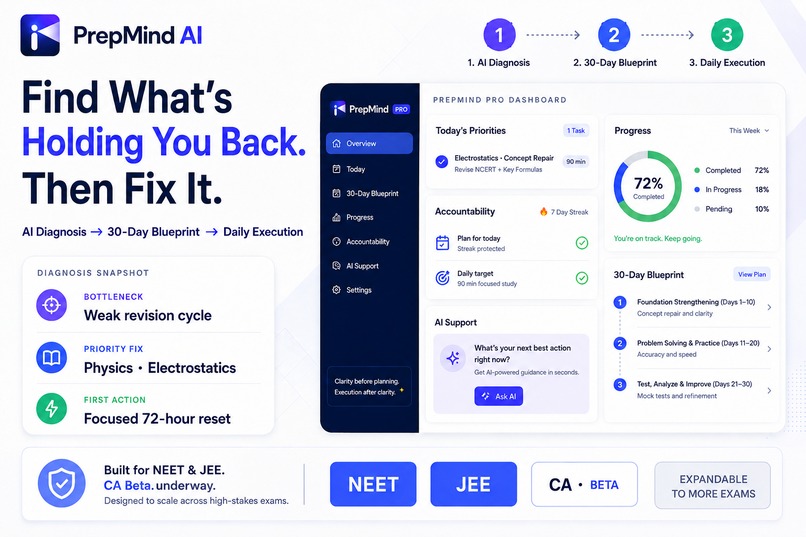
Final PrepMind overview
-
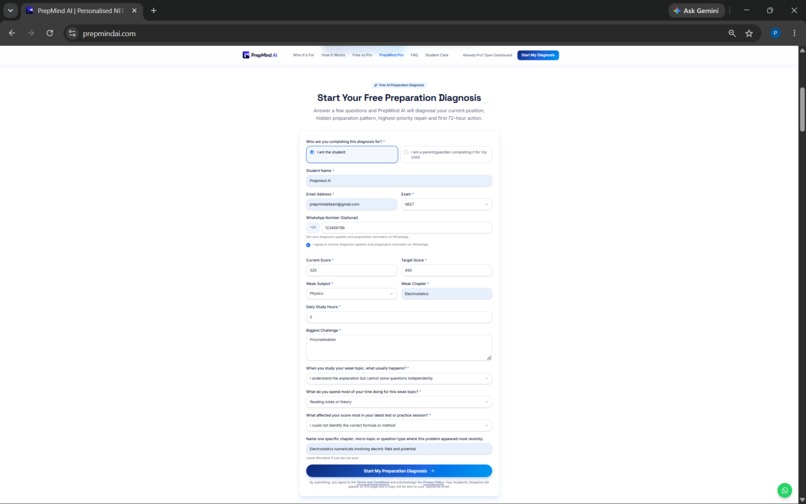
Free Form
-
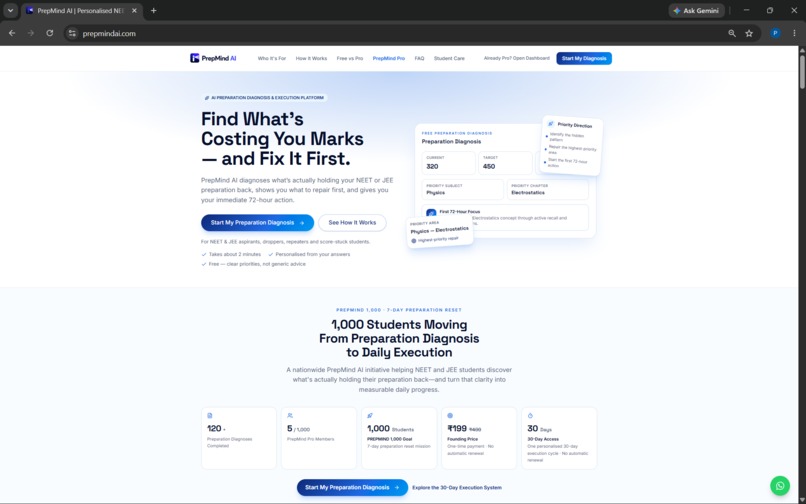
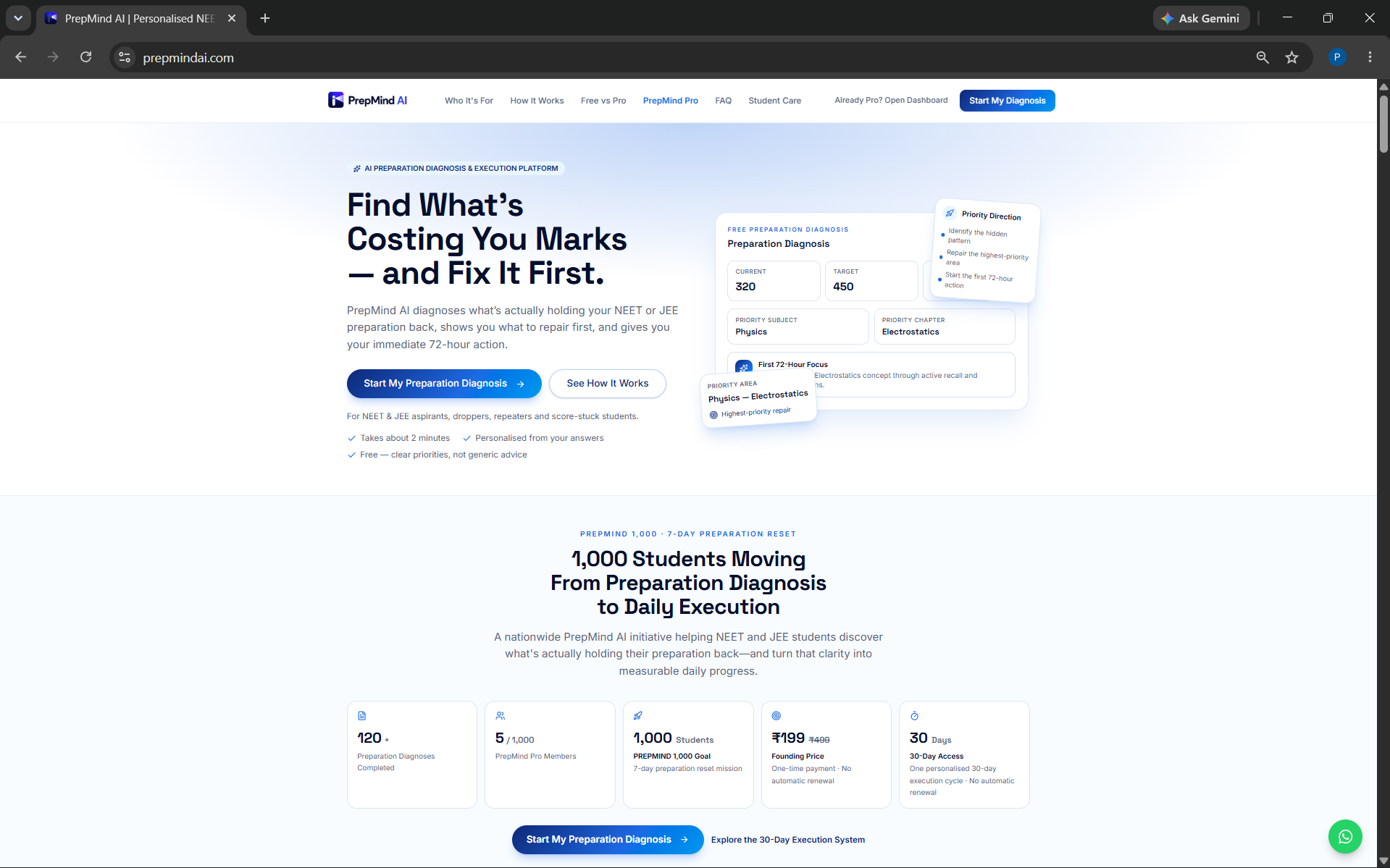
Live homepage
-
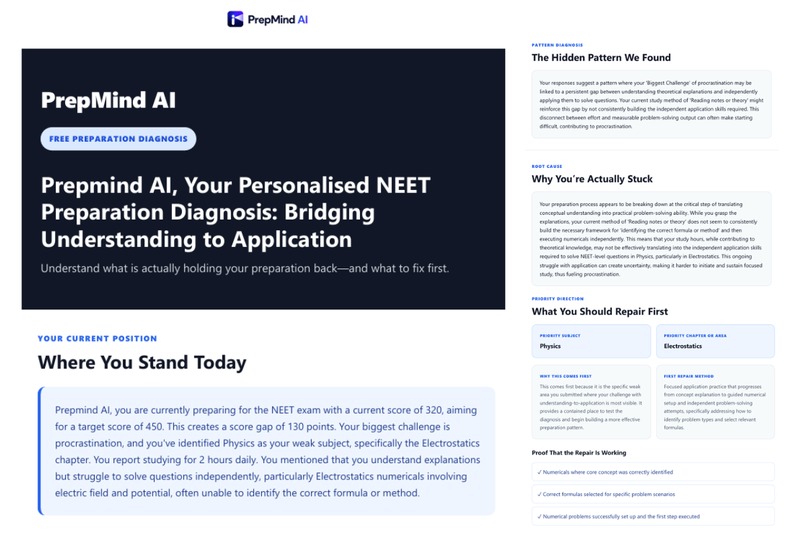
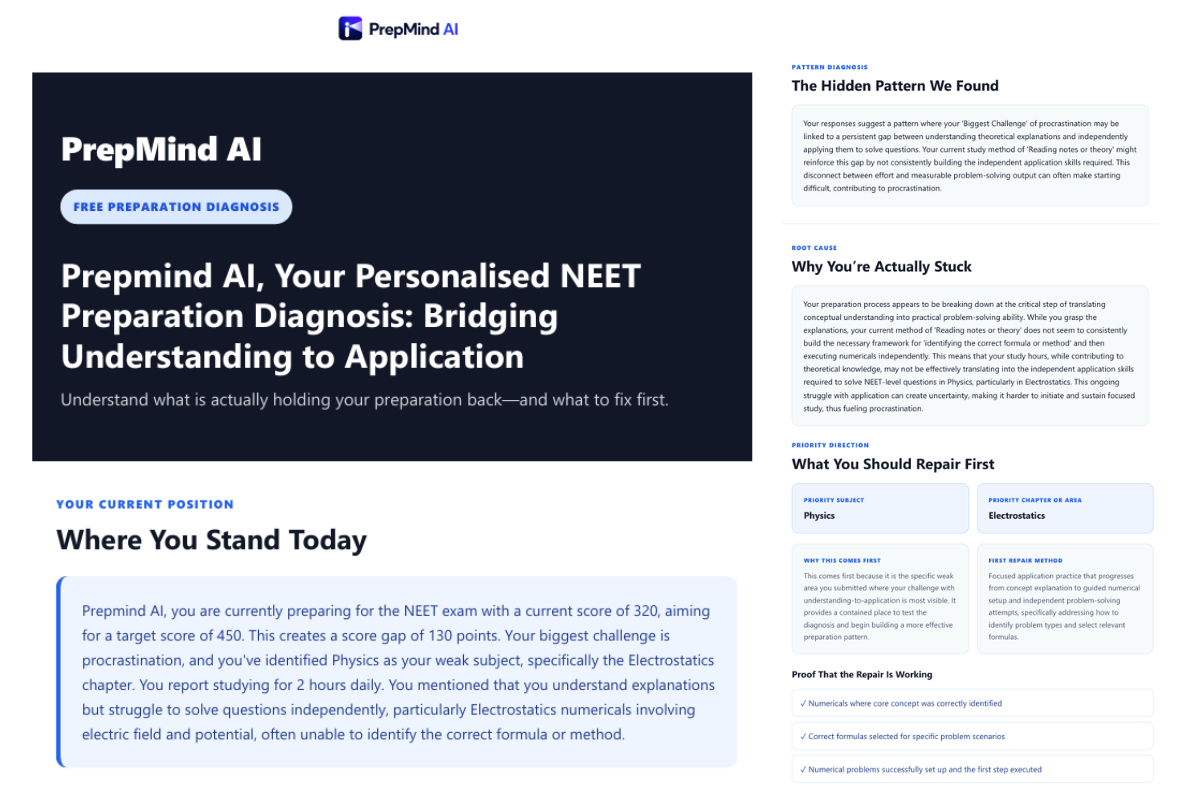
Free Preparation Diagnosis — Root Cause & Priority Fix
-
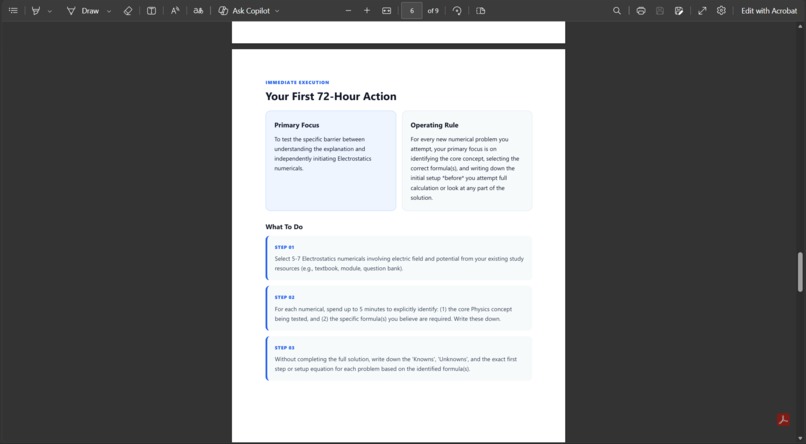
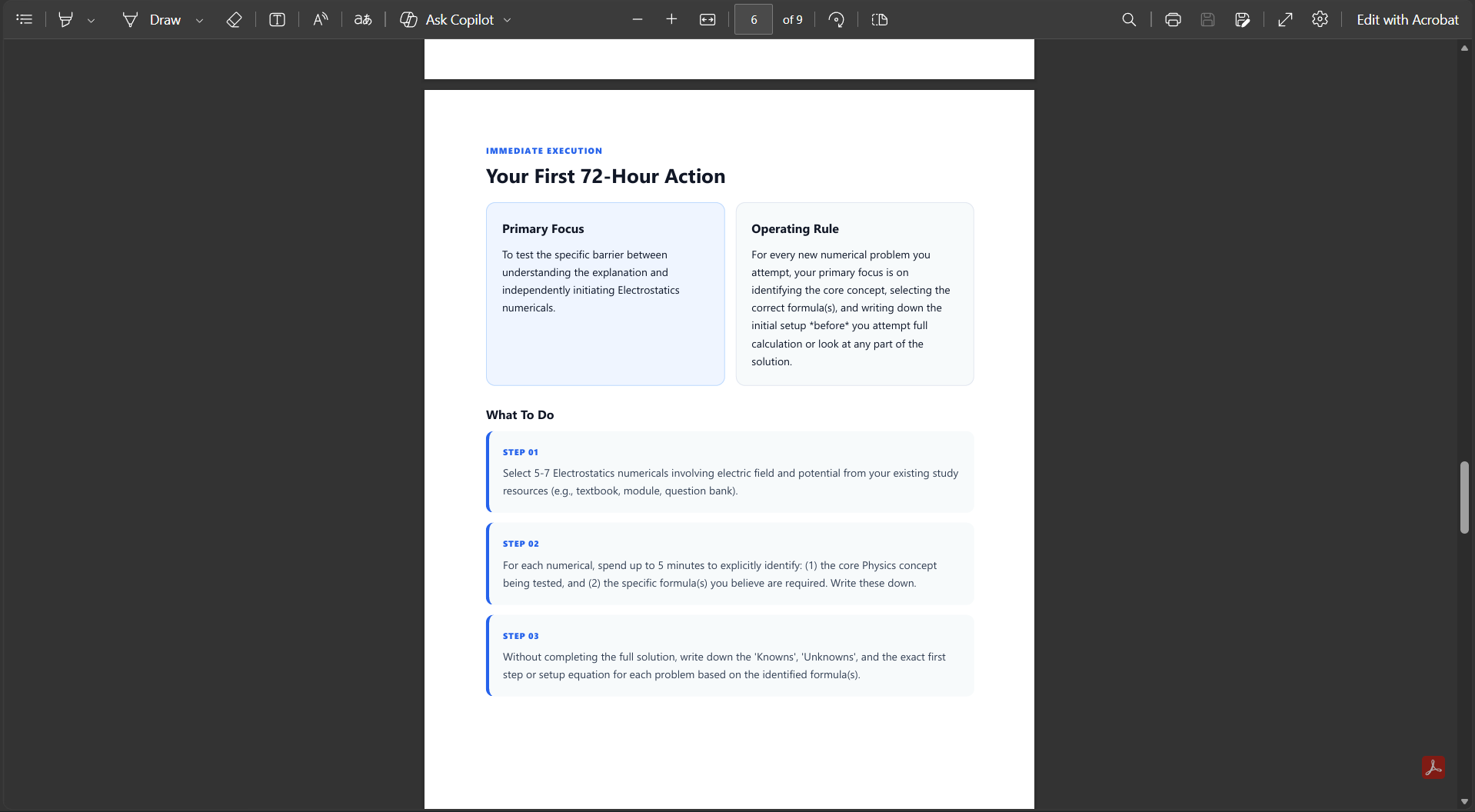
Free Preparation Diagnosis — First 72-Hour Action
-
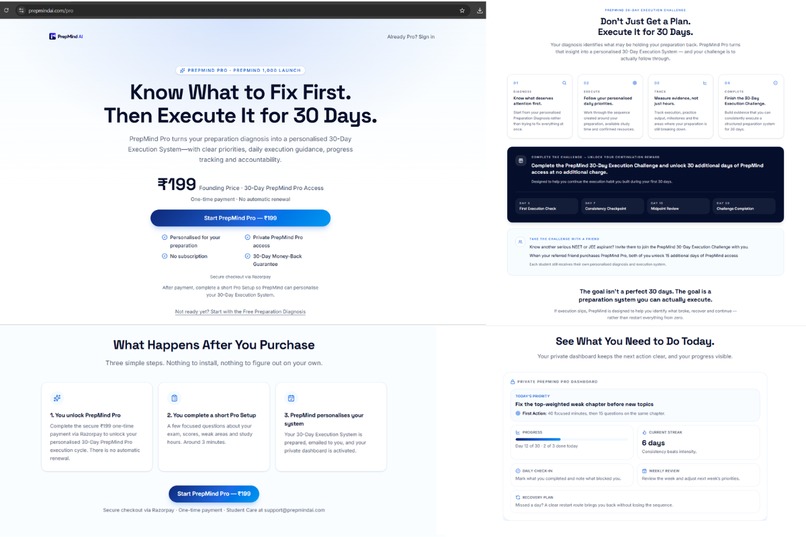
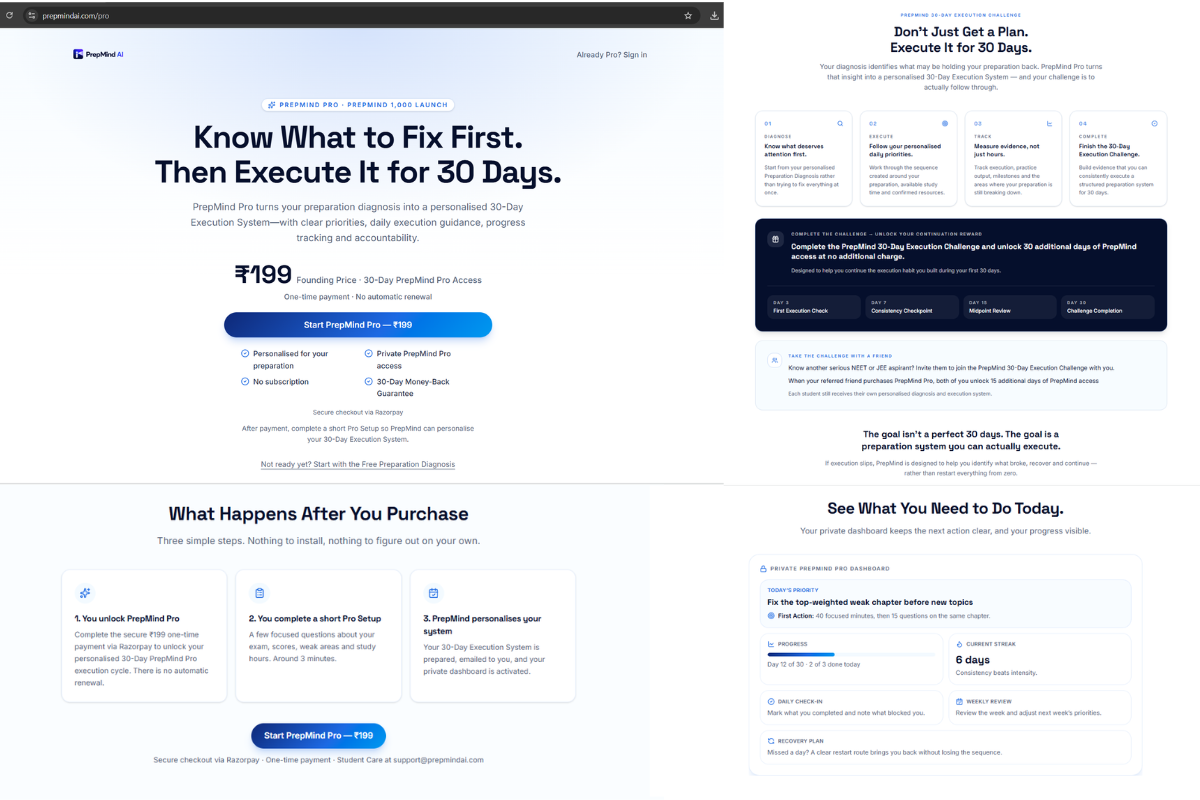
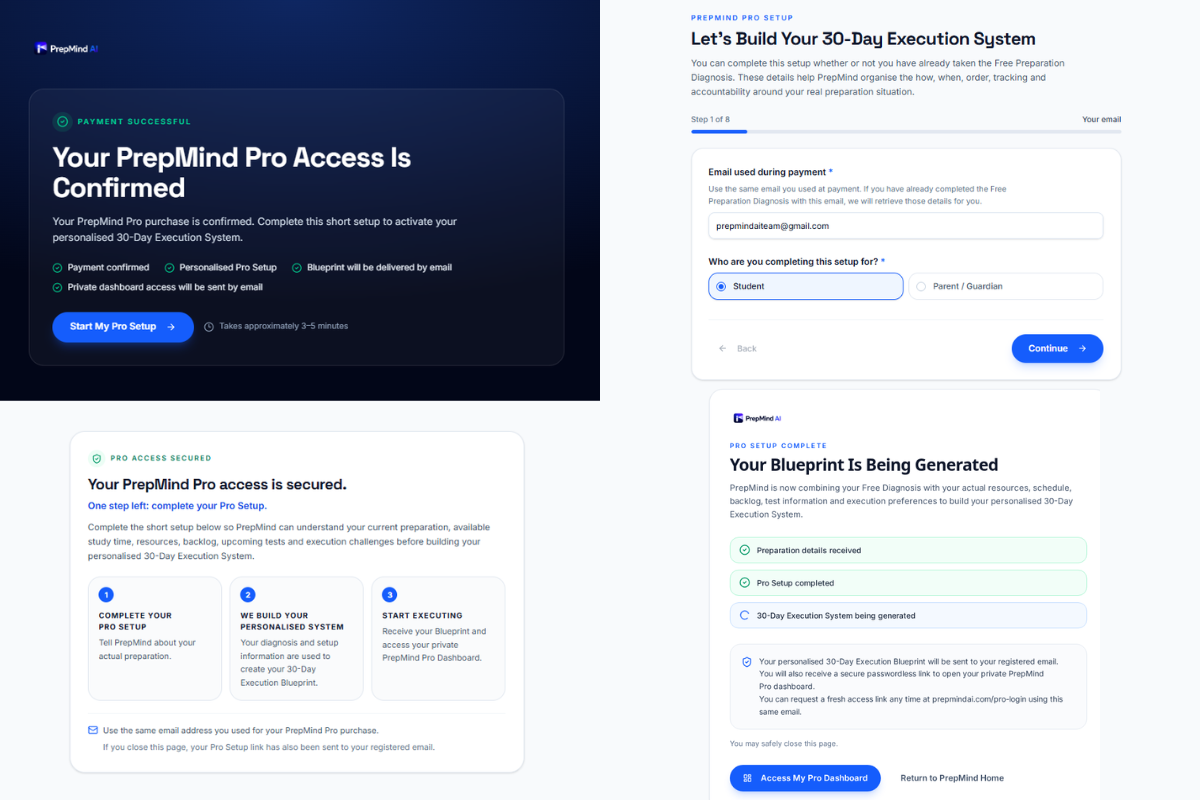
PrepMind Pro — From Diagnosis to 30-Day Execution
-
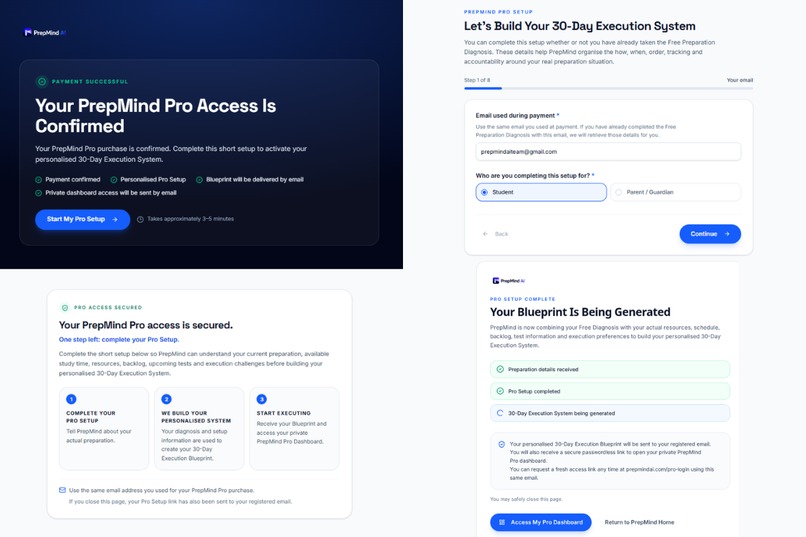
Pro Setup — Building the Personalised 30-Day Execution Blueprint
-
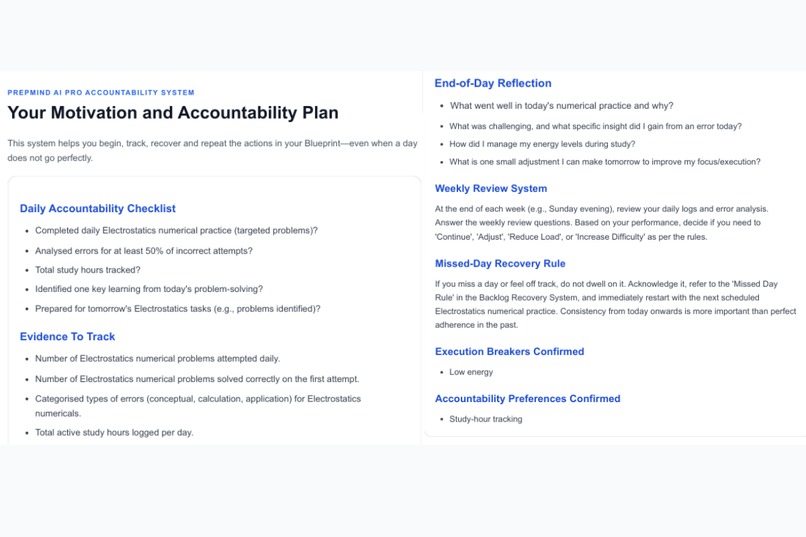
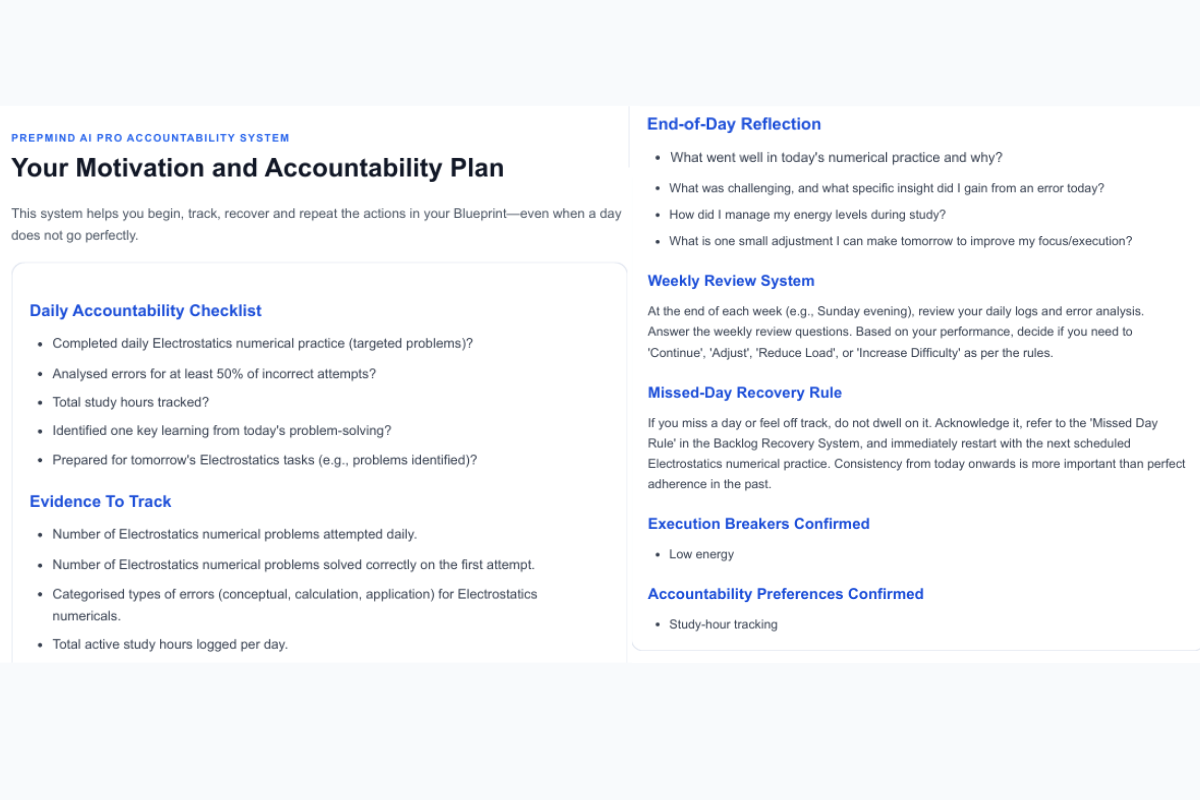
PrepMind Pro — Accountability, Reflection & Recovery System
-
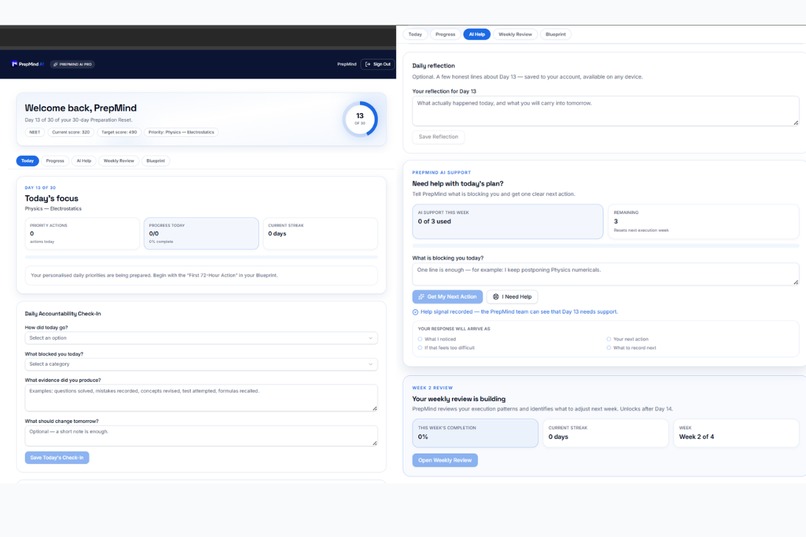
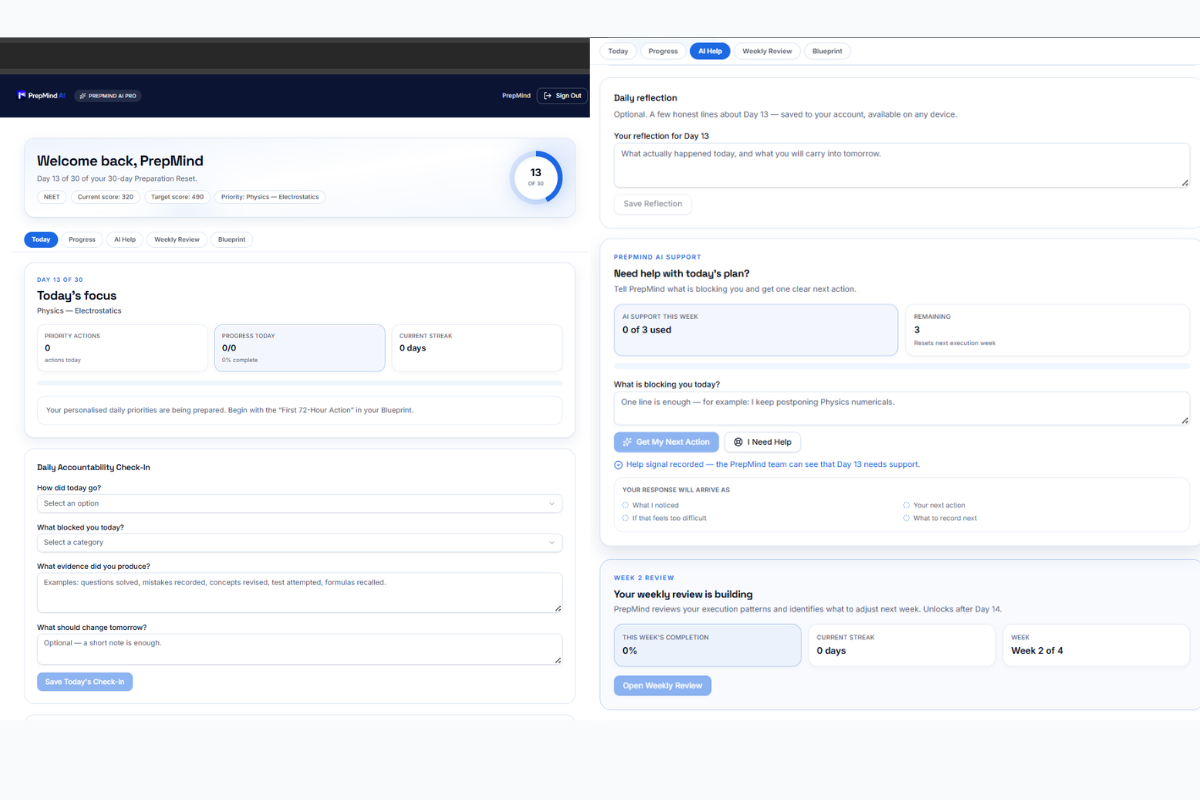
PrepMind Pro Dashboard — Daily Focus, Accountability & AI Help
-
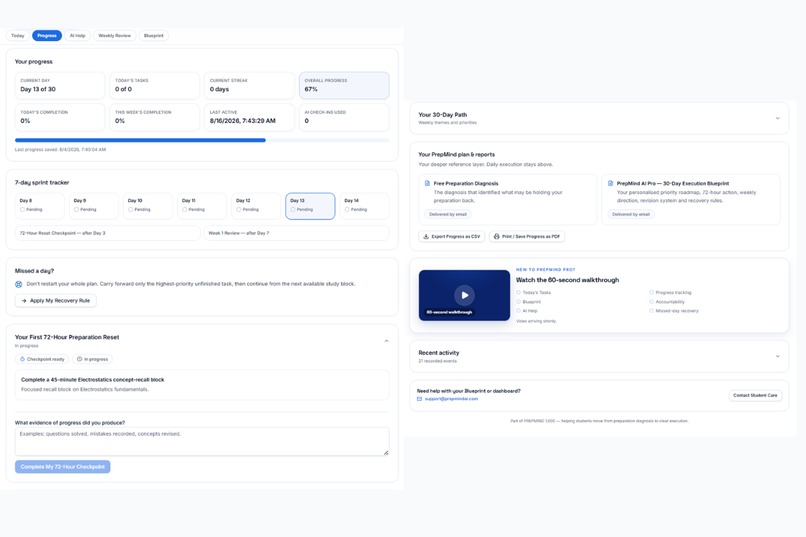
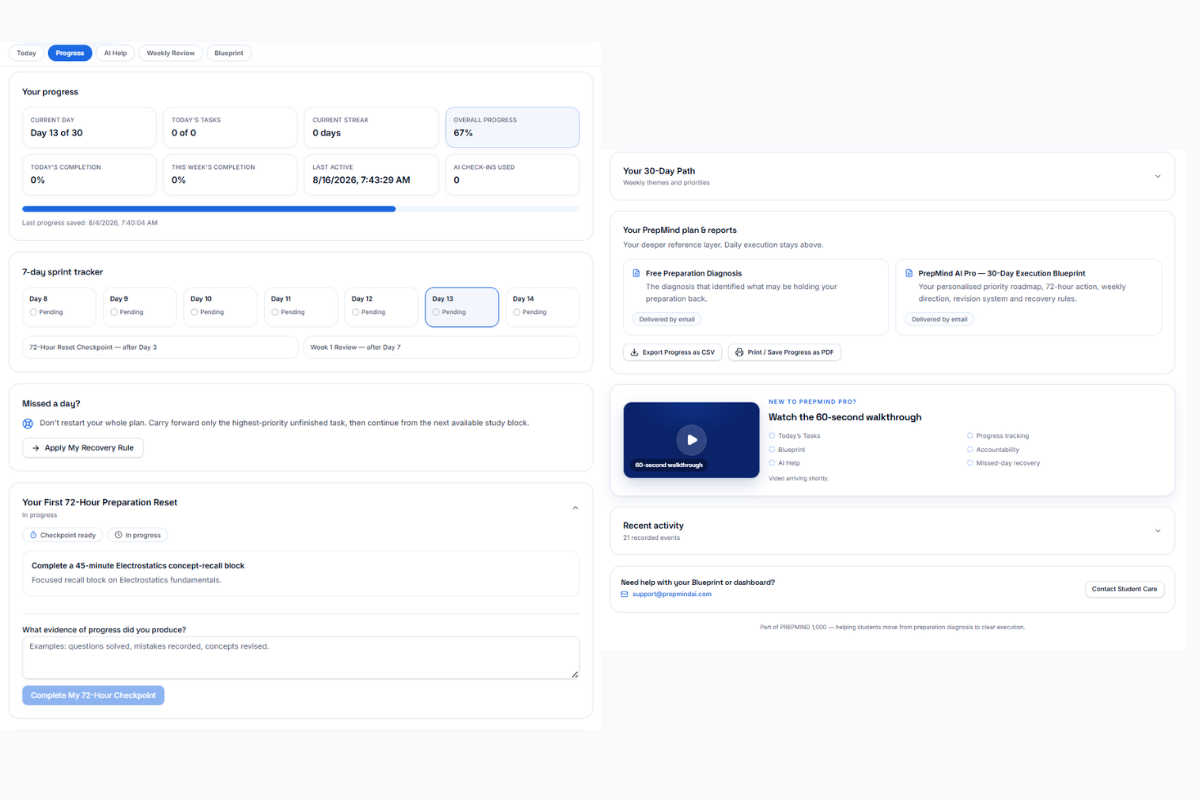
PrepMind Pro Dashboard — Progress Tracking, Recovery & Blueprint Access
Inspiration
PrepMind AI did not start with the question, “How can we use AI in education?”
It started with a more uncomfortable one:
Why do serious students keep working harder without knowing what is actually keeping them stuck?
I have seen education from several sides. I studied electronics engineering before moving into entrepreneurship, growth and AI-driven automation. Earlier in my career I worked with students as an overseas-education counsellor, and later helped build the startup roadmap for an education venture. My partner, now a doctor, also went through the intensity of NEET preparation herself.
The pattern stayed with me.
Students rarely lack content anymore. They have coaching, teachers, books, question banks, mock tests, YouTube, Telegram, study apps and now general-purpose AI.
What they often lack is someone — or something — that can look at their specific preparation and say:
This is the bottleneck. This deserves attention first. This is what you should do next.
Mass education is excellent at delivering curriculum at scale. But two students sitting in the same batch can have the same score for completely different reasons.
One may need stronger foundations.
Another may never analyse mock-test mistakes.
Another may keep changing resources.
Another may simply be mentally exhausted after repeated attempts.
That missing layer of individual diagnosis became PrepMind AI.
What it does
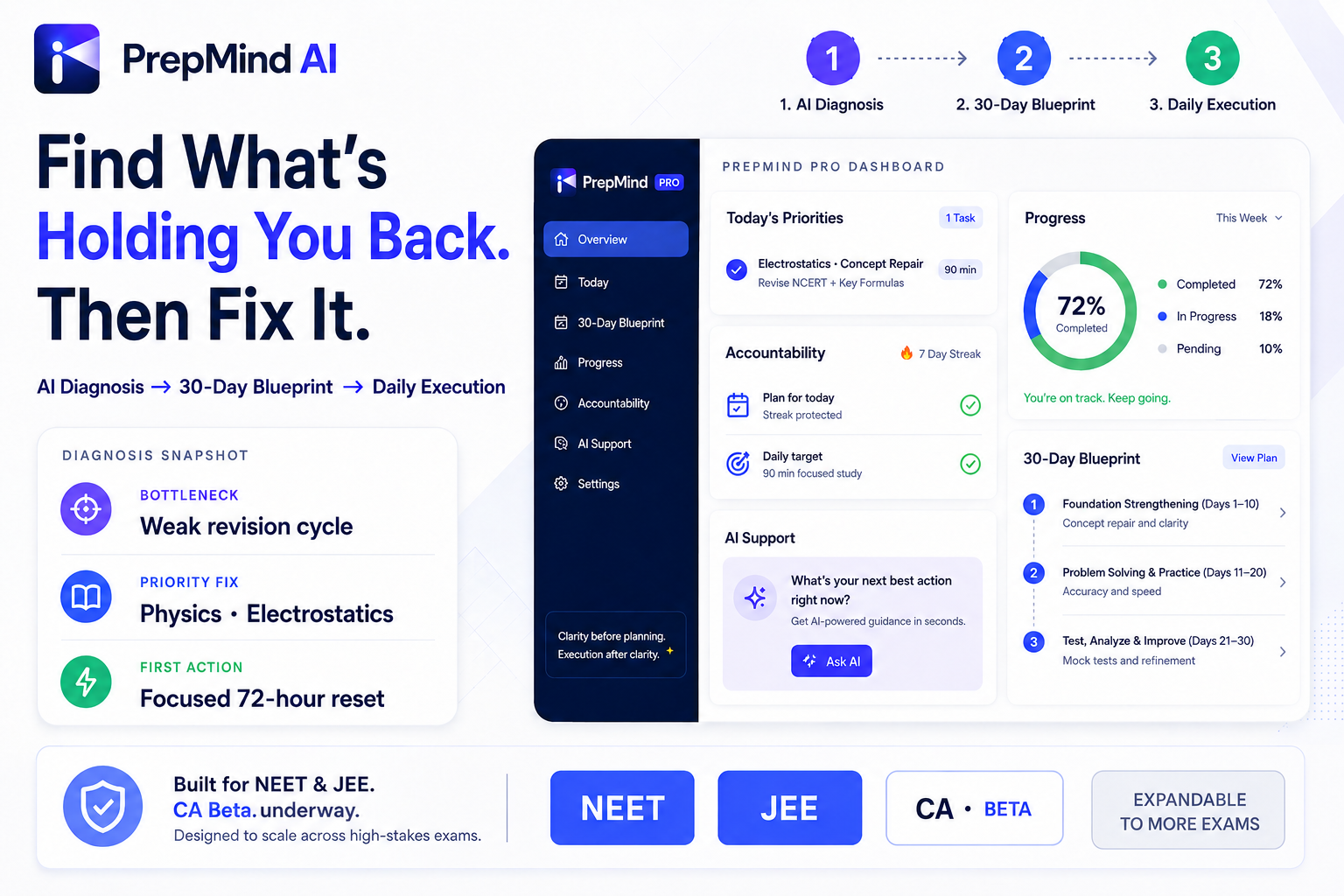
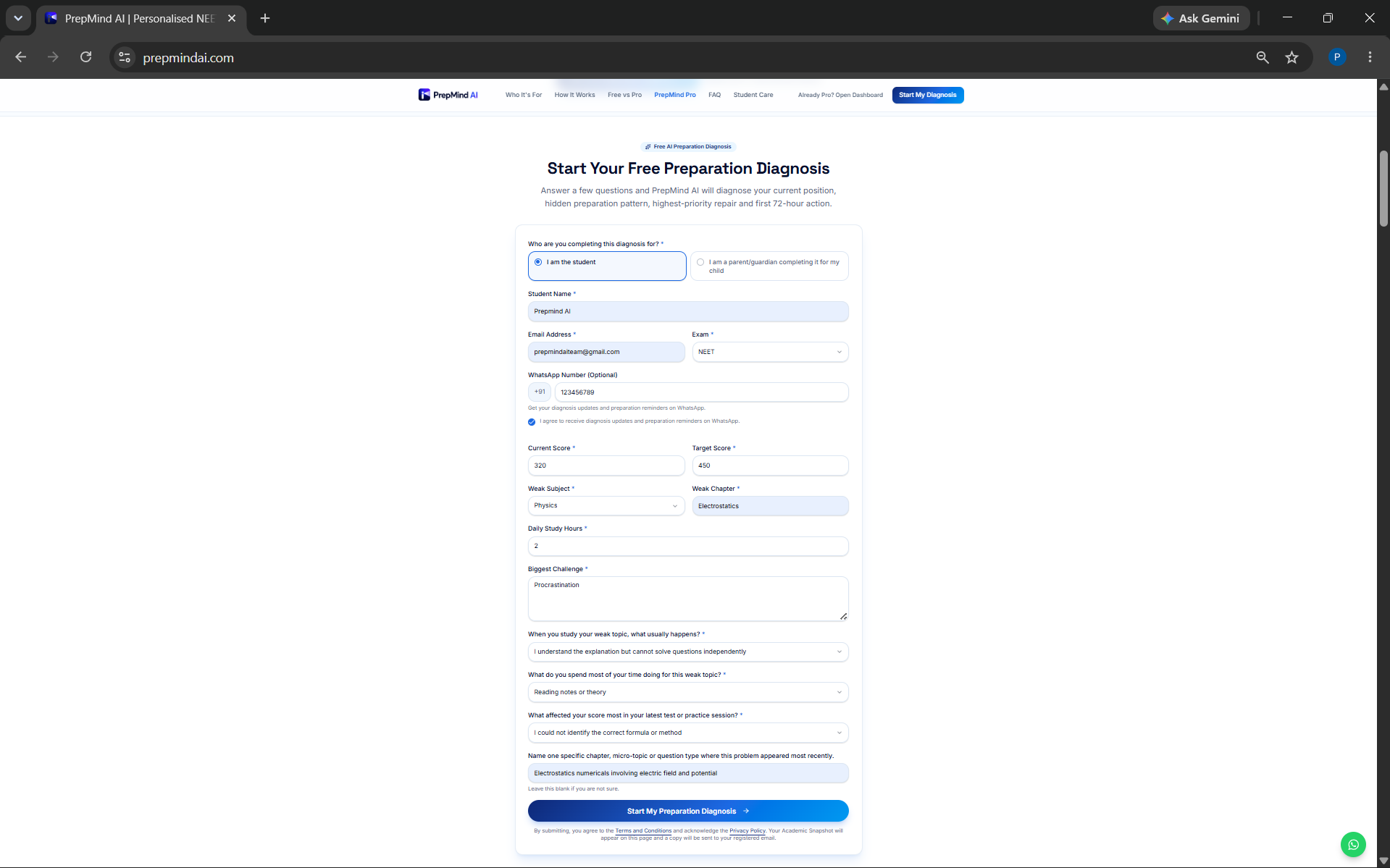
PrepMind begins with a structured Preparation Diagnosis.
Students share their current score, target, weak subject or chapter, study hours, preparation habits and biggest challenges.
What surprised us was how often the answer to “What is your biggest challenge?” told a different story from the weak subject.
Students told us things like:
- “I cannot concentrate.”
- “I procrastinate.”
- “I keep making the same mistakes.”
- “I cannot solve numericals.”
- “Everything feels weak.”
- “I need more study hours.”
The visible academic problem was real, but it was not always the first thing that needed fixing.
Gemini analyses this context to identify the likely preparation bottleneck, the highest-priority repair, the score-gap direction and a first action to test in the next 72 hours.
That became our core principle:
Diagnosis before planning.
But our launch taught us something else: diagnosis alone is not enough.
Knowing why you are stuck and consistently executing the right fix are two different problems.
So we built PrepMind Pro.
It converts the diagnosis into a personalised 30-Day Execution Blueprint built around the student's actual resources, available time, backlog, upcoming tests and execution blockers.
Inside the private Pro dashboard, students get:
- today's priorities
- a personalised 30-day path
- accountability check-ins
- progress and streak tracking
- missed-day recovery
- weekly review structure
- focused AI support when they get stuck
The system becomes:
Diagnose → Prioritise → Execute → Measure → Recover → Continue.
How we built it
PrepMind is not built as an unrestricted AI chatbot.
Gemini is embedded directly into the operating workflow.
The system uses AI to:
- interpret student preparation data
- identify likely bottlenecks
- determine the priority repair
- generate structured Preparation Diagnoses
- build personalised 30-Day Execution Blueprints
- provide contextual next-action support when execution breaks
The accountability AI does not begin from a blank chat.
It receives the student's existing diagnosis, 30-Day Blueprint, current day and current blocker before deciding the next useful action.
We also deliberately decided where not to use AI.
Checking a task, updating a streak or recording progress does not require another model call. AI is reserved for moments where personal reasoning adds value.
The product currently connects Gemini/Google Cloud, automated n8n workflows, structured student data, PDF and email delivery, Razorpay payments, Pro onboarding and a private execution dashboard into one system.
As a solo non-technical founder, I built the system by combining AI-assisted development, automation tools and repeated real-user testing.
Challenges we ran into
The hardest part was not generating AI text.
It was making the entire business loop work reliably.
We dealt with:
- AI outputs that initially felt too generic
- separating free diagnosis from paid execution value
- email deliverability problems
- duplicate student submissions
- payment and entitlement-state mapping
- Pro-access verification
- connecting student context across workflows
- designing AI usage limits so support remains economically scalable
- building accountability without turning PrepMind into another endless chatbot
One of the biggest lessons came from conversion.
We initially attracted real students to the free diagnosis, but paid conversion remained weak.
That forced us to confront a product problem:
We had built a good answer to “What may be wrong?”
But we had not built a strong enough bridge to “What do I actually do every day now?”
That failure directly led to the 30-Day Execution System, Pro dashboard and accountability layer.
Accomplishments that we're proud of
The thing I am most proud of is that PrepMind moved beyond a prototype.
During the hackathon we:
- launched the product publicly
- acquired real Preparation Diagnosis users
- collected real student preparation data
- ran real paid acquisition experiments
- generated personalised AI diagnoses
- built automated PDF and email delivery
- implemented payment-to-Pro onboarding
- generated 30-Day Execution Blueprints
- launched the private Pro dashboard
- built contextual Gemini-powered accountability support
- received real paid PrepMind Pro purchases
We also received an unexpected paid customer preparing for CA, outside our initial NEET/JEE focus.
Instead of claiming PrepMind already supports every exam, we created an early CA Beta setup to test whether the diagnosis-to-execution architecture can transfer responsibly into another high-stakes preparation journey.
That was an important signal: the problem may be broader than one exam.
What we learned
The biggest lesson is that generative AI becomes more useful when it is given a defined role, strong context and boundaries.
A general AI assistant can answer thousands of questions.
PrepMind is trying to answer one narrower and more consequential question:
Given this student's actual preparation, what should happen next?
We also learned that student problems are often layered.
A weak chapter may be the symptom.
The cause may be poor revision, repeated mistakes, resource switching, low-quality study hours, emotional fatigue or an execution system that continually breaks.
And we learned that personalised AI does not have to mean unlimited AI.
A scalable system can combine deterministic progress tracking with AI reasoning only at the moments where reasoning matters.
What's next for PrepMind AI
PrepMind currently starts with NEET and JEE, where long preparation cycles, large syllabi, repeated testing and intense performance pressure make the problem highly visible.
Our early CA Beta is the first test of a broader thesis.
Different examinations require different subject knowledge and diagnosis logic.
But the execution layer can be reusable:
understand the student → diagnose the bottleneck → identify the priority → create the path → track evidence → support recovery.
The long-term vision is to make PrepMind a clarity and execution layer for high-stakes learning, adaptable across exams, geographies and preparation systems.
The goal is not to replace teachers, coaching or educational content.
It is to help every student answer the question that mass systems struggle to answer individually:
What should I fix first — and how do I keep executing it?
PrepMind AI — Diagnosis before planning. Execution after clarity.
Built With
- canva
- chatgpt
- elevenlabs
- gemini-api
- github
- google-analytics
- google-apps-script
- google-cloud
- google-docs
- google-drive
- google-sheets
- google-vids
- hostinger
- javascript
- lovable
- meta-ads-manager
- meta-pixel
- n8n
- pdf.co
- razorpay
- rest-api
- supabase
- vertex-ai
- webhooks
- whatsapp-business


Log in or sign up for Devpost to join the conversation.