Inspiration
Students everywhere are drowning in disconnected tools — one app for notes, another for deadlines, a notebook for formulas, and pure guesswork for exam preparation. The intelligence needed to actually help a student understand and prepare has never been missing because AI doesn't exist; it's been missing because that intelligence has never been packaged into one coherent system built around how students actually study.
I experienced this firsthand. I watched classmates struggle not from lack of effort, but from lack of structure — no visibility into where they were falling behind, no system connecting their notes to their performance to their schedule. Brainwave's mission to empower the brains of tomorrow resonated directly with what I wanted to build: a platform that gives every student, regardless of background or access to private tutoring, the same calibre of intelligent academic support.
That is why I built Prepify AI — an academic operating system that turns raw notes into structured understanding, and structured understanding into real academic performance.
What It Does
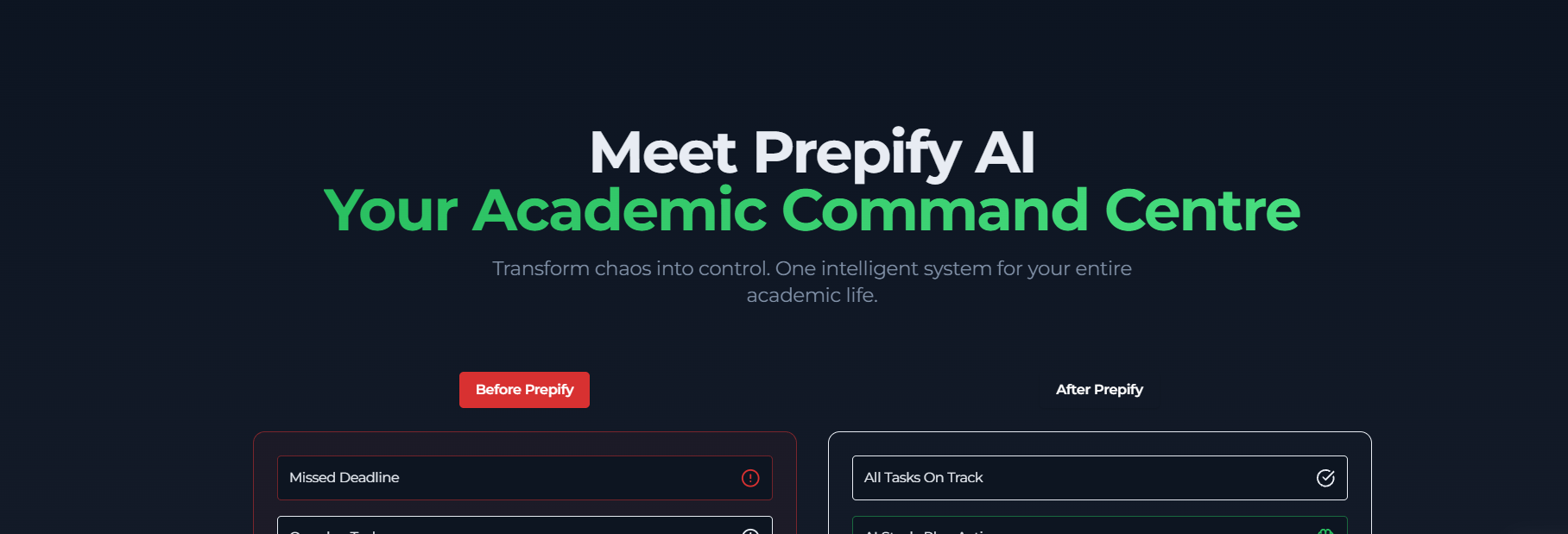
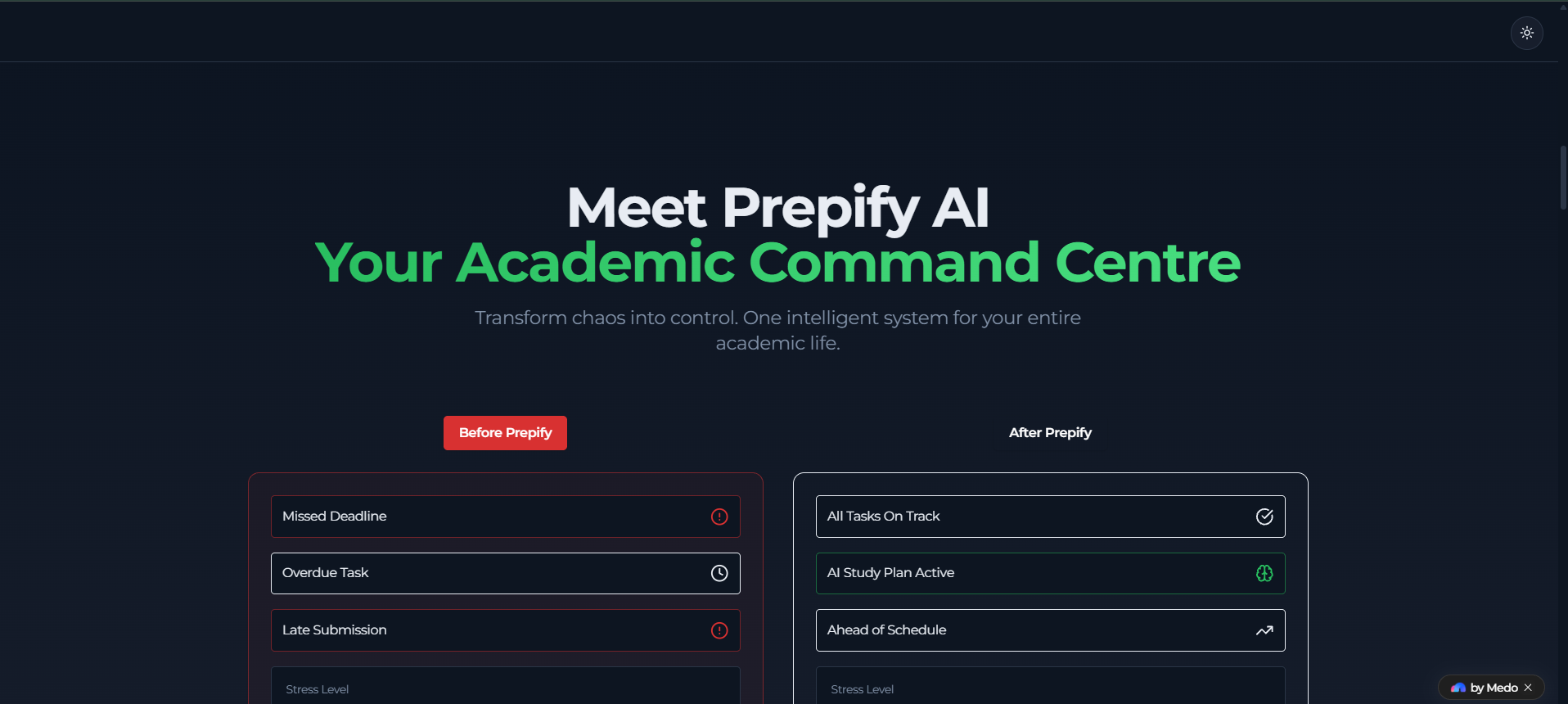
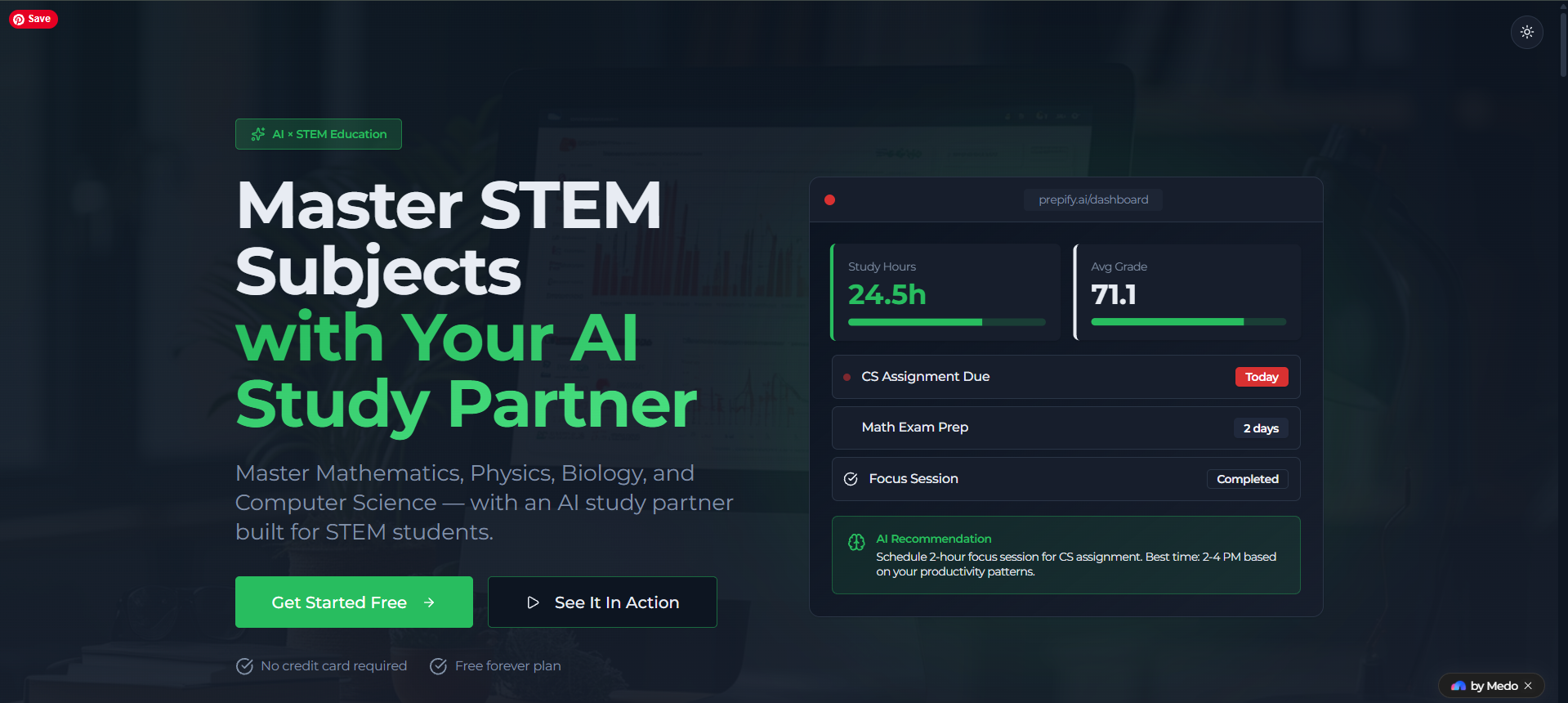
Prepify AI is a full-stack, AI-powered academic platform that centralises note intelligence, adaptive assessment, scheduling, and risk prediction into one system.
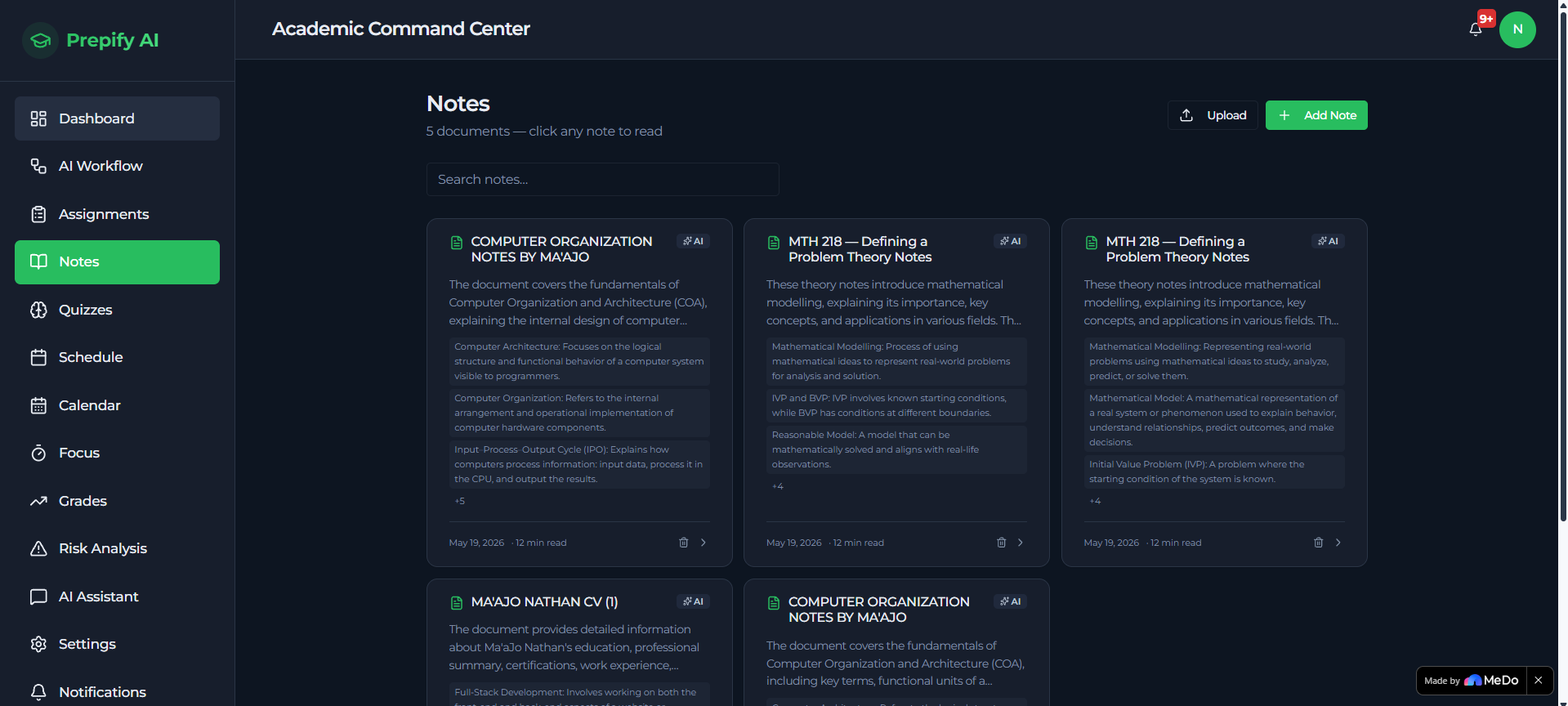
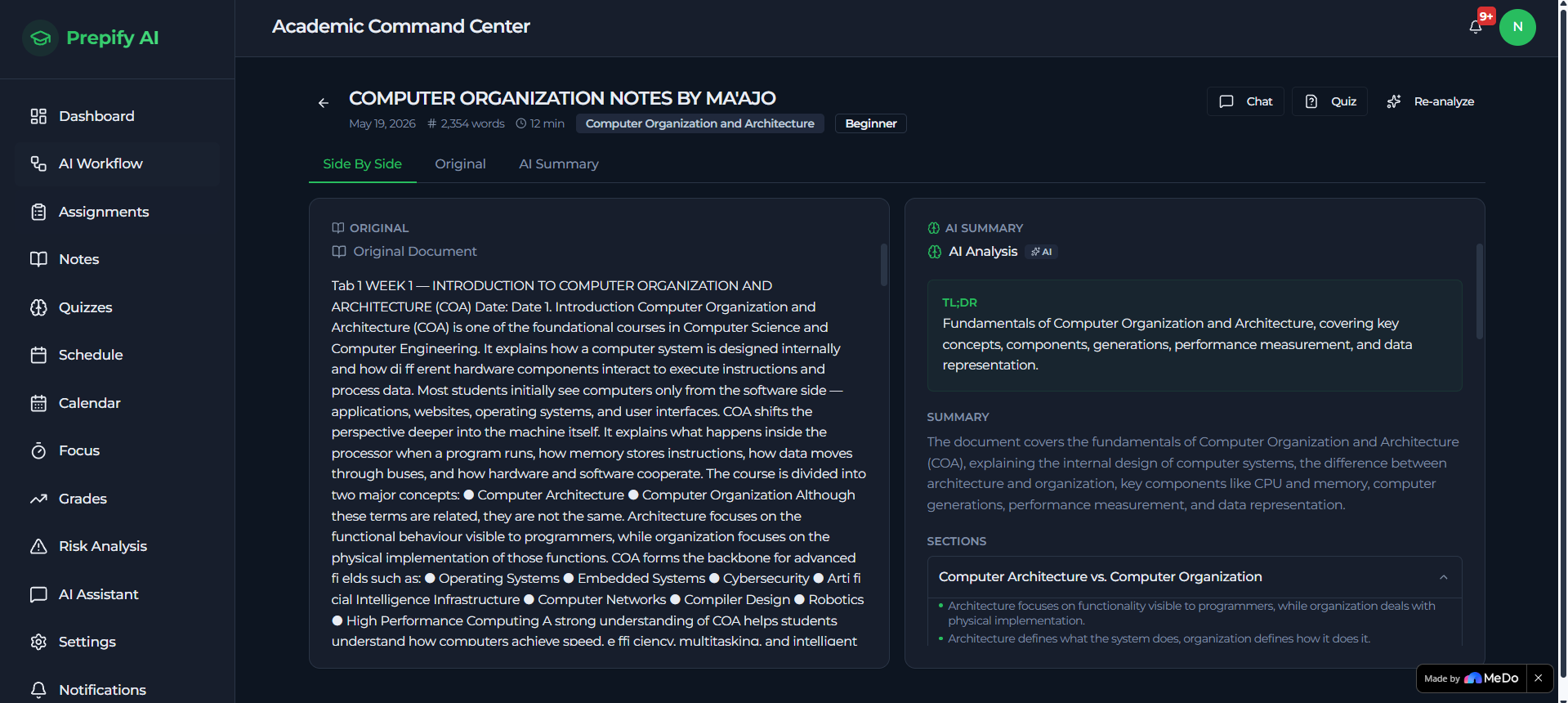
AI-Powered Note Intelligence Students paste their lecture notes — any subject, any format — and Prepify AI extracts the content, sends it to OpenAI, and returns a fully structured summary with key concepts, definitions, extracted formulas, and an automatically detected subject classification.
Properly Rendered Mathematics Every formula is rendered using KaTeX as real mathematical notation rather than raw text — derivatives, integrals, and equations display exactly as they would in a textbook.
Interactive Concept Maps Every processed note generates a visual knowledge graph, connecting AI-extracted key concepts in a radial layout — giving students an instant mental model of how ideas in a topic relate to one another.
AI Chat Assistant with Step-by-Step Solving A multi-turn conversational assistant grounded in the student's own notes. It can be asked to "solve step by step," breaking problems down into clearly numbered, properly formatted solutions.
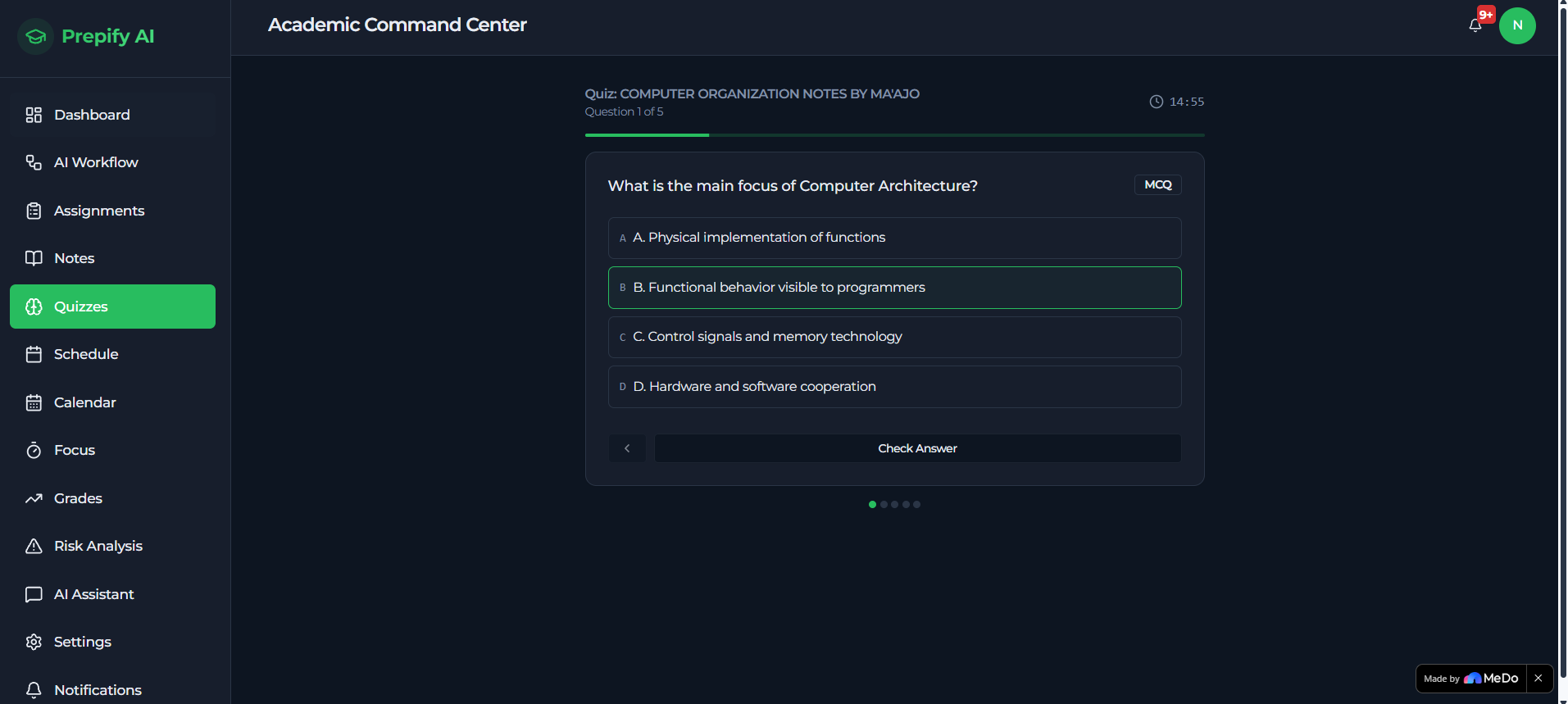
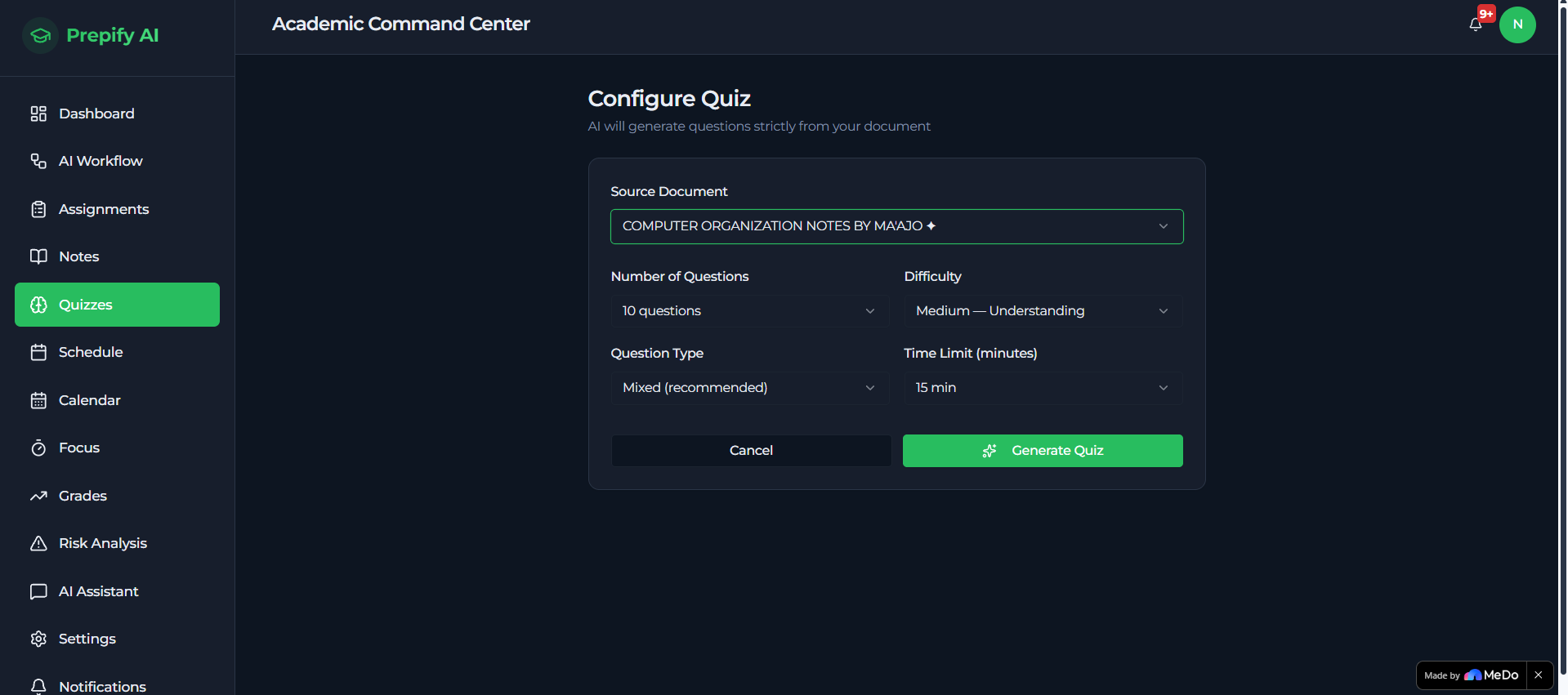
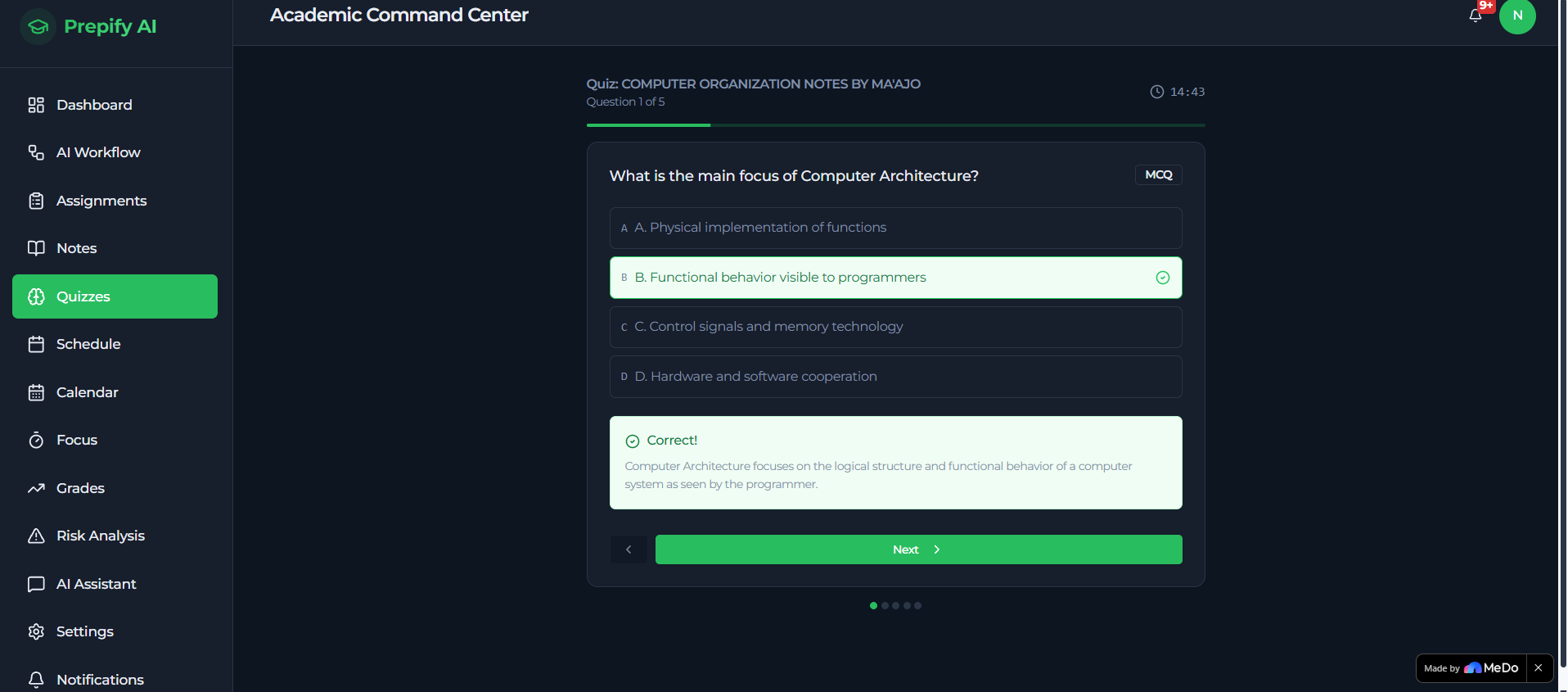
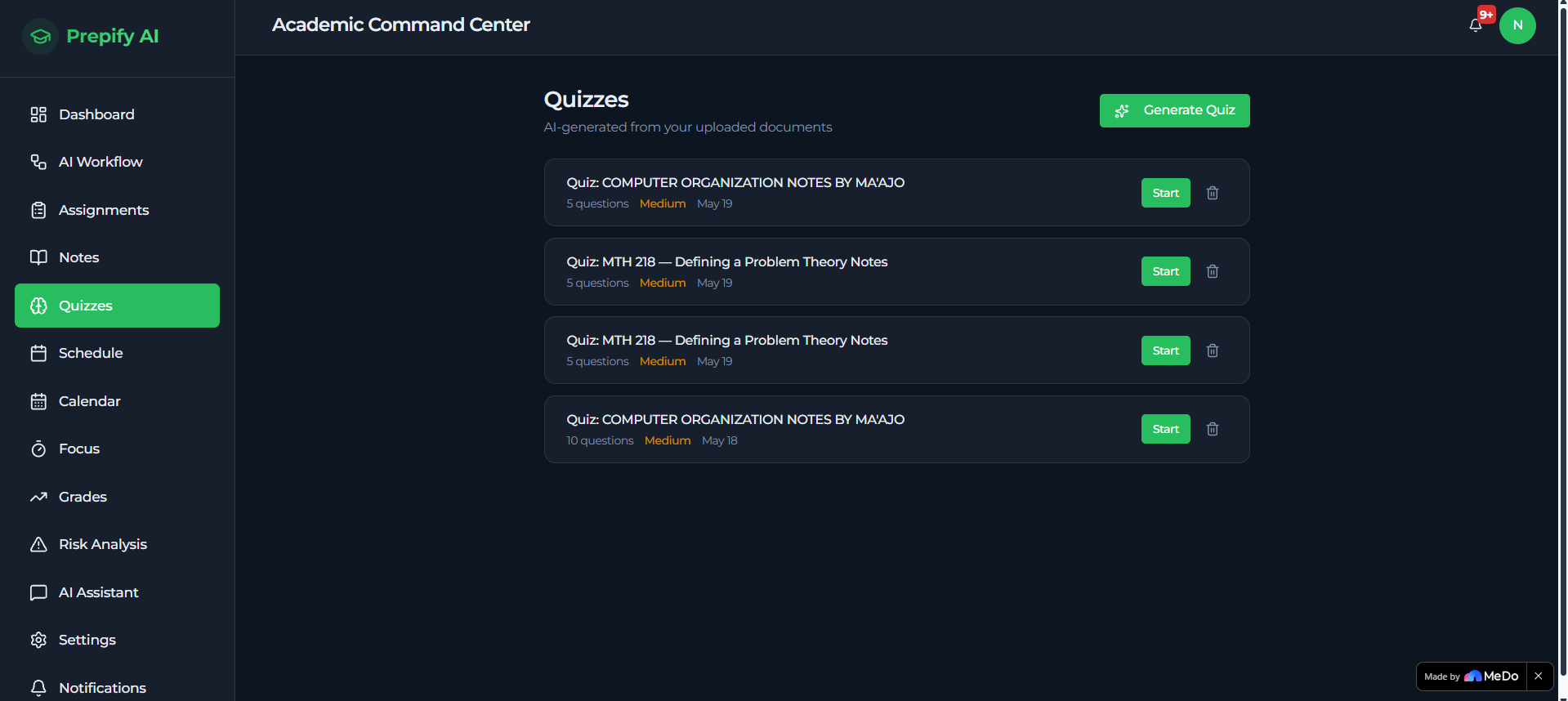
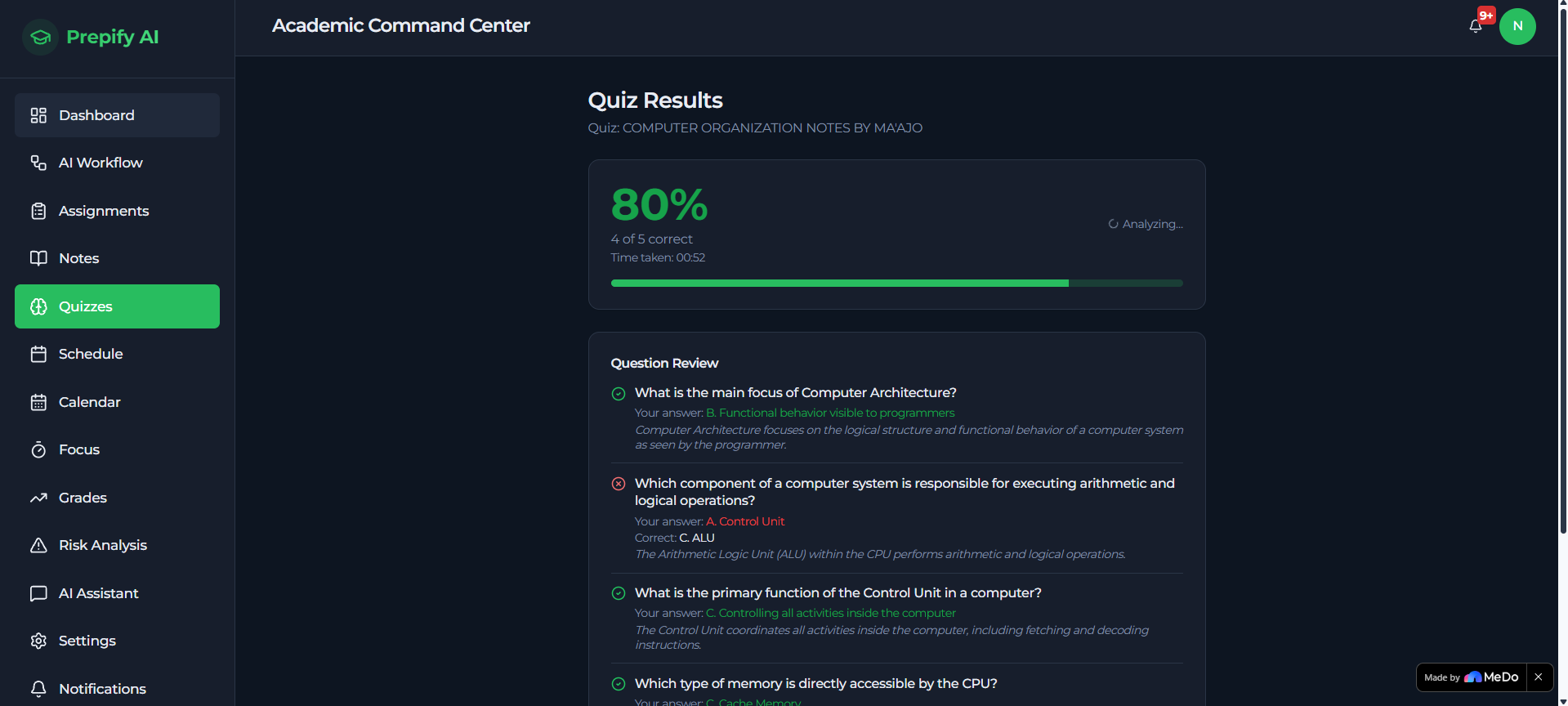
Adaptive Quiz Generator Custom quizzes generated directly from note content, with configurable difficulty and instant performance feedback identifying weak areas.
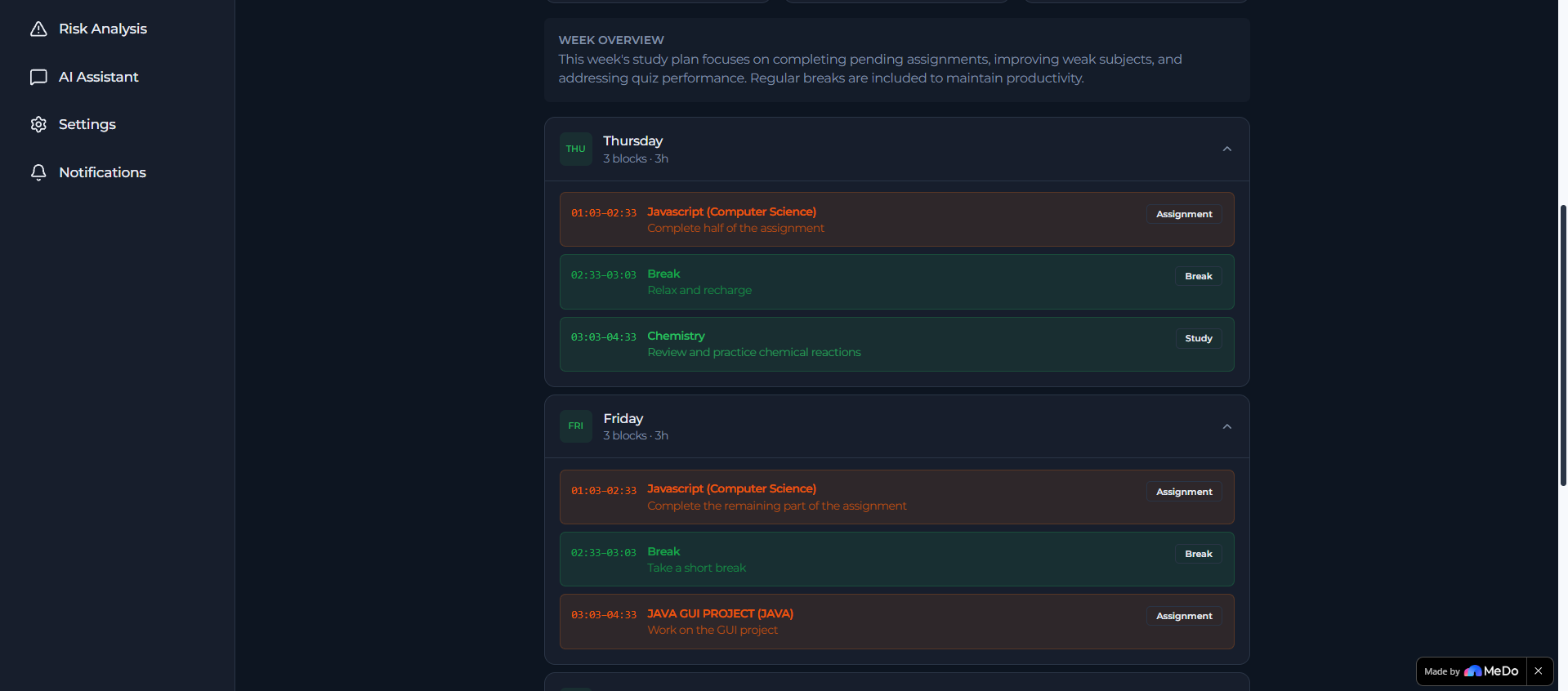
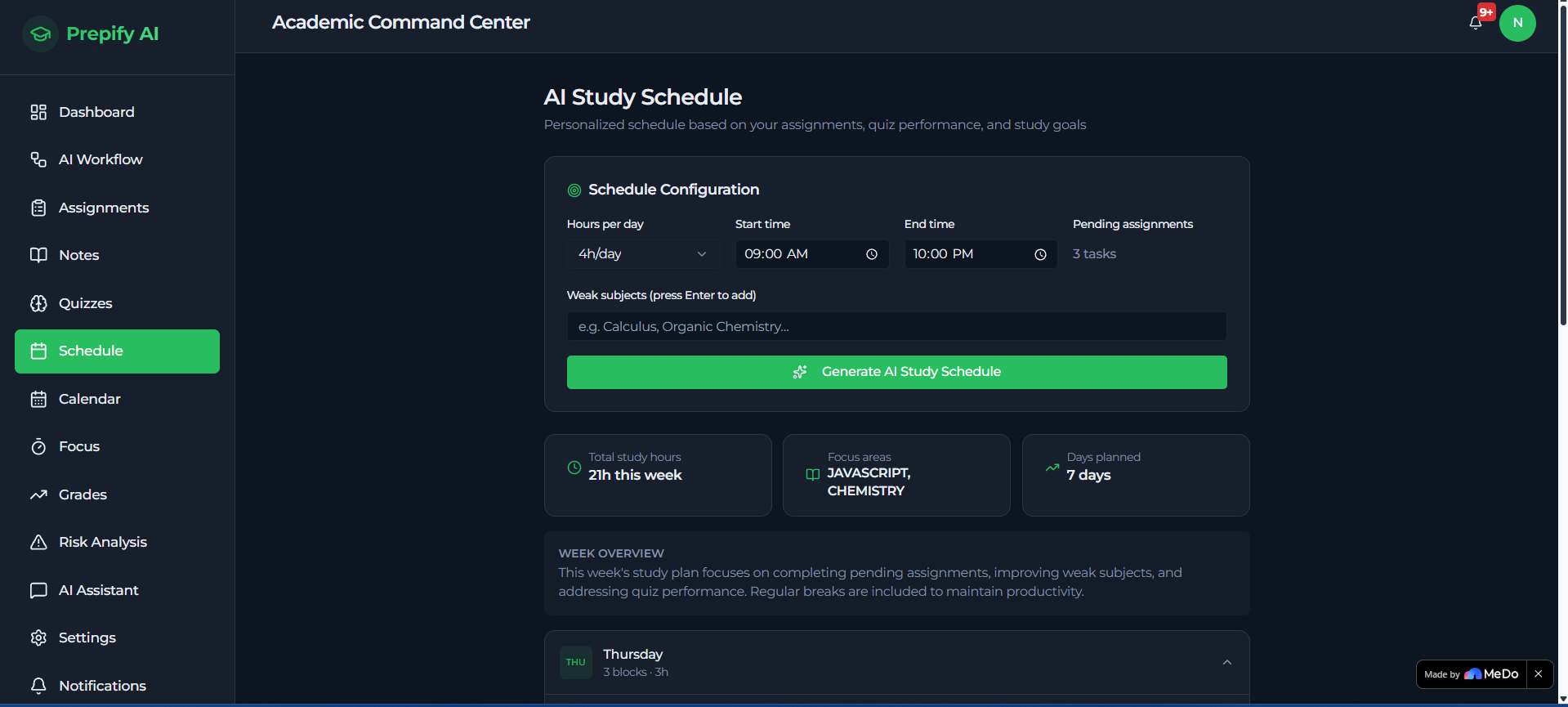
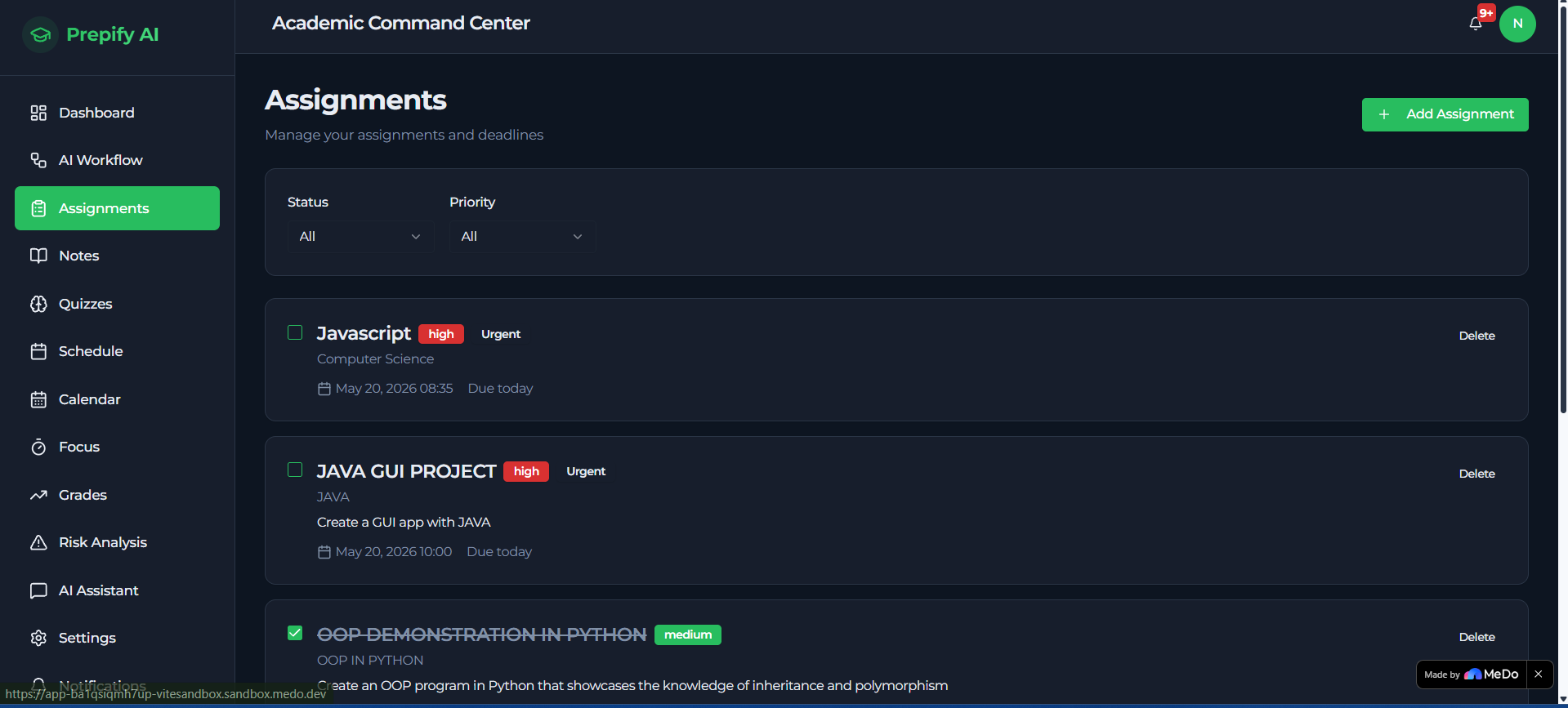
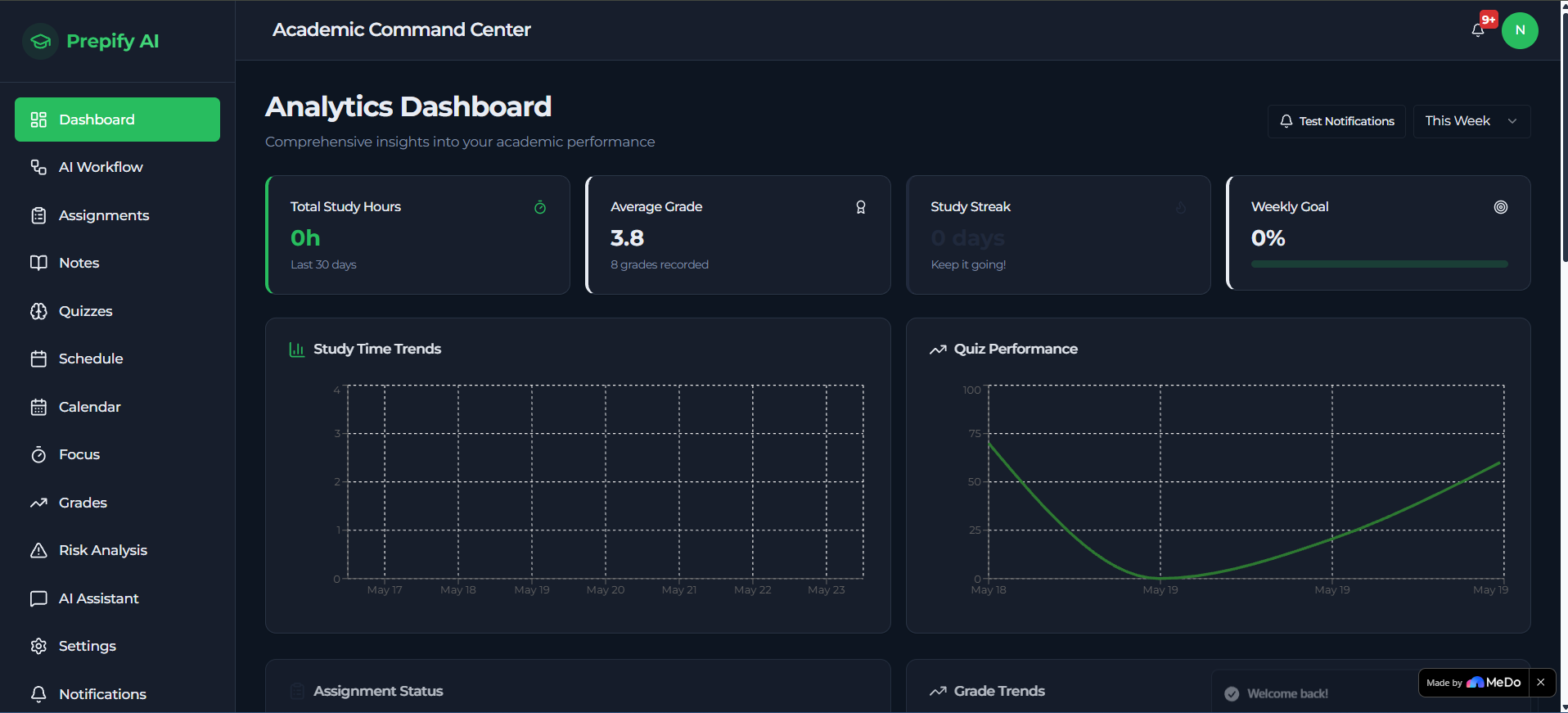
Smart Study Scheduler and Risk Predictor The AI builds personalised weekly study plans from deadlines and weak subjects, while continuously monitoring assignment completion and quiz trends to flag at-risk courses before decline becomes failure.
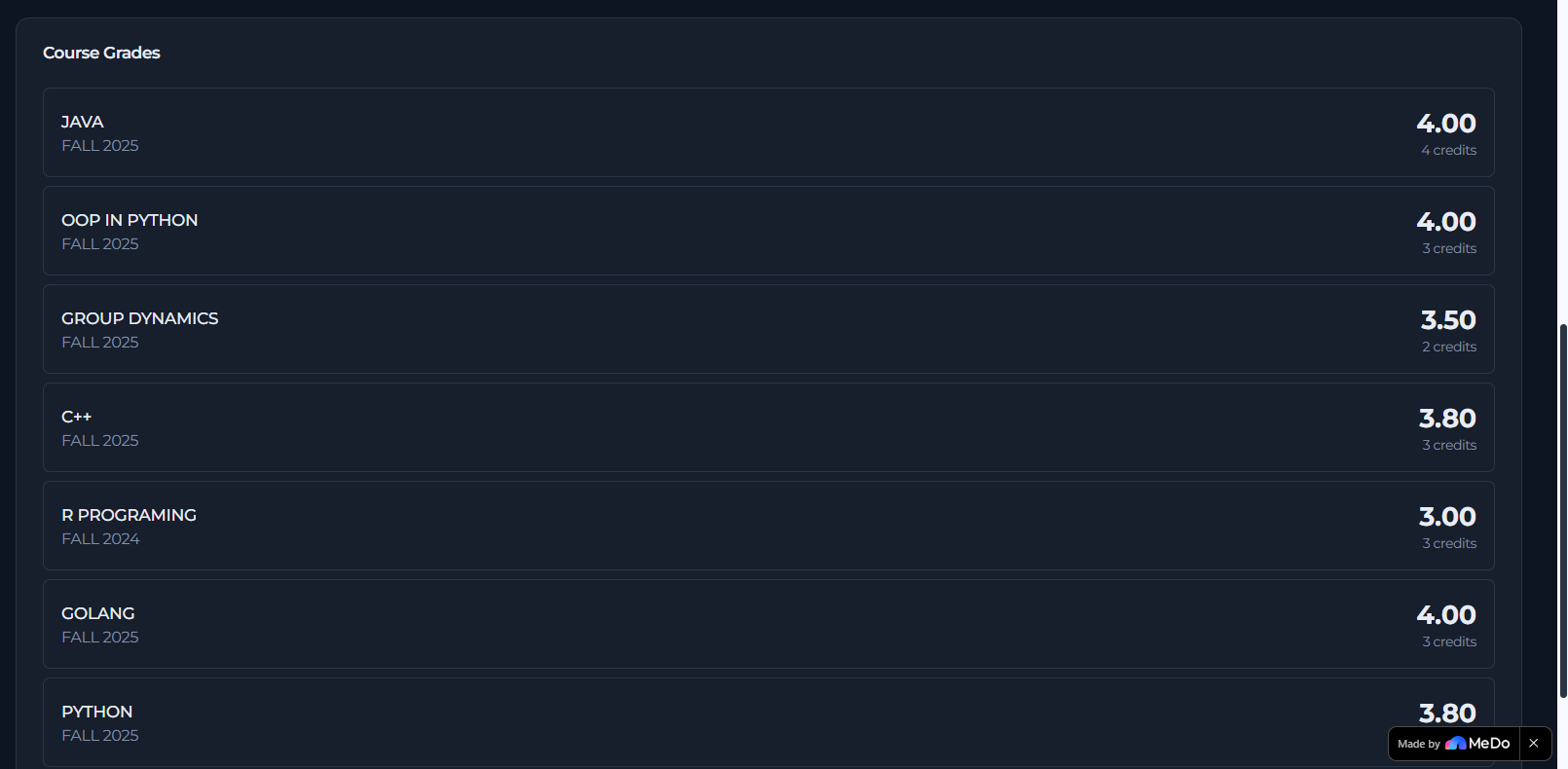
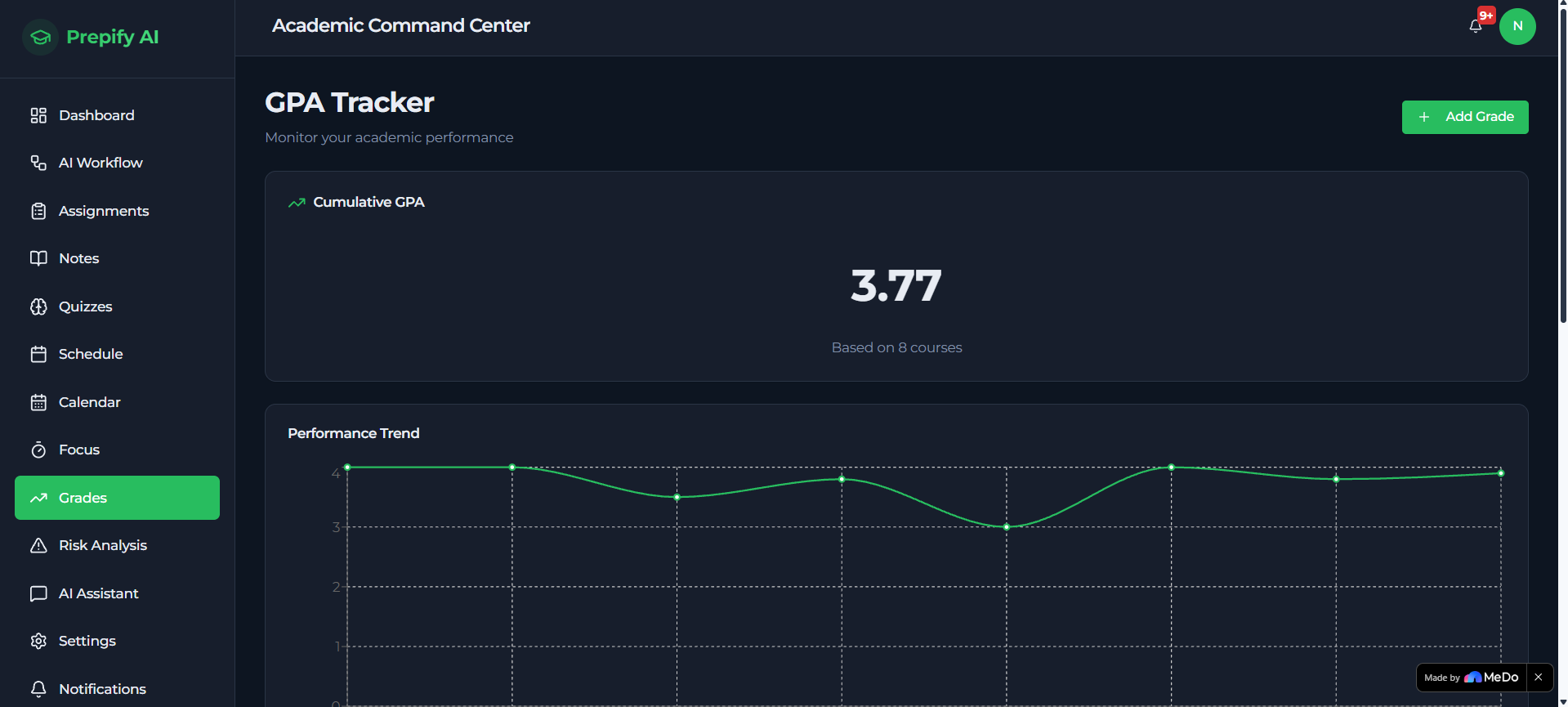
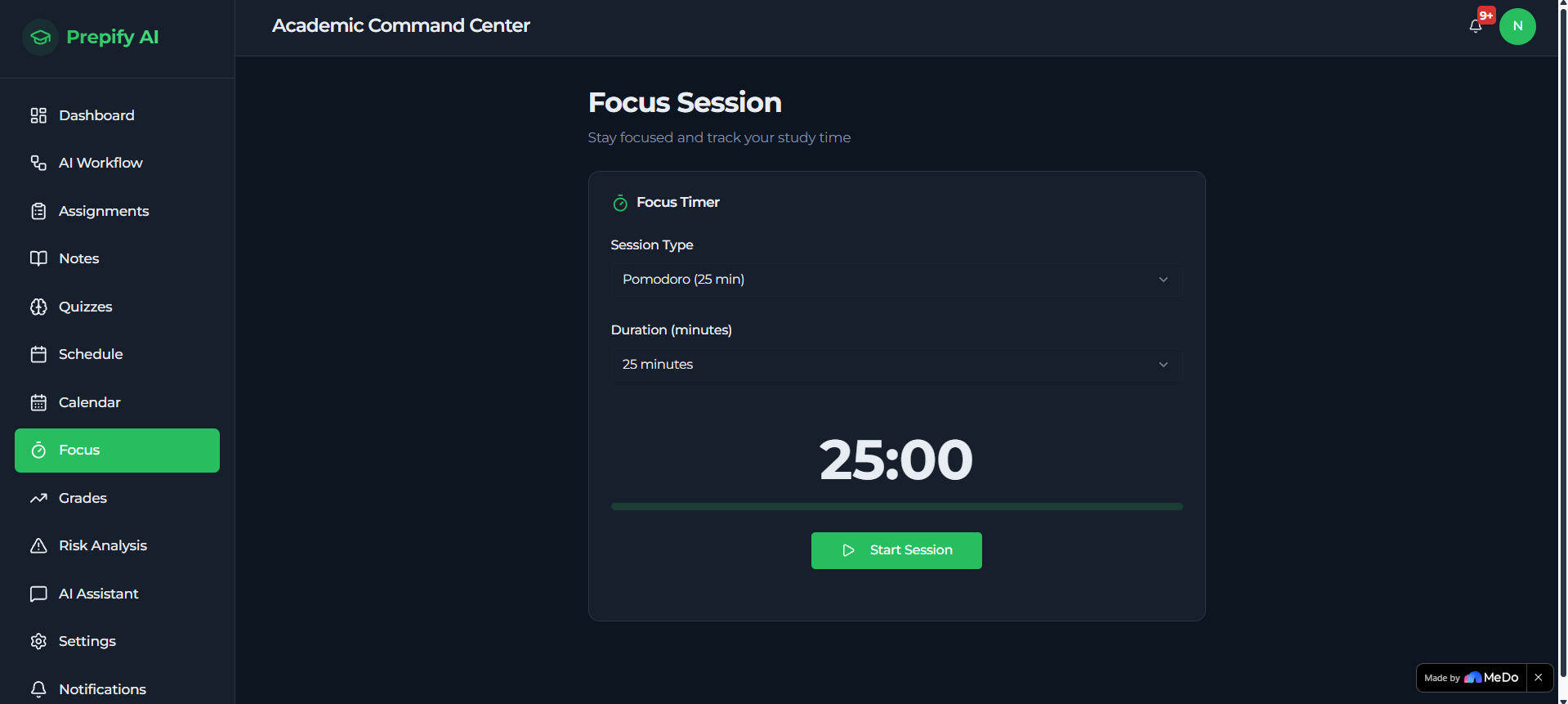
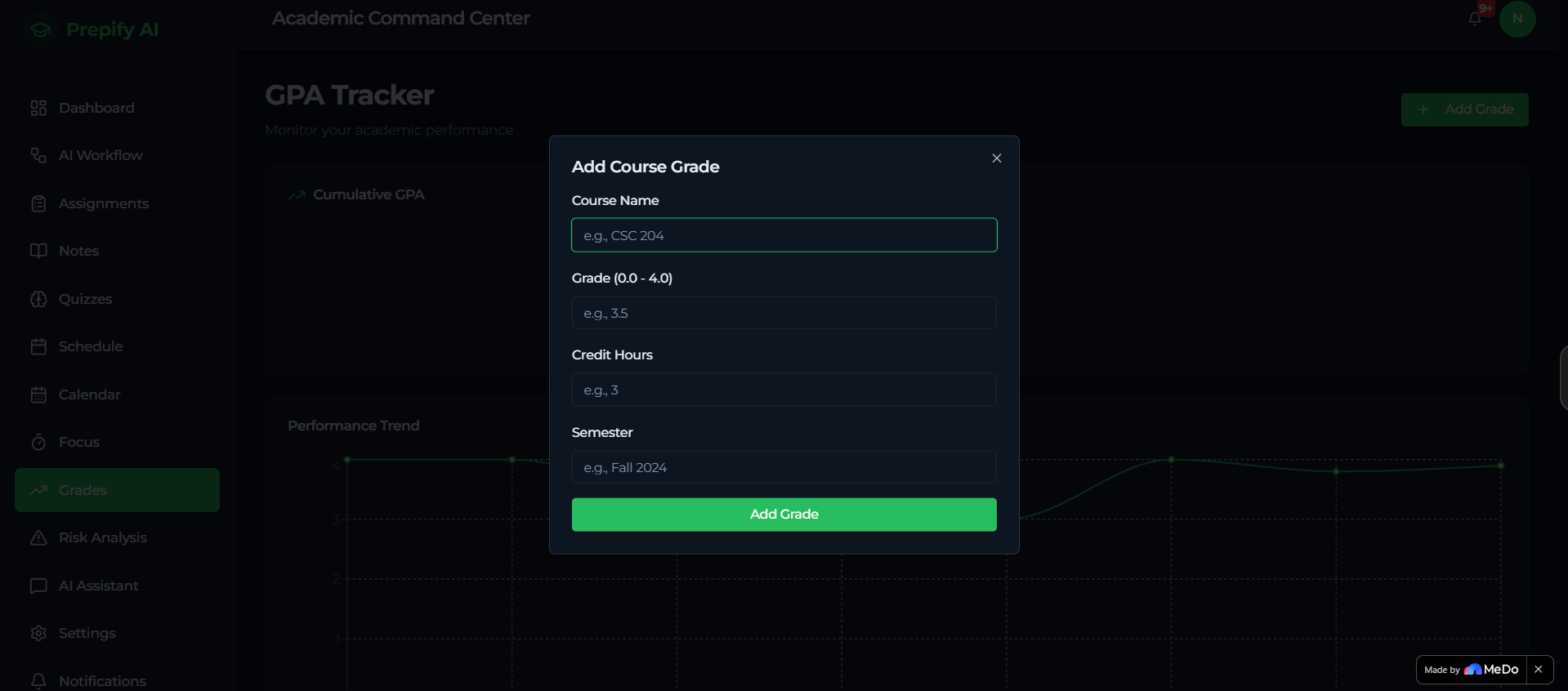
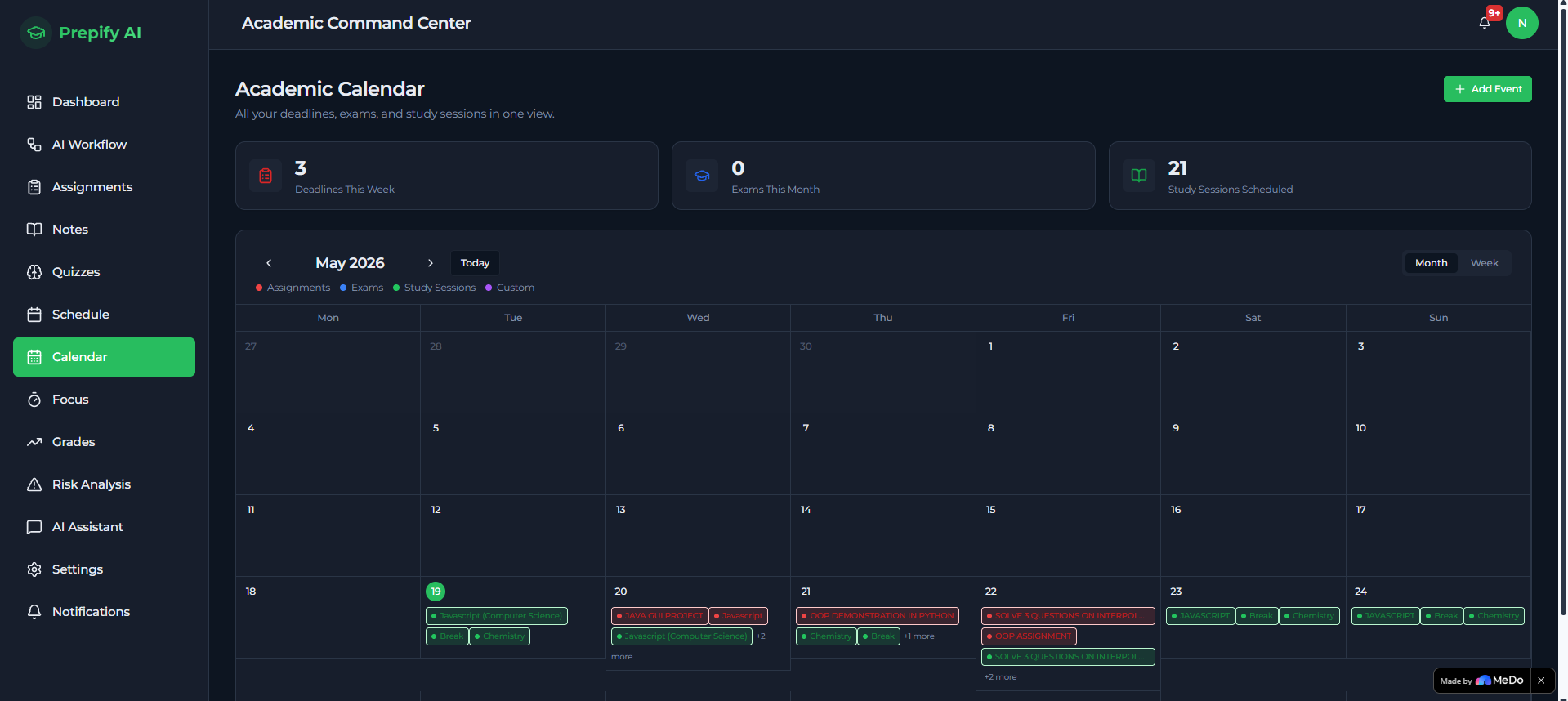
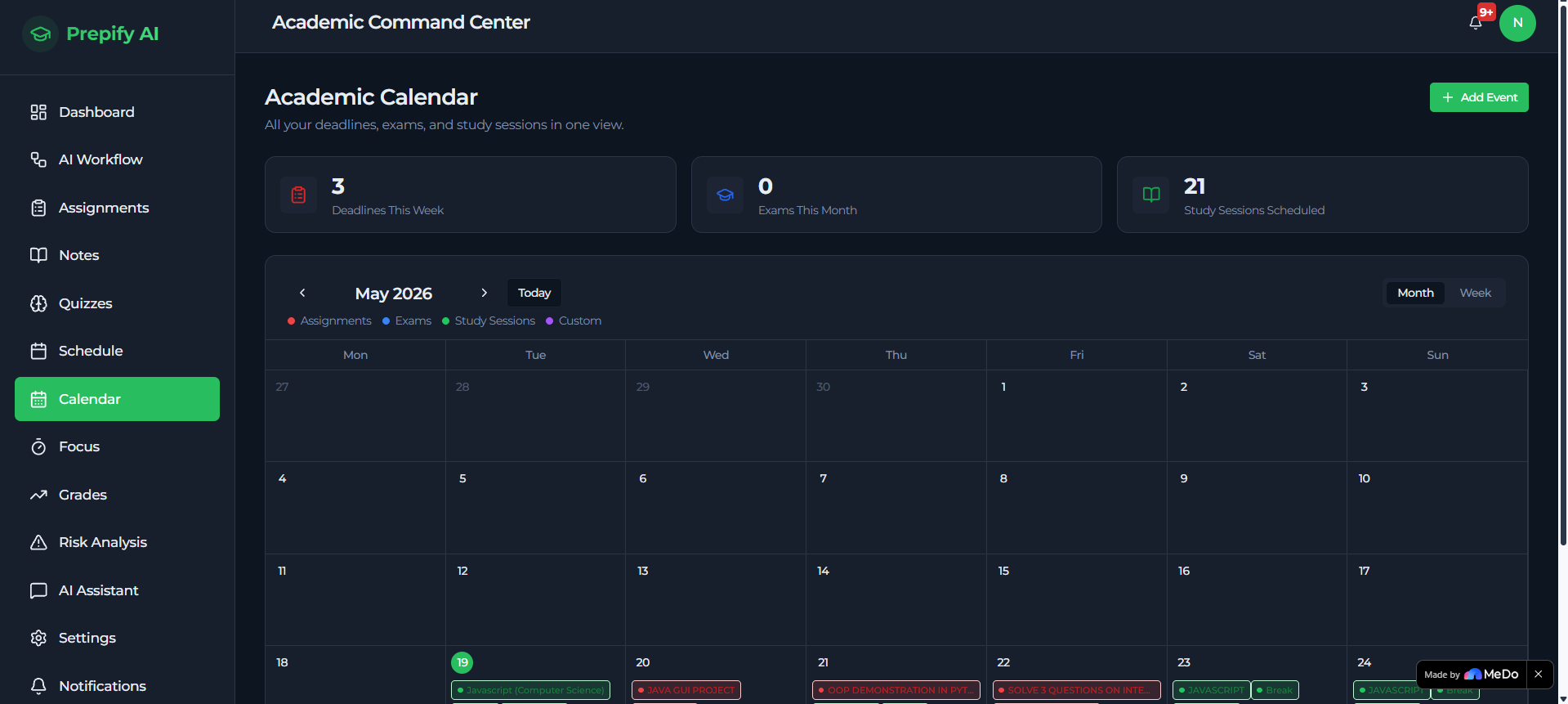
Supporting Systems A GPA/CGPA tracker, Pomodoro-style focus sessions, a colour-coded academic calendar, and a multi-channel notification system (email and browser push) round out the platform into a complete academic command centre.
How We Built It
Prepify AI was built using MeDo, an AI-powered full-stack generation platform, through structured natural language conversations across multiple development sessions. OpenAI powers every AI feature, with Google Gemini integrated as an automatic fallback provider, and Resend handles all email notification delivery.
The build process was iterative by necessity: a 16-table PostgreSQL database with full Row Level Security, 10 deployed serverless edge functions, and a 13-plus page React/TypeScript frontend, all generated and refined through conversation rather than manual scaffolding. Later iterations added subject auto-classification, KaTeX rendering across every surface where formulas appear, an interactive Concept Map component, and a Step-by-Step Solver mode in the AI chat — each added as a precise, scoped change to avoid destabilising existing functionality.
A key architectural decision was redesigning the note input flow around a paste-first experience, with direct file upload marked "Coming Soon," after diagnosing a production-only infrastructure issue. This kept the entire student experience seamless and error-free.
Challenges We Ran Into
Making Mathematics Actually Readable The AI generated correct content from the start, but formulas initially rendered as raw LaTeX text — technically correct, practically useless for a student trying to revise. Integrating KaTeX across AI summaries, the dedicated Formulas tab, and chat responses required careful, targeted prompting to fix rendering everywhere it mattered without breaking the "Original Document" view, which intentionally shows raw source text.
Production Infrastructure vs. Development Preview The most demanding challenge had nothing to do with AI logic. File uploads worked flawlessly in the development preview but failed in production — caused by API keys bound only to the development environment and Supabase storage policies blocking writes on the live server. Diagnosing environment variables, redeploying edge functions, and fixing Row Level Security policies taught me more about real production infrastructure than any other part of this project. Given limited development resources, I made the deliberate call to redesign around the constraint — building a flawless paste-based pipeline rather than continuing to chase a platform-level bug.
Visualising Knowledge Without New AI Calls I wanted a Concept Map feature, but generating one with a fresh AI call per note would be slow and resource-intensive. Instead, it reuses the key_concepts array already produced during summarisation, meaning every existing note instantly gained a visual knowledge graph with zero additional processing cost.
Accomplishments That We're Proud Of
- Built a fully functional, multi-page AI academic platform from concept to live deployment
- Achieved properly rendered mathematical notation throughout the entire app using KaTeX
- Built an interactive Concept Map feature turning AI-extracted concepts into a visual knowledge graph
- Implemented a Step-by-Step Solver mode where the AI chat breaks problems into numbered, formatted solutions
- Added automatic subject classification with colour-coded badges across multiple academic disciplines
- Integrated three real APIs — OpenAI, Gemini (fallback), and Resend — into one cohesive platform
- Designed a production-grade notification system with retry logic, quiet hours, and priority filtering
- Made a pragmatic engineering trade-off under resource constraints that ultimately strengthened the product
- Built an AI system generating study schedules, quizzes, risk predictions, concept maps, and summaries from a student's own real content, with zero mock or placeholder logic
What We Learned
The most important lesson was that correctness and usability are not the same thing. A mathematically correct formula rendered as raw text is still useless to a student — the rendering layer is not cosmetic, it is core to whether an academic tool actually works.
I also learned the practical difference between a development environment and a production environment — how API keys must be explicitly bound to production, how database security policies behave differently once deployed, and how to make sound engineering trade-offs when resources are limited. Rather than endlessly chasing a platform bug, I learned when to redesign around a constraint instead of fighting it.
Finally, I learned that building conversationally with an AI platform is a genuinely different engineering discipline. Every feature added after the initial build — Concept Maps, KaTeX, subject classification, the Step-by-Step Solver — required precise, scoped instructions to extend functionality without destabilising what already worked. That discipline of describing intent clearly and iterating incrementally is itself a transferable skill.
What's Next for Prepify AI
- Restoring direct file upload with a fully tested, production-hardened pipeline alongside the existing paste-first workflow
- A searchable Glossary Hub aggregating extracted definitions across every note a student has created
- Subject Readiness Scores on the dashboard, combining quiz performance and study hours into a per-subject exam-readiness percentage
- Difficulty-adaptive quizzes that automatically adjust based on a student's prior performance on a topic
- Voice input and text-to-speech for notes and AI responses, extending accessibility to students with visual impairments
- Integration with university LMS platforms such as Moodle and Blackboard for automatic deadline syncing
- Collaborative study groups for peer-to-peer problem solving and shared note libraries
- Multi-language support to expand access for students in underrepresented regions globally
The long-term vision is for Prepify AI to become the academic operating system every student relies on — to study smarter, understand deeper, and never face academic failure alone.
Built With
- ai
- api
- medo
- openapi
- react
- supabase
- tailwind
- typescript

Log in or sign up for Devpost to join the conversation.