-
-
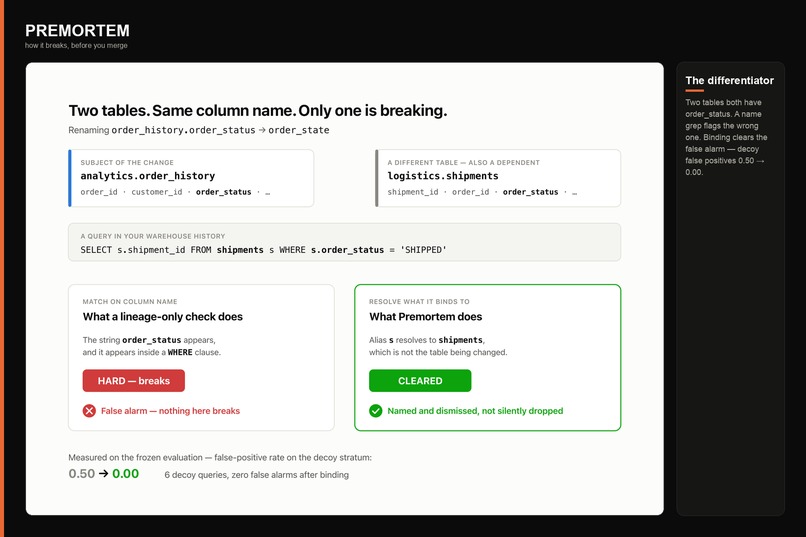
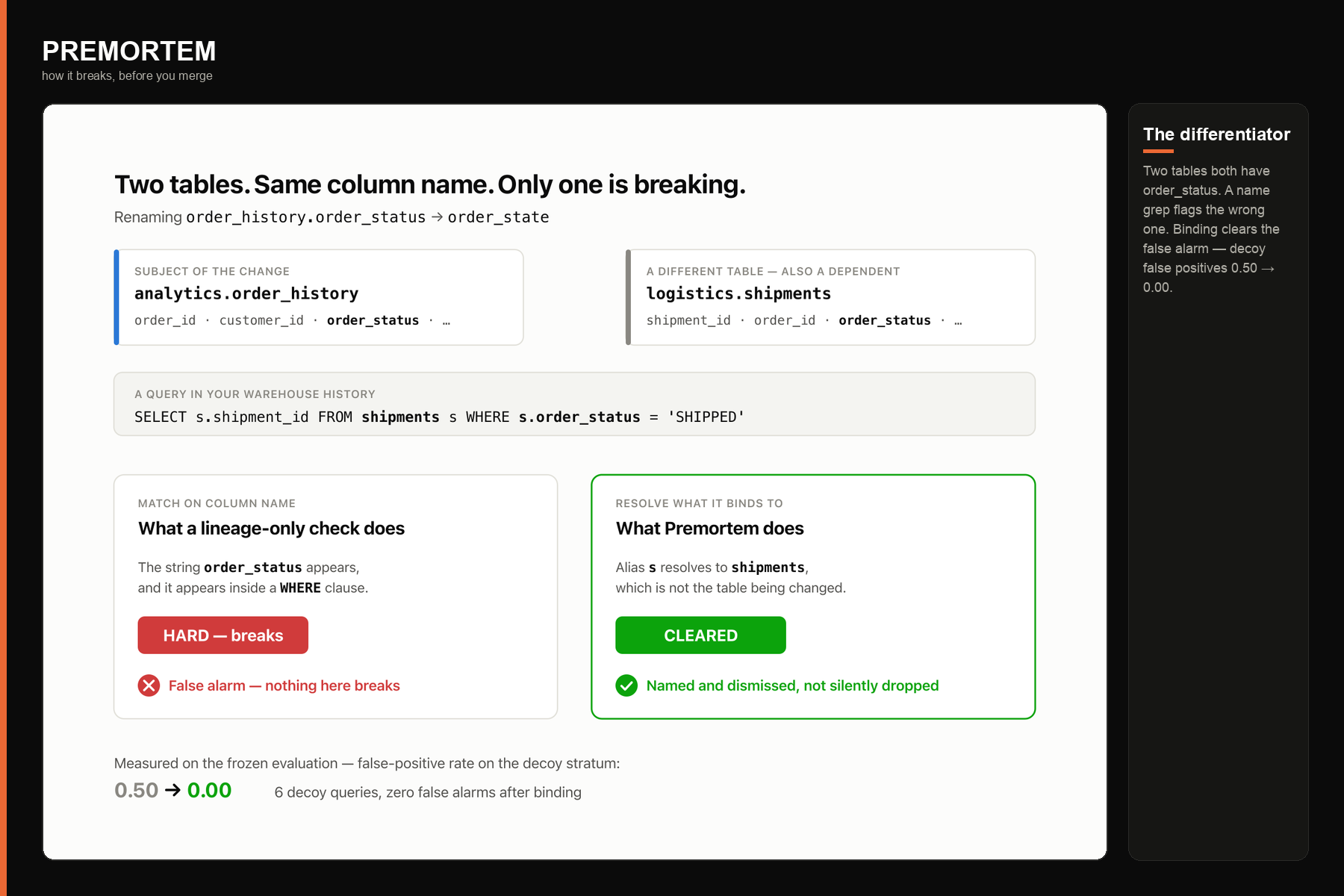
Two tables both have order_status; a name grep flags the wrong one. Binding clears the false alarm — decoy FP 0.50 → 0.00.
-
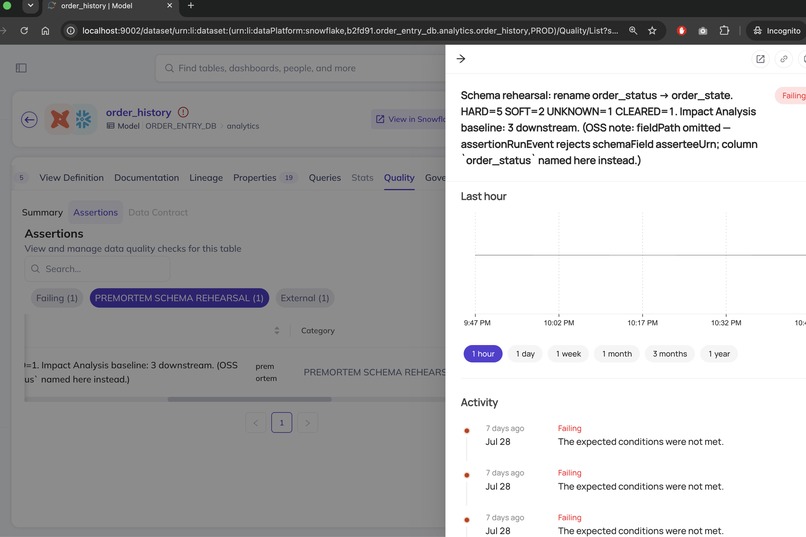
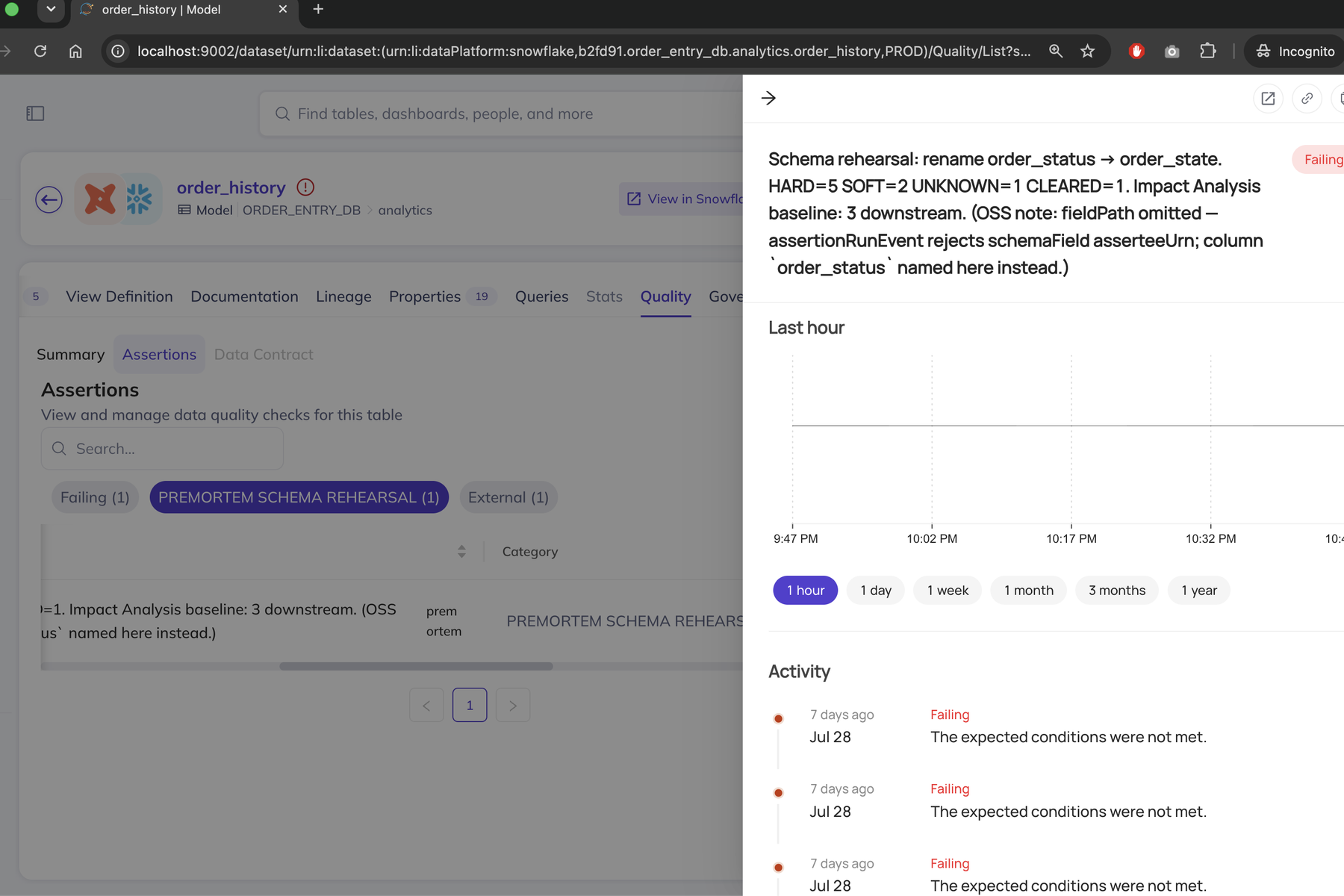
Premortem forecast written back to DataHub Quality (platform=premortem) — the next engineer inherits the rehearsal.
-
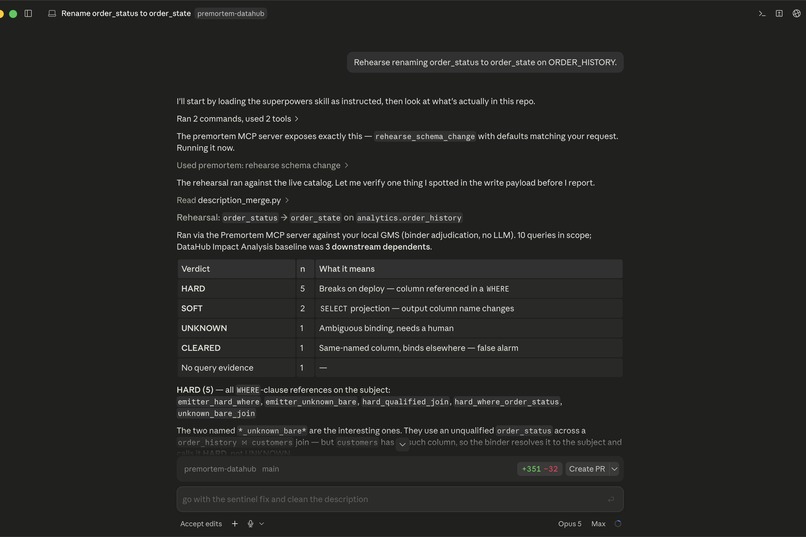
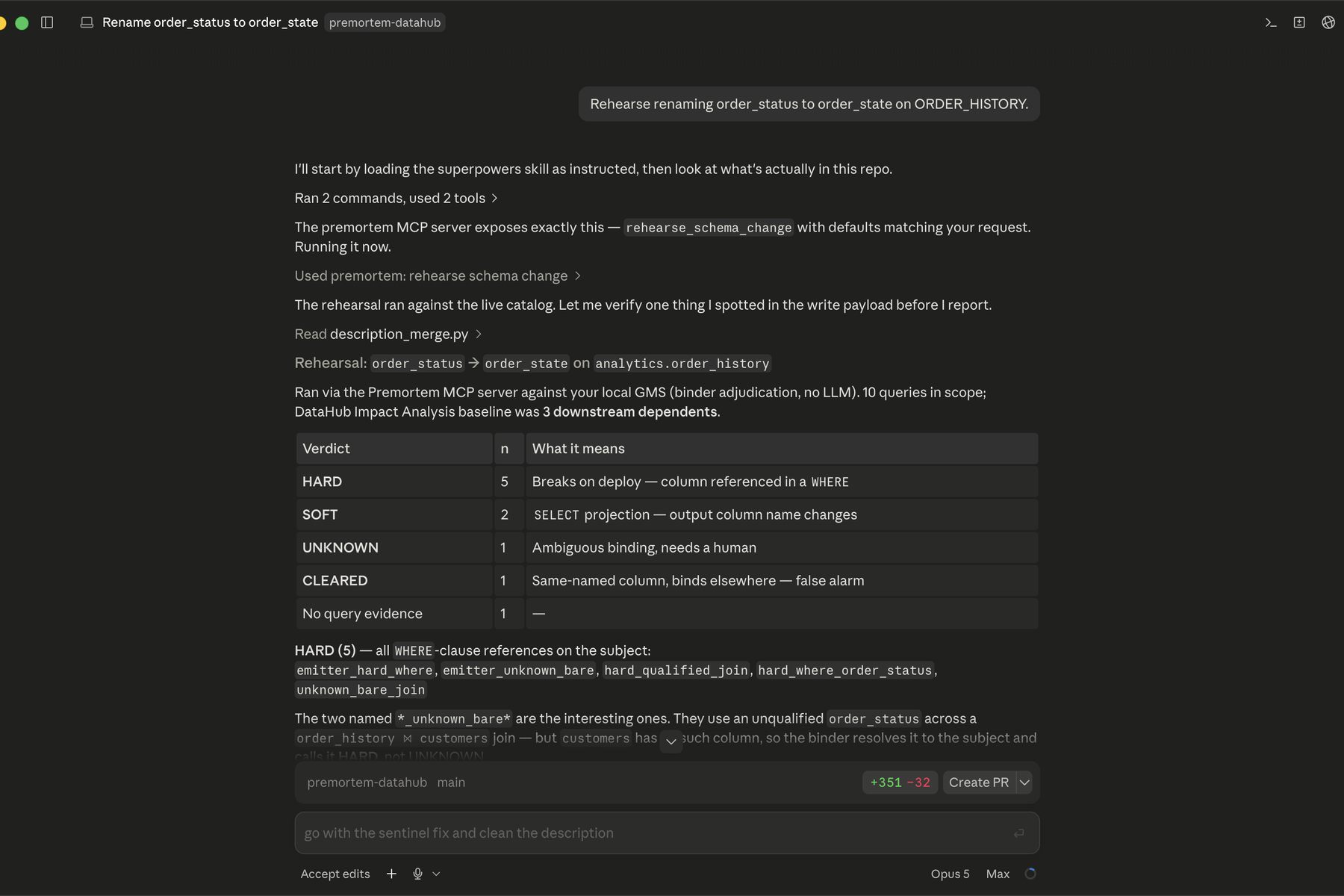
Live rehearsal: HARD / SOFT held, plus the two beats — UNKNOWN (refuse) and CLEARED (decoy bound to shipments).
-
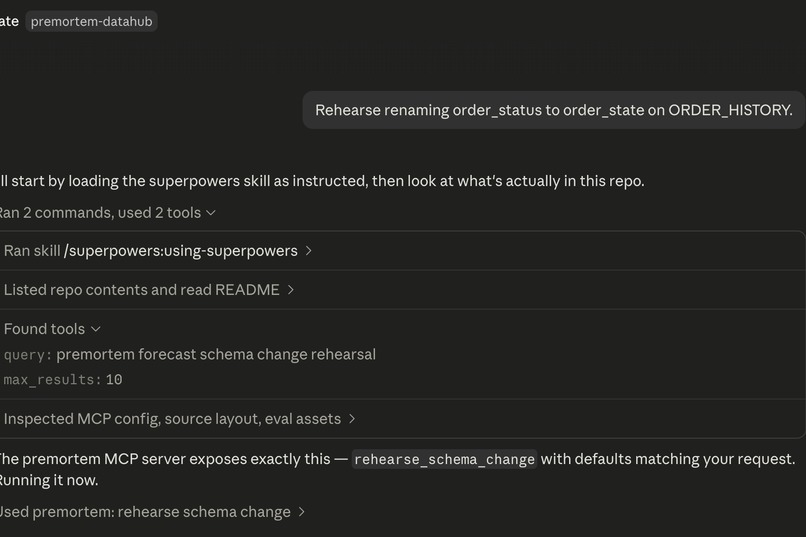
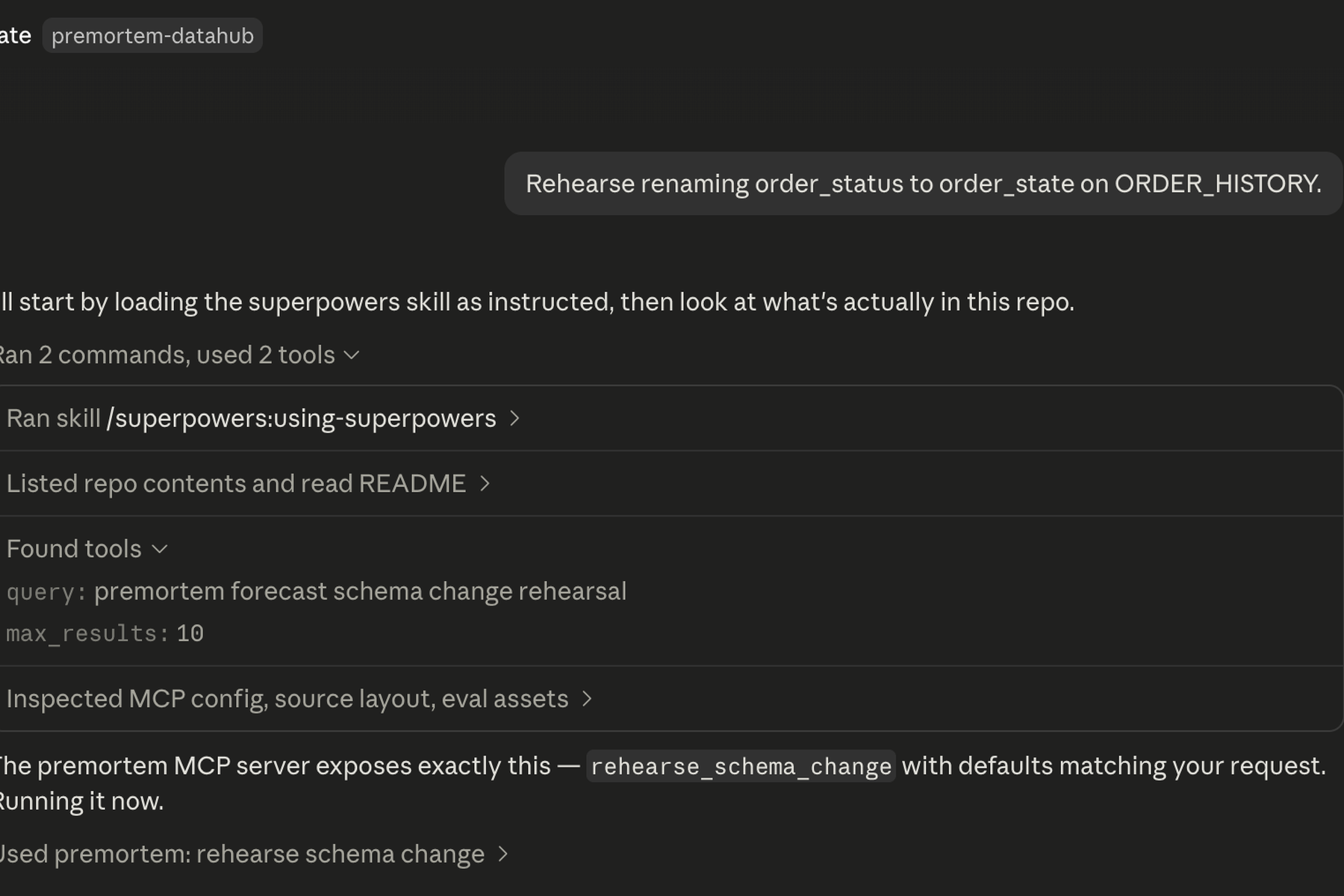
One agent session: DataHub MCP reads schema / lineage / query history; Premortem MCP returns forecast + write_payload.
-
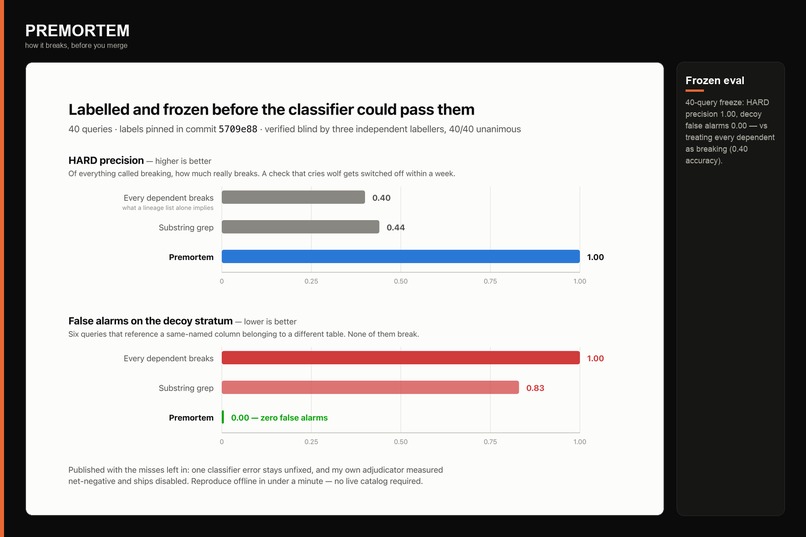
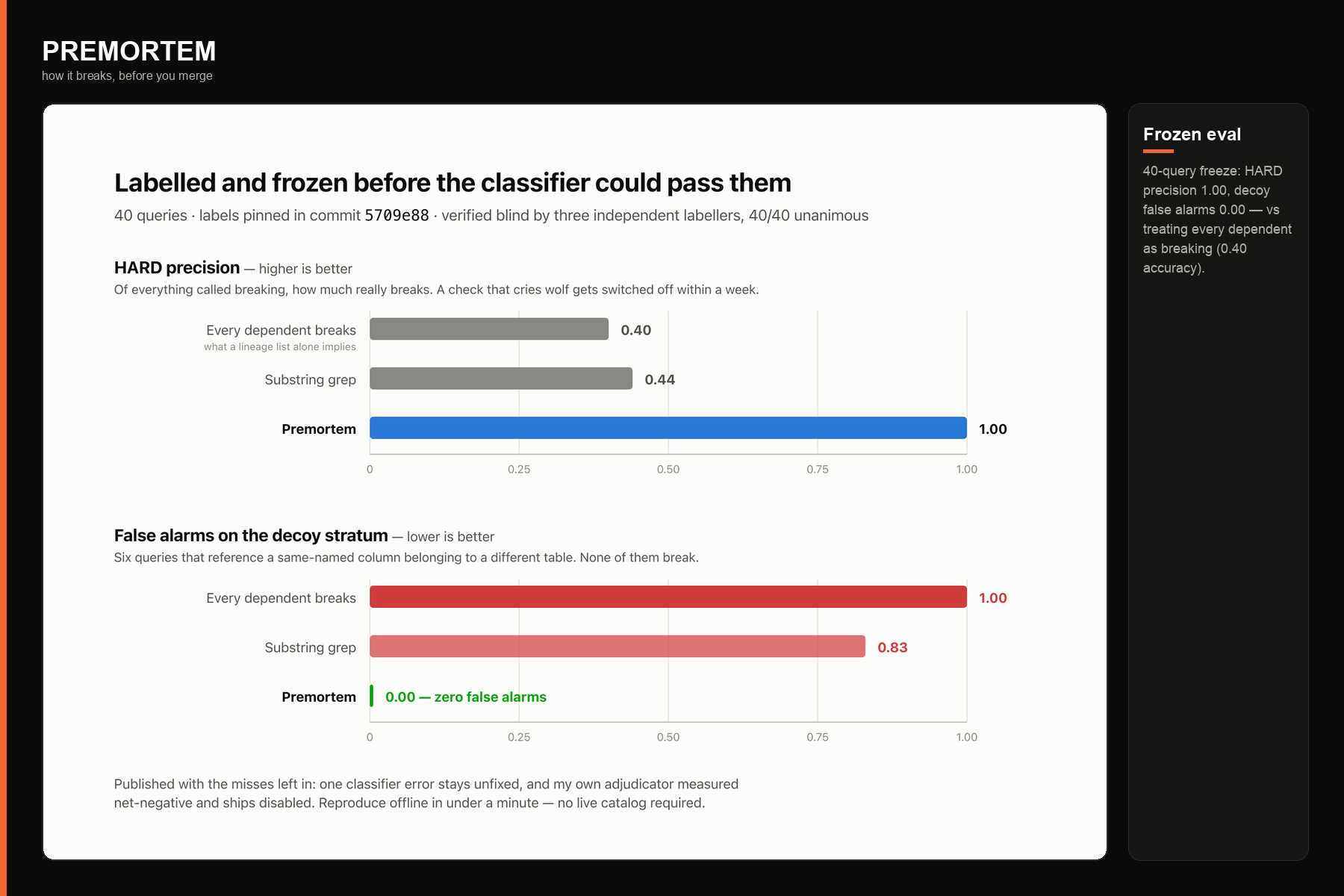
Frozen 40-query eval: HARD precision 1.00, decoy FP 0.00 — vs treating every dependent as breaking (~0.40).
-
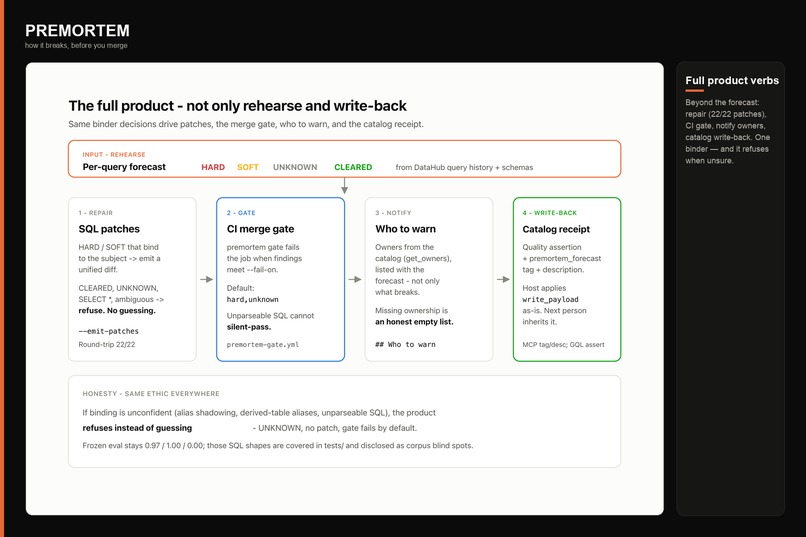
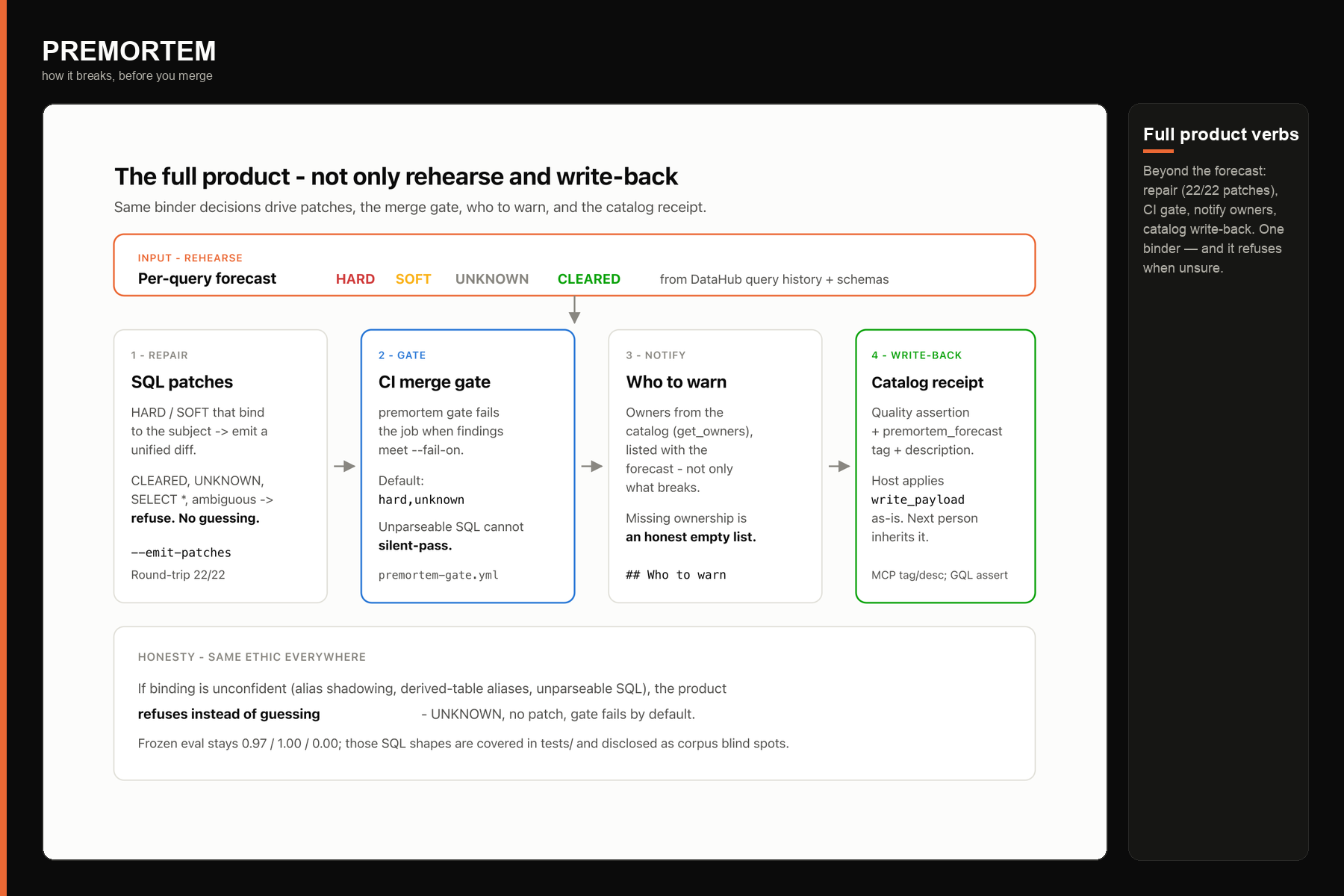
After the forecast: repair (22/22) → gate → notify → write-back. One binder; refuses when unsure.
-
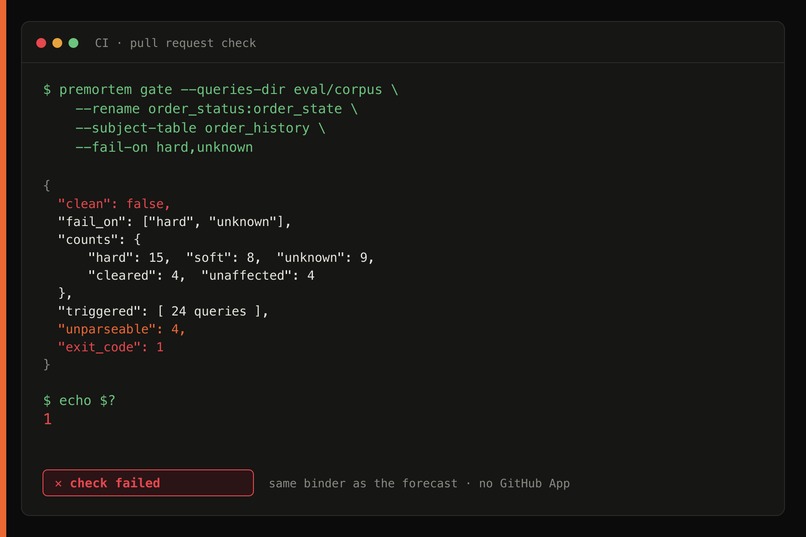
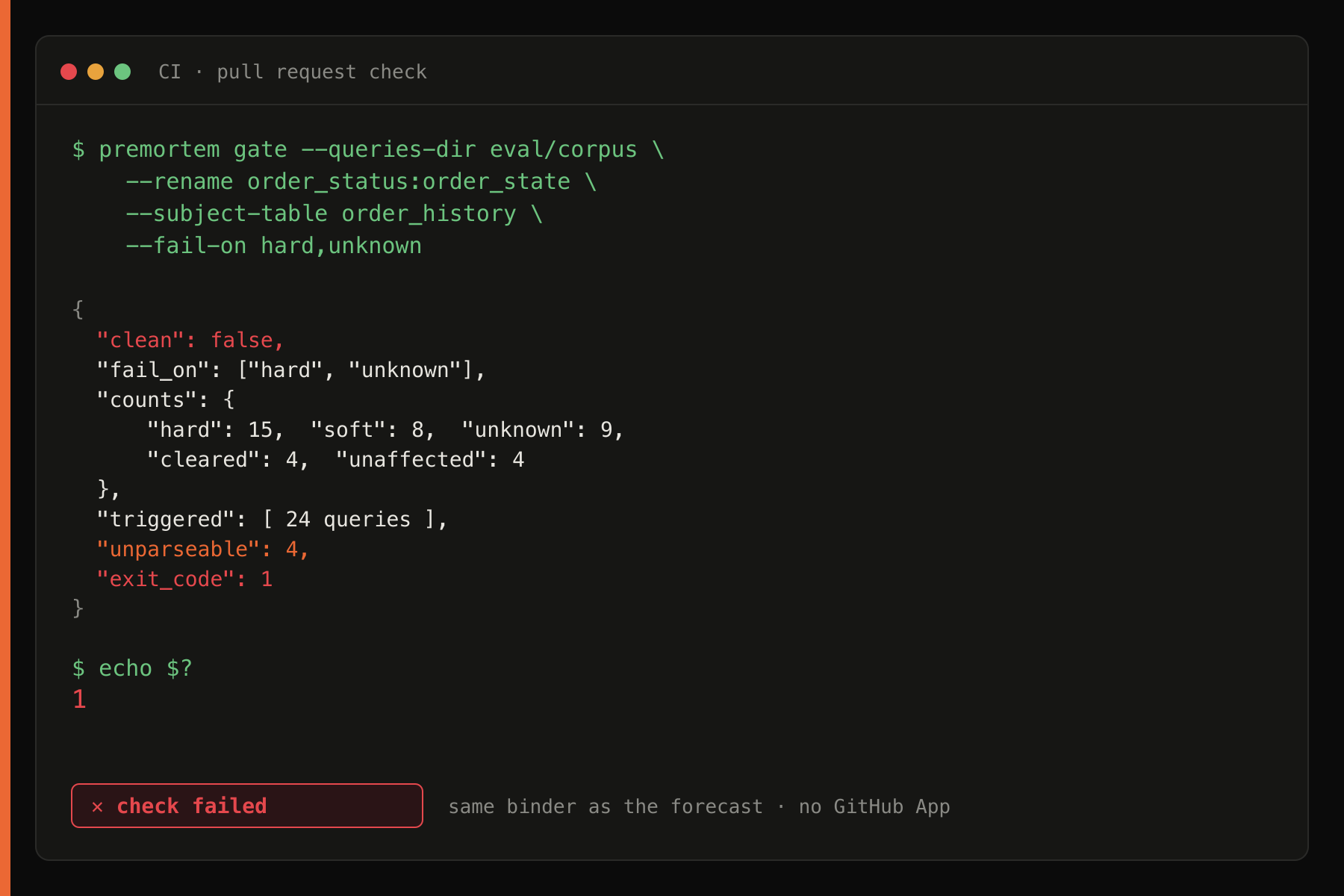
Merge gate on frozen corpus: 15 HARD + 9 UNKNOWN → exit 1, PR fails. Same binder as forecast — no GitHub App.
Inspiration
I am a data engineer about to rename a column. DataHub's Impact Analysis already lists what is connected. What it cannot tell me is which consumer queries actually break, or how badly — filter vs display-only vs false alarm. So I guess, ship, or stall. When the guess is wrong, it is rarely me who finds out first: a dashboard or a metric the business trusts breaks, and that Slack thread is the incident — for a change that was sitting in a PR while the answer was knowable.
Schema changes are human-initiated. I wanted the rehearsal before merge: replay what people actually run, score blast radius, write it back so the next person inherits it.
For judges — fastest paths in
| Path | Link | Time |
|---|---|---|
| Watch the demo | Demo video ↗ | ~3 min |
| Project page | Project page ↗ | 60 s |
| Try it locally (CLI) | README → Try it locally — premortem + premortem gate on the bundled corpus |
~2 min |
| Measure the frozen eval | pip install -e ".[dev]" → python eval/run_eval.py → eval/RESULTS.md |
~1 min |
| Wire the MCP (Claude / Cursor) | MCP setup guide ↗ | ~5 min + local DataHub |
| Live rehearsal report | HTML report ↗ | 30 s |
TL;DR: Bind query history → HARD / SOFT / UNKNOWN / CLEARED → repair → CI gate → Quality write-back. Three doors, one binder: CLI · MCP · eval. Frozen numbers 0.97 / 1.00 / 0.00. Dual-MCP compose with DataHub — not a UI fork.
Why it matters
Without Premortem, Impact Analysis answers “what is connected?” and I still guess on merge. With it, I get a merge decision (ship / patch first / hold for UNKNOWN), a CI gate so HARD and unread SQL cannot silent-pass, and a catalog memory on the Quality tab so the next engineer inherits the forecast instead of learning from a broken dashboard. Measured, not hand-waved: decoy false alarms 0.50 → 0.00 with binding; HARD precision 1.00 vs 0.40 if every dependent “breaks”; 22/22 eligible repair patches on the frozen corpus. Usability for a platform team: offline eval in under a minute, drop-in premortem gate, and one agent session that composes with DataHub — not a UI fork to adopt.
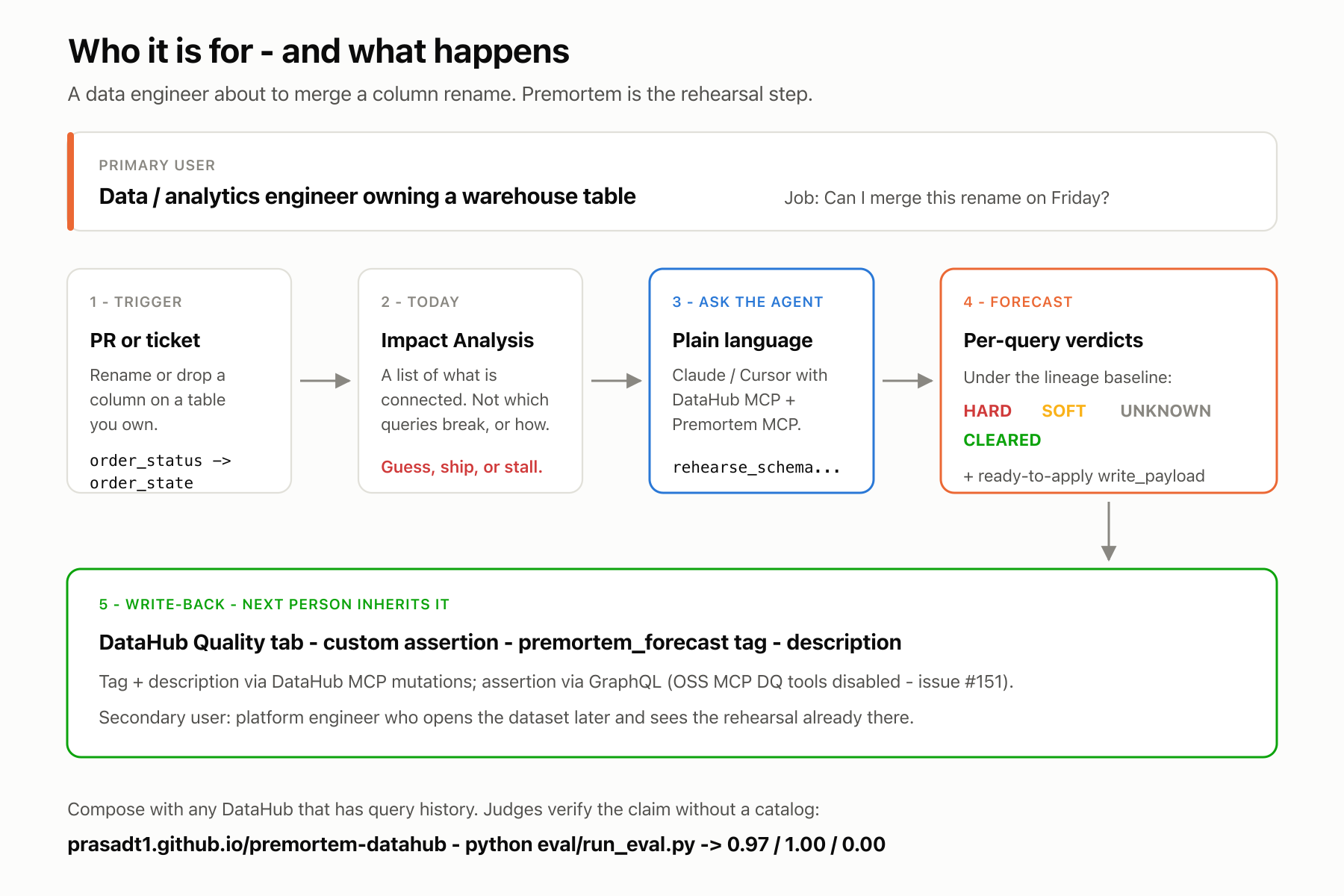
Primary user: the engineer owning the table. Secondary: the platform engineer who later opens the dataset and inherits the forecast. Integration model: compose with DataHub via MCP — not a UI fork.
What it does
Premortem takes a proposed column rename or drop, reads SQL from DataHub query history, binds each column reference to a real table, and issues a per-query verdict under the Impact Analysis baseline.
Interactive product walkthrough ↗ — seven beats on the project page: Impact Analysis → rehearse → bind → refuse → repair → gate → notify + write-back.
| Verdict | Meaning |
|---|---|
| HARD | Column in WHERE / JOIN / GROUP BY / ORDER BY / HAVING / window — careless repair can change results |
| SOFT | SELECT-list only — mechanical rename |
| UNKNOWN | Unparseable or still ambiguous after binding — needs a human; I do not guess |
| CLEARED | Named subset of UNAFFECTED: same column name, but it binds to a known different table — false alarm, listed |
The differentiator is binding, not name matching. Two tables can both have order_status; a name grep flags the wrong one. Binding clears the false alarm when the qualifier resolves to a known non-subject table — and refuses (UNKNOWN, no patch) when an alias is shadowed or a qualifier cannot be resolved confidently.
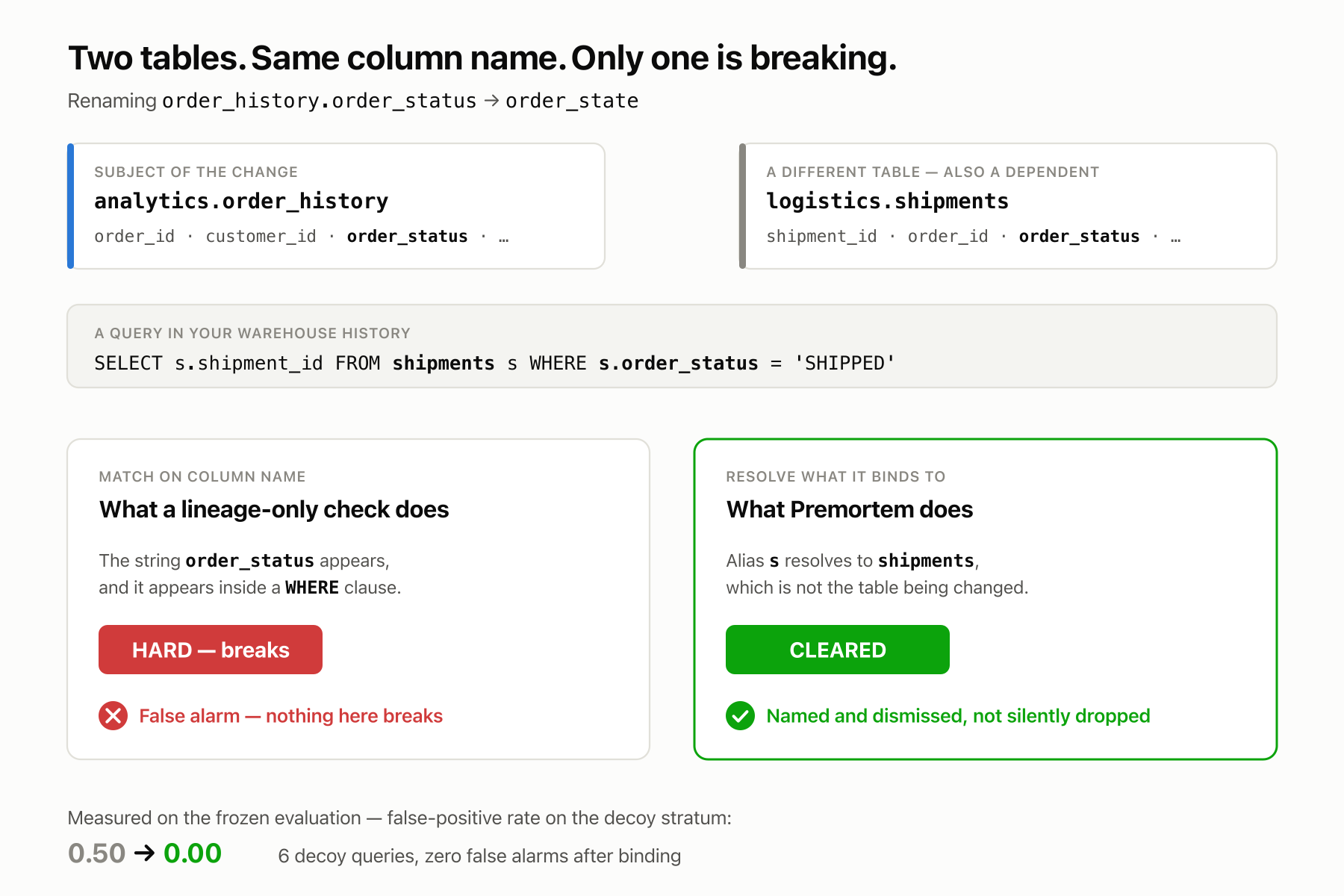
Binding took decoy false positives from 0.50 to 0.00 on the frozen eval. (Verdict taxonomy and dual-MCP flow are in the gallery — not repeated here.)
Rehearse → repair → gate → notify
The forecast is not the end of the workflow:
- Rehearse — binder scores each query (HARD / SOFT / UNKNOWN / CLEARED) against DataHub context.
- Repair — for subject-bound HARD/SOFT hits, emit a SQL patch (
order_status→order_state). CLEARED, UNKNOWN,SELECT *, and ambiguous binding are refused — I do not invent fixes. Round-trip on the frozen corpus: 22/22 eligible patches. Samples:examples/patches/. - Gate —
premortem gatefails CI when findings meet--fail-on. Drop-in workflow:examples/ci/premortem-gate.yml. - Notify — surface who to warn (dataset owners from the catalog) alongside the forecast.
- Share — same run can emit
--html-outfor reviewers who will not open the Quality tab (markdown + JSON still available).
The gate is the part with teeth. A forecast is advisory — someone still has to read it. premortem gate runs the same binder inside CI and exits non-zero when the change would ship a HARD break, so the rehearsal becomes policy instead of a document: no GitHub App, no service to run, no catalog required — a workflow file, a directory of SQL, and an exit code. The default is deliberately strict. --fail-on hard,unknown means SQL the binder could not read blocks the merge rather than passing quietly, and asking for --fail-on hard alone exits 2 — “refusing silent green” — instead of letting unparseable input through. That is the same refuse-instead-of-guess rule as the classifier, enforced at the one point where it costs something.
In one Claude Code session I register DataHub's MCP server and Premortem's. Plain language: rehearse renaming order_status on ORDER_HISTORY. Live reads use the DataHub Agent Context Kit (schema, lineage, query history). Premortem returns the forecast plus a write_payload. The host applies that payload as-is: tag + description via DataHub's MCP mutation tools; the custom assertion via GraphQL — OSS MCP Data Quality tools are DISABLED (the gap I filed as #151). The forecast lands as platform="premortem" on the Quality tab so the next person inherits it.
The numbers
I committed forty hand-labeled queries and gold labels before the classifier could pass them (5709e88). The binder was developed against tests/ fixtures; the frozen forty were never tuning targets. Three independent blind LLM labeling runs (given only the corpus, schema fixture, and taxonomy — not the rest of the repo) agreed with the authored labels 40/40.
| run | accuracy | HARD prec | HARD rec | decoy FP |
|---|---|---|---|---|
| Premortem (binder) | 0.97 | 1.00 | 0.94 | 0.00 |
| every-dependent-breaks | 0.40 | 0.40 | 1.00 | 1.00 |
| substring grep | 0.45 | 0.44 | 1.00 | 0.83 |
Accuracy 0.97 = 39/40 (truncated). HARD precision n=15; decoy FP n=6. Chart vs baselines is in the gallery.
Two unflattering results, published on purpose. A heuristic adjudicator bound 3 of 9 UNKNOWNs with bind accuracy 0.00 — shipped disabled. An LLM on the same residue correctly declined all three (gold is UNKNOWN); no lift, so live stays binder-only. Named miss: q39 (hard→soft). Cache committed so B2 reproduces with no API key.
pip install -e ".[dev]"
pytest -q
python eval/run_eval.py    # 0.97 / 1.00 / 0.00 — offline; no live catalog required
Foreign SQL (no labels): 118 queries from mozilla/bigquery-etl — parse rate 84.75%, 86% UNKNOWN under missing schemas (narrowable refs would bind with schemas present; the 11% CLEARED are qualified refs to known non-subject tables). Report ↗
Reproduce it
Judges do not need a hosted demo. Clone the public repo and run the product locally — Python 3.11+, no DataHub required for the CLI path:
git clone https://github.com/prasadt1/premortem-datahub.git
cd premortem-datahub
python3.11 -m venv .venv && source .venv/bin/activate
pip install -e ".[dev]"

# Same binder as the video — CLI rehearsal
premortem --queries-dir eval/corpus --rename order_status:order_state \
  --subject-table order_history --tables-json eval/schema.json

# Merge gate — expect exit 1 (HARD / UNKNOWN would ship)
premortem gate --queries-dir eval/corpus --rename order_status:order_state \
  --subject-table order_history --tables-json eval/schema.json --fail-on hard,unknown
echo "exit=$?"
Full README section: Try it locally (CLI).
Optional — measure the frozen eval (published numbers, not required to try the tool):
pytest -qpython eval/run_eval.py— expect 0.97 / 1.00 / 0.00 →eval/RESULTS.md
MCP door (Claude Code, Cursor, or any MCP host): needs a local DataHub with query history. Config + prompt: examples/MCP_COMPOSITION.md.
pip install -e ".[datahub,mcp]"
# optional demo seed: python tools/seed_demo_environment.py
Register Premortem + DataHub MCP, then ask: Rehearse renaming order_status to order_state on ORDER_HISTORY.
Live CLI against your catalog: premortem --live --rename order_status:order_state --html-out rehearsal.html (subject needs query history — #18676).
Premortem is a library + MCP server that composes with DataHub — not a hosted portal. Three doors, one binder: CLI · MCP · eval. Video shows MCP; the commands above are CLI; run_eval.py is the measured freeze.
How I built it
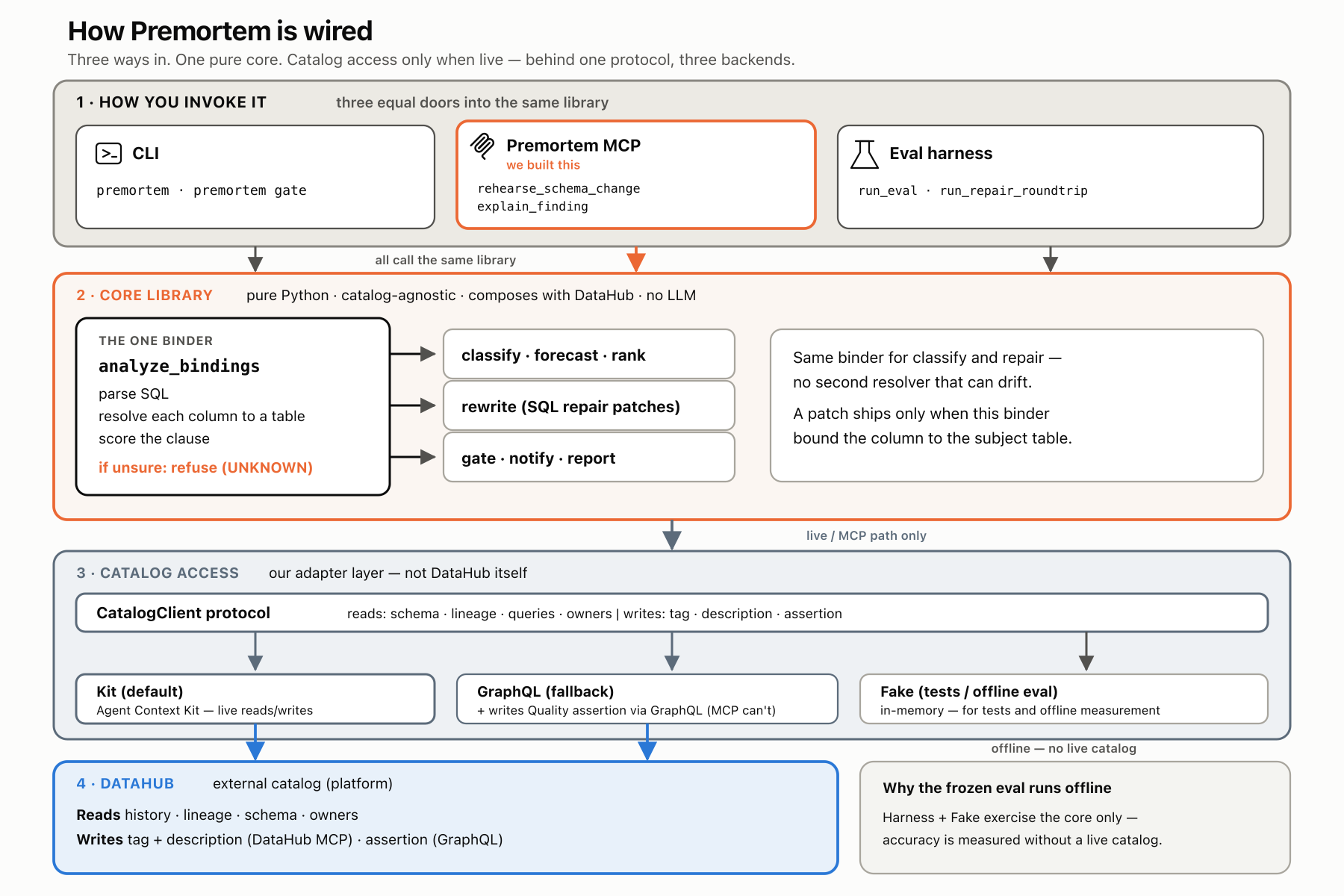
One binder, three doors in, DataHub via CatalogClient — the catalog-agnostic core is why the frozen eval runs offline.
Beyond what the diagram shows:
- Binding, not name matching — resolve unqualified columns against every in-scope table schema; ≥2 candidates → UNKNOWN; CLEARED only when the qualifier resolves to a known non-subject table.
- Refuse instead of guess — alias shadowing, unresolvable derived-table qualifiers, and unparseable input become UNKNOWN / gate-fail; never a confident-wrong CLEARED or a corrupting patch.
- Repair on a shared seam — the same binder decisions drive patches; round-trip kill criterion 100% on eligible corpus queries.
- Merge gate — offline or live CI exit codes (0 clean / 1 blocked / 2 misconfigured); default fail-on includes UNKNOWN so unread SQL cannot green-light, and the tool refuses a
--fail-onthat would let unparseable SQL through. - Write-back as a DataHub object — tag + description via DataHub MCP; assertion via GraphQL (OSS MCP DQ disabled — #151); Quality tab category with zero UI code.
Challenges I ran into
- Tautological adjudicator looked smart, scored 0.00 — frozen eval caught it.
- Live path once ran without sibling schemas while eval had them — green tests, wrong demo.
- Lineage self-edge nearly became a fake “1 downstream” baseline on camera.
- Adversarial review after the freeze found alias-scope binder bugs that would have shipped a confidently-wrong “safe to merge” — Tier-1 fix: refuse those shapes; disclosed as corpus blind spots in
eval/RESULTS.md. - OSS gaps filed upstream: #18674 column-level assertion run events, #151 DQ tools off on MCP, #18675 Document search, #18676
listQueriesindexing lag.
Accomplishments that I'm proud of
- Benchmark pinned before it could be passed — the frozen forty were never tuning targets
- Turns Impact Analysis from a dependency list into a merge decision + catalog memory the next person inherits
- The forecast is enforceable, not advisory —
premortem gateblocks the PR on the same binder, and refuses to be configured into a silent pass - Zero decoy false alarms on the frozen eval (decoy FP 0.00)
- Two negative agent results published instead of deleted (heuristic adjudicator 0.00 bind accuracy; LLM correctly declined all three UNKNOWNs with no lift)
- Repair round-trip 22/22 on eligible patches; unconfident shapes refused rather than guessed
- Four upstream DataHub / MCP issues filed from real gaps hit while building
What I learned
- Classification without binding is just name matching
- An agent that always says yes is not an agent
- Verify the demo path separately from the test path — green tests once hid a wrong live demo
- When the binder is unconfident, refuse — publishing the blind spot is worth more than hiding it behind 0.97
What's next for Premortem
- Per-scope binding via sqlglot's scope resolver (today those shapes are refused, not guessed)
- Event-driven rehearsal through DataHub Actions
- ML-consumer entities and type-change blast radii
- LLM-on-residue stays measured (B2) and non-default until it lifts the frozen eval
- Shareable HTML report — shipped as
--html-out; PR-check summary from gate JSON is a follow-on
Links
| Evidence | Link |
|---|---|
| Demo video | Demo video ↗ |
| Project page | Project page ↗ |
| Product walkthrough | product-tour ↗ |
| Live rehearsal report | Report ↗ |
| Source | github.com/prasadt1/premortem-datahub |
| Eval results | eval/RESULTS.md |
| Repair samples | examples/patches/ |
| Merge gate (CI) | premortem-gate.yml |
| Dual-MCP setup | MCP setup guide ↗ |
| Eval explorer | eval-explorer |
| Real-world run | real-world-run |
| Freeze commit | 5709e88 |
| Upstream issues | OSS_ISSUES.md |
Honest scope. The video demo uses a constructed Quickstart (synthetic shipments, seeded queries/lineage). Accuracy numbers come only from the frozen eval — which contains no cross-scope alias shadowing, derived-table aliases, or DML; those classes are covered in tests/ and refused rather than guessed. Macros and dynamic SQL land in UNKNOWN; no query evidence ≠ safe to change. Premortem reasons about tables, not view expansion.

Log in or sign up for Devpost to join the conversation.