Inspiration
A global movie can be completely finished and still miss its premiere because one localized asset fails minutes before distribution. A subtitle package, language master, or delivery dependency can trigger a manual war room across operations, localization, engineering, and distribution teams.
PremiereOps AI was inspired by that “last-mile” release problem: how can agentic AI help a studio recover quickly without giving AI uncontrolled authority over production systems?
The core design principle became:
AI reasons. Policy authorizes. Humans stay in control.
Instead of building another chatbot, PremiereOps AI acts as an operational command center that detects release risk, understands its blast radius, recommends recovery, validates the recommendation against deterministic policy, requires human approval, and leaves a complete audit trail.
What it does
PremiereOps AI is an agentic command center for global movie release operations.
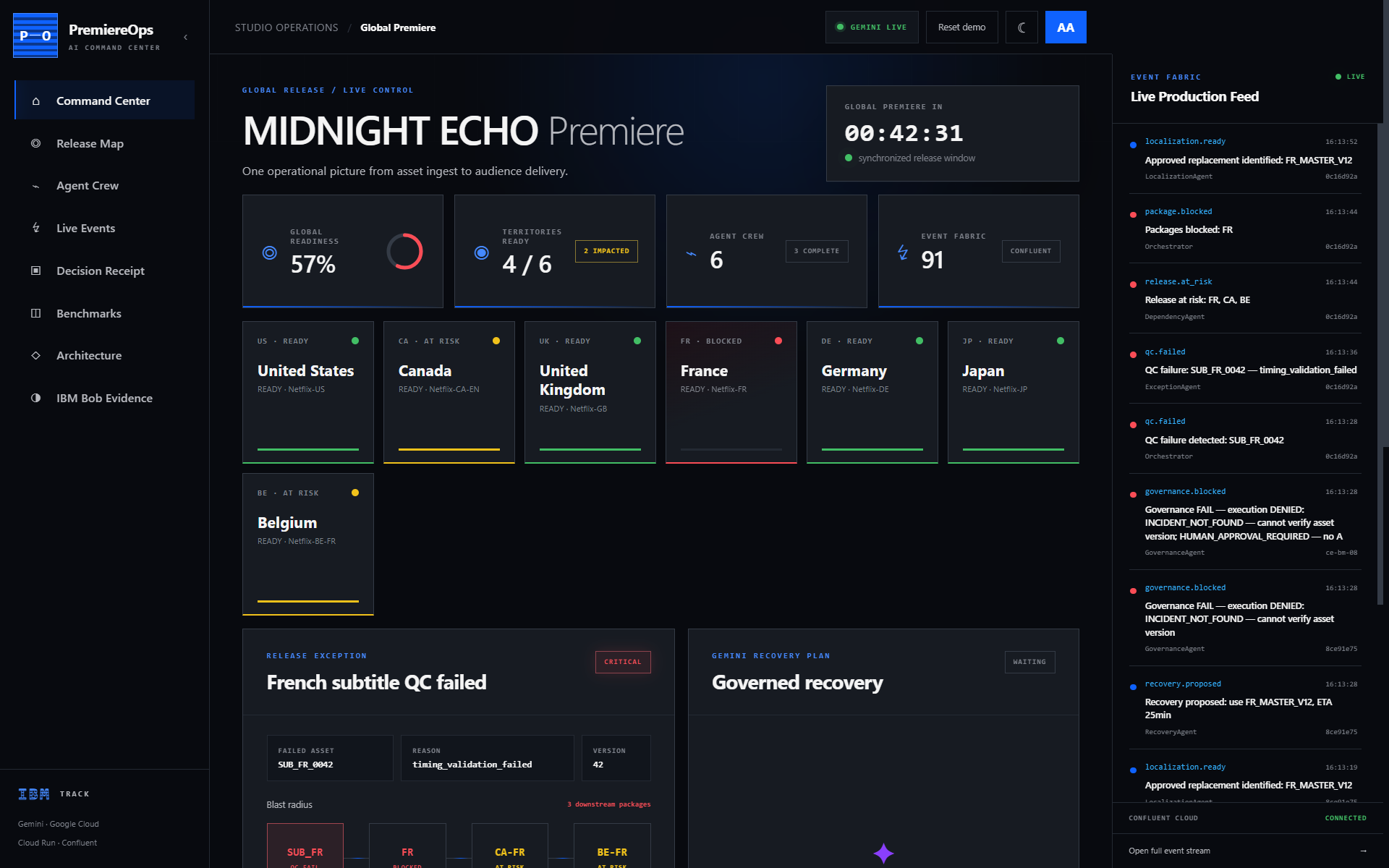
In the MIDNIGHT ECHO demonstration, a French subtitle asset fails QC shortly before a synchronized premiere. PremiereOps AI immediately:
- detects and classifies the exception,
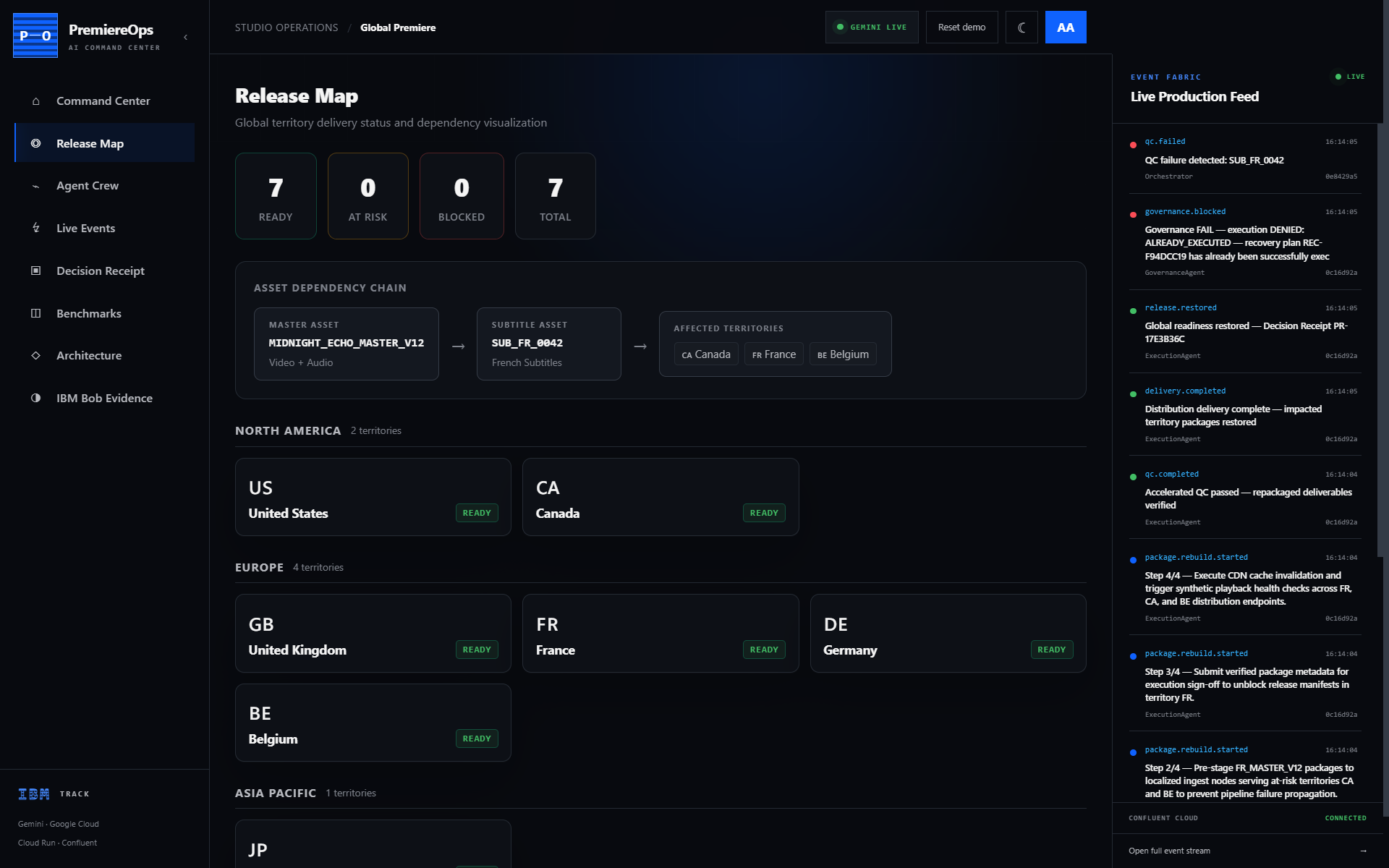
- identifies France as blocked and Canada-FR and Belgium-FR as at risk,
- coordinates specialized Exception, Dependency, Localization, Recovery, Governance, and Execution agents,
- uses Gemini 3.8 Flash through Vertex AI to reason about the safest recovery,
- identifies the approved
FR_MASTER_V12replacement, - validates the recovery through deterministic governance,
- requires producer approval before execution,
- rebuilds and revalidates affected packages,
- and generates a traceable Decision Receipt.
A stale-plan protection mechanism also prevents an AI recommendation from executing if the underlying asset state changes after the recommendation was created.
How we built it
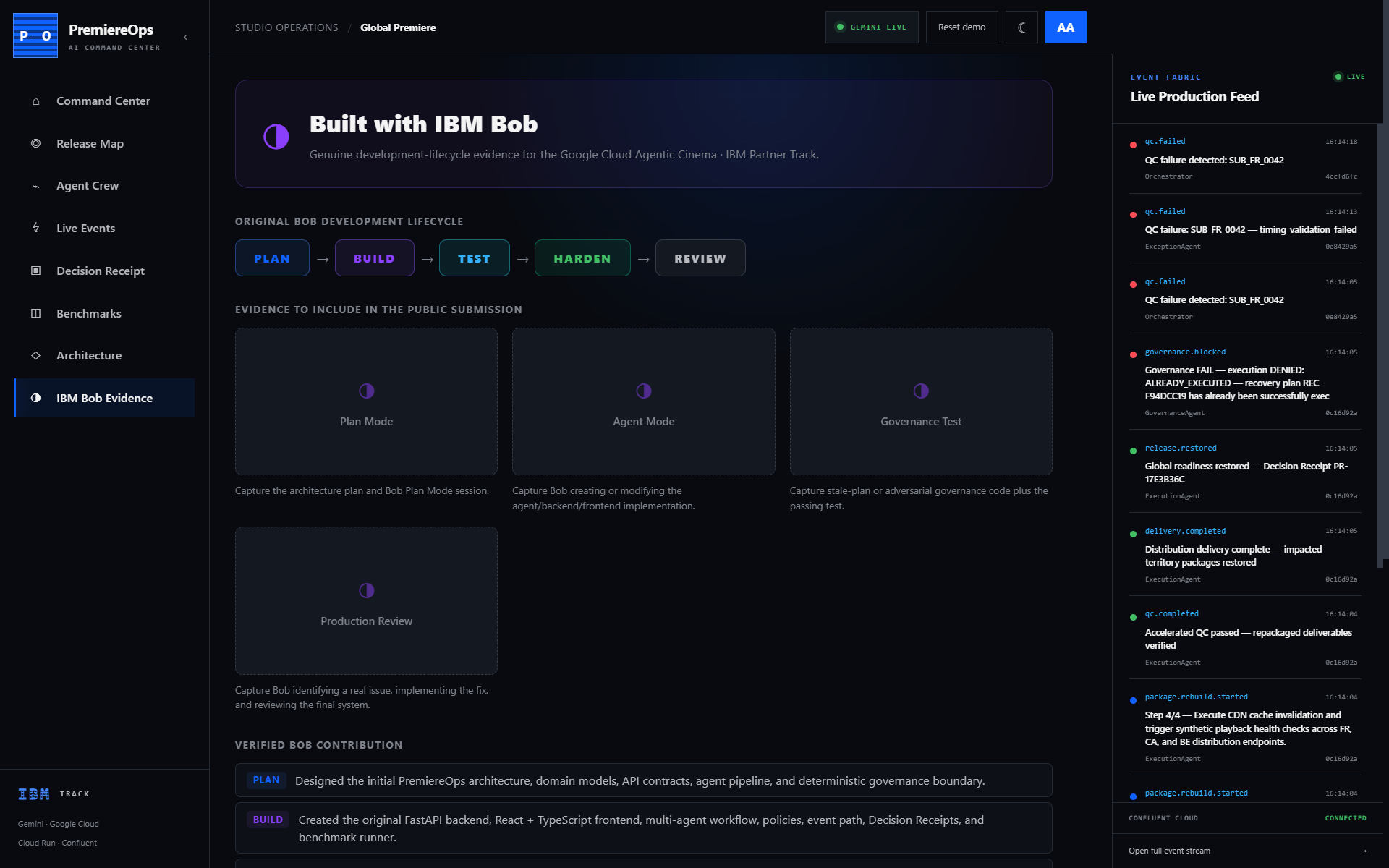
PremiereOps AI was developed with IBM Bob, using Plan Mode and Agent Mode to move from architecture through implementation, testing, governance hardening, and production deployment.
The production application uses:
- Google Cloud Run for the hosted runtime,
- Vertex AI + Gemini 3.8 Flash for live agent reasoning,
- FastAPI for the backend orchestration layer,
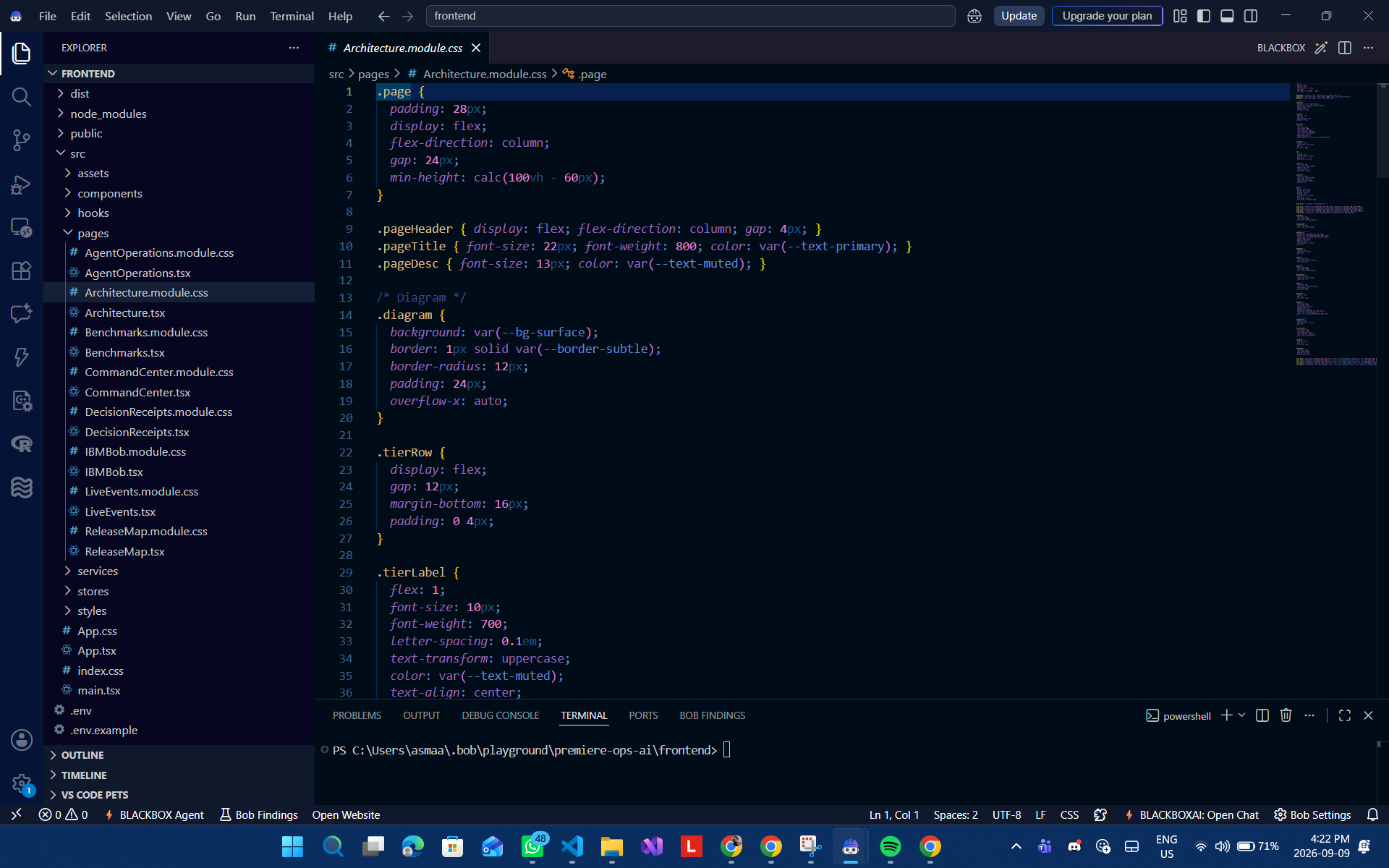
- React + TypeScript + Vite for the command-center experience,
- deterministic Python policy engines for authorization and stale-plan protection,
- event-driven workflows with a Confluent Cloud integration path and resilient local event fallback,
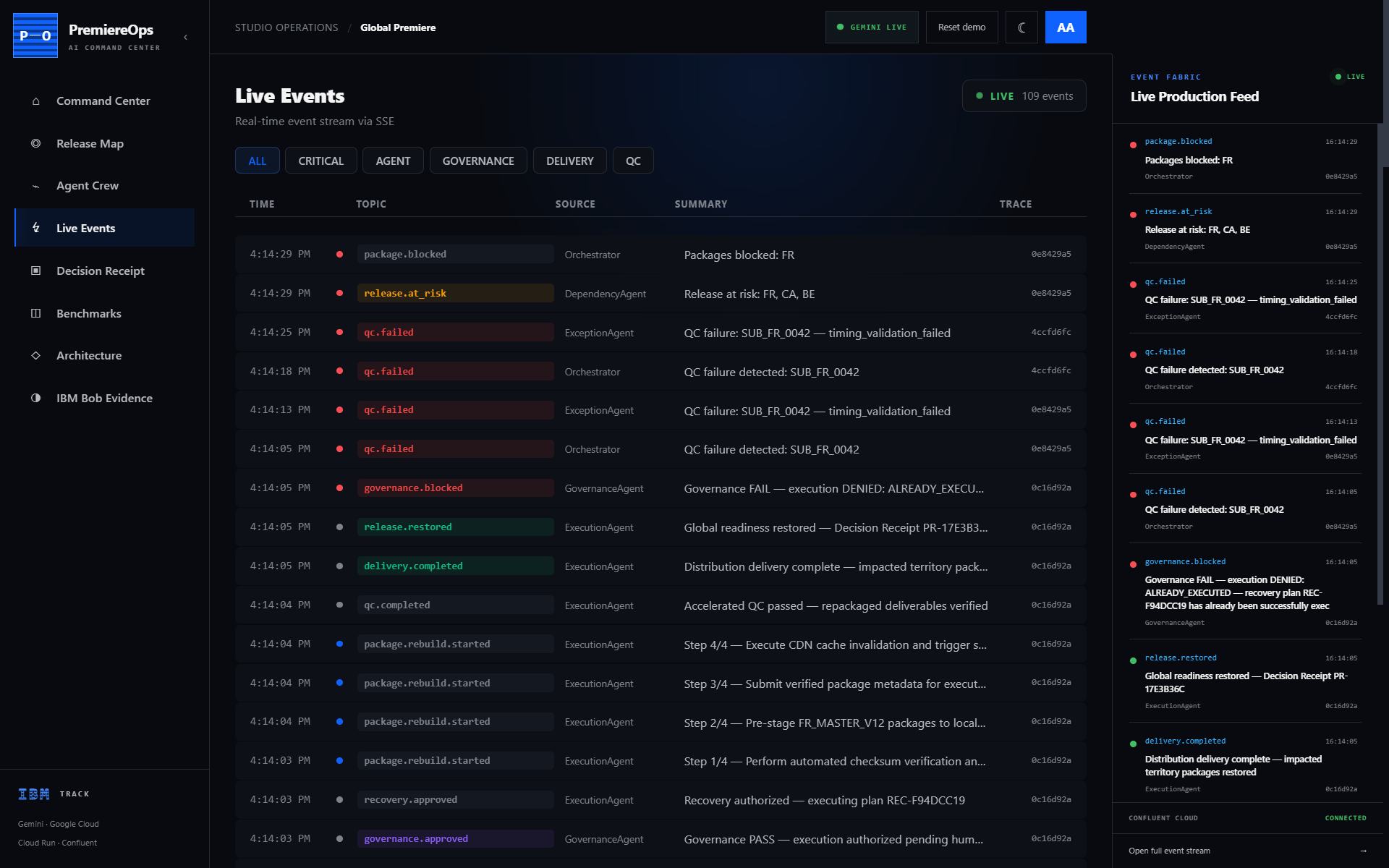
- Server-Sent Events for the live production feed,
- Docker and Cloud Build-compatible deployment infrastructure,
- and automated tests covering governance, approvals, blast radius, recovery, receipts, and adversarial stale-plan scenarios.
The deployed production health endpoint verifies both CLOUD_RUN runtime and VERTEX_AI Gemini execution.
Challenges we ran into
One of the biggest challenges was designing a system that was genuinely agentic without making AI the final authority.
Gemini is excellent at interpreting incidents, explaining dependencies, and proposing recovery strategies, but production release operations require deterministic controls. We therefore separated reasoning from authorization: Gemini proposes; policy validates; a human approves; only then can execution proceed.
We also worked through real production-integration challenges, including Gemini API demand and quota limits, Vertex AI regional model availability, Cloud Run deployment and IAM configuration, and event-broker authentication.
These challenges ultimately improved the architecture. PremiereOps now includes model retry/fallback handling, deterministic demo resilience, stale-plan protection, runtime health verification, and explicit fail-closed governance.
Accomplishments that we're proud of
We are especially proud that PremiereOps AI became more than a polished front-end prototype.
The final system is a functioning end-to-end agentic workflow running on Google Cloud Run, with successful live calls to Gemini 3.8 Flash through Vertex AI.
Other highlights include:
- a coordinated multi-agent operational workflow,
- deterministic governance layered around generative reasoning,
- human-in-the-loop production approval,
- TOCTOU/stale-plan protection,
- a live event-driven command center,
- traceable Decision Receipts,
- a synthetic benchmark suite covering multiple release scenarios,
- automated governance and workflow tests,
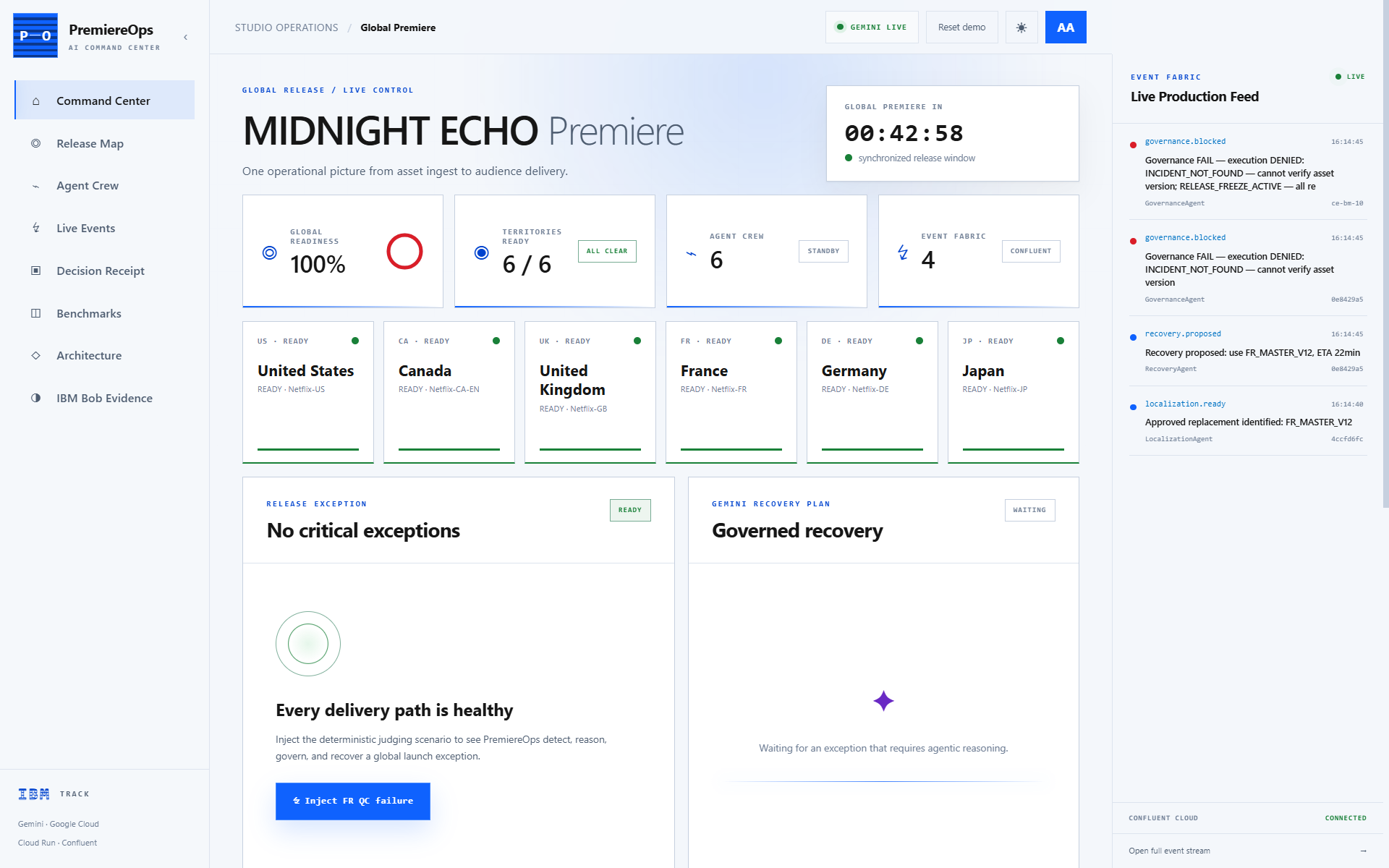
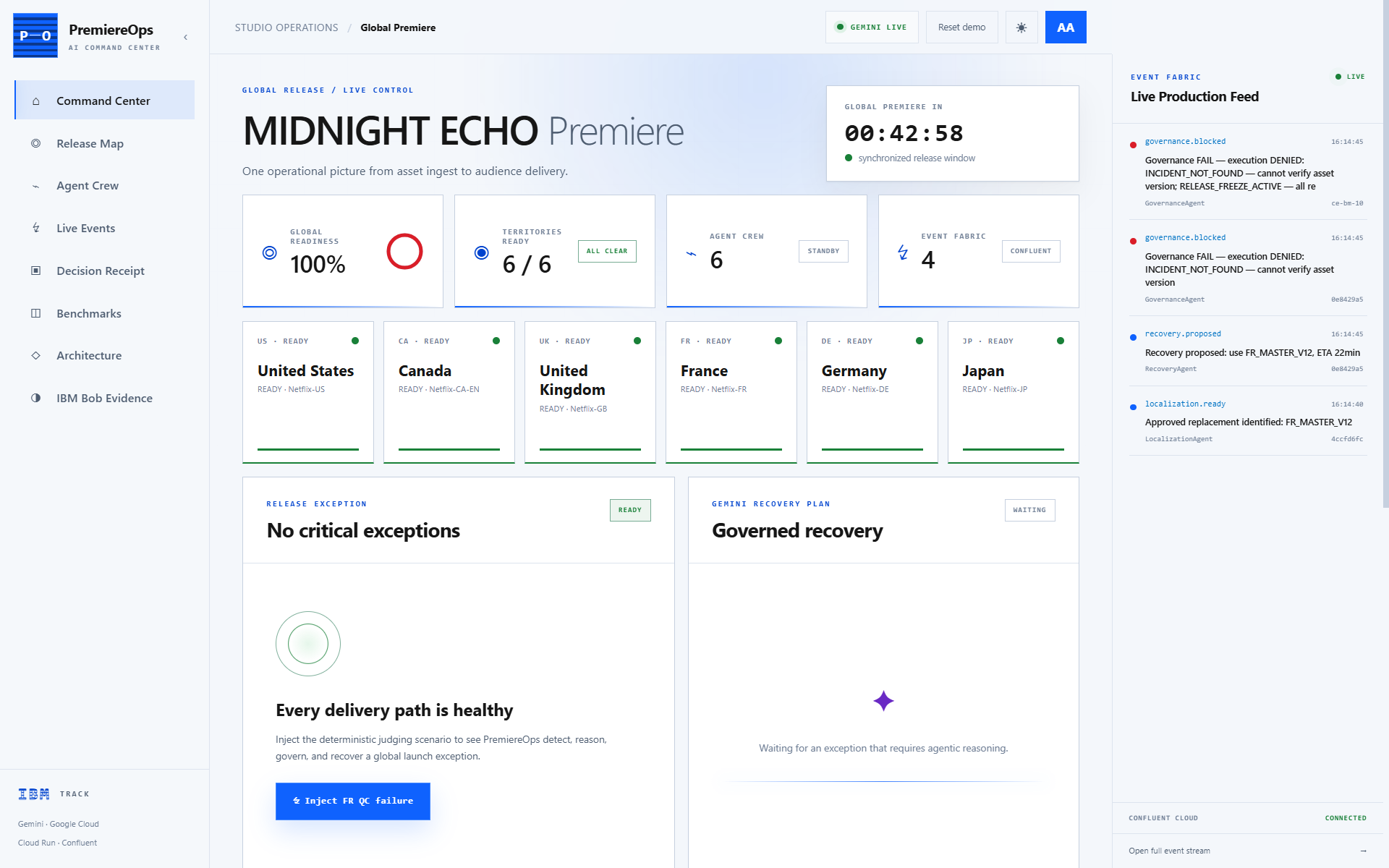
- dark/light production UI,
- and documented IBM Bob development evidence.
The system demonstrates how agentic AI can be useful in a high-stakes enterprise workflow without sacrificing control, traceability, or accountability.
What we learned
The biggest lesson was that production agentic systems need more than strong model reasoning.
The most effective architecture came from assigning different responsibilities to different layers:
Gemini handles ambiguity and reasoning. Deterministic code handles policy and authorization. Humans retain accountability for consequential actions.
We also learned how important observable state is in multi-agent systems. Operators need to understand not only what an agent recommends, but also why it recommended it, what dependencies are affected, what policy allowed or rejected the action, who approved it, and whether execution actually succeeded.
IBM Bob also reinforced the value of using AI throughout the engineering lifecycle—not only for code generation, but for architecture planning, testing, adversarial thinking, security hardening, and production readiness.
What's next for PremiereOps AI
The next step is to evolve PremiereOps AI from a single-release demonstration into a broader studio release operations platform.
Future work includes deeper Confluent event-stream integration, persistent release state with managed cloud storage, real media asset-management and QC integrations, richer IAM and role-based approvals, automated rollback workflows, multi-region release orchestration, and historical operational analytics.
We also want to expand the agent crew to handle rights windows, delivery-provider outages, localization compliance, trailer and artwork dependencies, and streaming-platform launch readiness.
Ultimately, PremiereOps AI could become a reusable control plane for high-stakes media operations: an AI system that moves quickly when minutes matter while still preserving the governance, auditability, and human accountability required by enterprise production.
The audience never sees the incident. The premiere stays on schedule. The show must go on.
Built With
- agentic
- apachekafka
- api
- bob
- build
- confluent
- docker
- fastapi
- flash
- governance
- human-in-the-loop
- ibm
- multi-agent
- python
- react
- rest
- server-sent
- systems
- typescript
- vertex
- vite

Log in or sign up for Devpost to join the conversation.