-
-
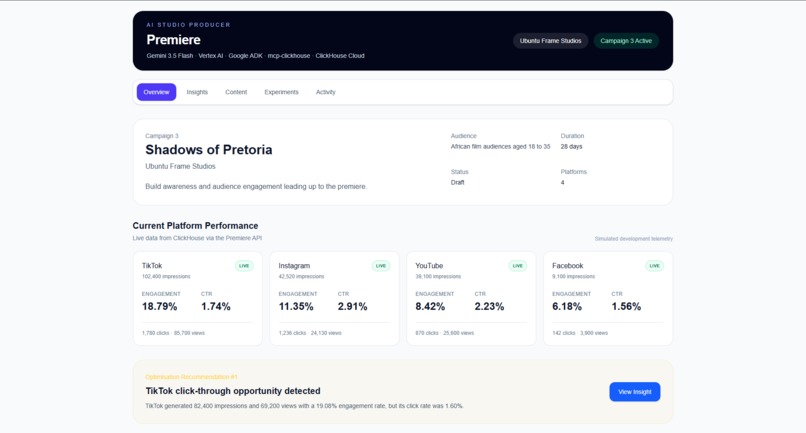
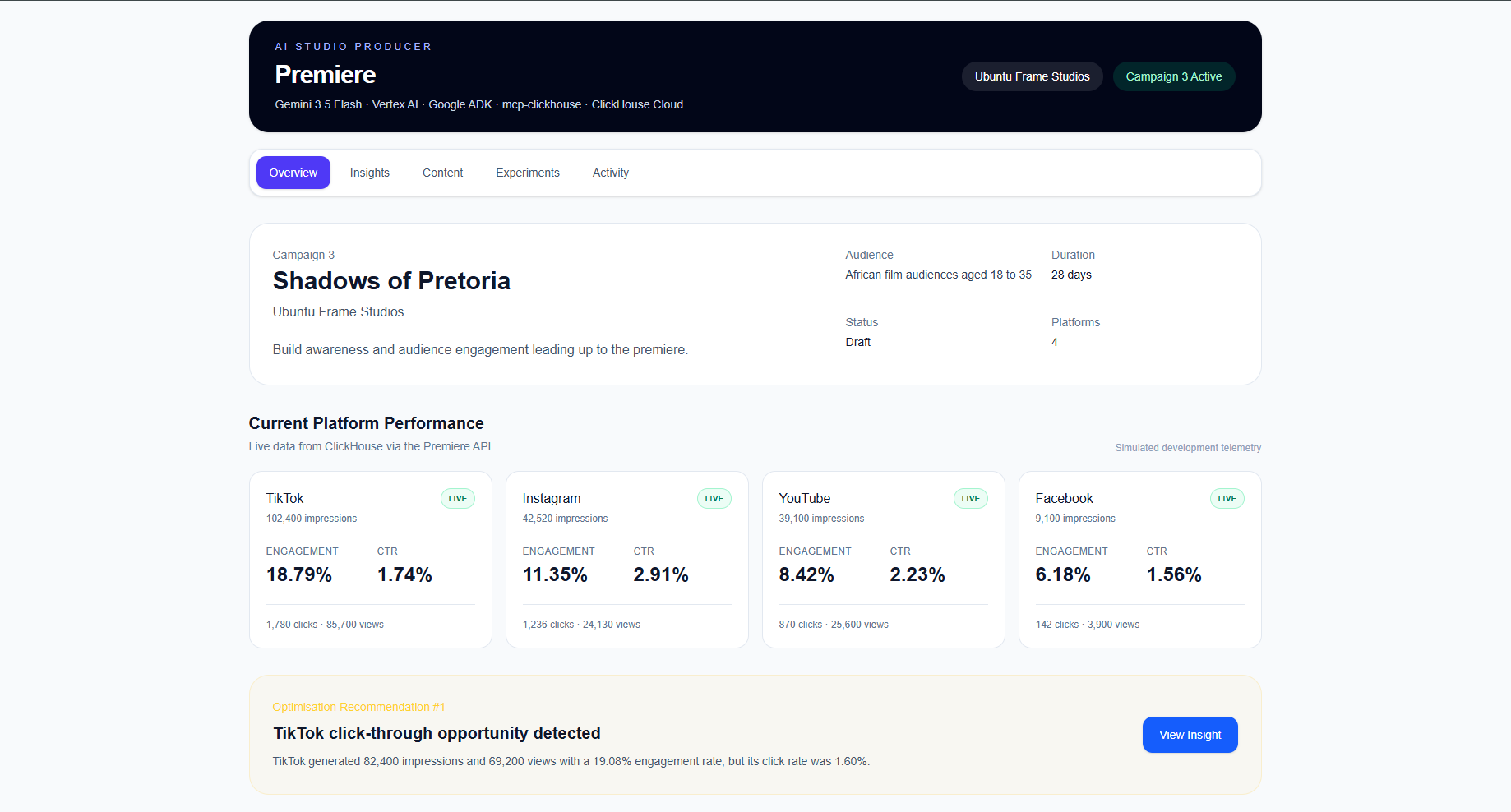
Overview Page
-
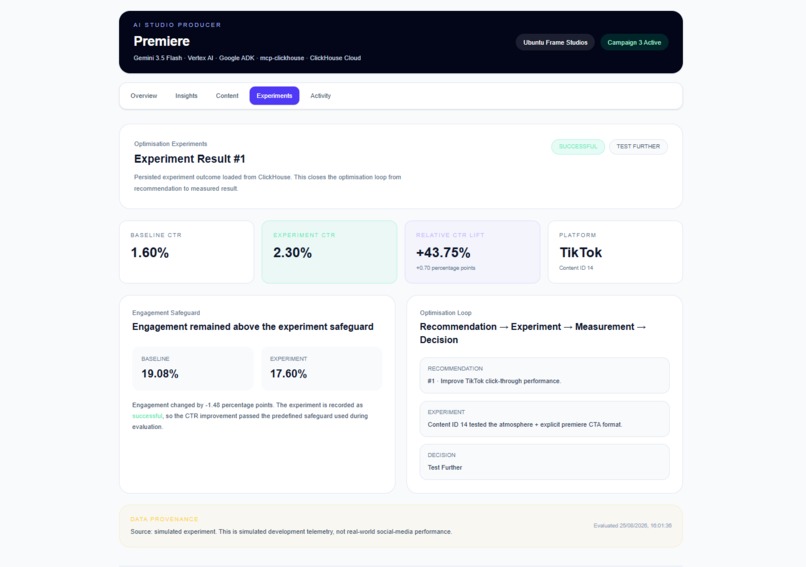
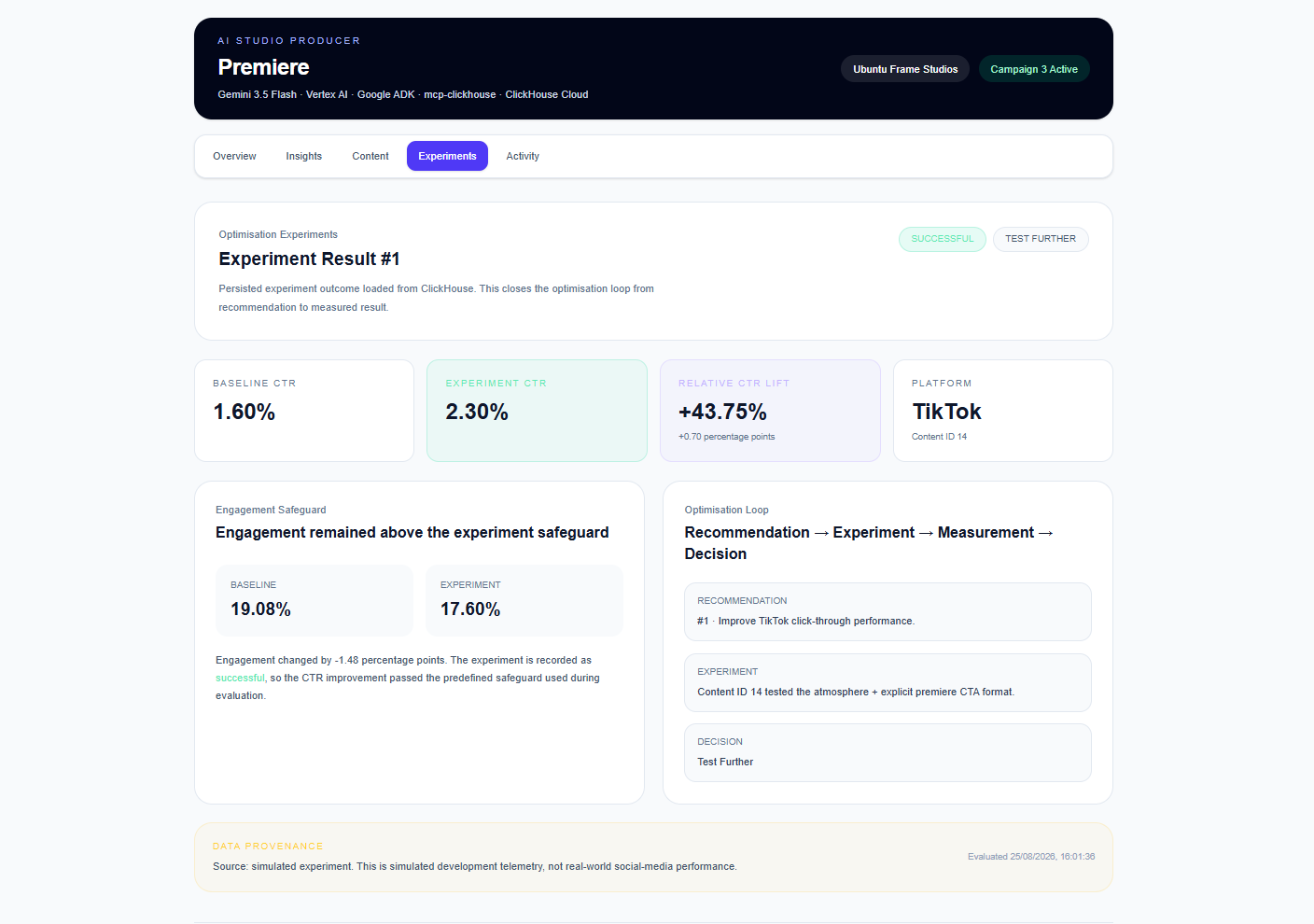
Experiments Page
-
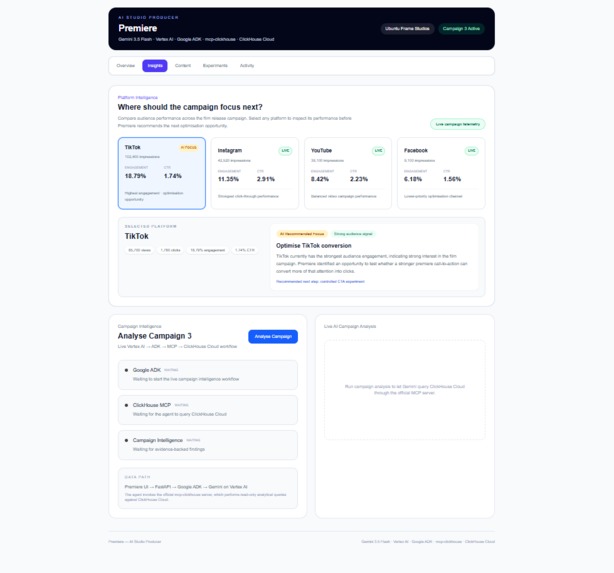
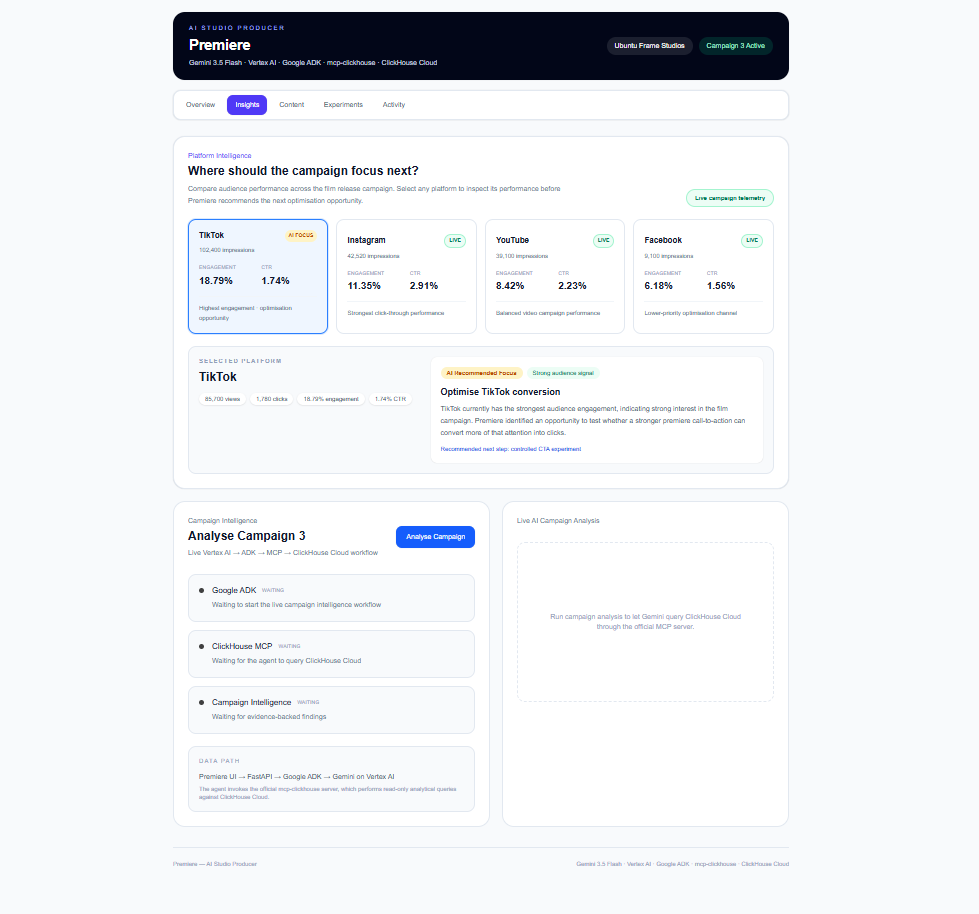
Insights Page
-
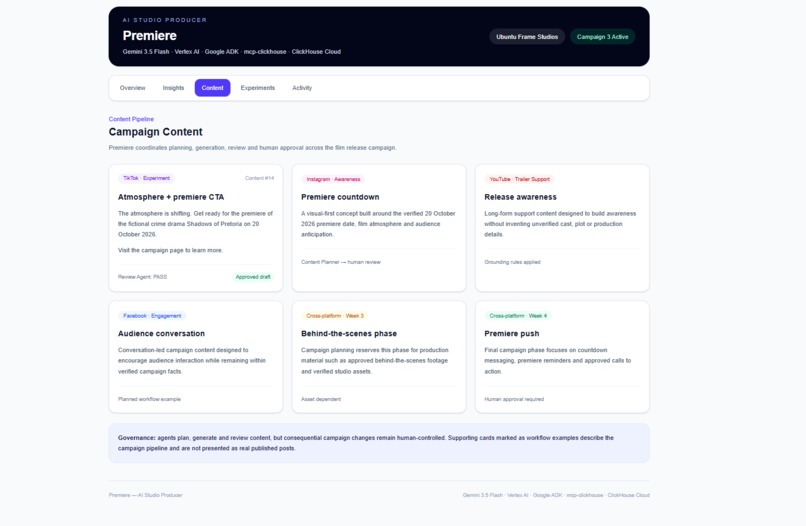
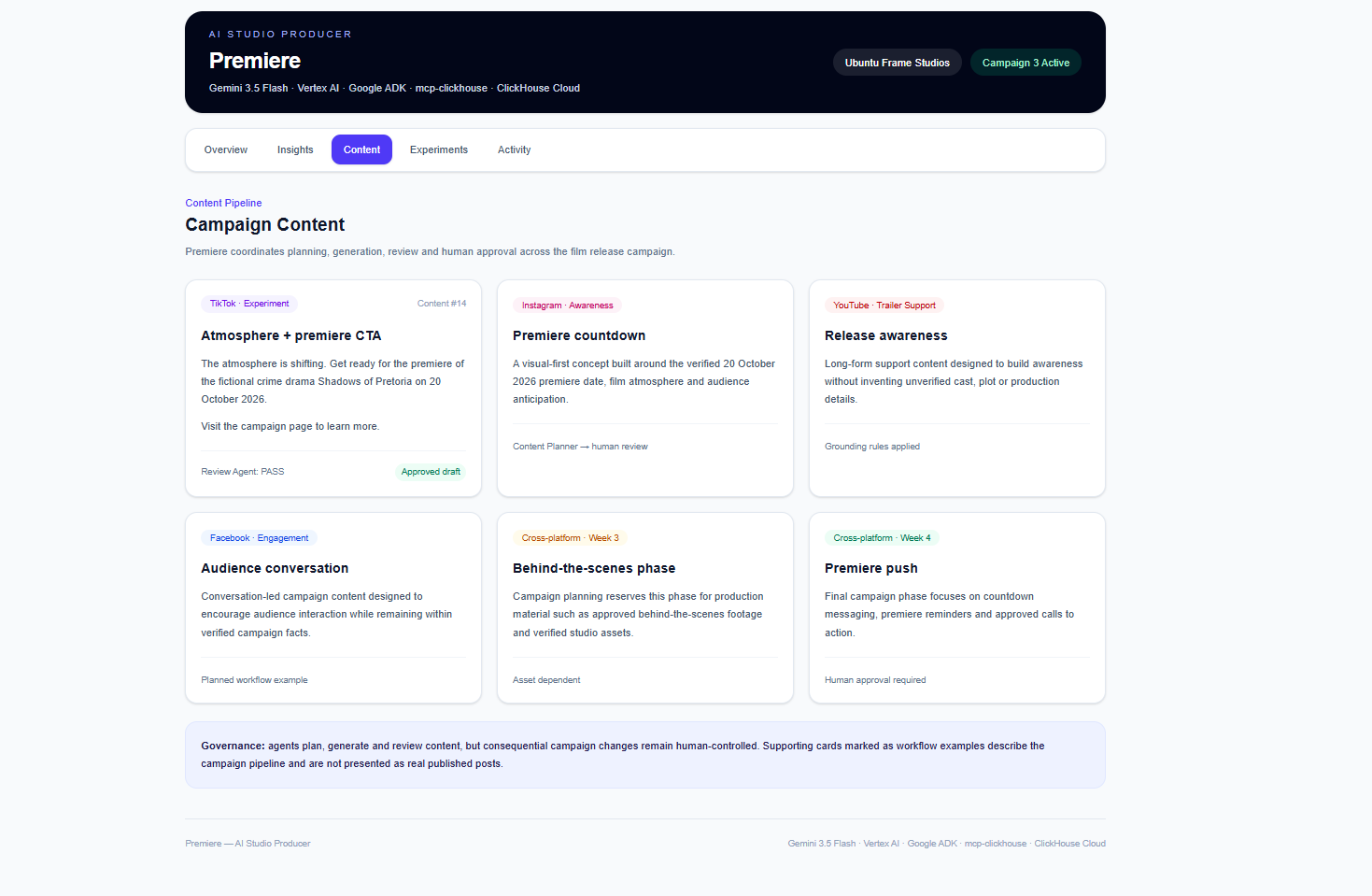
Content Page
-
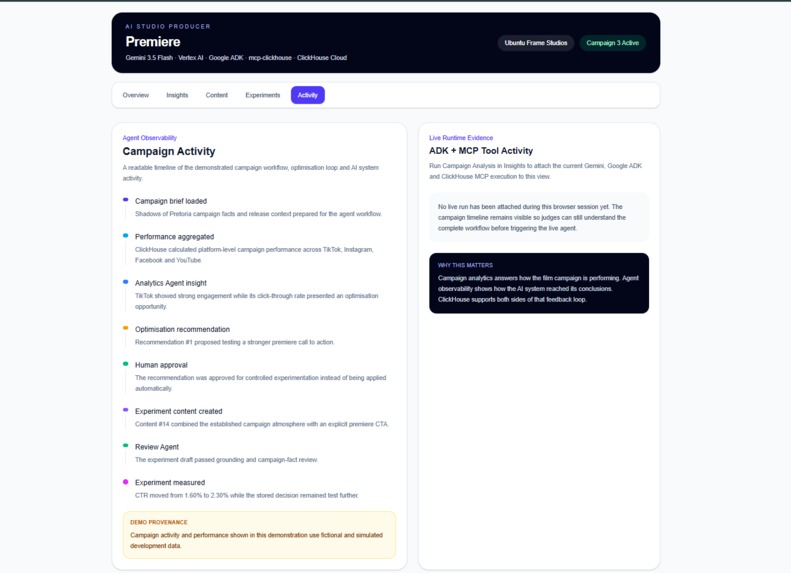
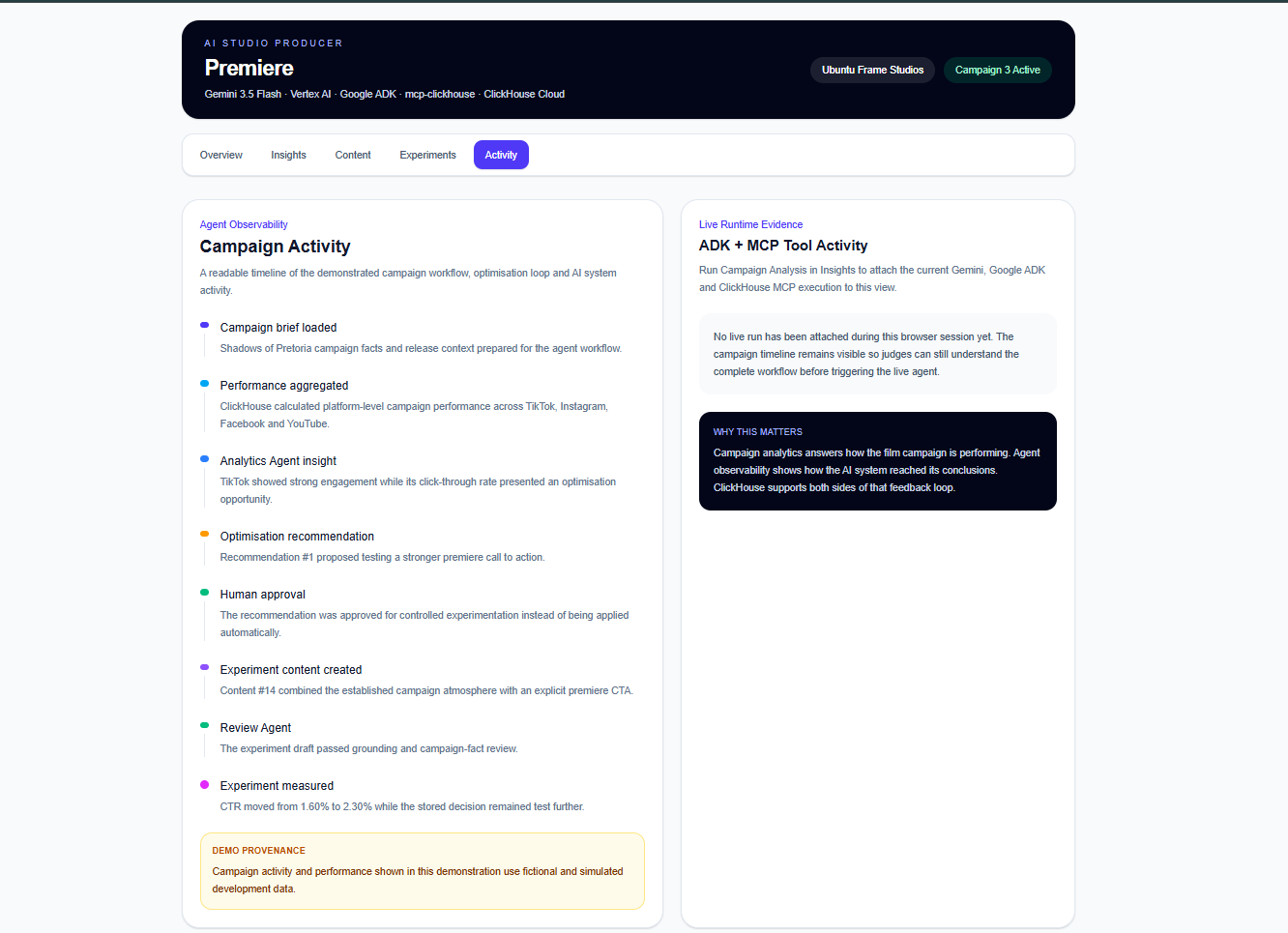
Activity Page
-
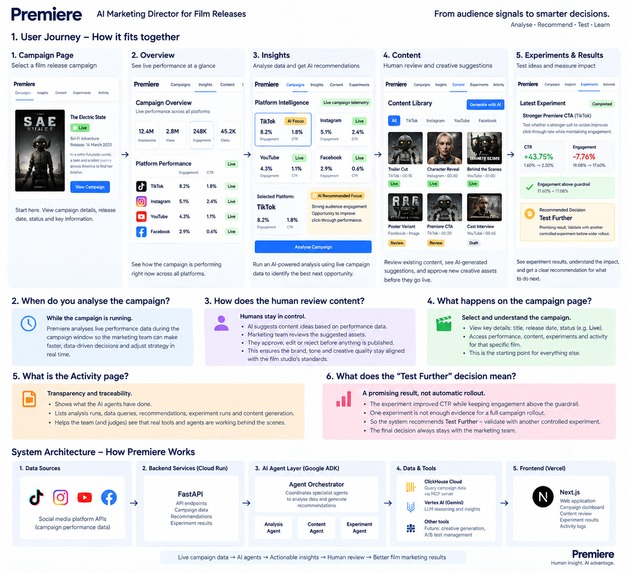
Project summary
Inspiration
A film's journey does not end when production finishes. In the weeks leading up to a premiere, filmmakers and studios need to build awareness, coordinate promotional content across multiple platforms, understand how audiences are responding, and continuously decide what to do next.
For independent filmmakers and smaller studios, this can require the capabilities of an entire marketing, analytics, and content team.
We were inspired by a simple question:
What if an AI system could act like a studio producer for the release campaign — not just generating content, but learning from audience signals and helping the team decide what to do next?
That idea became Premiere — AI Studio Producer.
Premiere explores how agentic AI can support the audience-development side of filmmaking by connecting campaign planning, content creation, performance analytics, experimentation, and human decision-making into one continuous loop.
What it does
Premiere is an agentic AI system for film-release campaigns.
Instead of simply asking an AI model to generate social-media posts, Premiere coordinates specialised agents that help a film team move through a complete campaign optimisation cycle:
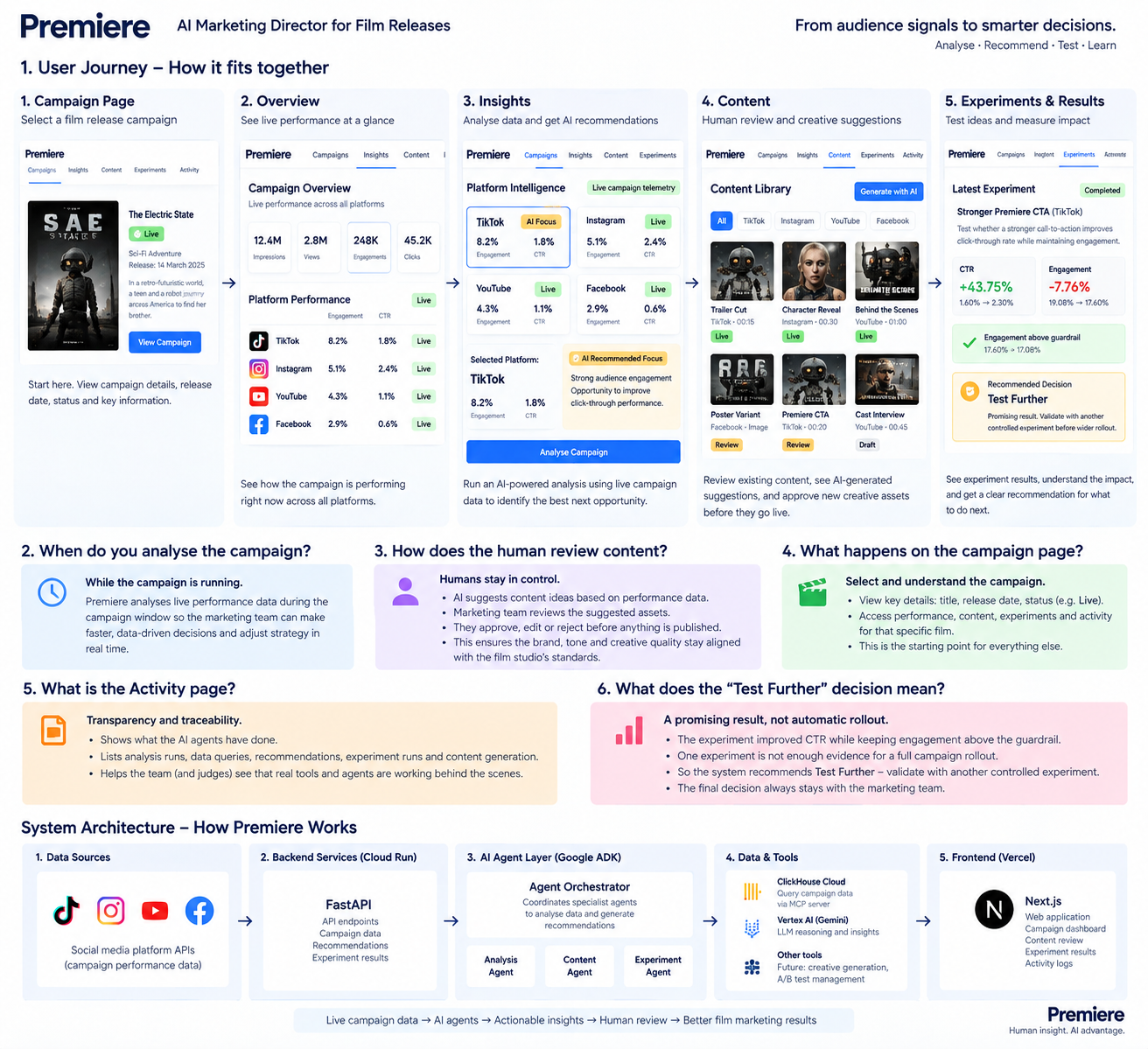
Analyse → Recommend → Approve → Create → Review → Test → Measure → Learn
A film team can monitor campaign performance across platforms such as TikTok, Instagram, YouTube, and Facebook.
Premiere compares those audience signals and helps identify where the team should focus next.
For example, in our fictional Shadows of Pretoria release campaign, the system identified TikTok as an optimisation opportunity because it showed strong audience engagement while leaving room to improve click-through performance.
The system can then recommend a measurable campaign experiment rather than simply producing another piece of content.
After human approval, campaign content can move through generation and review before being tested.
In our simulated experiment, TikTok CTR moved from 1.60% to 2.30% — a 43.75% relative increase — while engagement remained above the predefined guardrail.
Premiere deliberately did not interpret one experiment as proof that the strategy should be deployed everywhere. The stored decision was Test Further, demonstrating how agentic systems can recommend actions while keeping consequential campaign decisions under human control.
All film, campaign, and engagement performance data in the demonstration is fictional or simulated development data.
How we built it
Premiere combines Google Gemini, Google ADK, Vertex AI, ClickHouse Cloud, the official ClickHouse MCP server, FastAPI, Next.js, and Google Cloud Run.
The AI layer is built around specialised agents for campaign planning, content generation, review, analytics, and optimisation.
Google ADK provides the agent framework and orchestration, while Gemini 3.5 Flash on Vertex AI provides the reasoning capability.
ClickHouse plays a central role as Premiere's analytical memory. Campaign performance, optimisation recommendations, experiments, and agent telemetry can be stored and analysed there.
For live campaign analysis, the AI connects to ClickHouse Cloud through the official mcp-clickhouse MCP server with read-only access. This allows the agent to query campaign information using tools such as list_databases, list_tables, and run_query instead of relying on campaign statistics embedded in prompts.
Consequential application writes remain on the controlled application path rather than being exposed through the MCP connection.
The production architecture includes:
Next.js/Vercel → FastAPI/Google Cloud Run → Google ADK/Gemini on Vertex AI → official ClickHouse MCP → ClickHouse Cloud
This architecture allows the frontend to demonstrate not only campaign analytics, but also evidence of the actual agent and tool execution behind the recommendation.
Challenges we ran into
One of the biggest challenges was moving from an AI content-generation concept to a genuinely agentic closed-loop system.
Generating promotional copy with Gemini was relatively straightforward. The more difficult problem was enabling the system to analyse performance, make an evidence-backed recommendation, turn that recommendation into an experiment, measure the result, and then make a responsible next decision.
Integrating the official ClickHouse MCP server into the Google ADK workflow also required careful dependency management and configuration.
We had to ensure that the production agent was genuinely querying ClickHouse through MCP while maintaining a clear security boundary between read-only AI analytics and controlled application writes.
Deployment introduced additional challenges involving Cloud Run environment configuration, Secret Manager, Vertex AI permissions, frontend CORS configuration, and maintaining the complete AI → MCP → ClickHouse path in production.
Another challenge was designing the interface so that the technology did not overwhelm the film-industry use case. Premiere needed to explain why a platform was selected for optimisation, not simply present a TikTok experiment without context.
Accomplishments that we're proud of
We're particularly proud that Premiere became more than an AI-generated-content demonstration.
We built a working production path where Gemini, running through Google ADK, can invoke the official ClickHouse MCP server and perform live analytical queries against ClickHouse Cloud.
The production agent exposes evidence of that execution, including MCP verification and the tools used during analysis.
We also implemented a complete optimisation story:
campaign performance → AI insight → recommendation → human-controlled action → content → experiment → measurement → next decision
Our simulated experiment demonstrates this loop with a measurable result: CTR increased from 1.60% to 2.30%, while engagement remained above its predefined guardrail.
We're equally proud that Premiere does not automatically interpret a positive experiment as permission for full rollout. The Test Further decision reflects the idea that useful agentic systems should understand the limits of the evidence available to them.
What we learned
We learned that the most interesting application of AI in film marketing is not necessarily content generation.
The more powerful opportunity is connecting creative work with audience intelligence.
An AI system becomes substantially more useful when it can answer not only:
“What should we create?”
but also:
“What is our audience responding to, why might that be happening, and what should we test next?”
We also learned how valuable MCP can be for agentic systems. Instead of placing analytical results directly into an AI prompt, the model can use tools to investigate the underlying data when it needs evidence.
Finally, we learned that human oversight should be part of the architecture rather than an afterthought. AI can analyse, recommend, generate, and evaluate, while people retain control over consequential campaign decisions.
What's next for Premiere — AI Studio Producer
The current prototype demonstrates the core closed-loop architecture using a fictional film campaign and simulated performance telemetry.
The next stage is to evolve Premiere into a broader film-release intelligence platform.
Future versions could connect authorised social-platform APIs so studios can ingest real campaign performance, manage multiple films and release campaigns, and compare audience response across release windows.
We also want to expand the human-review workflow so marketing teams can approve, reject, revise, and annotate AI-generated campaign material directly inside Premiere.
The experimentation system could support multiple creative variants, audience segments, platforms, and campaign objectives while maintaining statistical and human-governance safeguards.
Over time, ClickHouse could allow Premiere to build an increasingly valuable analytical history across a studio's releases — helping teams understand which creative strategies, platforms, formats, and audience approaches have worked for different films.
The long-term vision is not to replace filmmakers, producers, or marketing teams.
It is to give them an intelligent system that can continuously help answer:
“How is our audience responding — and what should we do next?”
Premiere turns audience signals into smarter, human-controlled decisions for film releases.
Built With
- clickhouse
- clickhouse-cloud
- cloud-run
- docker
- fastapi
- google-adk
- google-cloud
- google-gemini
- mcp
- mcp-clickhouse
- nextjs
- python
- react
- tailwind-css
- typescript
- vercel
- vertex-ai

Log in or sign up for Devpost to join the conversation.