-
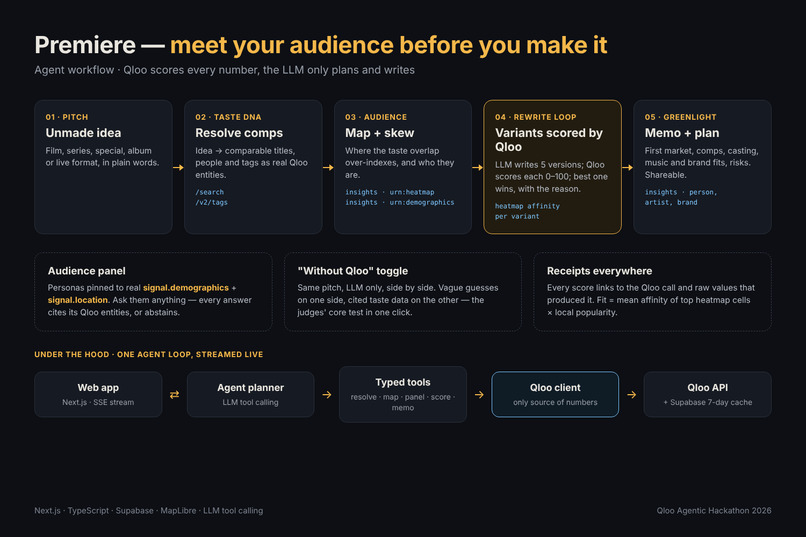
Premiere agent workflow: Qloo scores every number, the LLM only plans and writes
Inspiration
Studios, labels and creators decide what to make on gut feel and a handful of comparable titles. Real audience research takes weeks and costs more than most indie creators can spend. We wanted anyone with an idea to meet its audience before making it.
What it does
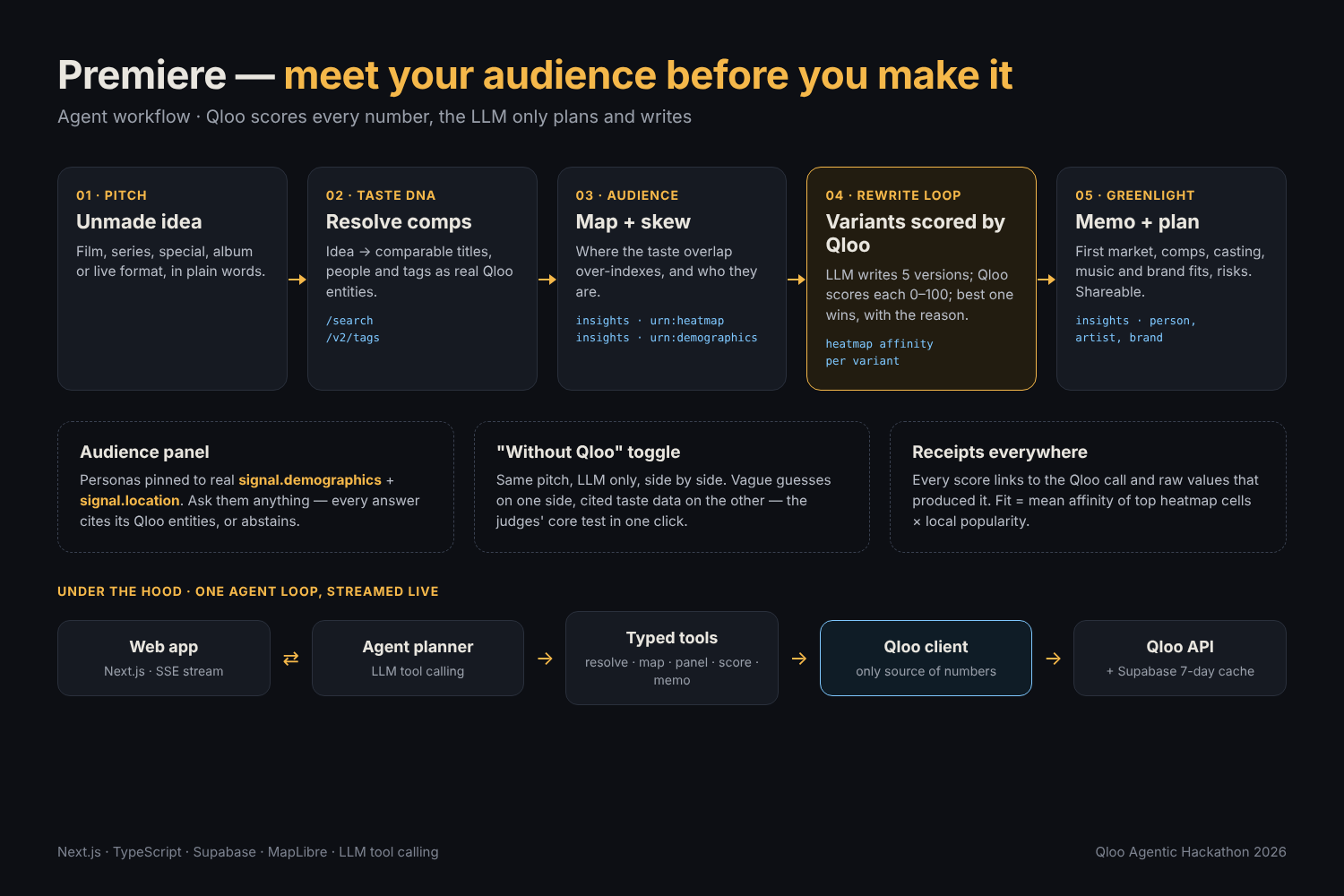
Premiere is a greenlight agent for ideas that don't exist yet. Describe an unmade film, series, comedy special, album or live format, and Premiere:
- Builds its Taste DNA – breaks the idea into comparable titles, people and tags and resolves them to real Qloo entities (you can add or remove any).
- Maps the audience – a heatmap of where that taste overlap over-indexes, plus its demographic skew.
- Convenes an audience panel – personas pinned to real Qloo demographic + location signals. Ask any of them a question; every answer cites the Qloo entities behind it, and a persona abstains when the data is thin.
- Runs a rewrite loop – the agent writes variants of the idea (new setting, lead comp, tone, format), scores every version against Qloo with the same method, and ranks them on a live leaderboard with the reason the winner wins.
- Writes a greenlight memo – first market, comps, casting and music fits, brand partners and risks, shareable as a link.
A "Without Qloo" toggle re-runs the same pitch with the LLM alone, side by side, so you can see the difference yourself.
What makes it Qloo-powered
Every number comes from Qloo; the LLM never scores. The LLM writes variants and words; Qloo decides which version lands. We use:
/searchand/v2/tagsto resolve comps and themes/v2/insightswithfilter.type=urn:heatmapfor the audience map/v2/insightswithfilter.type=urn:demographicsfor audience skew/v2/insightswithsignal.demographics.*andsignal.locationto ground personas/v2/insightsforurn:entity:person,artistandbrand(withfeature.explainability) for casting, music and partner fits
Fit score = mean affinity of the top heatmap cells, weighted by local popularity, scaled 0–100 – applied identically to every variant so scores are comparable.
How we built it
- Frontend: Next.js (App Router, TypeScript), Tailwind, shadcn/ui, MapLibre + deck.gl for the heatmap
- Agent: an LLM with tool calling that plans a loop over typed tools (
resolve_comps,audience_map,build_panel,persona_answer,generate_variants,score_variant,write_memo). The model may only name entities a tool returned. - Data: Supabase Postgres for runs, share links and a Qloo response cache
- Streaming: server-sent events, so the agent log and leaderboard fill in live
- Hosting: Vercel
Challenges we ran into
- Ideas that don't exist yet have no Qloo entity, so we had to triangulate an audience from the overlap of comparable titles and tags.
- Keeping personas honest: we pinned each one to a real signal and forced every answer to cite its entities, or abstain.
- Making variant scores comparable: one fixed scoring method, with raw inputs shown.
Accomplishments that we're proud of
- Qloo isn't just a data source here – it is the objective function that shapes the creative idea itself.
- Every number in the app has a receipt back to the Qloo call that produced it.
What we learned
Taste data is most powerful before launch, when it can still change what gets made.
What's next for Premiere
Backtesting against past releases, team workspaces for studios and agencies, and deeper live-entertainment planning (touring formats, first-market picks).
Built With
- maplibre
- next.js
- openai
- qloo
- react
- supabase
- tailwindcss
- typescript
- vercel

Log in or sign up for Devpost to join the conversation.