Inspiration
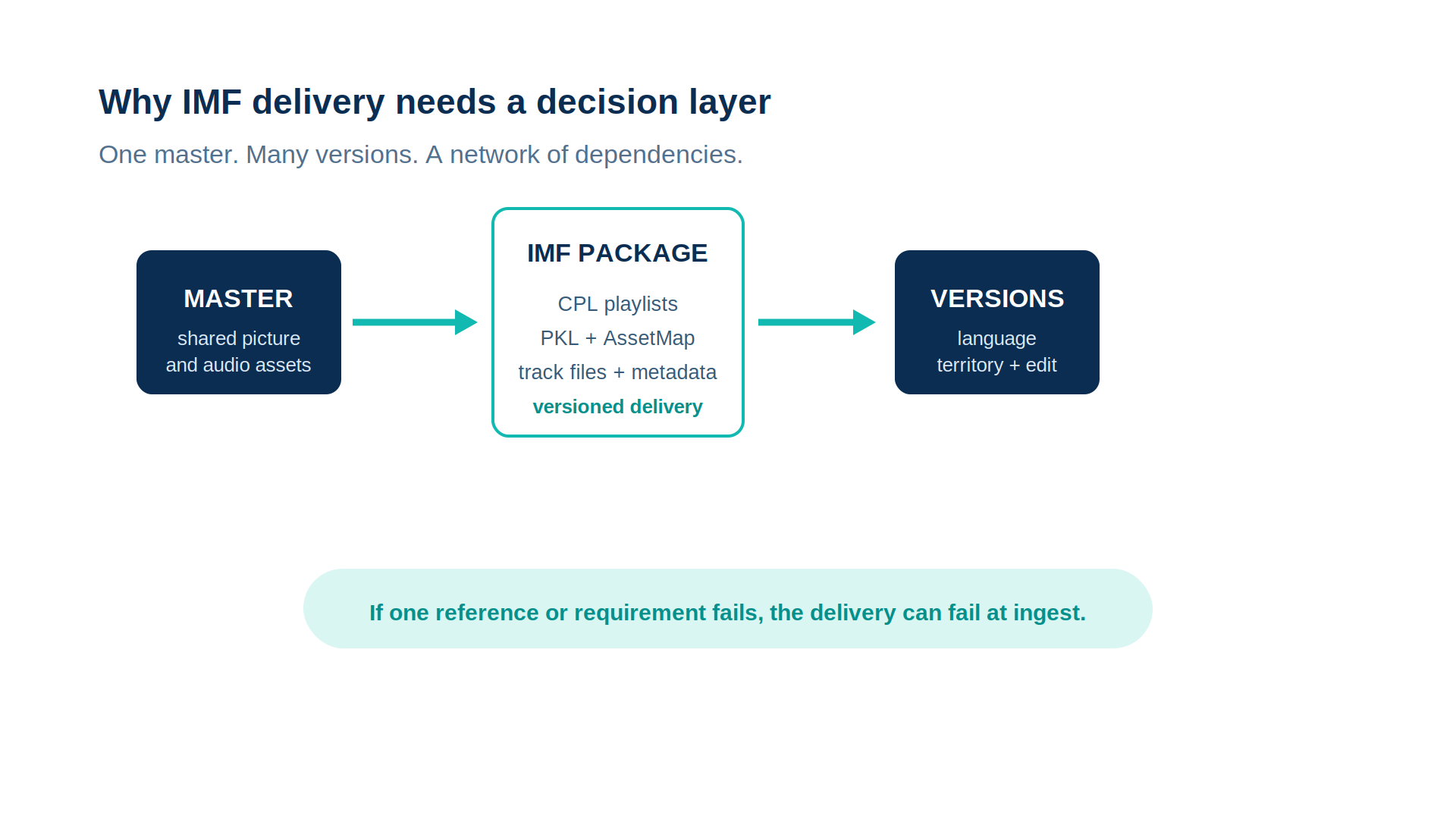
Interoperable Master Format (IMF) helps studios manage multiple versions of the same finished work for different territories, languages, edits, and distribution platforms. It's the SMPTE-standardized delivery format now required across the industry; Netflix, Disney, Amazon, and the BBC all use it for content delivery, and Netflix was one of the format's original architects, building it specifically to solve this multi-version problem at streaming scale.
That efficiency depends on relationships among Composition Playlists, Packing Lists, track files, metadata, and shared media assets.
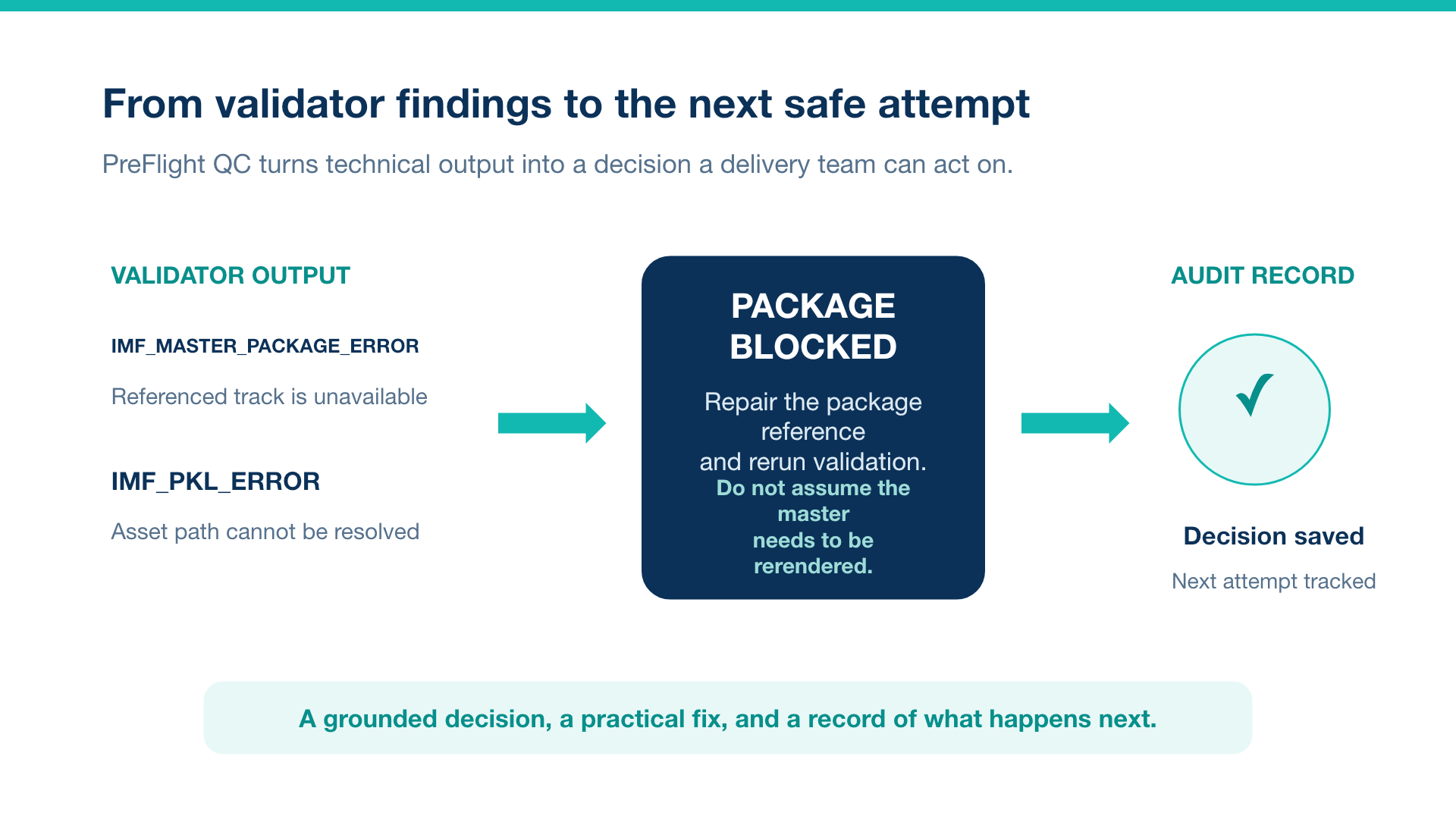
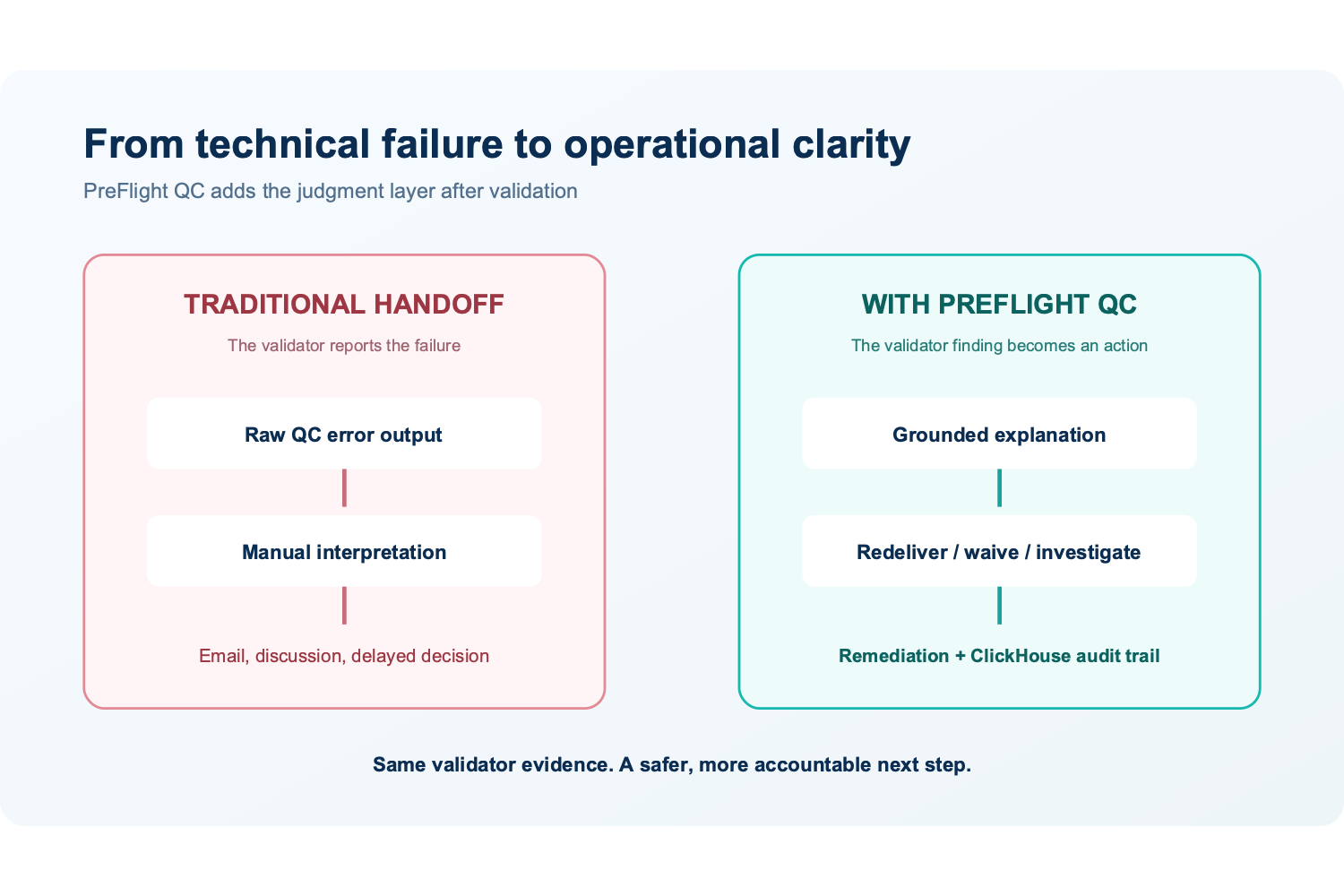
When one of those relationships or technical requirements fails, a delivery team must determine what the quality-control (QC) finding means operationally, whether it blocks delivery, what needs to be corrected, and how the next attempt should be tracked.
Netflix's documented IMF workflow illustrates this complexity. Deliveries pass through multiple validation stages, and if a referenced track or essence fails inspection, the IMP delivery can be rejected. Photon is one of the tools used to validate IMF package structure and related components.
PreFlight QC adds an explainable decision layer after QC validation. It turns technical findings into grounded recommendations, historical risk context, actionable remediation, and an auditable redelivery record.
Sources:
What It Does
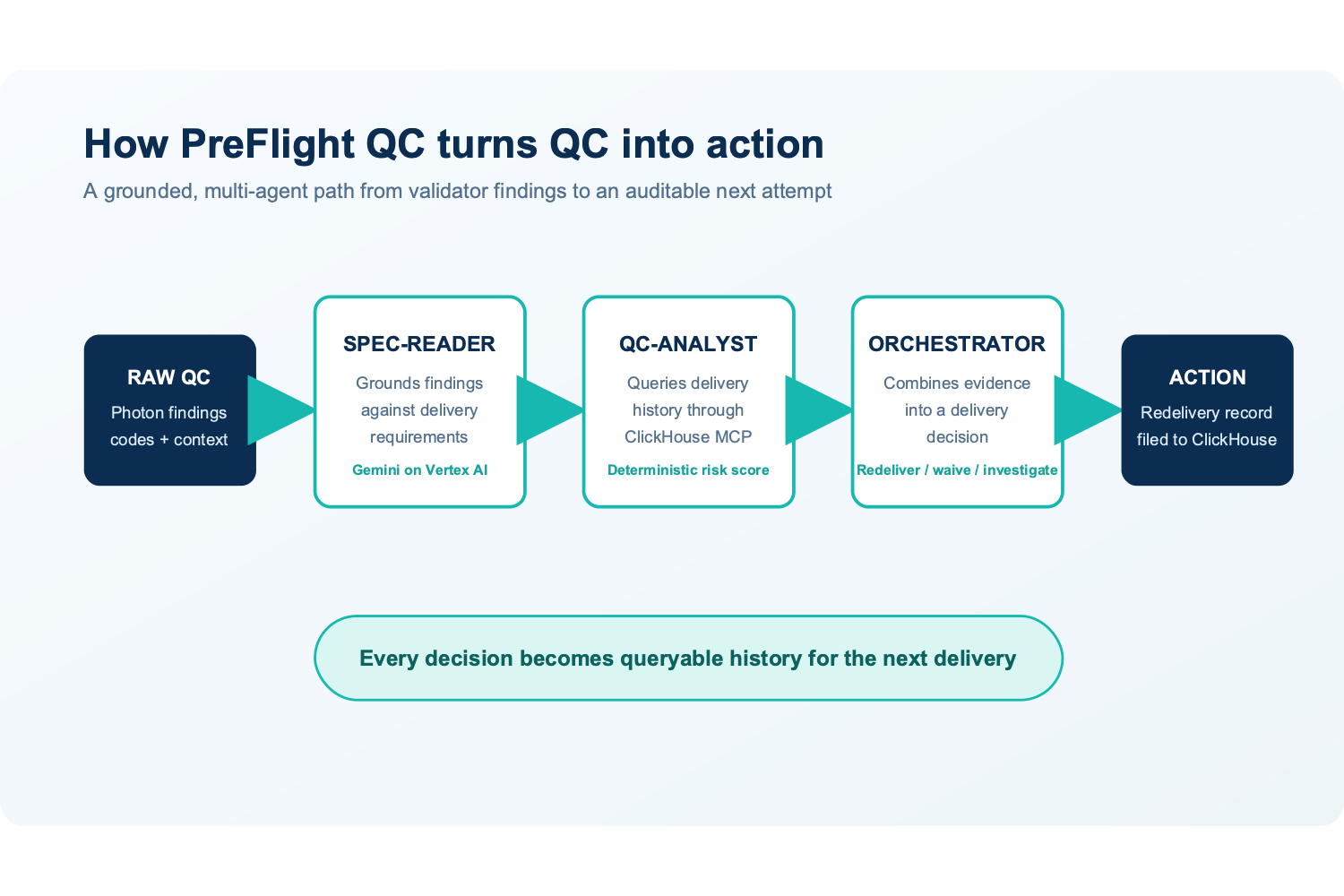
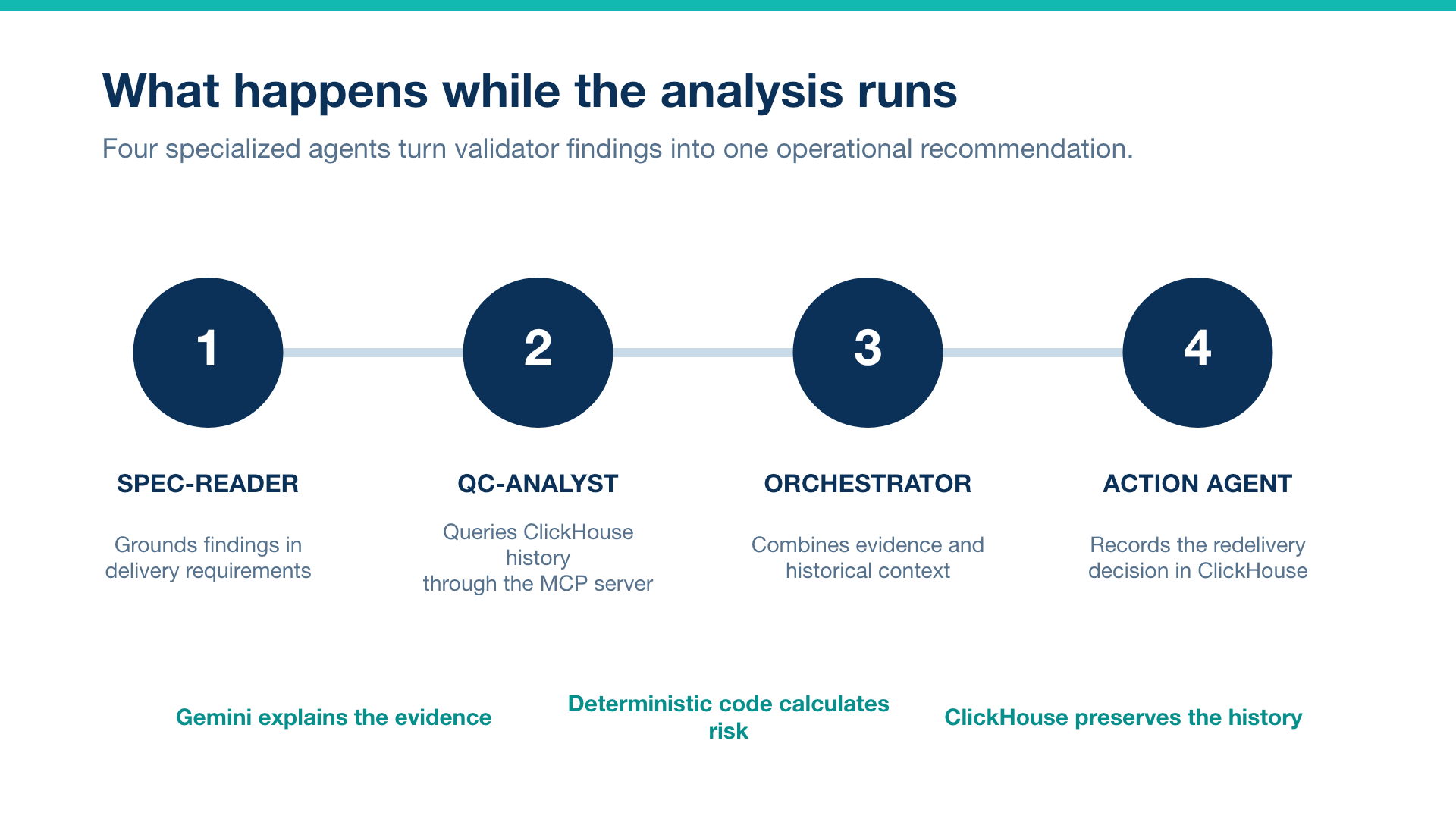
PreFlight QC accepts structured QC results from an IMF validator and coordinates a four-agent workflow.
Spec-Reader Agent: Grounds findings in official platform delivery requirements, including Netflix IMF and audio requirements. When a source page is not machine-readable, the project uses a clearly attributed repository snapshot rather than presenting invented requirements as live material.
QC-Analyst Agent: Queries ClickHouse Cloud at runtime through the official mcp-clickhouse server. It analyzes historical inspection records, vendor patterns, recurring error codes, and remediation-cost context using analytical SQL.
Deterministic Risk Scoring: The risk score is calculated by deterministic application code from the returned historical metrics and confidence factors. Gemini explains and contextualizes the score rather than inventing the number.
Orchestrator Agent: Combines specification findings and historical context into a recommended action: redeliver, waive, escalate, or investigate. It provides vendor-oriented remediation instructions while preserving the distinction between blocking and advisory findings.
Action Agent: When redelivery is recommended, it writes a structured RedeliveryRecord to ClickHouse through the official MCP integration. Webhook, Jira, and Slack adapters are implemented as extensibility points and remain inactive unless configured.
How We Built It
- Multi-agent orchestration: Google ADK with typed Pydantic contracts.
- LLM engine: Gemini 2.5 Flash on Vertex AI through Google Cloud Application Default Credentials.
- Analytical backbone: ClickHouse Cloud queried through the official
mcp-clickhouseserver using the Model Context Protocol. - Ground truth: IMF error taxonomy and validator evidence derived from Netflix’s open-source Photon project.
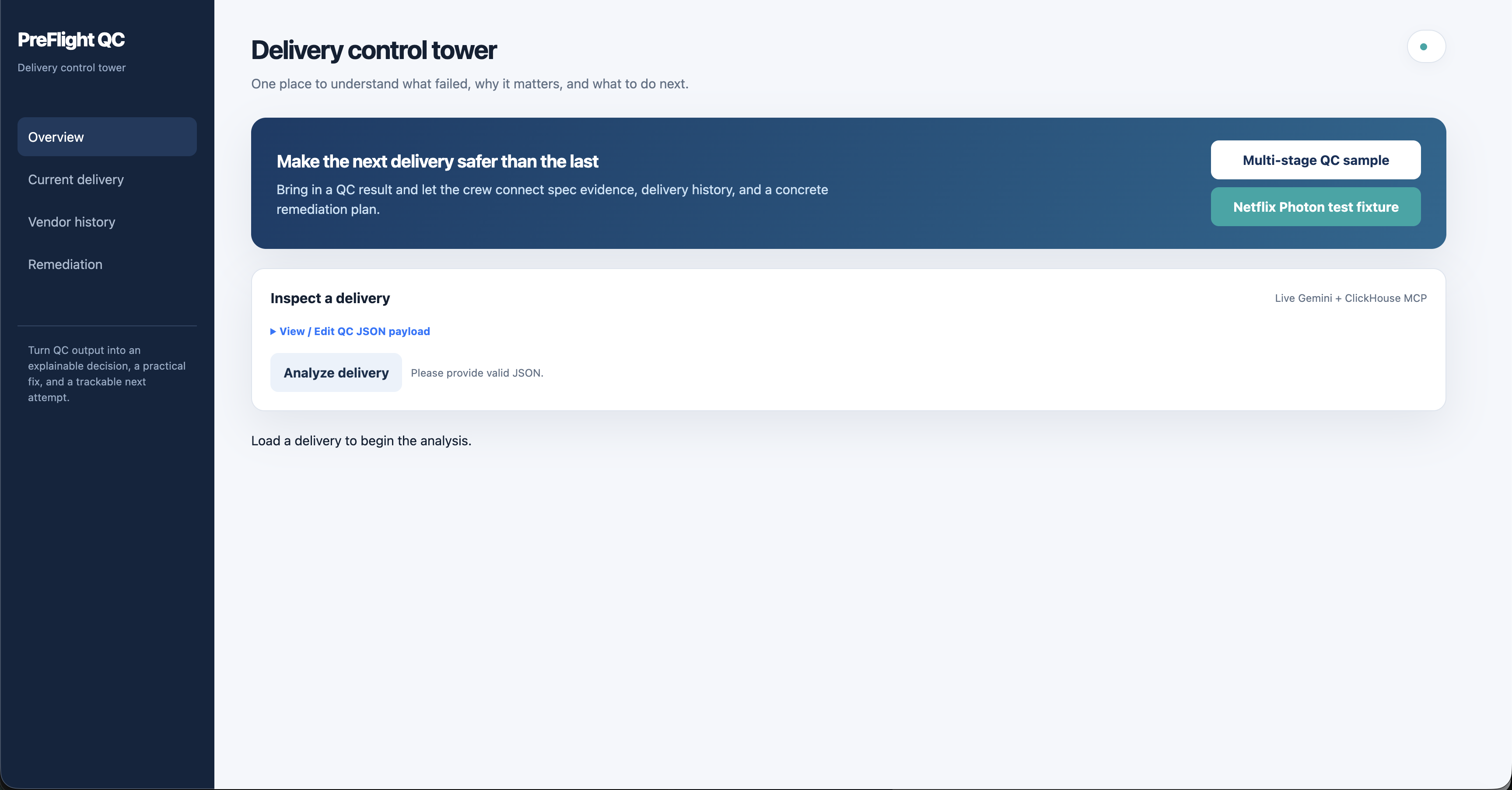
- Web dashboard: A responsive Delivery Control Tower showing package status, findings, historical context, recommended action, and audit status.
- Cloud infrastructure: Docker, Cloud Run, and Secret Manager.
The historical corpus used in the demonstration is synthetic and illustrative. ClickHouse querying and audit writes are real; the project does not claim access to confidential studio delivery records.
Challenges We Ran Into
Integrating ClickHouse MCP into a live agent workflow: We connected the agent pipeline to ClickHouse Cloud through the official ClickHouse MCP server using its standard stdio transport. We then handled cloud connection startup, MCP session lifecycle, query timeouts, and secure credential injection so ClickHouse could provide reliable analytical context during live execution. The official server also supports network transports such as Streamable HTTP and SSE.
Keeping numerical reasoning deterministic: We separated quantitative risk calculation from Gemini’s narrative reasoning so the model explains evidence without fabricating statistical values.
Maintaining typed contracts across agents: Multi-step model responses sometimes returned alternate field names or nested values. Defensive normalization and schema validation keep the final decision compatible with the application’s data contracts.
Building a durable specification-grounding workflow: Netflix Studio Partner materials provide the authoritative delivery context, but some pages are delivered as browser applications rather than machine-readable text. The prototype uses a clearly attributed, versioned reference snapshot when necessary. A production version would add source versioning, change detection, and an approved workflow for refreshing snapshots or coordinating access to platform documentation.
Accomplishments
- Closed the loop from QC finding to recommended action and ClickHouse audit record.
- Used ClickHouse as an analytical history layer rather than a message or key-value store.
- Built the demonstration around a real IMF delivery problem and Photon-derived evidence.
- Preserved the distinction between validator evidence, specification grounding, deterministic analysis, and model-generated explanation.
- Verified targeted unit tests, ClickHouse MCP smoke tests, and end-to-end integration tests.
- Deployed a live-only demonstration on Google Cloud Run.
What We Learned
- IMF’s modular package structure improves version management but makes references and metadata important to validate.
- MCP provides a standardized way for agents to access specialized analytical systems such as ClickHouse.
- In enterprise workflows, an explanation is more trustworthy when it includes its evidence, calculation boundary, and operational consequence.
- A useful agentic system must produce a concrete, auditable side effect rather than only return conversational text.
What’s Next
- Connect approved webhook, Jira, Slack, and studio workflow adapters.
- Add additional platform-specific delivery requirement sets.
- Expand the historical corpus with validated operational data.
- Develop automated remediation tools for selected XML and audio corrections, subject to human review and platform-specific approval.
Built With
- asyncio
- clickhouse
- clickhouse-cloud
- clickhouse-mcp
- css3
- docker
- fastmcp
- gemini
- google-adk
- google-cloud
- google-cloud-run
- google-secret-manager
- google-vertex-ai
- html5
- imf
- javascript
- model-context-protocol
- multi-agent-systems
- netflix-photon
- pydantic
- pytest
- python
- quality-control
- rest-api
- smpte-st-2067

Log in or sign up for Devpost to join the conversation.