Inspiration
In South Africa every organisation that handles personal information falls under POPIA and has to appoint an Information Officer. In practice the privacy policy lives in a PDF or a Confluence page, and the work that changes how personal data is collected, stored or shared lives in Jira. Nothing connects the two. A ticket like "add the customer's ID number to signup" can be built, reviewed and shipped without anyone asking why the ID number is needed, how long it is kept, or whether the Information Officer has seen it.
The cost of that gap is now real. In October 2026 South Africa's Information Regulator announced a R1 million fine for a major bank and a R500,000 fine for a college that shared personal information without a lawful reason. When a complaint arrives, the first question is always "who approved this?", and if the decision was made in a Jira ticket nobody can answer it.
Existing tools don't close that gap. Privacy scanners find personal data after it is already in Jira. Checklist apps can block Done, but only if someone remembered to add the right checklist, and by the time a ticket is closed the field has already shipped. I wanted the policy to show up at the moment it matters: when someone starts building.
What it does
Preflight is a Forge app for Jira that turns an organisation's privacy review into two gates.
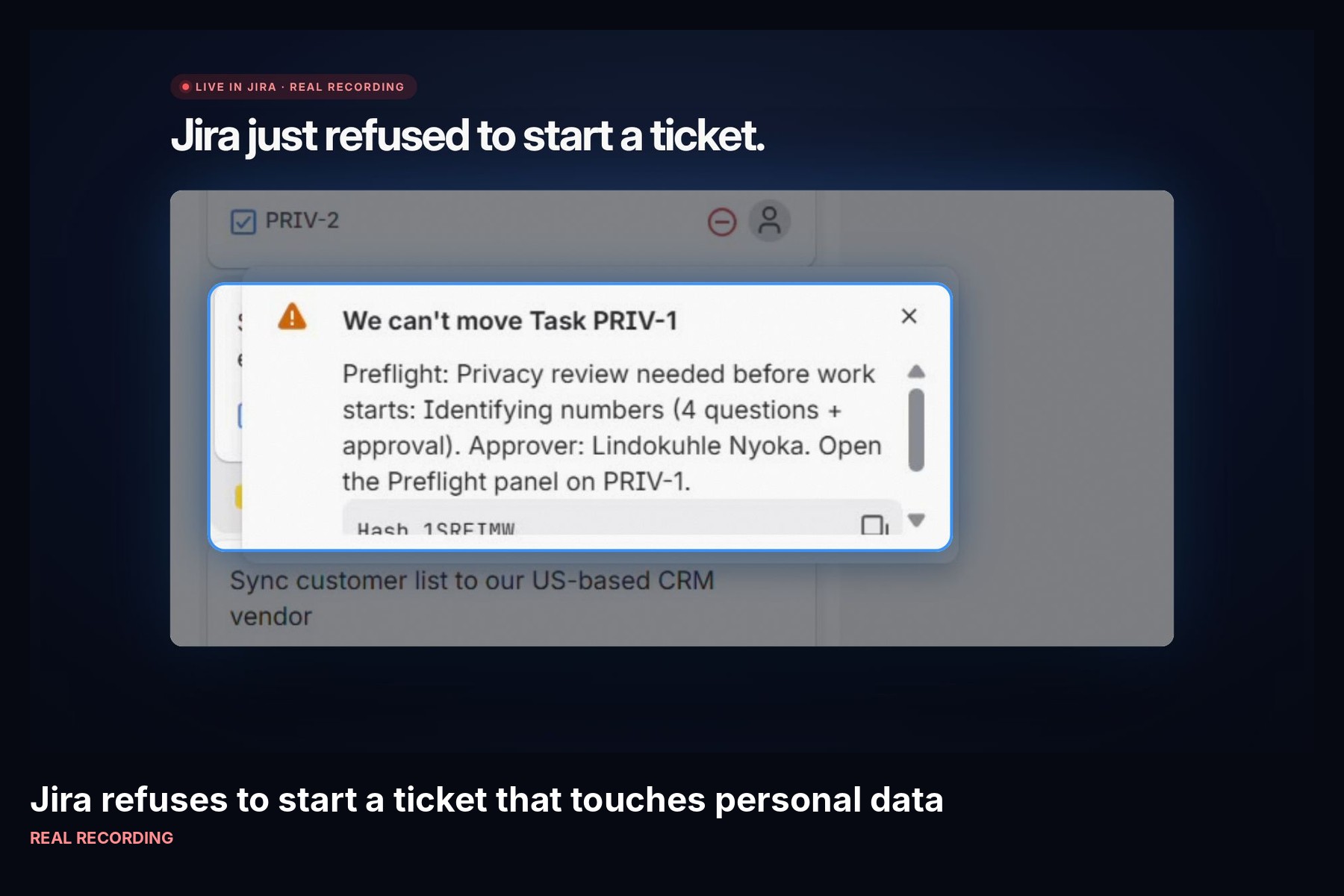
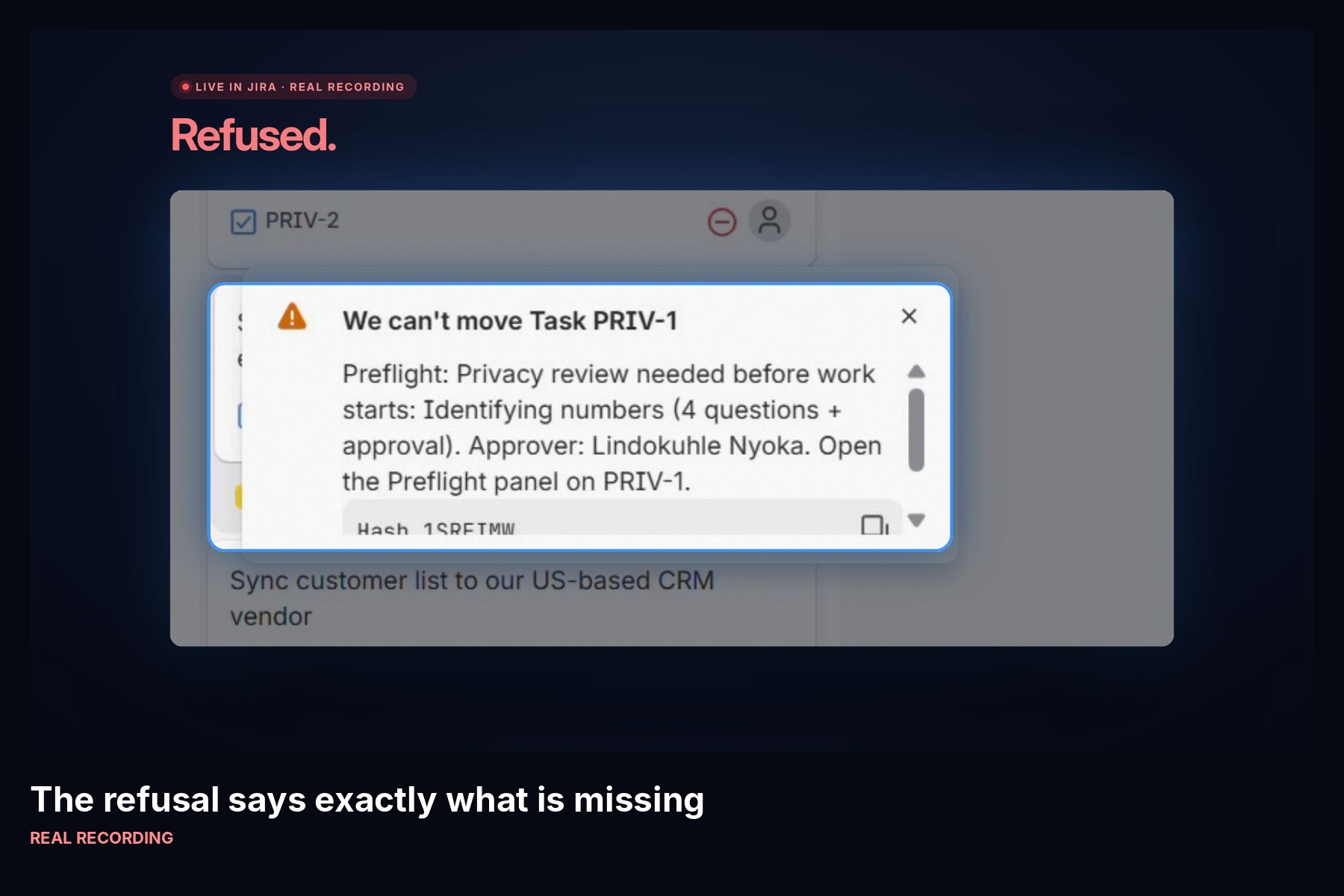
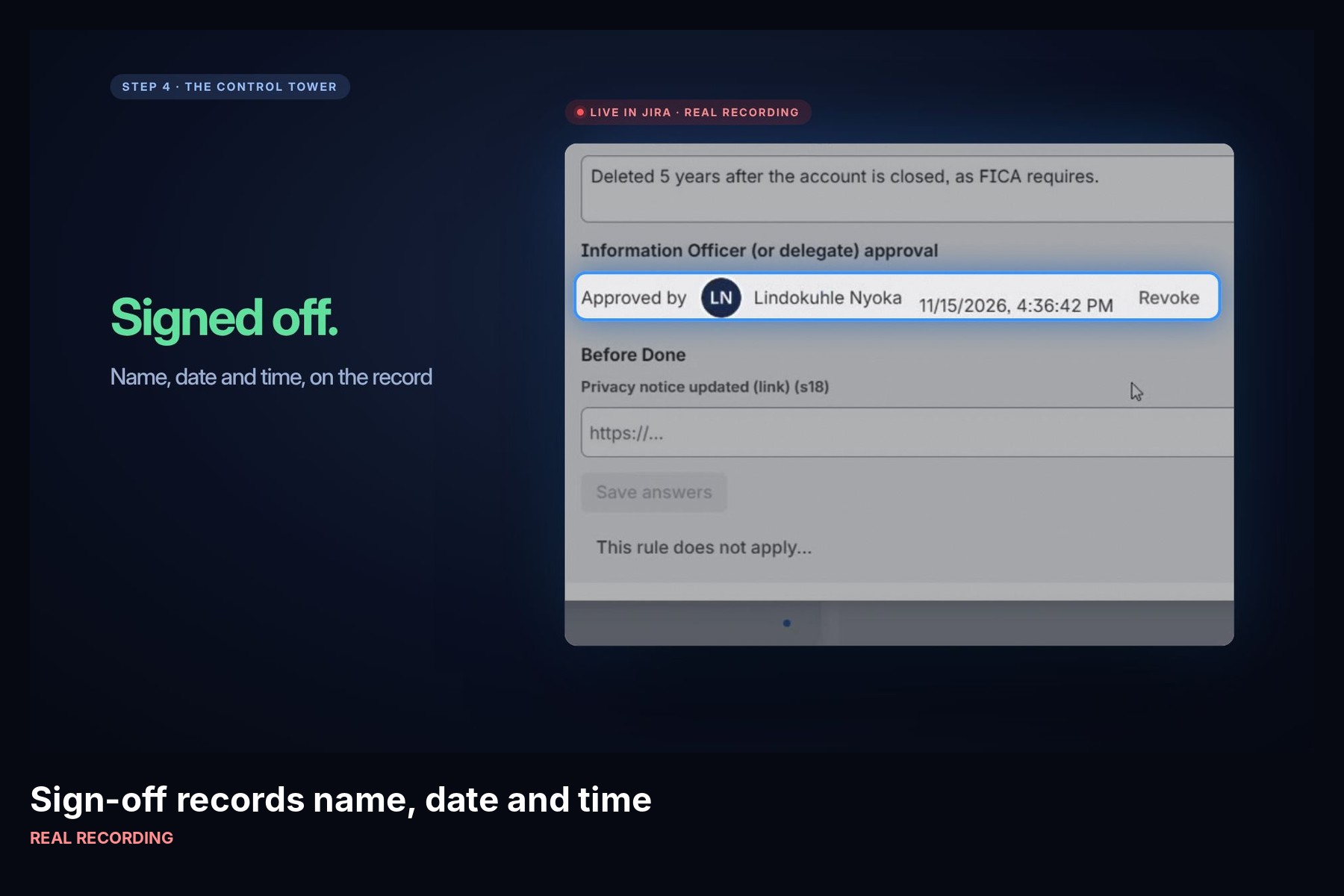
- Review before build. When a work item proposes a change to how personal information is collected, used, stored or shared, moving it to In Progress is refused until the team answers the review questions your policy requires (purpose, why less data won't do, lawful basis, retention) and a named approver signs off.
- Evidence before Done. Moving it to Done is refused until the ship-time evidence is recorded, such as the updated privacy notice.
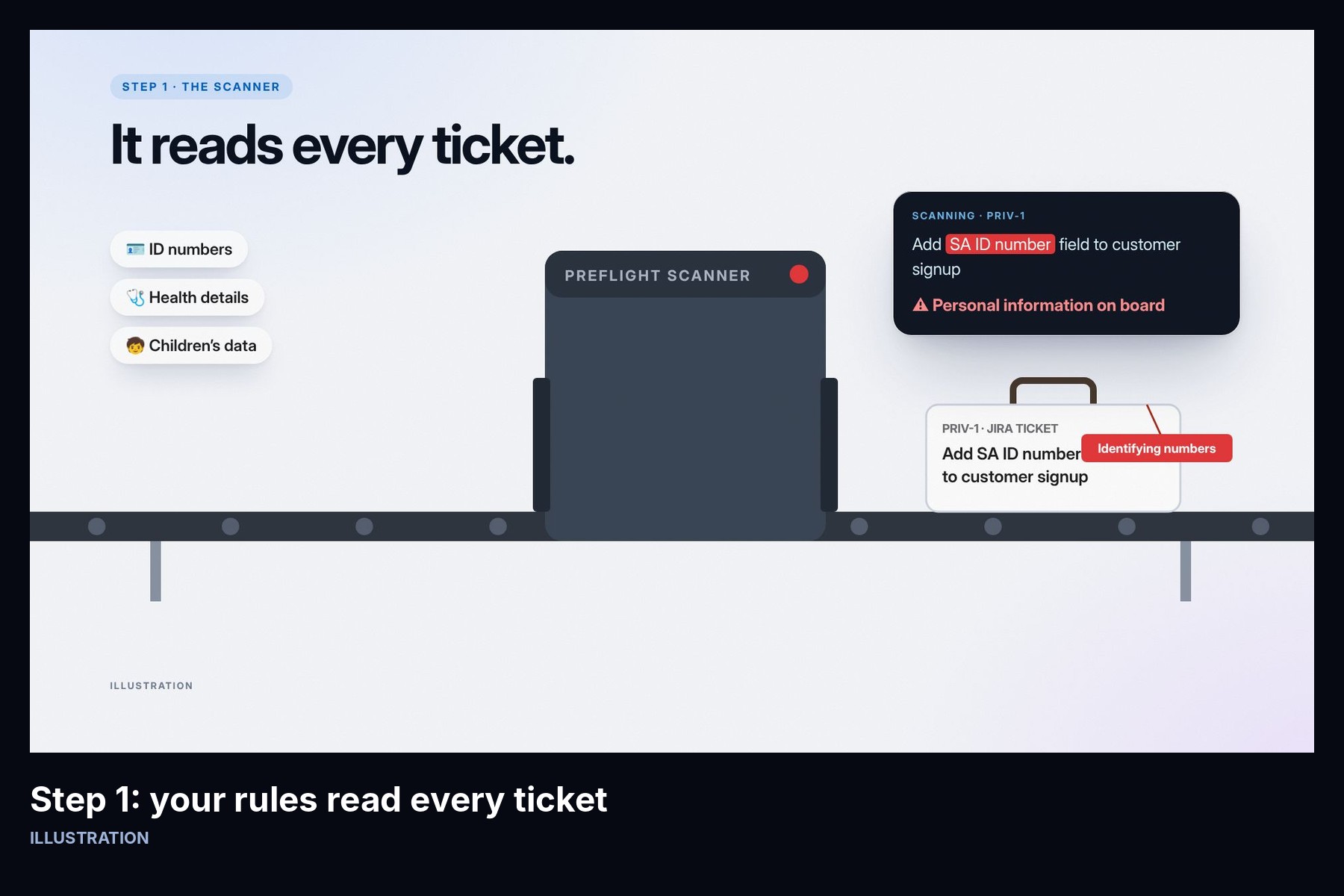
- It knows which review applies. A deterministic, stem-aware rules engine reads the ticket and shows exactly why a rule matched ("mentions 'SA ID number'"). Rewording the ticket doesn't make a review disappear; only an approver can dismiss a rule, with a reason.
- The panel says what to do next and who approves. Questions are grouped before work starts and before Done.
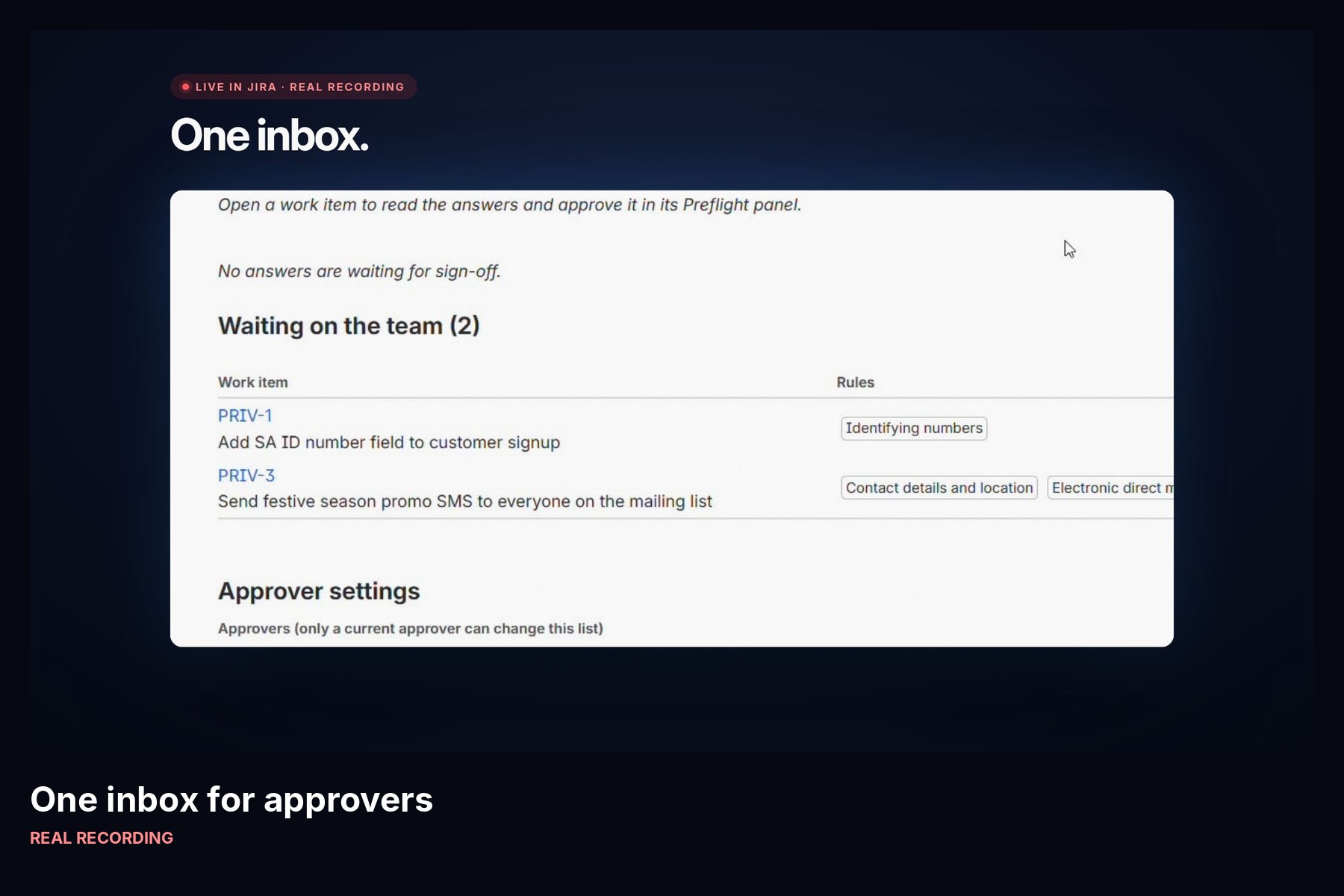
- An inbox for the Information Officer. Preflight reviews lists everything waiting for approval and everything waiting on the team.
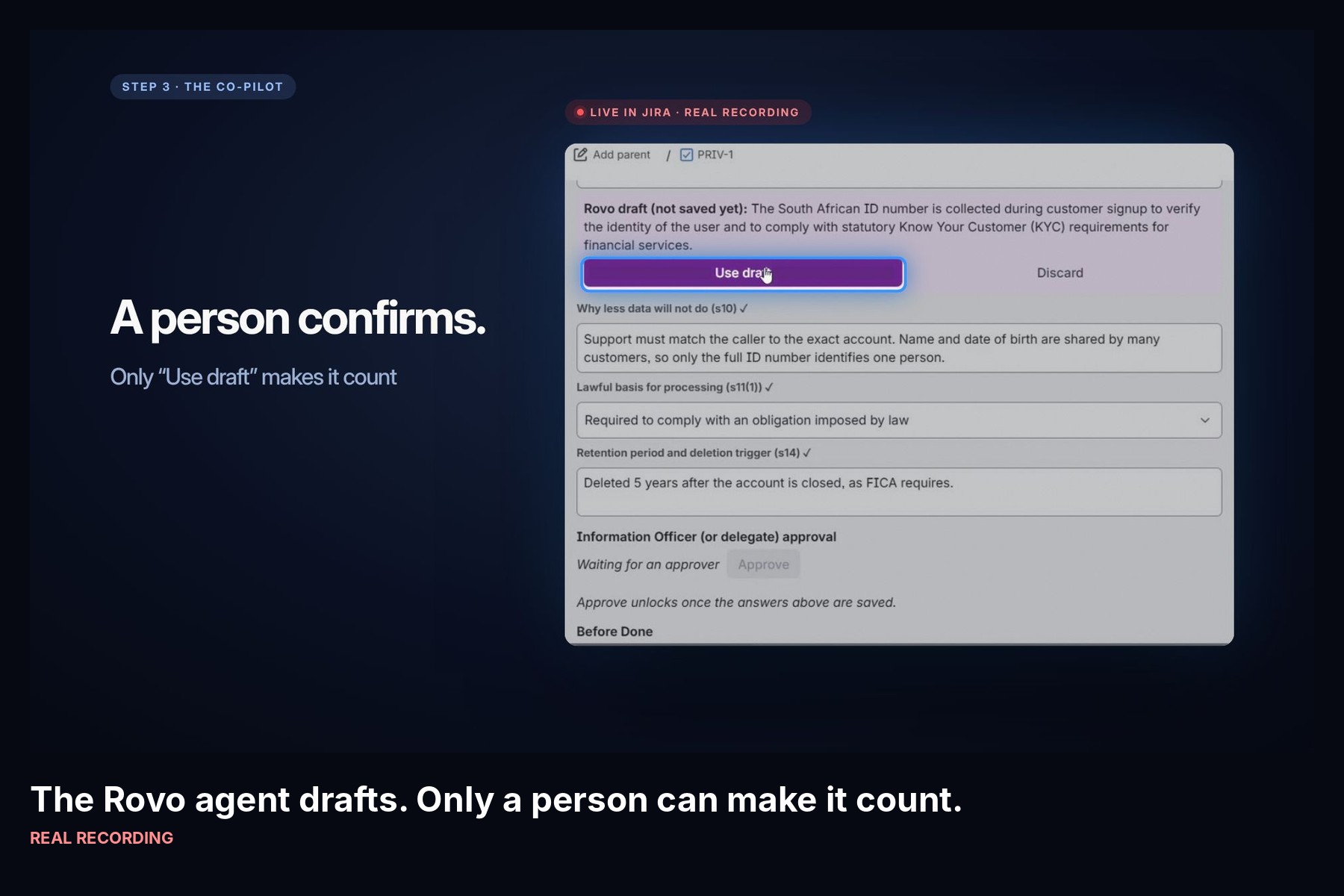
- Rovo helps, humans decide. The Preflight agent explains the gaps and drafts answers with the developer, but a draft only counts after the person confirms it in the panel. The agent can never approve, dismiss, grant exceptions, activate rules, or declare that a change has no personal data.
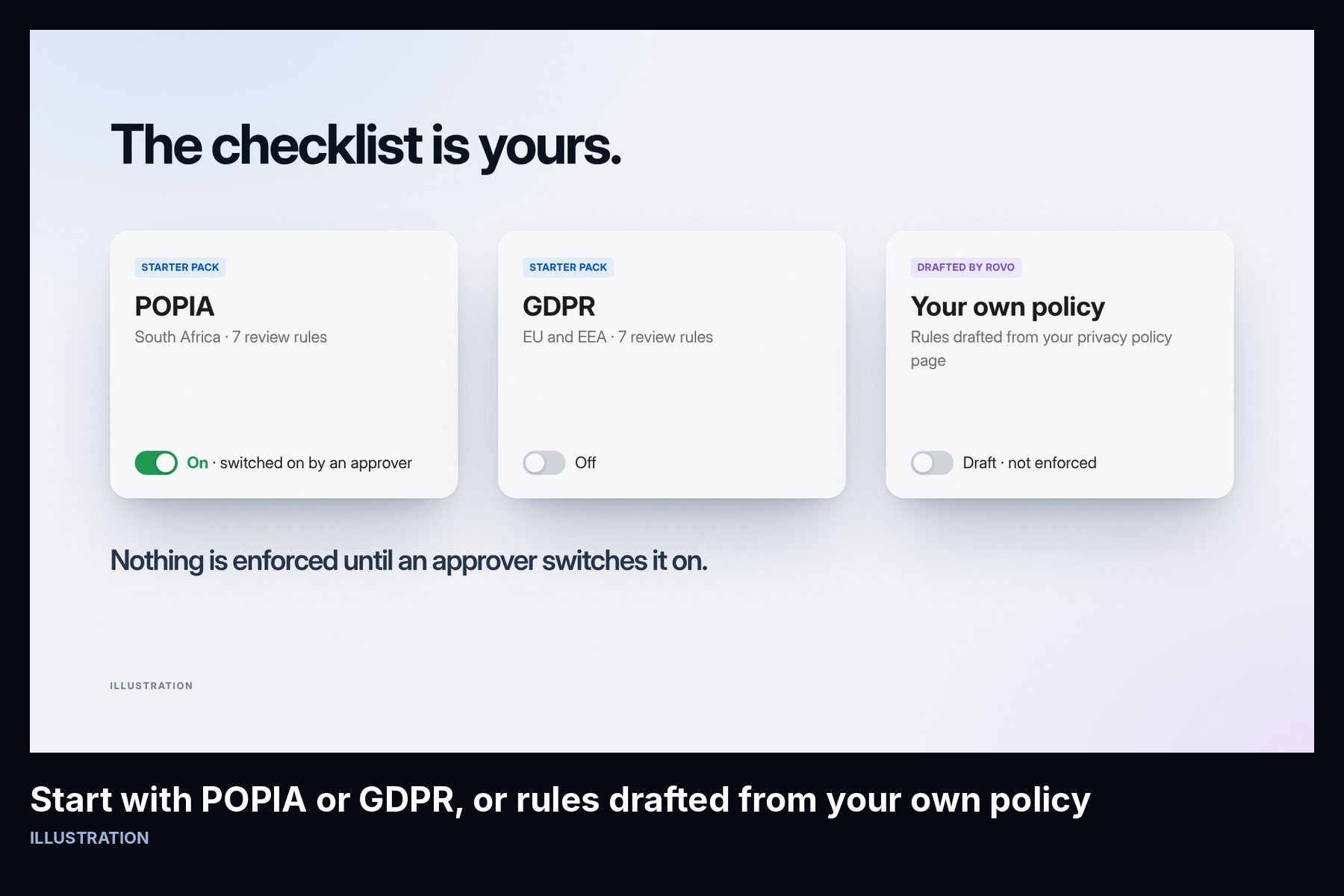
- Rules come from your policy. Admins give the agent their policy text (pasted, or a page shared in the Rovo chat) and it proposes draft rules, with example tickets that must and must not match. Nothing is enforced until it is activated.
- Answers have to be real. "TBD", "not sure" and keyboard filler are rejected, and a retention answer has to say when the data goes.
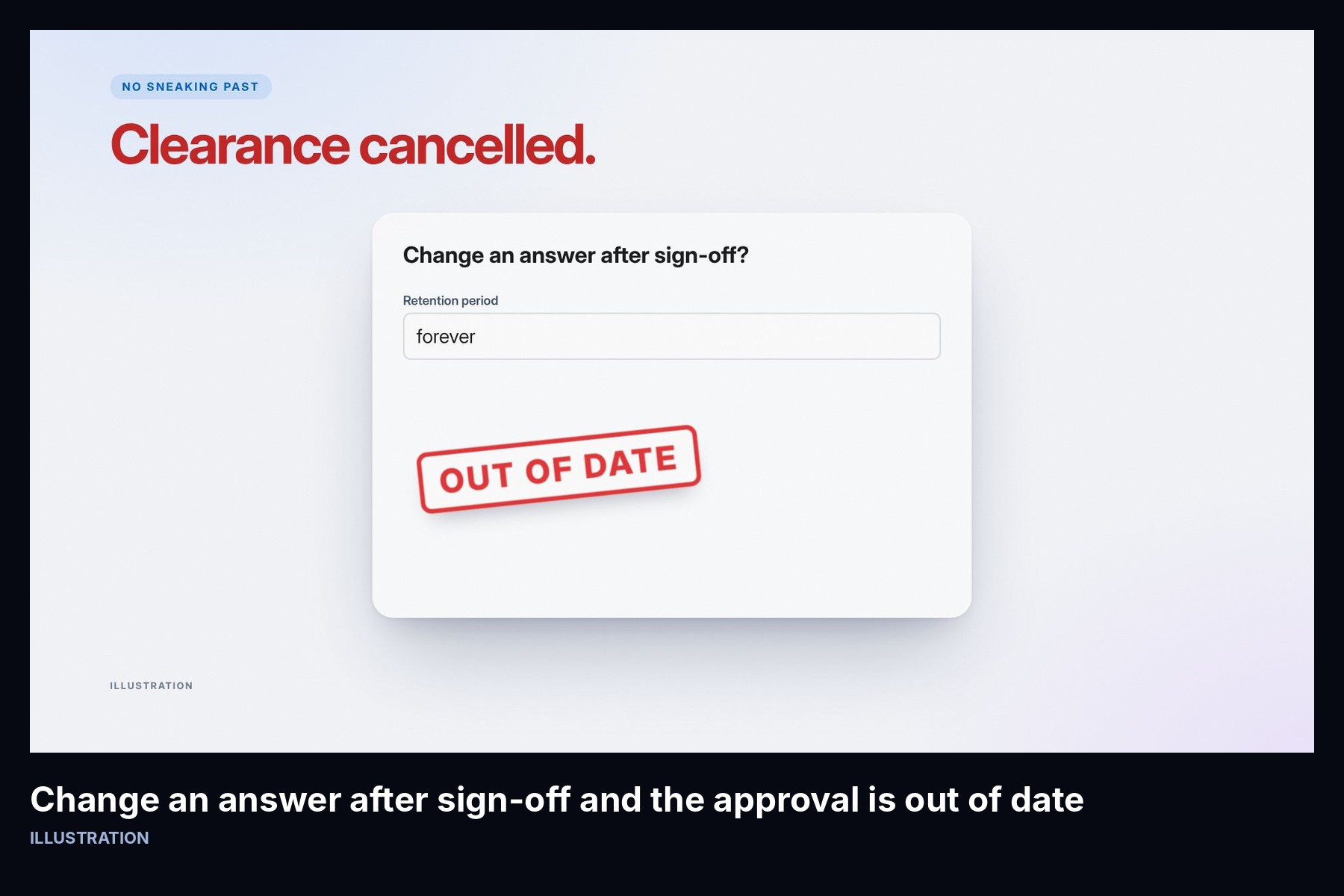
- Governance built in. Once approvers are named, a Jira admin can't approve, can't add themselves as approver, and an admin's changes to active rules become proposals. The approver sees every changed field, with anything that weakens the rule flagged first and the rule's examples re-run against the new version. Weakening a setting needs an approver, a break-glass reset needs a second admin and 72 hours, and bulk actions can't switch enforcement off.
- Bypasses are caught. Work that reaches In Progress or Done another way (moved from another project, changed type, a workflow without the gate) is flagged to the approvers in a comment and in the inbox.
- It keeps the privacy rules itself. Preflight reports the Atlassian account IDs it stores to Atlassian's personal data reporting API every week and anonymises closed accounts everywhere, even in the audit history.
- A write-once audit history of every answer, approval, rule change, setting change and bypass, plus a coverage check that lists workflow transitions without a gate.
It ships with two editable starter packs, POPIA (South Africa) and GDPR (EU / EEA), each with seven rules: identifying numbers, contact details and location, special categories, children, electronic direct marketing, cross-border transfers and bulk exports. The GDPR pack knows that hosting in Ireland is not a transfer but hosting in South Africa is. Neither is a complete legal assessment; they are starting points for an Information Officer or DPO to adapt. The engine is regulation-agnostic, so HIPAA or an internal policy is a new pack, not new code.
Preflight enforces your organisation's own review process. It never says work is "compliant" and it is not legal advice.
How I built it
- Forge with UI Kit for the issue panel, the admin page and a global Preflight reviews page; two
jira:workflowValidatormodules (enabled for company-managed and team-managed projects); product triggers for create, update and delete; ajira:entityPropertyfor JQL; and the Forge Key-Value Store. - One deterministic engine (
src/engine/evaluate.js) powers both gates, the panel, the Rovo actions and the MCP tools, so they can never disagree. No LLM sits in the enforcement path: a blocking validator has to be fast, explainable and free to run. - Matching that respects Jira, measured honestly. Stem-aware phrases, context triggers ("GPS" only counts with "track" or "driver"), excludes for Jira idioms ("race condition", "child issue", "health check endpoint"), per-rule examples checked on every save, and a regression corpus of about 245 realistic tickets. Three blind tests (titles written by a reviewer who hadn't seen the rules) caught 68%, 63% and 70% of privacy tickets with at most 1 false alarm in 40; each round's misses were fixed. Keywords will always miss some wording, which is why there is also a Yes / No / Unsure declaration step.
- Rovo agent (
rovo:agentwith sevenactionmodules) androvo:mcpexposing the read-only check and rule tools plus a rate-limited approval request to coding agents. - Trust engineering on KVS. Audit events are separate keys written with
FAIL_IF_EXISTS, so history can't be rewritten through the app. Record updates run under a per-ticket lock (aFAIL_IF_EXISTSkey with a TTL) so concurrent saves don't overwrite each other. Approvals carry a fingerprint of the answers they approved and go stale if those answers or the rule change. Evidence is deleted with its ticket. - Permissions are checked server-side in every resolver and action. The panel always takes the issue from Jira's context, never from the request.
- 84 automated tests cover the engine, the matcher corpus and end-to-end flows with Jira and storage faked, plus regression tests for the holes found by three independent reviews of the code (for example: an admin hiding a weakened rule from the approver, overriding someone else's "Yes" in two steps, or an approval surviving a rule change).
Challenges
- Making a gate people won't hate. My first matcher blocked "Promo code bug" and "race condition" tickets and missed "ID numbers" because of the plural. I rebuilt it with stemming, context triggers and excludes, then tested it on tickets it had never seen. It now ships with a regression corpus so it can't quietly get worse.
- Putting the gate in the right place. Blocking Done is too late: the code has shipped. The real value is a review before build, with only proof-of-delivery checked at Done.
- Deciding where AI belongs. It would be easy to let an LLM decide whether a ticket is "POPIA compliant". That would be slow, unexplainable and legally dangerous. AI drafts and explains; deterministic rules and humans decide.
- Governing the governors. A privacy control is only as strong as whoever can switch it off. I had independent reviews attack the code; they found ways for an admin to weaken a rule without the approver noticing and for a user to undo someone else's declaration. Each is now fixed and has a regression test.
- Getting the law right. Each rule lists the POPIA sections it draws on, and I kept the distinctions the Act makes: an ID number is ordinary personal information (s1), not special personal information under s26. It is still a starter pack for an Information Officer to adapt, not legal advice.
- Jira refuses an app's ticket creation unless the space's permission scheme grants the hidden
atlassian-addons-project-accessrole, so "Load demo" now explains exactly which permission to fix instead of failing with a bare 403. - On Windows,
npm installfailed because the Forge CLI (then a project dev dependency) compiles a native module that breaks on folder paths with spaces. The CLI now only lives globally.
What I learned
- How Forge validators, triggers, entity properties, KVS key policies and TTLs, Rovo actions and
rovo:mcpfit together into one product. - That trust features (stale approvals, sticky matches, write-once audit, governance) matter more in a compliance tool than clever AI.
What's next
- JSM support for data-subject access requests (POPIA s23, GDPR Art 15), and more starter packs beyond POPIA and GDPR.
- Watching a Confluence policy page and proposing rule changes when the policy changes.
- A Marketplace listing for South African teams.
---8<---
Built With
- atlassian-forge
- forge
- forge-kvs
- forge-ui-kit
- governance
- javascript
- jira
- jira-cloud
- mcp
- node.js
- popia
- privacy
- react
- rovo
- rovo-agents
