-
-
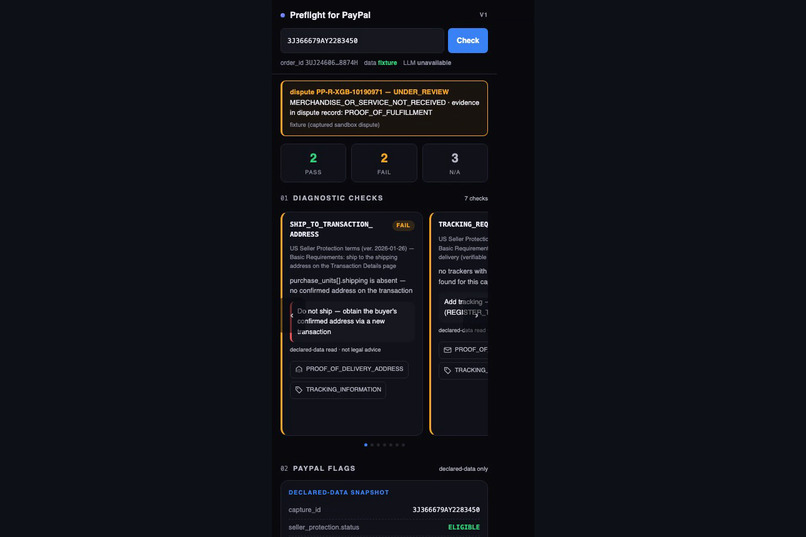
Diagnose: a real sandbox dispute is correlated — declared-data ELIGIBLE, yet 2 of 7 Seller Protection checks fail.
-
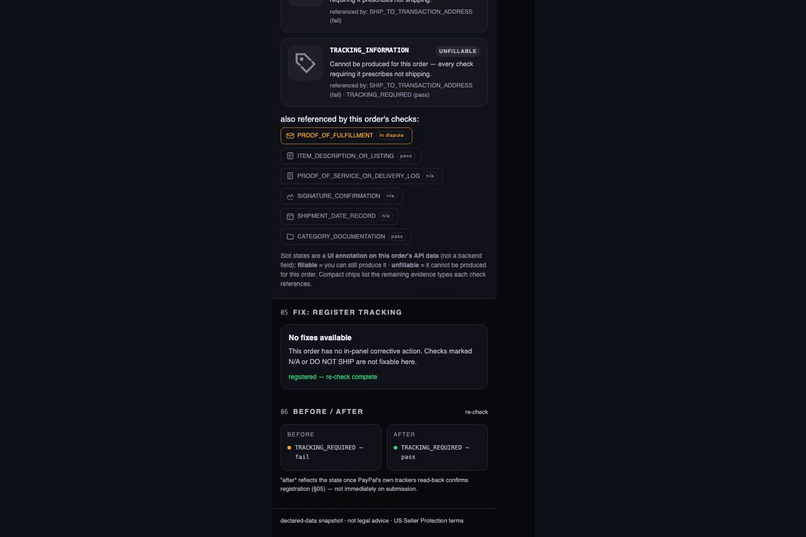
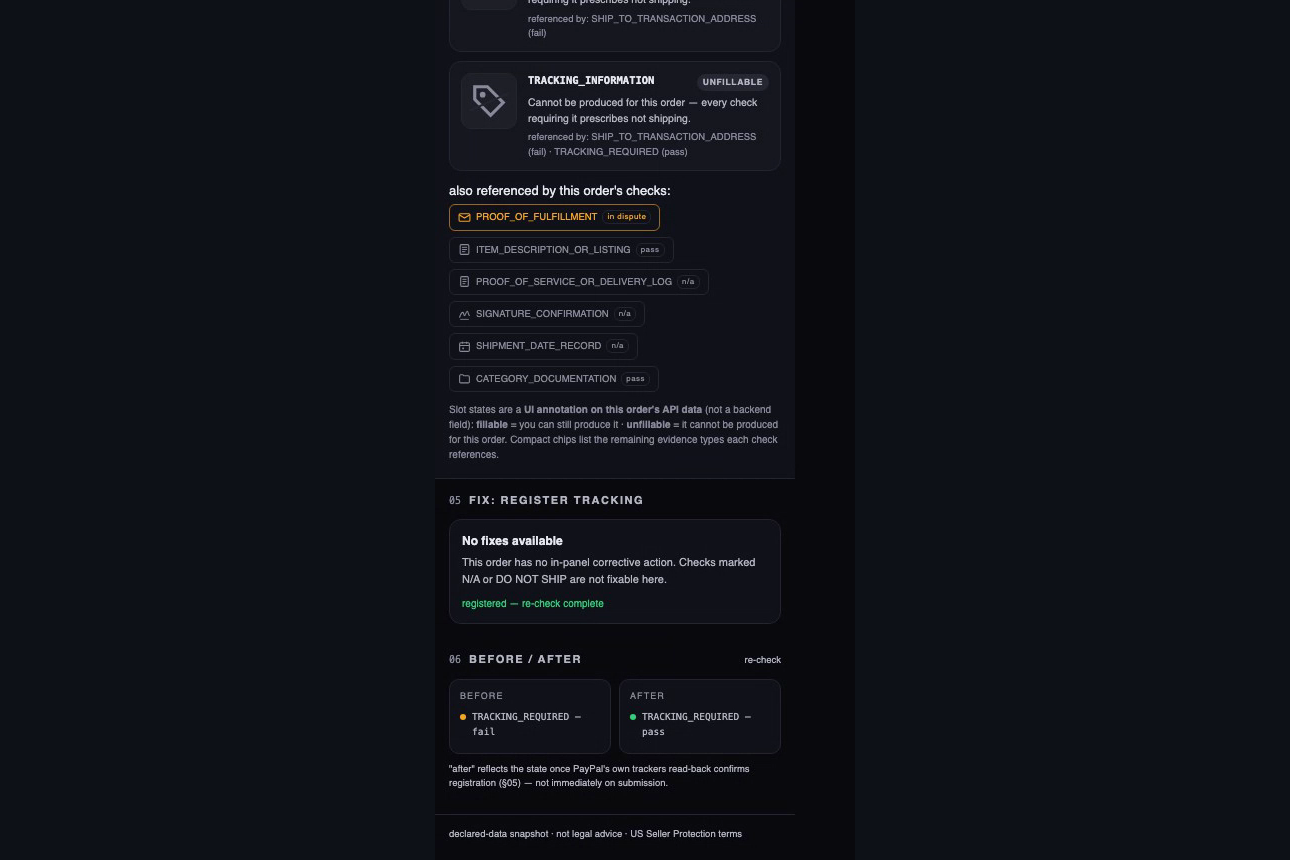
Register tracking via Shipping Trackers API, re-check — TRACKING_REQUIRED flips fail→pass. No outcome prediction.
-
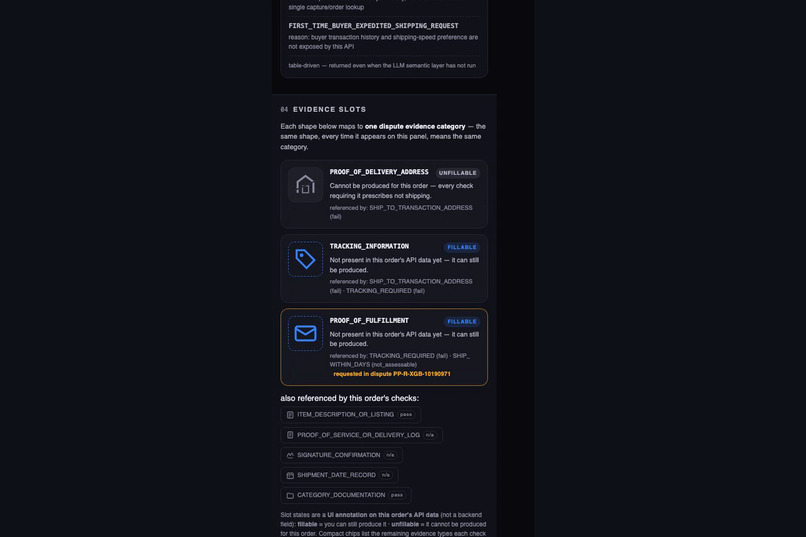
Evidence slots map checks to dispute evidence types — PROOF_OF_FULFILLMENT was actually requested in this order's dispute.
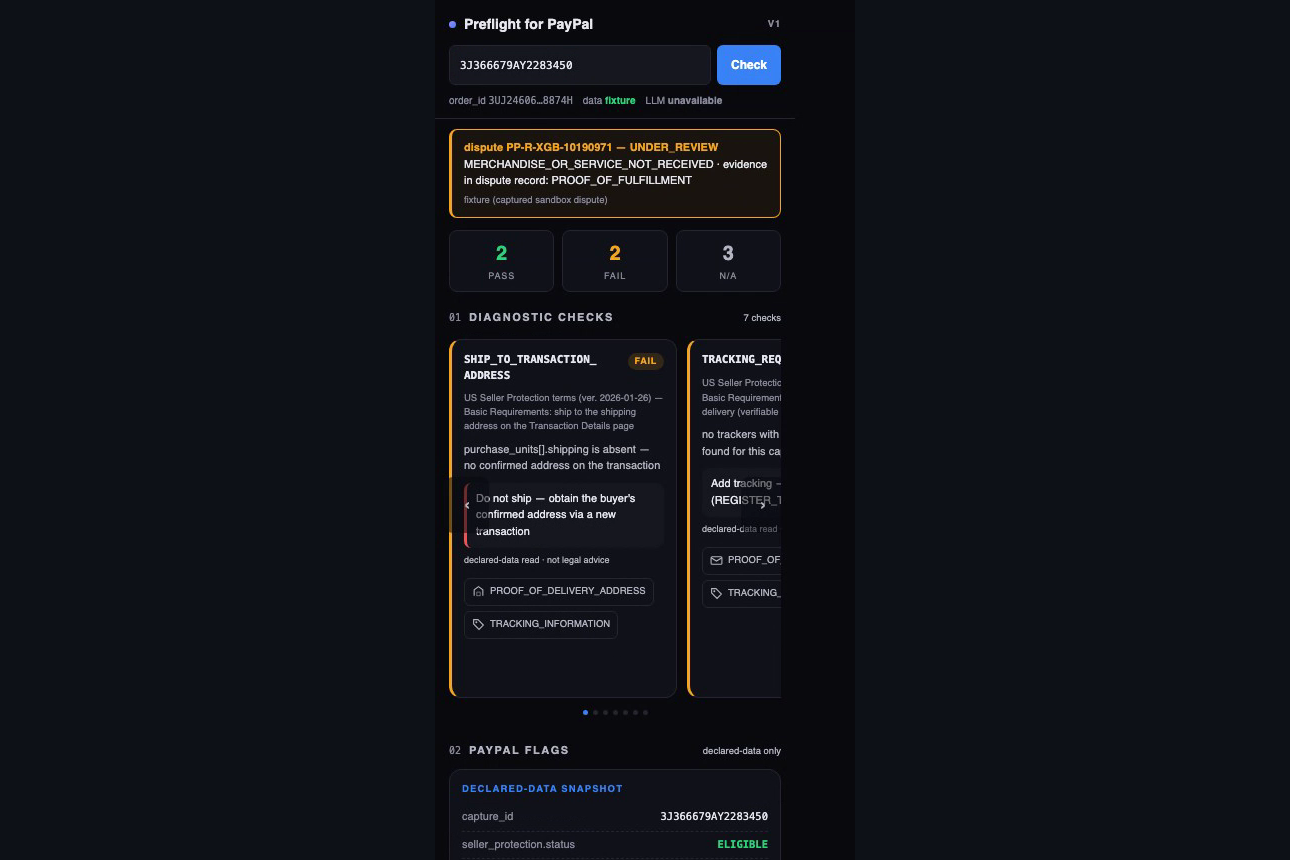

Preflight for PayPal — Seller Protection readiness for sellers: 7 checks, 6 fixture orders, 1 captured sandbox dispute — runnable in ~2 minutes with no PayPal account.
Inspiration
PayPal's seller_protection.status flag says ELIGIBLE — but it is a declared-data snapshot, not a decision on whether the seller's actions satisfy the US Seller Protection terms (ver. 2026-01-26). In our sandbox measurements the flag stayed ELIGIBLE on orders missing a shipping address, missing tracking, and carrying digital goods — while a card-funded capture flipped to NOT_ELIGIBLE the moment payment_source changed. A seller who trusts the flag ships unprotected, and when an item-not-received dispute lands they lose the goods and the payment.
What it does
Preflight is a Chrome extension living inside the PayPal merchant console. Before shipping, the seller pastes a capture/order ID and Preflight evaluates the transaction against 7 checks mapped to the current US Seller Protection terms — each check carrying the real clause name it derives from. Results split honestly into pass / fail / not assessable (conditions the Orders API cannot see are never presented as failures). Every fail ships a fixed prescription, including "do not ship" where correction is impossible.
The demo walks three acts:
- Diagnose — capture
3J366679AY2283450showsELIGIBLEyet fails two Basic Requirements (no shipping address, no tracking). - Correct — registering UPS tracking
1Z999AA10123456784writes through PayPal's Shipping Trackers API; re-check flipsTRACKING_REQUIREDfail→pass while the unfixable address fail honestly remains. - Correspondence — the same capture later became real sandbox dispute
PP-R-XGB-10190971; thePROOF_OF_FULFILLMENTevidence slot carries a "requested in dispute" marker. The evidence PayPal demands after a dispute is what Preflight surfaces before shipment.
How we built it
- Orders API (
GET /v2/checkout/orders) + Payments capture — transaction shape, shipping address presence,seller_protectionflag read as declared data. - Shipping Trackers API (
/v1/shipping/trackers-batch,GET /v1/shipping/trackers) — the write-back correction loop, verified live in sandbox. - Disputes API (
/v1/customer/disputes) — real sandbox dispute record driving the evidence-correspondence layer. - Deterministic rule layer (
backend/rules.py+backend/policy.py) — every check cites its clause by real section name, pinned to document version 2026-01-26 (audited against the current legalhub text; invented section numbers were found and removed inbd/AUDIT-seller-protection-terms_20261012.md). - Honest-degrading LLM meaning layer (
backend/meaning.py) — reportsran=falsewithout a key; the product never hides its unavailability. - Chrome extension (MV3) side panel + Python stdlib localhost backend (127.0.0.1-only bind, token auth on the write path, constant-time token compare, 1 MB body cap).
- Judge-runnable fixture mode — 6 orders / 6 captures / 1 dispute captured from a real sandbox, served locally with an in-memory tracker store so the register→re-check loop works without any PayPal account.
- 110 pytest cases + 37 browser checks green; the demo video is produced by a Playwright harness that asserts on-screen content, not just file existence.
Challenges we ran into
- The sandbox
seller_protectionflag is a stub: six varied orders all returnedELIGIBLE. That measurement became the product's thesis — the flag alone cannot tell a seller they are unprotected, so the semantic/action layer had to be built on top rather than trusting the flag. - Seller Protection terms are prose. Mapping each check to the current US version required a clause-by-clause audit; the $750 signature-confirmation check exists only in other regions' terms, so it was downgraded to a fixed not-assessable note rather than a fabricated failure.
- Dispute creation in sandbox needs buyer-side credentials (
PayPal-Auth-Assertion+buyer_transaction_id), so a second dispute had to be documented as a manual-UI step — the evidence-request machinery itself was still verified end-to-end on a real dispute.
Accomplishments we're proud of
- The flag-vs-conditions gap is not asserted — it is measured (six-order variation matrix; card vs. wallet payment-source flip measured live).
- The product closes a real write loop through PayPal's API, not a screenshot of one.
- Every claim a judge can click is backed by a captured response, a test, or an audit note — including the things that did not work.
What we learned
payment_source moves the flag: a card-funded capture returned NOT_ELIGIBLE where wallet-funded captures returned ELIGIBLE — meaning sellers taking card-side payments sit outside Seller Protection entirely. Also: the Disputes API's evidence-request lifecycle (require-evidence → provide-evidence → adjudication) is fully drivable in sandbox, which is what let us prove the pre-shipment/post-dispute correspondence.
What's next for Preflight for PayPal
Real-seller validation (one seller walkthrough on a sandbox-replayed live order — currently unverified and labeled as such), live-mode hardening for app review, and coverage of the remaining non-assessable conditions as PayPal exposes more signals.
Judging-criteria map
- Technical implementation — deterministic rule layer over the Orders API and Shipping Trackers API with per-check clause citations pinned to ver. 2026-01-26, an honest-degrading LLM layer, token-authenticated localhost backend, and a dispute record via the Disputes API.
- Design — the flag-vs-conditions gap is surfaced inside the merchant console at the moment of shipping, not in a separate dashboard after the dispute arrives.
- Impact — sellers lose goods and payment when a dispute arrives unprotected; pre-shipment warnings map 1:1 onto the evidence types PayPal later requests, demonstrated on a real sandbox dispute.
- Innovation — for agentic commerce, declared data must be verified at the edge: Preflight turns the flag's declaration into checked conditions with fixed prescriptions, never predicting dispute outcomes.
- Presentation — 2-minute 3-act demo video plus a judge-runnable fixture mode: no PayPal account, ~2 minutes.
Honest limitations
Fixture mode labels its data source on screen; the LLM semantic layer reports unavailable rather than faking output; the tool is not legal advice and never predicts dispute outcomes; business/customer validation is explicitly unverified. ELIGIBLE is always presented as PayPal's declared data, not our endorsement.
Built With
- chrome
- javascript
- manifest-v3
- paypal-disputes-api
- paypal-orders-api
- paypal-shipping-trackers-api
- playwright
- python
- sandbox-testing

Log in or sign up for Devpost to join the conversation.