Inspiration
Publishing a video today is essentially a one-way gamble. A creator can spend hours producing a video, yet discover only after publication that it contains a policy violation, profanity, inaccessible content, exposed credentials, poor audio, unreadable text, visual problems, or another issue that can affect reach, monetization, or trust.
Existing moderation and analysis tools are usually detectors: they identify individual problems and return a result. But detection alone does not answer the harder questions:
Did the system actually examine the entire video? Is the finding supported by evidence? Do multiple signals corroborate it? What policy does it violate? Can it be fixed automatically? Did the fix actually work? Did the fix introduce something new?
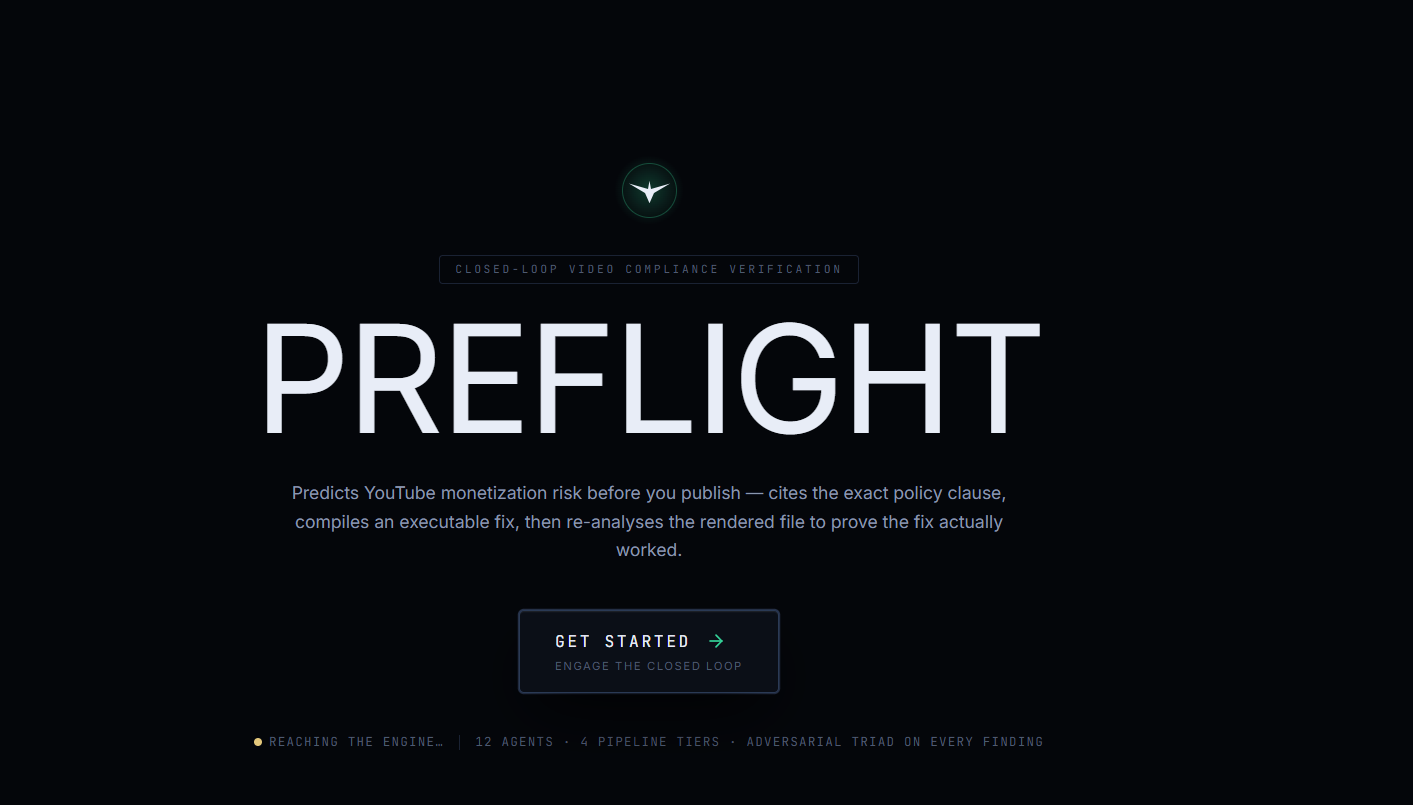
That led us to build PREFLIGHT — an Autonomous Video Assurance Engine.
Our idea was inspired by the concept of a pre-flight check in aviation. A pilot does not simply ask whether one component works. Multiple systems are inspected, anomalies are cross-checked, failures are documented, corrective actions are performed, and the aircraft is verified before takeoff.
We applied the same philosophy to video publishing.
Instead of asking:
“Can AI detect something wrong in this video?”
PREFLIGHT asks:
“Can an autonomous system investigate the video, prove its findings, remediate the problems, and verify that the final artifact is actually safe to publish?”
What PREFLIGHT Does
PREFLIGHT turns a raw video into an evidence-backed, auditable publication decision.
The pipeline is:
VIDEO → INGEST → MULTIMODAL ANALYSIS → EVIDENCE → POLICY RETRIEVAL → FUSION → INCIDENTS → ADJUDICATION → SIMULATION → REMEDIATION → RE-ANALYSIS → VERIFICATION
The important difference is that this is not simply a collection of independent AI models.
It is an autonomous multi-agent investigation system.
The orchestrator dynamically coordinates specialized agents, preserves their evidence, tracks their coverage, resolves conflicts, groups related findings, evaluates policy implications, and ultimately determines whether remediation actually succeeded.
The Multi-Agent Architecture
PREFLIGHT uses specialized agents because different modalities require fundamentally different forms of evidence.
Orchestrator Agent The Orchestrator is the control plane of the system.
It creates the execution plan, manages dependencies, tracks agent states, handles retries and fallbacks, maintains the run timeline, and passes structured evidence between agents.
It does not pretend to be a detector.
Its role is coordination rather than creating fake corroboration.
Video Processing Agent This agent establishes the physical structure of the video.
It analyzes:
duration resolution frame rate codecs streams orientation color information HDR characteristics scene transitions motion frame sampling freeze frames black frames visual anomalies
It also creates reusable analysis artifacts so downstream agents do not repeatedly decode the same video.
This led to an important optimization: expensive FFmpeg operations are memoized using content-aware cache keys, reducing duplicate decoding while preserving correctness.
Vision Agent The Vision Agent examines sampled visual evidence.
It can reason about:
violent content unsafe scenes inappropriate imagery visual anomalies screen content objects and environments scene context visual policy signals
The sampler is duration-aware and motion-aware, rather than blindly analyzing every frame.
Static regions still receive representation because a motion-only sampler could completely miss an important presentation slide or screen recording.
Speech Agent The Speech Agent converts spoken content into structured temporal evidence.
It analyzes:
transcription word timing profanity suspicious phrases speech segments conversational context speaker-related information where available
Every detected phrase remains connected to its timestamp so downstream reasoning can point back to the original evidence.
Audio Agent The Audio Agent investigates the acoustic layer independently from speech.
It analyzes:
loudness clipping silence dynamic range background interference sudden audio changes speech-to-background balance delivery quality
This separation is important because something can be acoustically problematic even when the transcript itself appears perfectly normal.
OCR / Security Agent OCR extracts visible text from frames and screens.
PREFLIGHT then performs semantic security analysis over that text instead of treating OCR output as ordinary words.
It can identify patterns such as:
API keys access tokens passwords authorization headers database credentials credential-like URLs email addresses phone numbers credit-card-like sequences
Sensitive findings are redacted at capture time, preventing the secret detected in the video from being copied into the report, HTML interface, or logs.
The system also applies precision checks such as checksum validation where appropriate to reduce false positives.
Accessibility Agent The Accessibility Agent evaluates whether the video can be consumed by a broader audience.
It checks signals such as:
missing captions subtitle availability timed-text streams speech accessibility audio delivery problems relevant accessibility metadata
Most importantly, it produces file-scoped evidence correctly rather than incorrectly pretending that a file-wide issue occurs at a particular timestamp.
Metadata Agent The Metadata Agent evaluates available publication metadata and identifies problems that cannot be discovered from pixels and audio alone.
It can reason over:
title description tags content metadata metadata-policy consistency
Metadata is treated as another evidence modality rather than being mixed blindly with visual findings.
Policy Retrieval Agent PREFLIGHT maintains a local policy corpus and retrieves the clauses relevant to detected findings.
The retrieval layer combines:
semantic similarity + lexical search
using:
FAISS IndexFlatIP + BM25 + Reciprocal Rank Fusion (RRF).
For a query, the fused ranking can be represented conceptually as:
RRF(d)= m∈M ∑
k+rank m
(d) 1
where each retrieval method contributes evidence to the final ranking.
This keeps policy retrieval fast, deterministic, local, and reproducible without requiring a remote vector database for a small policy corpus.
Multi-Agent Policy Reasoning
Policy analysis is deliberately separated from raw detection.
A detector can say:
“Profanity detected at 00:13.”
The policy layer asks:
“Which policy clause applies, what evidence supports the classification, and what action does that clause imply?”
This separation prevents the final adjudication layer from inventing policy reasoning.
Evidence Fusion
Different agents can observe the same underlying problem.
For example:
Speech → profanity detected
OCR → offensive text detected
Vision → contextual evidence
Instead of simply averaging their scores, PREFLIGHT maintains modality-specific evidence and combines independent observations through controlled confidence fusion.
Conceptually:
C fusion
=1− i=1 ∏ n
(1−C i
)
with additional safeguards preventing the same detector from effectively corroborating itself multiple times.
This produces a stronger confidence estimate when genuinely independent evidence agrees.
Coverage-Aware Intelligence
One of PREFLIGHT's strongest design principles is:
Absence of evidence is not evidence of absence.
Every agent has measurable coverage.
PREFLIGHT distinguishes:
NEGATIVE_EVIDENCE — the material was examined and nothing was found.
INSUFFICIENT_COVERAGE — the system examined some material but not enough to support an absence claim.
NO_COVERAGE — the relevant span was not examined.
NOT_RUN — the modality never executed.
Therefore:
A 9% vision sample cannot certify that the remaining 91% is clean.
This prevents a common failure mode of automated moderation systems: turning incomplete inspection into false confidence.
Adaptive Evidence Sampling
Vision is computationally expensive, especially for long videos.
Instead of blindly sending every frame to a model, PREFLIGHT uses an adaptive sampling strategy.
The sampling budget balances:
S=αU+(1−α)M
where:
U represents uniform temporal coverage M represents motion/scene-informed coverage α preserves representation of static content
This prevents two opposite failures:
Pure uniform sampling can miss short high-risk events.
Pure motion sampling can miss static screens, text, slides, credentials, and other visually important content.
Incident Intelligence
Individual findings are not automatically treated as separate incidents.
PREFLIGHT groups related findings using temporal proximity, semantic compatibility, and evidence relationships.
However, proximity alone is not enough.
Two unrelated problems occurring at the same second should remain separate if their evidence is unrelated.
This prevents:
“Two things happened at the same timestamp”
from incorrectly becoming:
“These two things are the same incident.”
The resulting incident graph becomes the basis for investigation and remediation.
Evidence-Grounded Adjudication
PREFLIGHT enforces a strict no-hallucination principle.
A claim cannot exist without a source.
A claim must point to something that already exists in the run:
finding evidence span policy clause detector agent observation
Therefore the reasoning layer cannot simply invent:
“This violates policy.”
without identifying why and where the evidence came from.
The system also distinguishes:
looked and found nothing
from
never examined the material.
That distinction is fundamental to trustworthy autonomous reasoning.
Autonomous Remediation
PREFLIGHT goes beyond reporting.
When a finding has a valid remediation strategy, the system converts it into an executable edit plan.
The remediation pipeline is:
Finding → Edit Decision List → FFmpeg → Render → Structural Verification
Examples include operations such as:
cutting problematic spans replacing/removing problematic sections applying audio transformations producing a corrected artifact
The rendered file is written atomically and checked structurally before being promoted.
Decision Simulation
Before applying a remediation, PREFLIGHT can simulate its expected effect.
The simulator removes the evidence associated with the proposed edit and re-evaluates the expected outcome using the same scoring logic that produced the original decision.
This avoids having:
one algorithm predict the result
and
another algorithm produce the actual result
because those systems could disagree.
The Most Important Feature: Verification
The biggest difference between PREFLIGHT and a traditional detector is what happens after the fix.
PREFLIGHT does not trust:
“FFmpeg completed successfully.”
Instead:
ORIGINAL
↓
DETECT
↓
REMEDIATE
↓
RENDER
↓
RE-ANALYZE THE NEW ARTIFACT
↓
COMPARE
↓
FINAL VERDICT
The second analysis is important because the corrected video is a new artifact with a different content hash.
PREFLIGHT therefore verifies the actual output instead of assuming the edit worked.
Before vs After Intelligence
The verification engine compares the original and corrected reports using semantic identity rather than unstable run IDs.
A finding can become:
RESOLVED
PERSISTING
NEW
or
INCONCLUSIVE
This matters because remediation can have unexpected side effects.
For example:
Two original findings are successfully removed.
But re-analysis discovers:
One new risk appeared in the corrected artifact.
A conventional system might report:
“Fix successful.”
PREFLIGHT reports:
“PARTIALLY_REMEDIATED — original risks resolved, persistent risks remain, and a new risk was detected.”
That is a much more defensible publication decision.
Risk Scoring
The final score combines multiple dimensions while preserving critical failures.
Conceptually:
R= i=1 ∑ n
w i
s i
but the system also applies severity-aware constraints so that a critical failure cannot simply disappear inside a high average.
This prevents a video from receiving a misleadingly good score because excellent audio or metadata compensates mathematically for a severe security or policy problem.
What We Learned
The most important lesson was that building an autonomous AI system is not primarily about adding more models.
It is about engineering trust between imperfect components.
We encountered failures that looked correct at first:
duplicate decoding incorrect sampling distributions OCR silently unavailable credential patterns missed inside environment variables false confidence from insufficient coverage incorrect incident merging false corroboration from non-detector agents remediation that completed but had not actually been verified
Each failure changed the architecture.
The result is a system where correctness, provenance, coverage, and verification are first-class concepts rather than afterthoughts.
Why PREFLIGHT Is Novel
Most systems answer:
“What did the model detect?”
PREFLIGHT answers a much harder question:
“What did the system actually examine, what evidence supports the finding, which policy applies, how should it be remediated, did the remediation work, and what changed in the resulting artifact?”
That transforms video analysis from detection into autonomous assurance.
PREFLIGHT is designed to act as a final intelligent checkpoint between video creation and video publication.
DETECT → INVESTIGATE → PROVE → SIMULATE → REMEDIATE → RE-ANALYZE → VERIFY
Don't just publish. Prove it's ready.
Built With
- adaptive
- agentic
- bm25
- computer-vision
- evidence
- faiss
- fastapi
- ffmpeg
- fusion
- llms
- multi-agent
- multimodal
- natural-language-processing
- ocr
- python
- rank
- react
- reciprocal
- recognition
- safety
- speech
- tailwind
- typescript


Log in or sign up for Devpost to join the conversation.