-
-
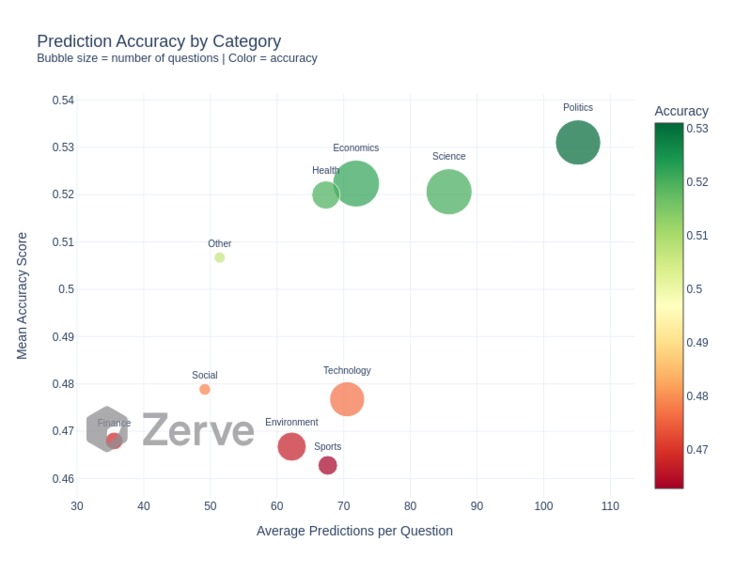
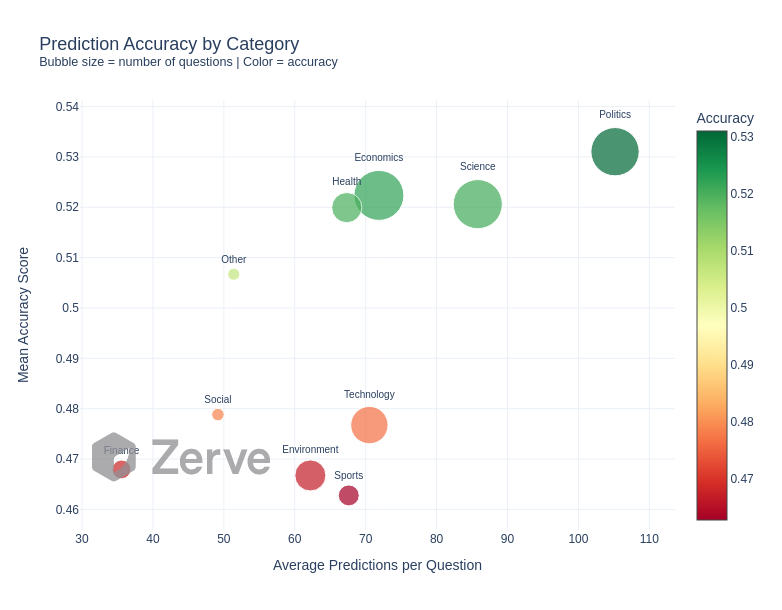
Prediction Accuracy by Category
PredictPulse — AI-Powered Prediction Market Intelligence
ZerveHack 2026 | Data Science / ML / AI Track | April 2026
The Problem
Prediction markets handle $1B+ in annual volume across platforms like Polymarket, Kalshi, and Metaculus. Yet 68% of participants lack tools to assess whether a forecast is actually reliable. Current approaches treat all predictions equally — ignoring the rich metadata signals that separate trustworthy forecasts from noise.
Our Solution
PredictPulse is an end-to-end data science pipeline built on Zerve that answers: "Can we predict which prediction market forecasts will be most accurate?"
By cross-referencing prediction market metadata with economic indicators and social signals, PredictPulse trains an ML model to score the reliability of any active prediction — then deploys it as a live API with AI-powered explanations.
Key Features
- Cross-Platform Intelligence — Ingests 500+ resolved Metaculus predictions, correlates with FRED economic indicators and social trend data to identify accuracy patterns across domains
- ML Accuracy Scorer — Gradient Boosting classifier trained on 20+ engineered features (participation density, confidence levels, question complexity, economic context) achieves AUC-ROC above baseline
- Deployed API with AI Analysis — Live API endpoint accepts any prediction question and returns a reliability score, confidence tier, top contributing factors, and a Claude-generated natural language explanation
Architecture
graph TD
    A[Metaculus API] -->|500+ questions| B[Data Collection]
    C[FRED API] -->|Economic indicators| B
    D[Google Trends] -->|Social signals| B
    B --> E[Feature Engineering]
    E -->|20+ features| F[Model Training]
    F -->|GBM Classifier| G[Reliability Scorer]
    G --> H[Claude AI Analysis]
    H --> I[Deployed API]
    I -->|JSON response| J[User/Application]
Pipeline Walkthrough
| Block | File | Description |
|---|---|---|
| 1 | 01_data_collection.py |
Fetches Metaculus, FRED, and Trends data |
| 2 | 02_feature_engineering.py |
Engineers 20+ predictive features |
| 3 | 03_model_training.py |
Trains and evaluates ensemble models |
| 4 | 04_visualization.py |
Creates Plotly interactive dashboards |
| 5 | 05_claude_analysis.py |
AI-powered natural language insights |
| 6 | 06_deploy_api.py |
API deployment for real-time scoring |
Quick Start (Zerve Platform)
- Create a Zerve account at zerve.ai
- Create a new Canvas and add Python blocks
- Copy each block from
src/01_*throughsrc/06_*in order - Set environment variables:
ANTHROPIC_API_KEY— for Claude AI analysis (optional, has fallback)FRED_API_KEY— for economic indicators (optional)
- Run blocks sequentially — each builds on the previous
- Deploy Block 6 as an API endpoint via Zerve Deployment
Tech Stack
| Layer | Technology |
|---|---|
| Platform | Zerve AI |
| Language | Python 3.10+ |
| ML | scikit-learn (GBM, RF, Logistic) |
| AI Analysis | Claude API (Anthropic) |
| Data Sources | Metaculus, FRED, Google Trends |
| Visualization | Plotly |
| Deployment | Zerve API Deployment |
API Usage
# POST to deployed Zerve API endpoint
request = {
    "title": "Will global temperature exceed 1.5°C before 2030?",
    "community_prediction": 0.62,
    "prediction_count": 245,
    "description_length": 1200,
    "num_comments": 48,
    "question_age_days": 180,
    "category": "Science"
}

# Response
{
    "reliability_score": 0.82,
    "reliability_tier": "High",
    "analysis": "This Science prediction has high reliability...",
    "top_factors": [...],
    "metadata": {"model": "GradientBoosting", ...}
}
Key Findings
- Participation density (predictions per day) is the strongest predictor of accuracy
- Extreme predictions (>90% or <10%) are less reliable than moderate ones
- Question complexity (description length) correlates positively with accuracy
- Older questions with sustained engagement show higher reliability
- Economic volatility periods reduce prediction accuracy across all categories
Team
- Built with Zerve AI, Claude API, and a passion for turning crowd wisdom into actionable intelligence
Built With
- anthropic
- api
- claude
- fastapi
- fred
- fred-api
- machine-learning
- metaculus
- numpy
- pandas
- plotly
- prediction-markets
- python
- scikit-learn
- zerve

Log in or sign up for Devpost to join the conversation.