-
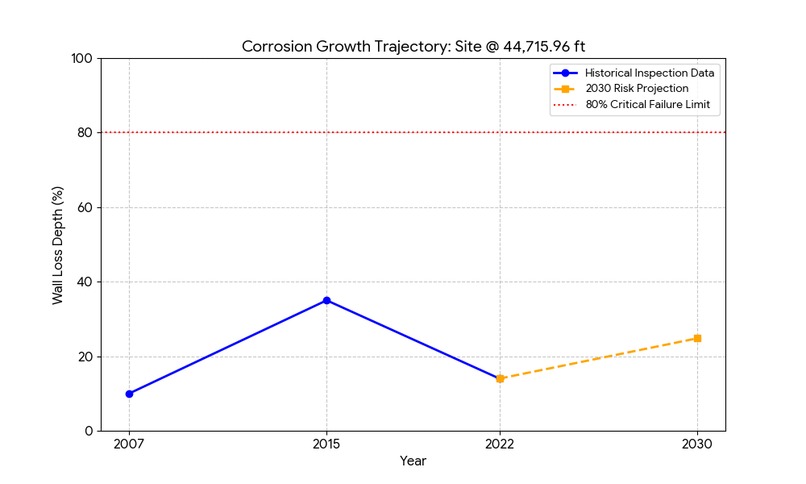
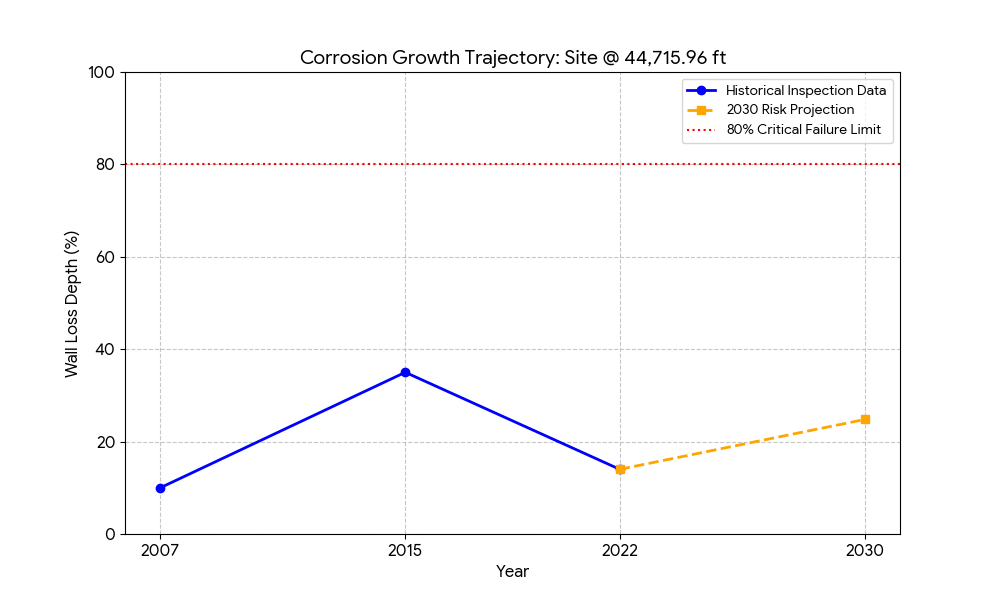
Priority Monitoring List (High to Low Growth)
-
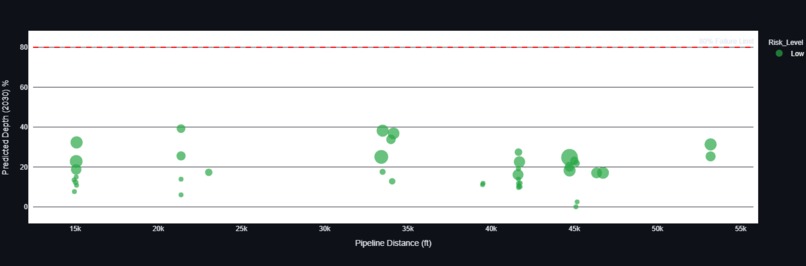
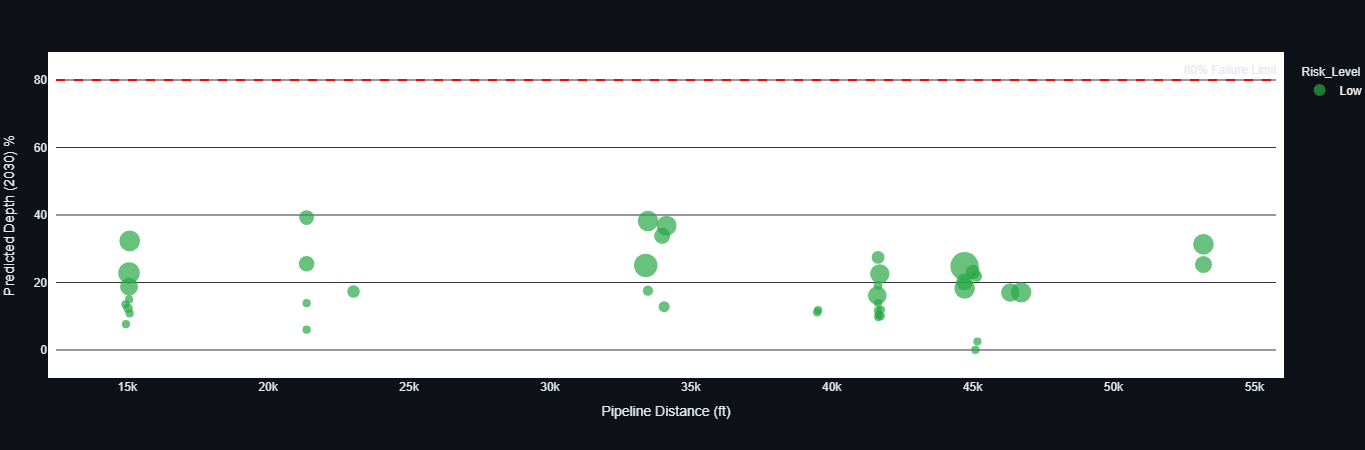
Risk Radar Chart
Inspiration
Pipeline maintenance is a game of millimeters, but tracking those millimeters over decades is a massive data challenge. We were inspired by the difficulty operators face when trying to match "corrosion signals" across 15 years of inspection logs. Odometer drift and sensor variations often lead to "ghost" defects or missed growth trends. We wanted to build a system that creates a persistent, verifiable identity for every physical anomaly on the pipe.
What it does
The Predictive Pipeline Integrity System is a full-stack solution that synchronizes of In-Line Inspection (ILI) data to predict corrosion risks through 2030. It anchors 2007 and 2015 datasets to a 2022 "Master" baseline using physical girth welds as staples. It then identifies 42 high-confidence "Golden Features" and uses linear regression to forecast wall loss, providing an interactive "Risk Radar" for operators.
How we built it
Alignment: We used FastDTW (Dynamic Time Warping) to align the longitudinal distances of the 2007 and 2015 runs to the 2022 baseline.
Matching: We implemented the Hungarian Algorithm to find the mathematically optimal 1-to-1 pairing of defects across years.
AI Auditing: We integrated Google Gemini 1.5 Flash as an "Agentic Auditor" to verify growth trends and filter out physically impossible sensor noise (e.g., pipe depth decreasing over time).
Frontend: A Streamlit dashboard hosted on AWS allows for real-time risk assessment and longitudinal visualization.
Challenges we ran into
The biggest challenge was Data Reversal. We encountered sensor readings where the 2022 depth appeared smaller than the 2015 depth—which is physically impossible for corrosion. Initially, this skewed our growth models. We overcame this by building the AI Auditor to flag these anomalies as "REJECT," ensuring our final predictions were only based on verified physical realities.
Accomplishments that we're proud of
Precision Alignment: We achieved a 0.0000 ft error at our primary reference valves, proving our "stapling" method works.
Reliability: Our system achieved a 90.4% Consensus Score with the AI Auditor, giving us high confidence in our 2030 forecast.
Safety Buffer: We successfully proved that the pipeline currently maintains a 47.7% safety margin below the 80% failure limit.
What we learned
We learned that while math (Linear Regression) is great for prediction, it needs a "logic layer" to be useful in engineering. Integrating LLMs like Gemini 1.5 Flash isn't just for chat; they are powerful tools for auditing technical data and enforcing the laws of physics in automated pipelines.
What's next for Predictive Pipeline Integrity System
We plan to expand the system to include Soil Corrosivity Data and Cathodic Protection (CP) readings. By combining internal ILI data with external environmental factors, we can move from simple linear growth rates to sophisticated machine learning models that predict where new corrosion is likely to initiate before it even appears on a sensor.

Log in or sign up for Devpost to join the conversation.