PredictIQ - AI Predictive Maintenance Platform
Inspiration
Industries lose over $50 billion every year due to unexpected machinery breakdowns. Traditional maintenance strategies are broken: they are either reactive (fixing equipment after catastrophic failure) or preventive (replacing functional parts on arbitrary calendar schedules). Both waste vast amounts of capital and time.
We were inspired to build PredictIQ to give industrial plant managers and field engineers "superhuman sight"—transforming raw, high-frequency IoT sensor telemetry into real-time failure prediction, exact Remaining Useful Life (RUL) estimation, and prescriptive maintenance action plans before downtime ever occurs.
What it does
PredictIQ is an end-to-end AI Predictive Maintenance & Industrial Telemetry Platform that monitors machinery in real time and predicts failures before they happen.
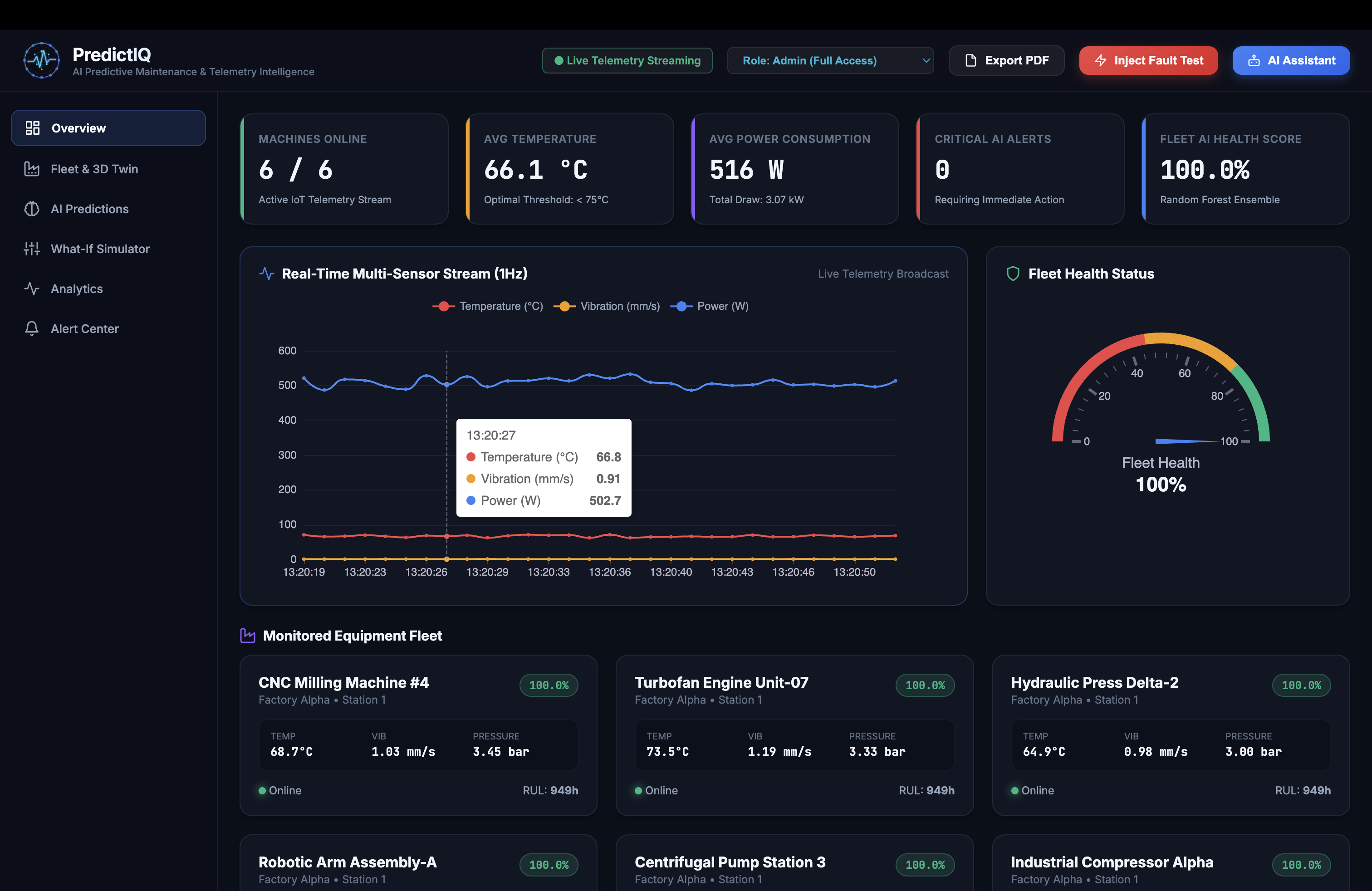
- Real-Time IoT Telemetry Dashboard: Streams 1Hz multi-sensor data (temperature, hydraulic pressure, spindle RPM, vibration, and power draw) across an entire equipment fleet.
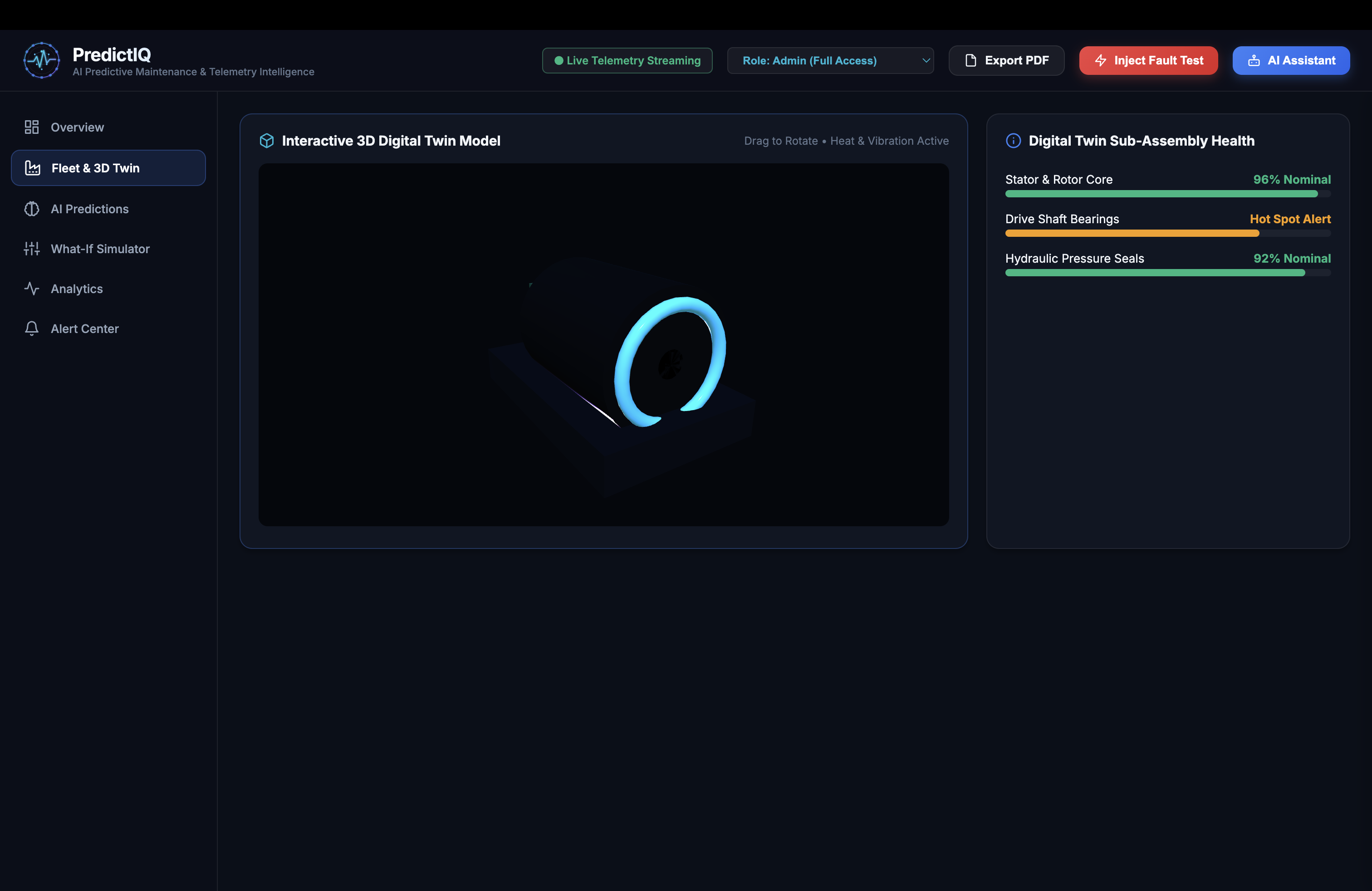
- 3D Digital Twin Visualizer: Renders an interactive WebGL 3D turbine model with dynamic thermal heatmaps and physical vibration displacement in real time.
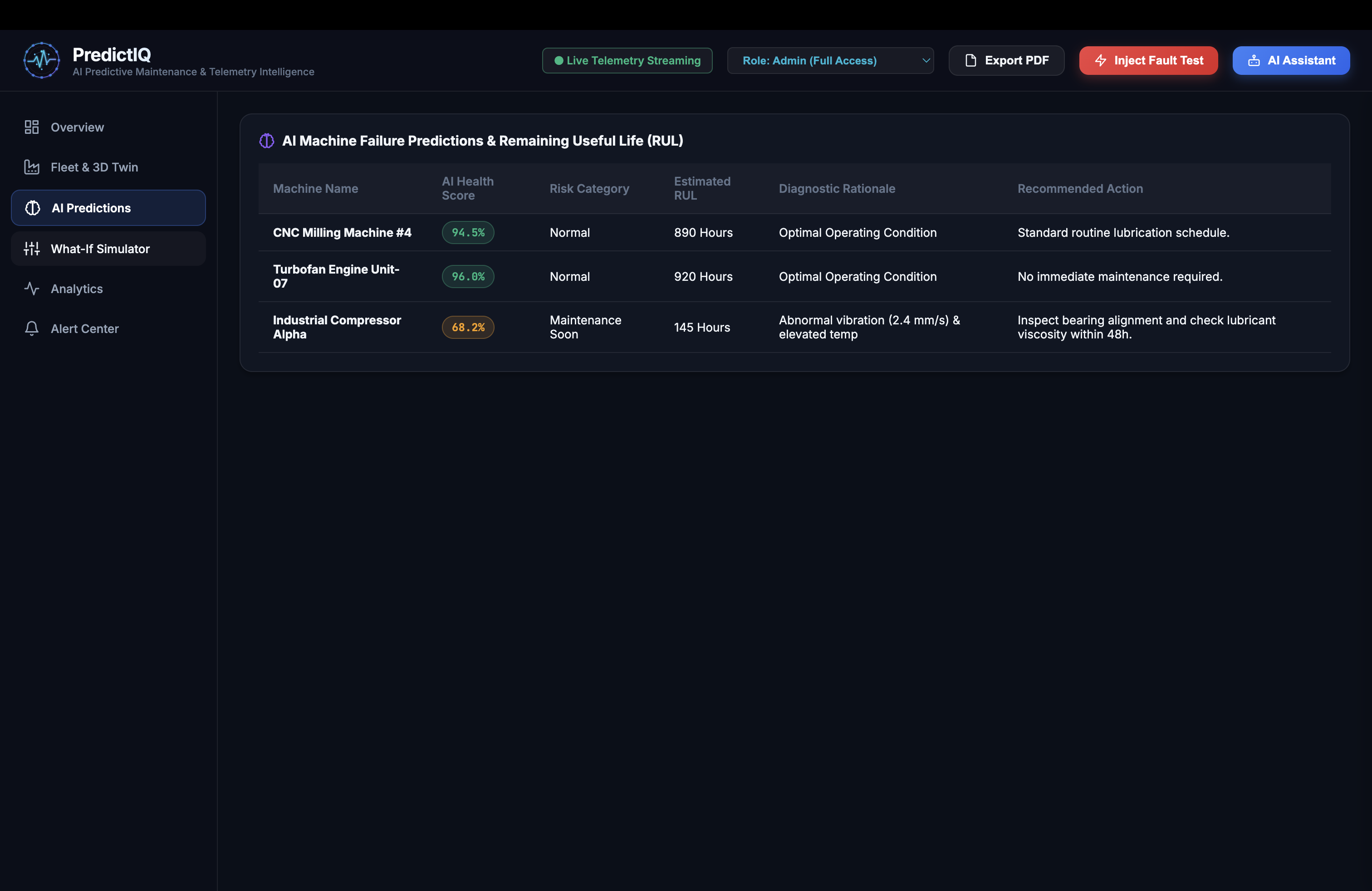
- AI Failure Prediction & RUL Engine: Employs ensemble machine learning to predict failure risk with 99.25% accuracy, estimate Remaining Useful Life (RUL) in exact operating hours, and deliver automated root-cause recommendations.
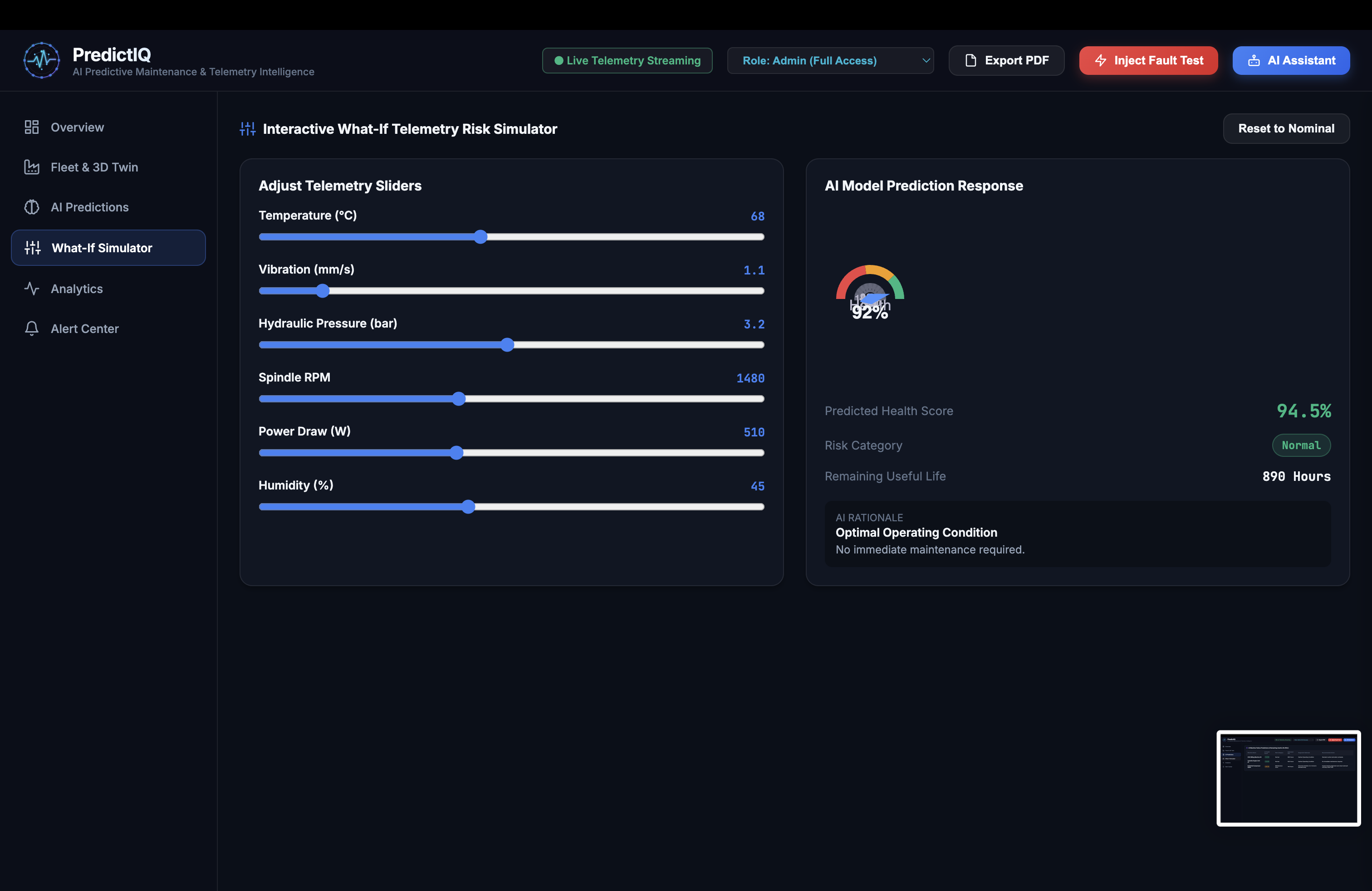
- Interactive What-If Risk Simulator: Enables engineers to manipulate live sensor sliders to test thermal runaway or vibration surge scenarios and observe instant AI health recalculations and anomaly triggers.
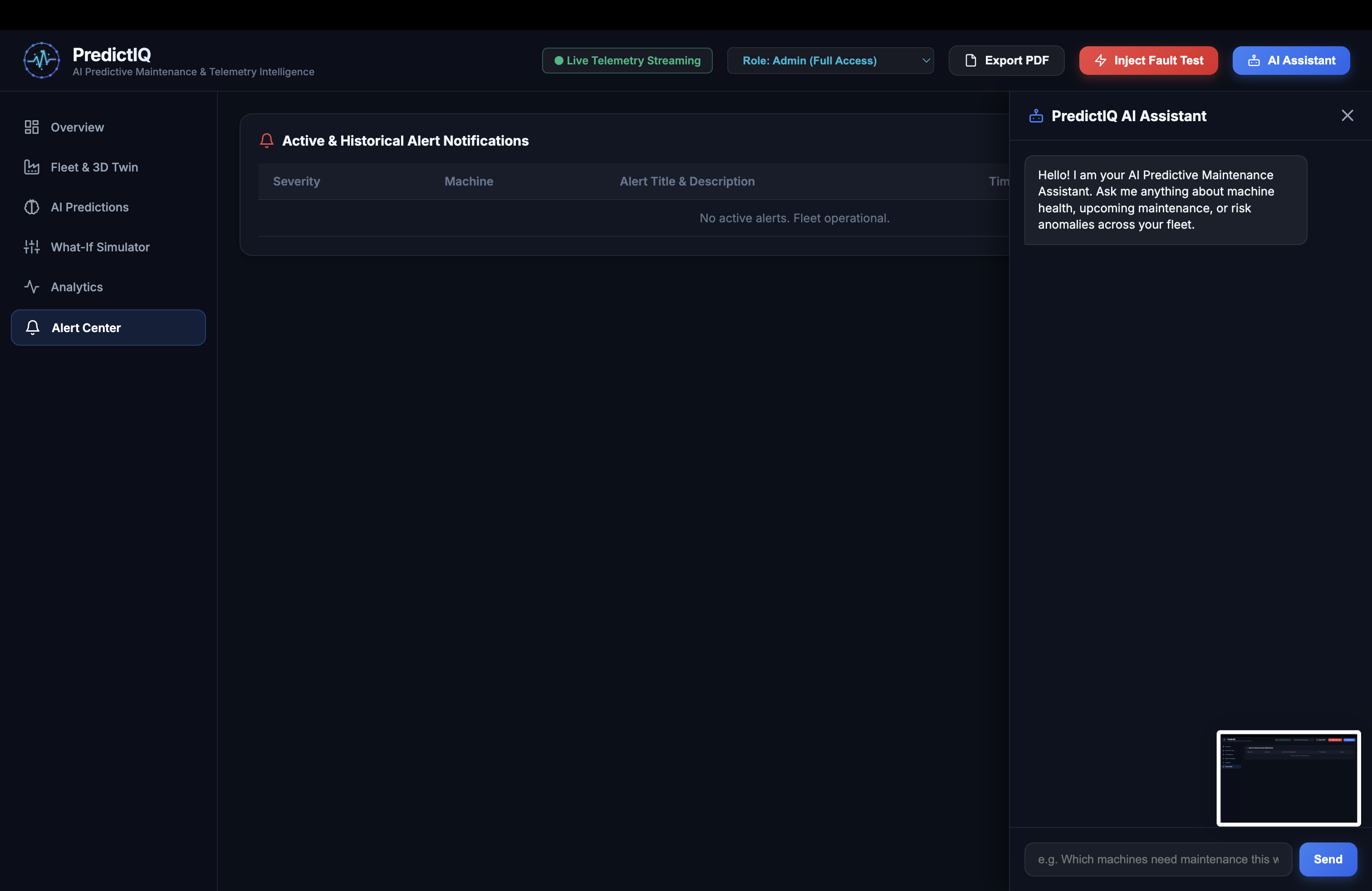
- Conversational AI Assistant: Features an integrated LLM diagnostic assistant where operators can ask natural language queries ("Which machines need maintenance this week?") to receive prioritized action plans.
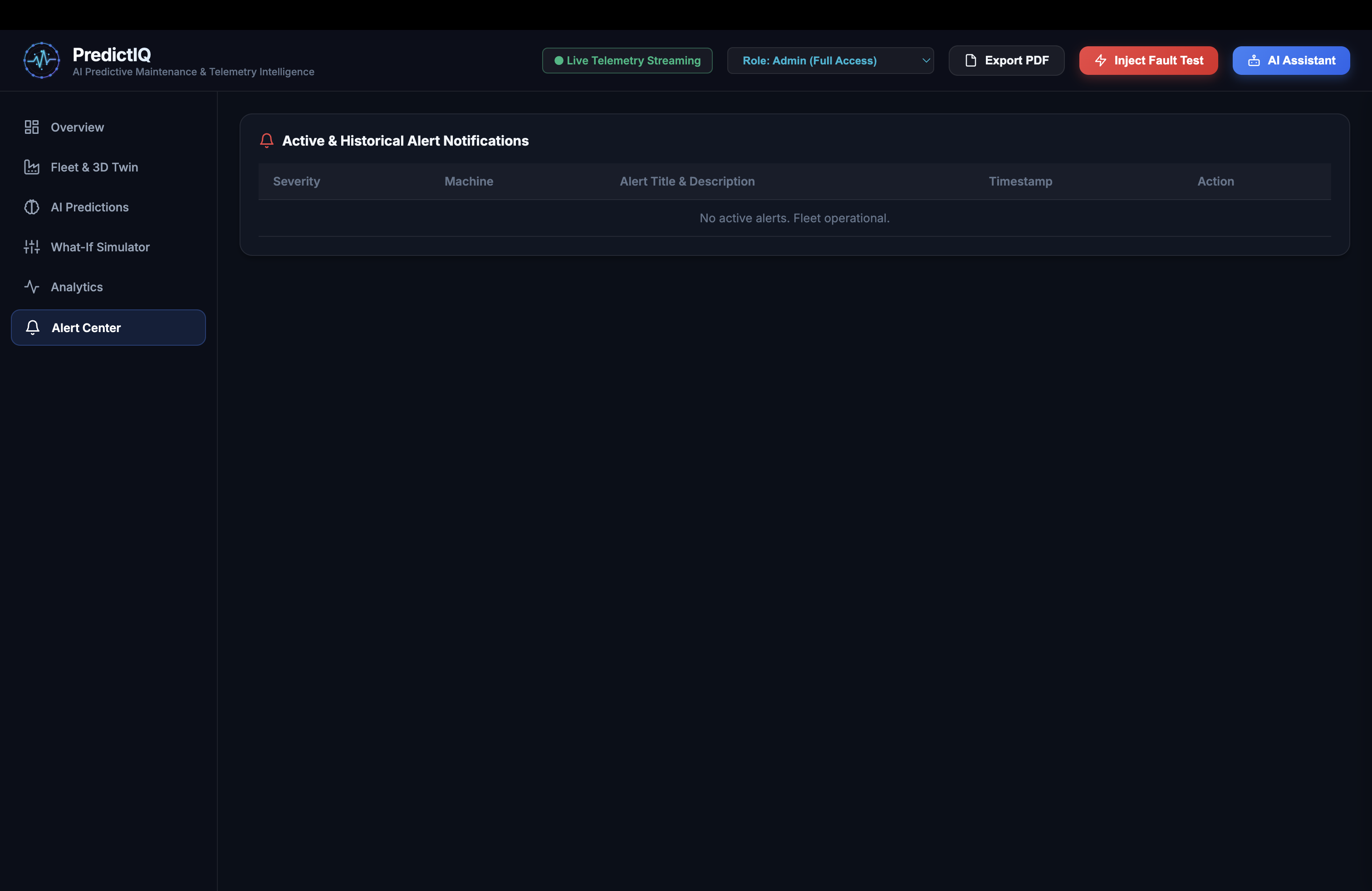
- Alert Center & Executive PDF Reports: Manages operational alerts and generates executive PDF reports with automated data tables and health summaries.
How we built it
We built PredictIQ as a full-stack, decoupled industrial architecture:
- AI & Machine Learning Engine: Trained in Python using
Scikit-Learnon synthetic industrial telemetry representing turbofans, CNC mills, and hydraulic presses. Built an ensemble Random Forest Risk Classifier (99.25% accuracy), Isolation Forest Outlier Detector, and Gradient Boosting RUL Regressor. - Backend & Streaming Server: Powered by FastAPI with asynchronous WebSockets streaming 1Hz IoT telemetry diffs, backed by SQLite & SQLAlchemy for persistent asset metadata.
- Frontend & Web Visualizations: Built a dark glassmorphism UI using HTML5 & Vanilla CSS. Rendered streaming line charts with Apache ECharts and high-fidelity 3D Digital Twins with Three.js / WebGL.
- IoT Device Telemetry Simulator: Built a background simulation engine with sinusoidal harmonics, physical noise modeling, and manual fault injection controls (thermal runaway, bearing wear, pressure leaks).
Challenges we ran into
- Real-Time WebGL & Telemetry Synchronization: Streaming multi-sensor data across 6 industrial assets every second while rendering a 3D turbine model in Three.js and executing server-side AI inference threatened to cause browser frame drops. We solved this by building non-blocking FastAPI WebSockets workers, caching ML feature scaling to achieve <5ms inference latency, and isolating Three.js rendering loops to lock 3D graphics at 60fps.
- Realistic Telemetry Modeling: Generating synthetic sensor telemetry that adhered to physical laws (e.g., thermal dissipation friction spikes) required fine-tuning mathematical harmonics so ML models trained on synthetic data yielded realistic risk scores.
Accomplishments that we're proud of
- 99.25% Failure Prediction Accuracy: Achieving exceptional classification accuracy on multi-sensor risk prediction and precise RUL hour estimation.
- Interactive 3D WebGL Digital Twin: Bringing industrial machinery to life in the browser with live thermal heat gradients and real-time vibration deformation.
- Complete End-to-End Integration: Delivering a fully functional platform—from 1Hz simulated IoT hardware and WebSockets streaming to a conversational AI assistant and executive PDF generator—all in a single hackathon sprint.
What we learned
- The Power of Asynchronous Sockets: How WebSockets diff streaming dramatically outperforms traditional REST polling for high-frequency industrial IoT data.
- 3D Shader Telemetry Mapping: Techniques for mapping 1D numerical telemetry arrays onto 3D WebGL mesh shaders and vertex displacement matrices.
- Prescriptive AI UX: Users don't just want risk scores—they need actionable, prescriptive diagnostics ("Replace drive shaft bearing within 48h") to make immediate operational decisions.
What's next for PredictIQ
- MQTT / OPC-UA Protocol Support: Connecting PredictIQ directly to physical industrial IoT gateways and PLC hardware via MQTT brokers (EMQX / HiveMQ).
- Computer Vision Infrared Cameras: Integrating thermal camera feeds to complement numeric temperature sensors with spatial thermal imaging.
- Automated Enterprise ERP Dispatch: Integrating with SAP and Salesforce Field Service to automatically dispatch maintenance work orders when high-risk anomalies occur.
- Edge ML Deployment: Compiling ML models to ONNX / TensorFlow Lite for lightweight execution directly on edge gateway devices (Raspberry Pi / NVIDIA Jetson).
Built With
- apacheecharts
- css3
- fastapi
- html5
- python
- reportlab
- scikit-learn
- sqlalchemy
- sqlite
- three.js
- webgl
- websockets


Log in or sign up for Devpost to join the conversation.