-
-
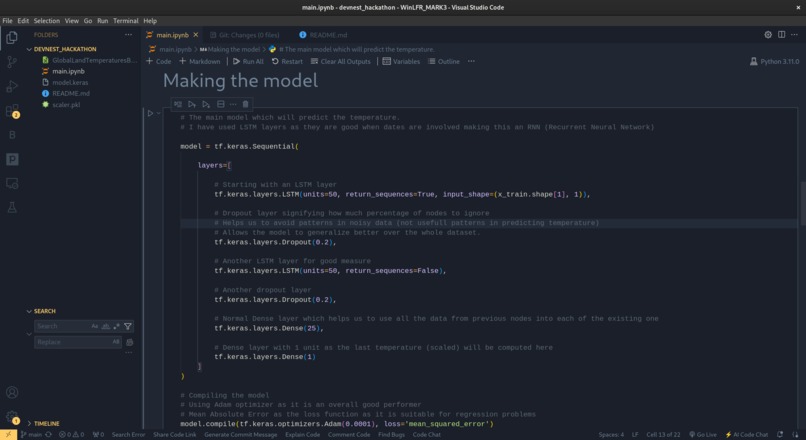
Code demo
Inspiration
My recent interest in Recurrent Neural Networks (RNNs) and my aspiration to become a machine learning engineer inspired this project. The idea of leveraging historical data to make accurate predictions fascinated me, and I wanted to explore the capabilities of LSTM networks in handling time-series data. By focusing on temperature prediction, I aimed to create a practical application that could have real-world significance in areas like weather forecasting and climate research.
What it does
This project predicts future temperatures based on historical data from India using an RNN with LSTM layers. The model analyzes past temperature trends to forecast upcoming temperatures, providing a visual comparison between predicted and actual values. This tool can be particularly useful for identifying weather patterns, planning agricultural activities, or conducting climate research.
How I built it
I built the model using the following steps:
- Data Collection: I used the
GlobalLandTemperaturesByCountry.csvdataset, focusing on temperature data from India. - Preprocessing: The data was cleaned, normalized, and structured into sequences suitable for time-series prediction.
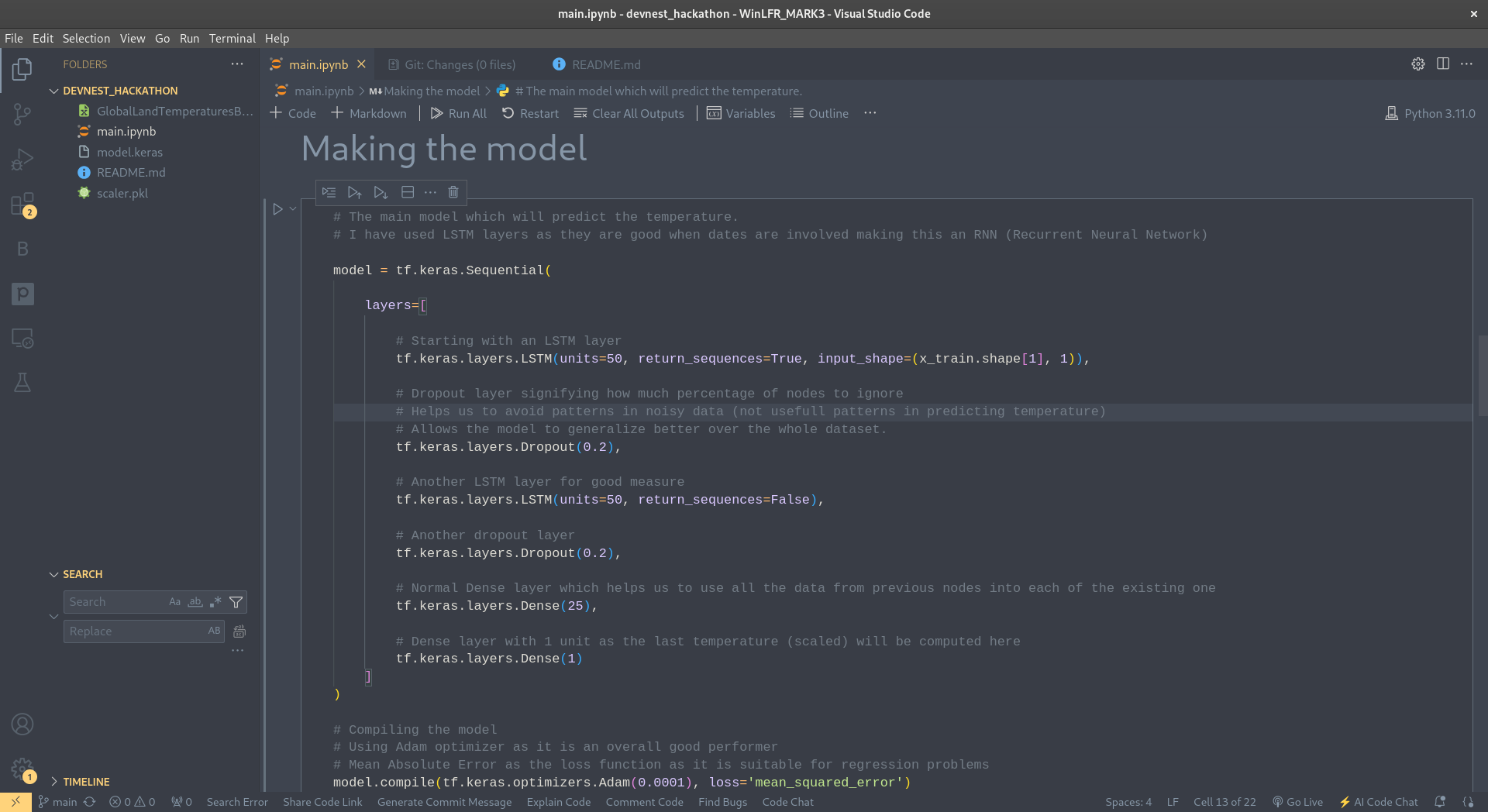
- Model Development: I designed an LSTM-based neural network to capture temporal dependencies in the data.
- Training: The model was trained on a subset of the data, with another subset reserved for testing.
- Evaluation: I compared the model's predictions with actual temperature values and visualized the results.
- Deployment: The trained model and data scaler were saved for future use, enabling easy prediction on new data.
Challenges I ran into
Some of the challenges I encountered include:
- Data Quality: The dataset had missing values and only monthly temperatures, which limited the granularity of the predictions.
- Model Tuning: Fine-tuning the LSTM model to avoid overfitting while capturing complex patterns was challenging.
- Scaling Issues: Ensuring that the data was properly scaled and inverted during prediction to maintain accuracy.
Accomplishments that I'm proud of
I'm proud of successfully building and training a model that can predict future temperatures with reasonable accuracy. The project's success in effectively visualizing the predictions against actual data was a significant achievement, demonstrating the model's potential for practical applications in weather forecasting and climate analysis.
What I learned
Throughout this project, I learned:
- Data Preprocessing: The importance of cleaning and preparing data for time-series analysis.
- LSTM Networks: How LSTM layers can be effectively used in RNNs to handle sequential data.
- Model Evaluation: Techniques for evaluating and visualizing model performance against real-world data.
- Scaling: The critical role of data scaling in ensuring the accuracy of predictions, especially in time-series forecasting.
What's next for Prediction of Temperature through RNN
Next steps for this project include:
- Data Enhancement: Incorporating additional data sources, such as daily temperatures or other weather variables, to improve model accuracy.
- Model Optimization: Further fine-tuning the model's hyperparameters and exploring alternative architectures to enhance prediction performance.
- Deployment: Developing an interface for real-time temperature prediction, making the model accessible for broader use cases.
- Expansion: Extending the model to predict temperatures for other regions or countries, enabling more comprehensive climate analysis.
Built With
- python
- scikit-learn
- tensorflow.keras

Log in or sign up for Devpost to join the conversation.