-
p3
-
p1
-
p2


H1 Predicting the Future of the ISS: A Data-Driven Approach
H1 Inspiration
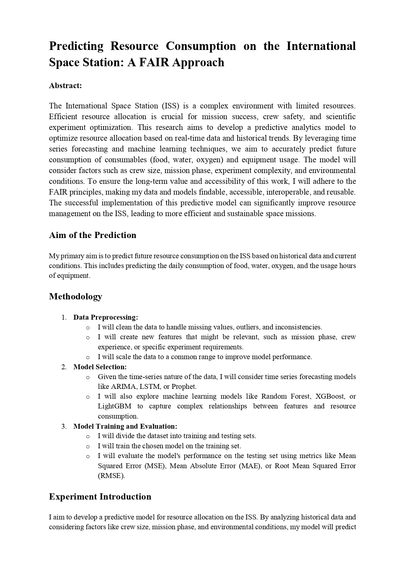
The International Space Station (ISS) is a marvel of human engineering, orbiting Earth and serving as a platform for groundbreaking scientific research. However, maintaining this complex system requires careful resource management. The idea of using data and AI to optimize these resources sparked my interest.
H1 Learning Experience
Throughout this project, I've delved into the world of time series analysis and machine learning. I've learned to:
Clean and preprocess data: Handle missing values, outliers, and inconsistencies.
Feature engineering: Create relevant features like mission phase, crew experience, and experiment complexity.
Select and train models: Experiment with various models, including ARIMA, LSTM, Random Forest, XGBoost, and LightGBM.
Evaluate model performance: Assess models using metrics like MSE, MAE, and RMSE.
Interpret model results: Understand the factors influencing resource consumption.
H1 Building the Project
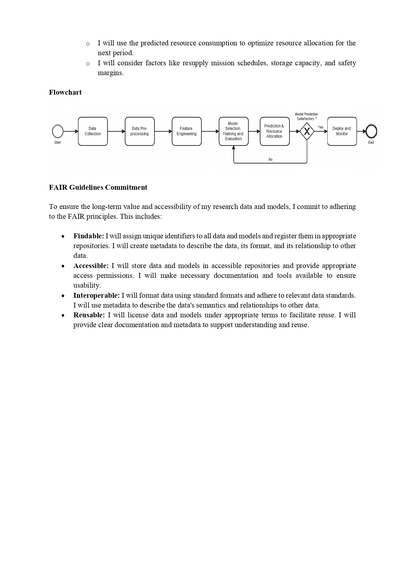
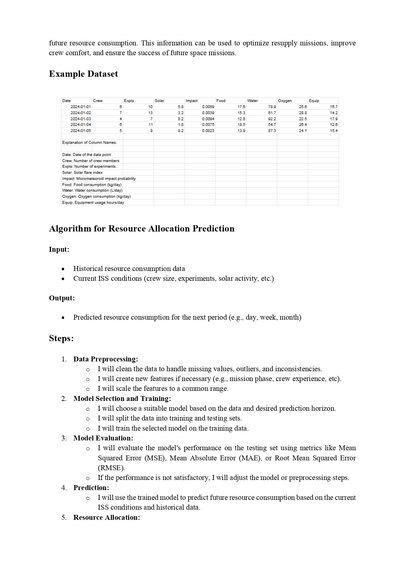
# H2 Data Collection: Gathered historical data on resource consumption, crew size, experiments, and environmental conditions. # H2 Data Preprocessing: Cleaned and normalized the data to ensure consistency and improve model performance. Feature Engineering: Created relevant features to capture the nuances of the ISS environment. # H2 Model Selection and Training: Experiment with different models to find the best fit for the data. Trained the selected model on the historical data. # H2 Model Evaluation: Evaluated the model's performance on a validation set. # H2 Prediction and Optimization: Used the trained model to predict future resource consumption. Optimized resource allocation based on the predictions.
# H1 Challenges Faced
Data Quality: Ensuring data accuracy and completeness was a significant challenge.
Feature Engineering: Identifying relevant features and capturing complex relationships was crucial.
Model Selection: Choosing the right model for the specific problem required careful consideration.
Overfitting and Underfitting: Balancing model complexity and generalization was essential.
Interpretability: Understanding the model's decision-making process was important for building trust and making informed decisions.
By overcoming these challenges, I've developing a robust predictive model that can help optimize resource allocation on the ISS and contribute to the success of future space missions.

Log in or sign up for Devpost to join the conversation.