-
-
Homepage
-
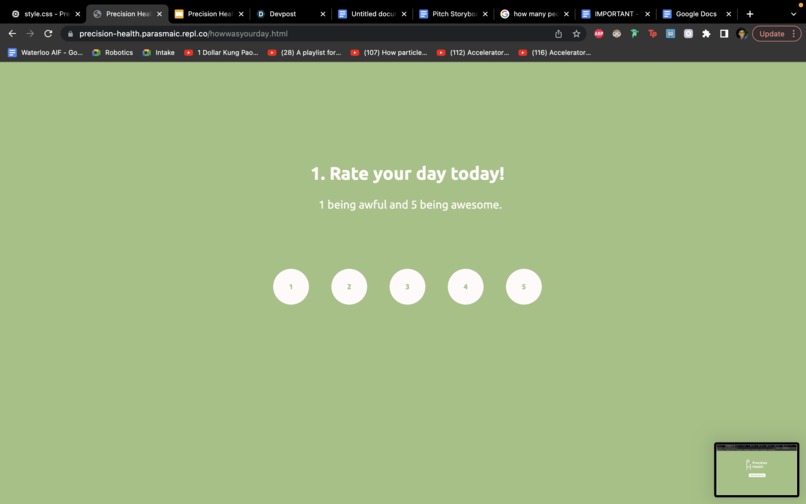
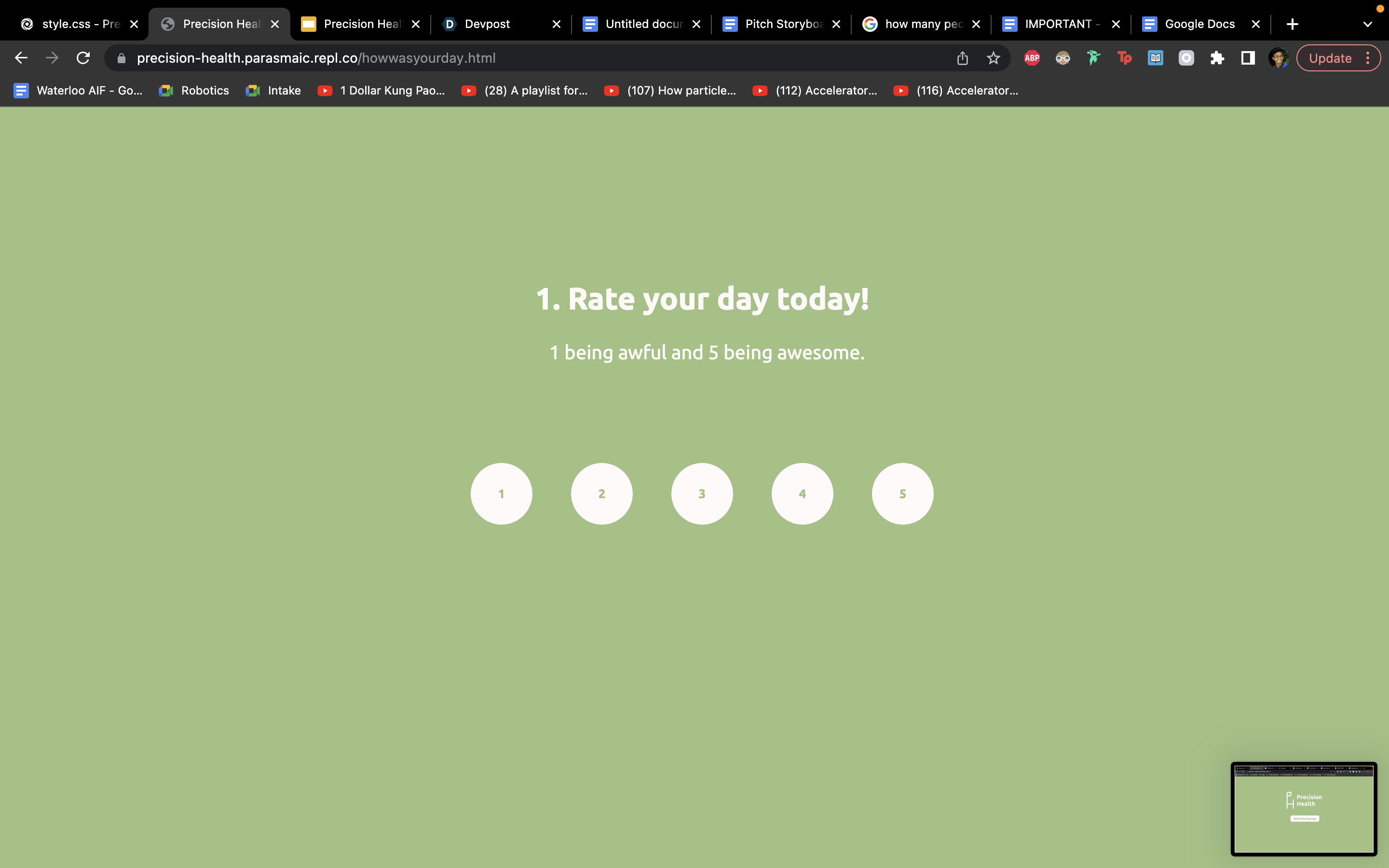
1-5 rating page
Inspiration
Going through the COVID Pandemic as students, we realized that oftentimes, students don’t have nearly enough time to check up on their mental and physical health. Even though physicians are supposed to help in this area, they do not have nearly enough time to follow up regularly with patients about their general health. The result is many people overlooking their day to day health. This is where we found the seedling for Precision Health.
What it does
A diagnostic tool that uses questions pertaining to mental health and physical health to assess a user’s general mental and physical health. Although most survey’s usually just output a number rating, our website provides curated personalized resources to support users with their underlying health issues.
How we built it
We built Precision Health using html5 and css3 for the front end, and we used pure javascript for all the data analysis and personalization features. Since being able to Provide users with a calming beautiful experience was a must, we spent time making sure our UI and front-end was easy to use and intuitive. Furthermore, we programmed our backend right in the same directory using JS so that there would be less hiccups in the code.
Challenges we ran into
We ran into two major challenges during Jamhacks. The first, was us not knowing how to connect java to html5. Our two back-end teammates had knowledge of java, but we ended up learning javascript during the hackathon to be able to make everything work together. Secondly, we learned that as JS is technically a front-end language, it stores variables only temporarily (as long as you’re on one webpage). As soon as we changed webpages to the results page, all of our variables were erased and reset to 0. This was a massive problem. We ended up solving it by storing our variable in sessionStorage instead, which allowed us to carry the variable across multiple pages while still maintaining a JS backend.
Accomplishments that we're proud of
We’re proud of our time management throughout the hackathon. We finished our hack with many hours to spend on refining and polishing our project. We were able to put time into our pitch and devpost submission. Secondly, we’re proud of our teamwork throughout Jamhacks. Our strategy of splitting into two subgroups for front-end and back-end worked out really well with team meetings with everyone every 1-2 hours. This allowed us to really collaborate and make best use of our time at Jamhacks.
What we learned
The main thing we learned is to never give up. No matter how many bugs or problems we had with our project, we were always able to find an intuitive solution that allowed us to move forward. Had we given up, we wouldn’t have the product we do now. Secondly, we all learned a good amount of javascript to make sure that the entire project actually worked. It was great to learn that learning a language isn’t as hard as we thought.
What's next for Precision Health
The big future improvement for Precision Health is a mobile app. A mobile app would allow for a huge opening of doors that all lead to more positive and greater user interaction and experience. We want to be able to have students be reminded daily through a push notification to log their personal health, and be able to refer them to resources even easier. Mobile apps allow for better shareability with friends, and easier ways to read more on a suggestion. In tandem with the mobile app, there would be an expanded database for personalized suggestions, follow up questions to learn more about a user, user accounts and data storage, and much more. We hope to see Precision Health as a staple in the personal health industry.


Log in or sign up for Devpost to join the conversation.