-
-
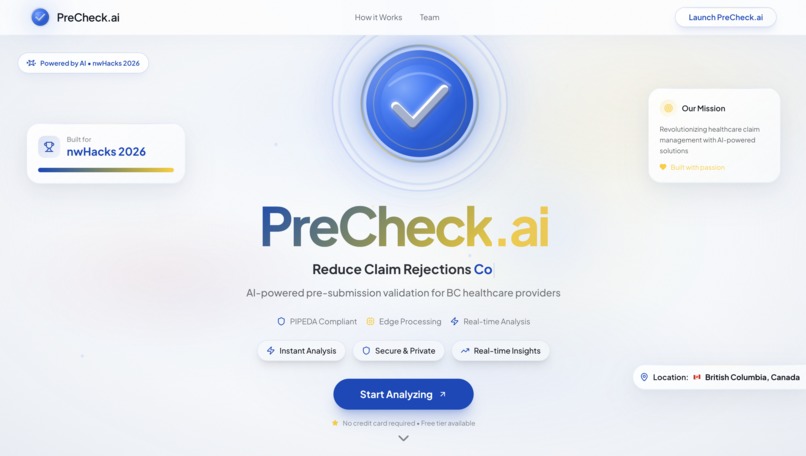
Landing Page
-
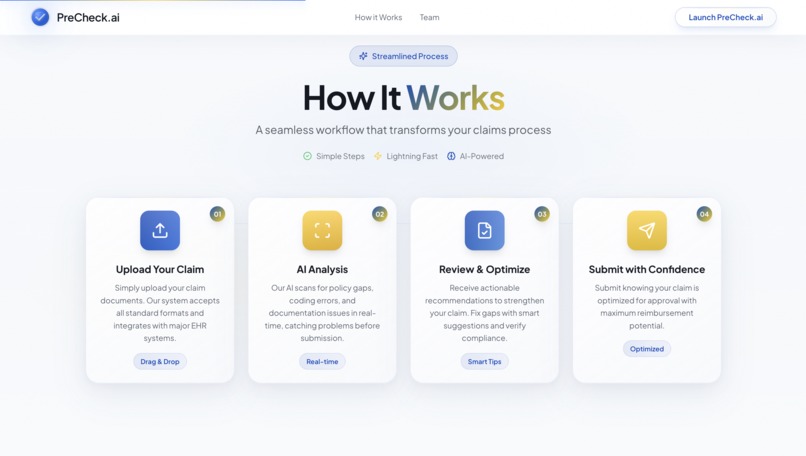
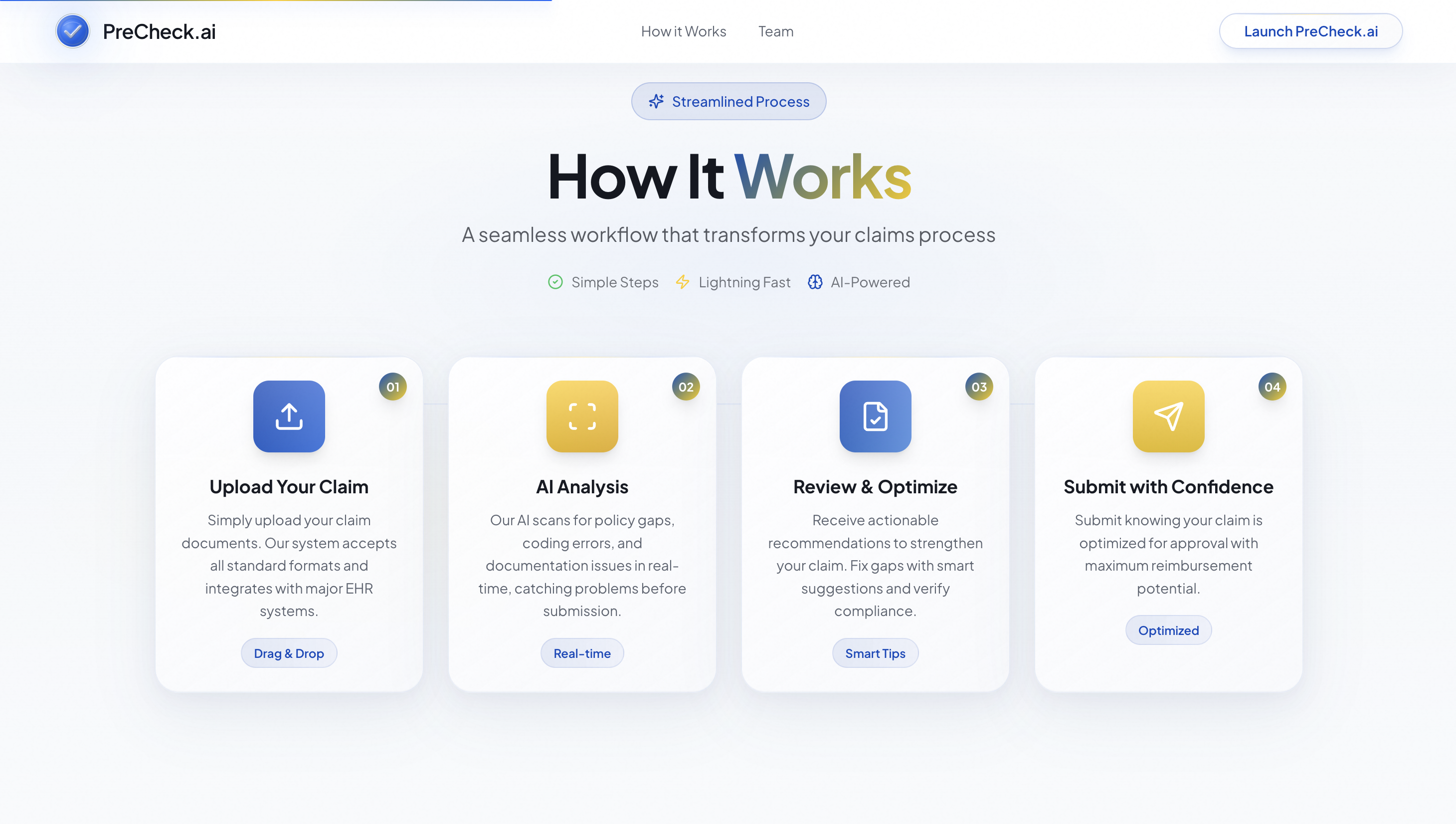
User Workflow
-
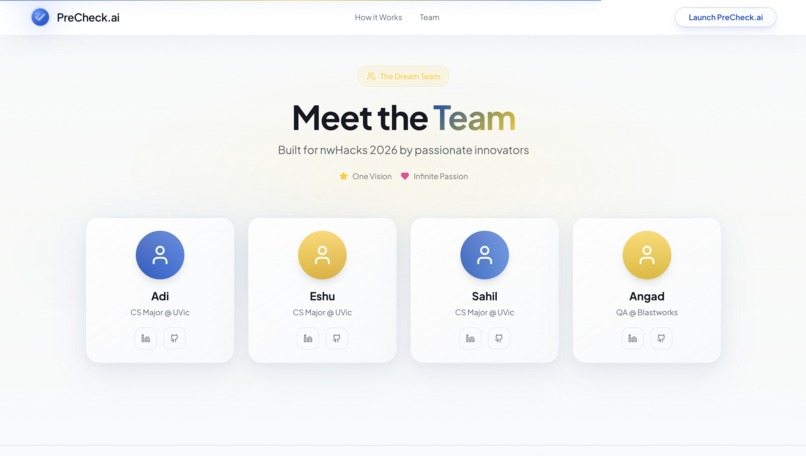
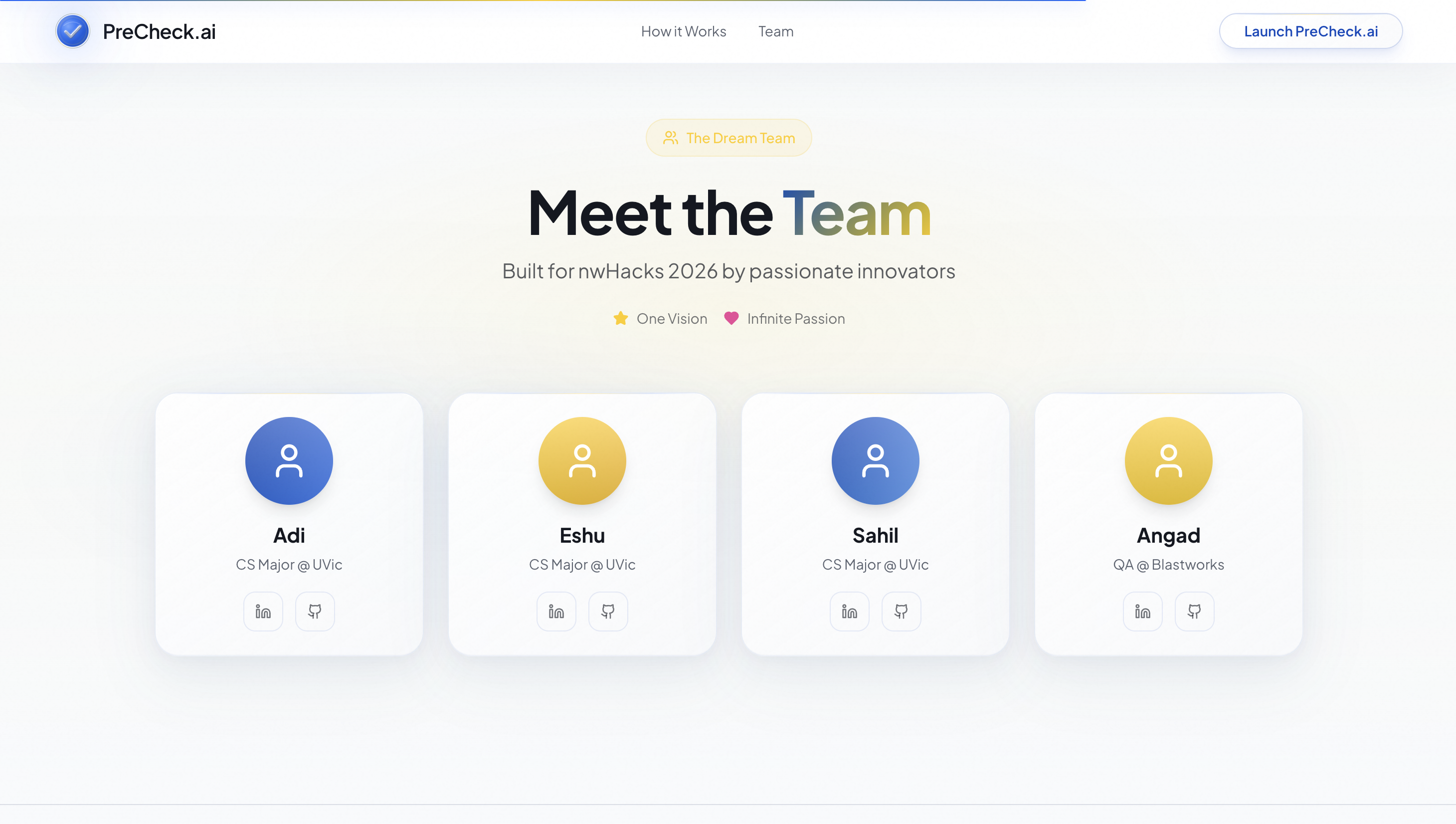
Team Members Descriptions
-
Footer
-
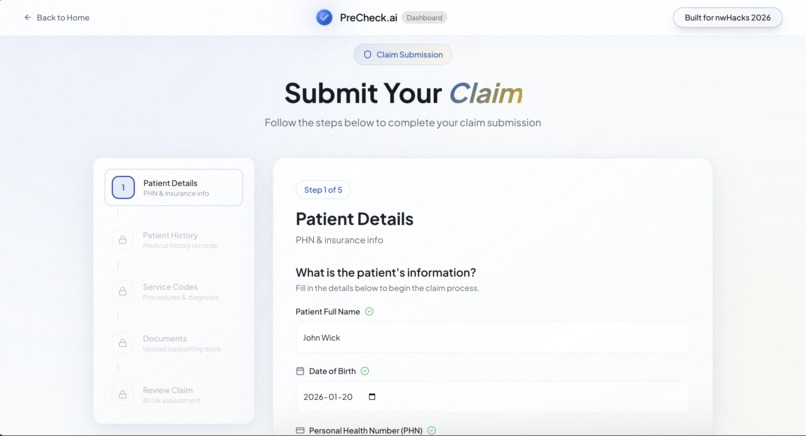
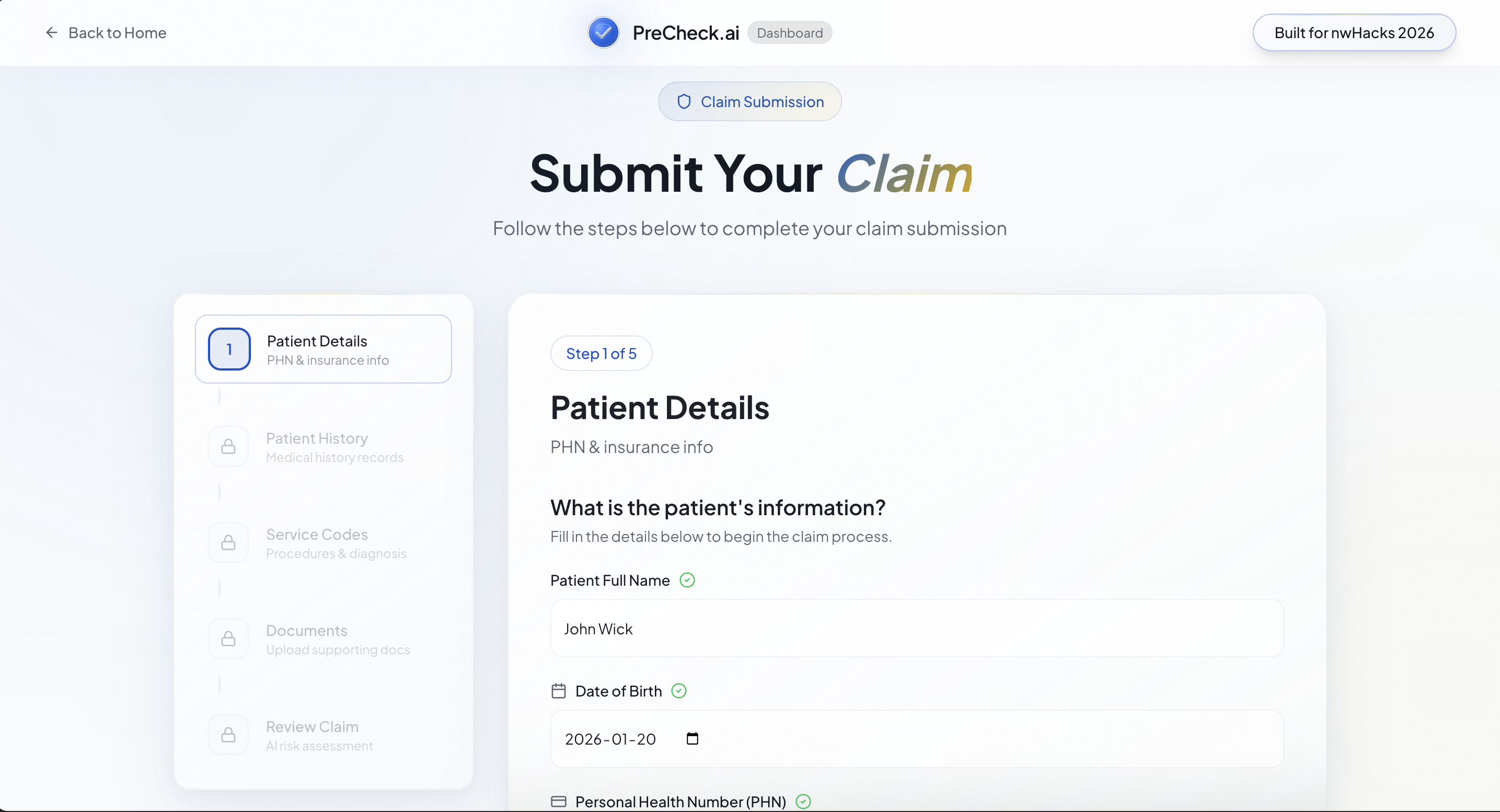
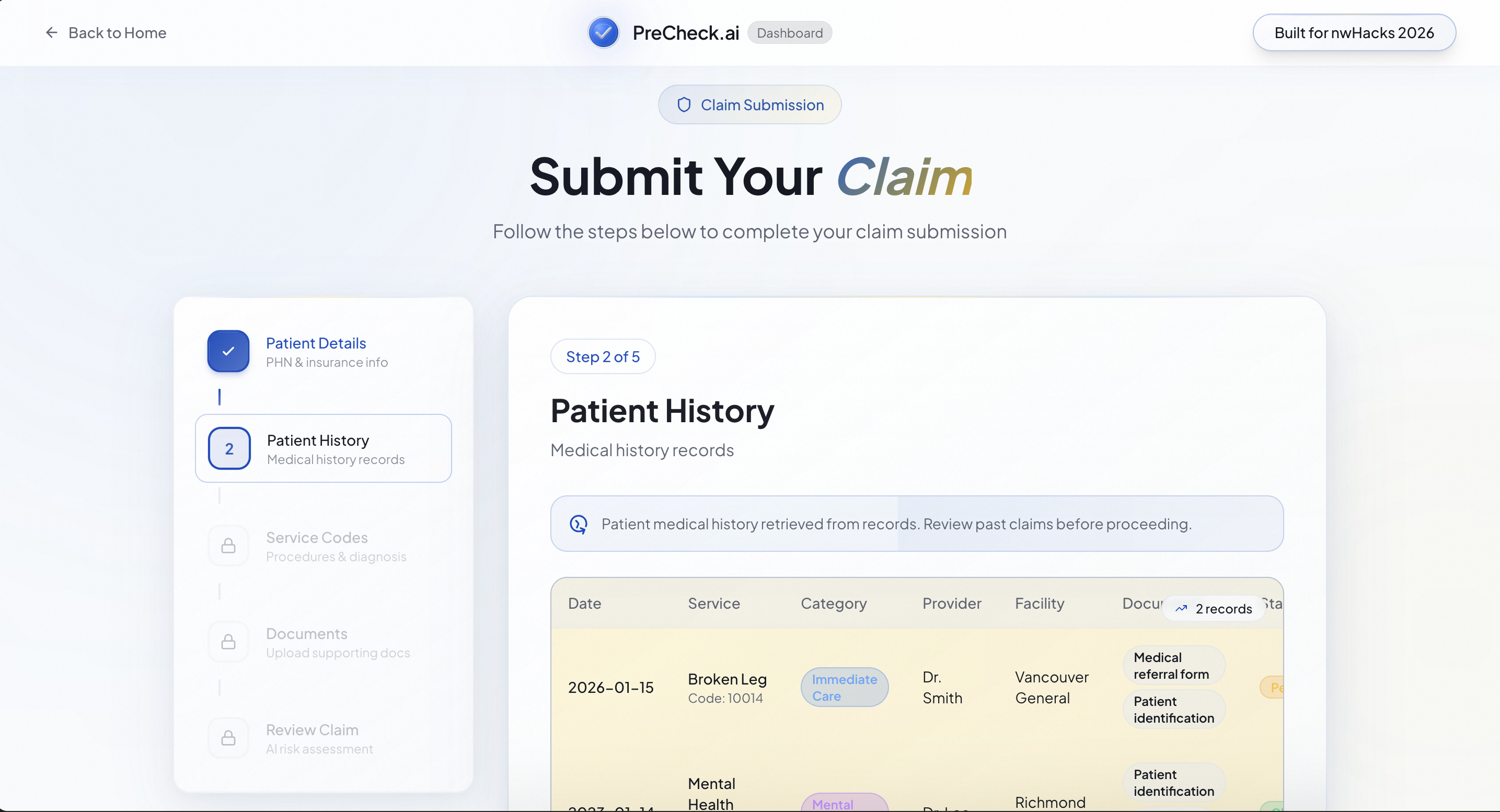
Claim Request (PHN)
-
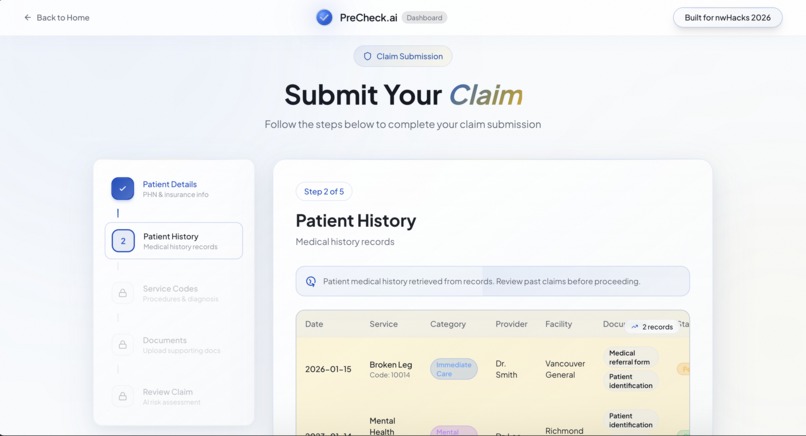
Patient History
-
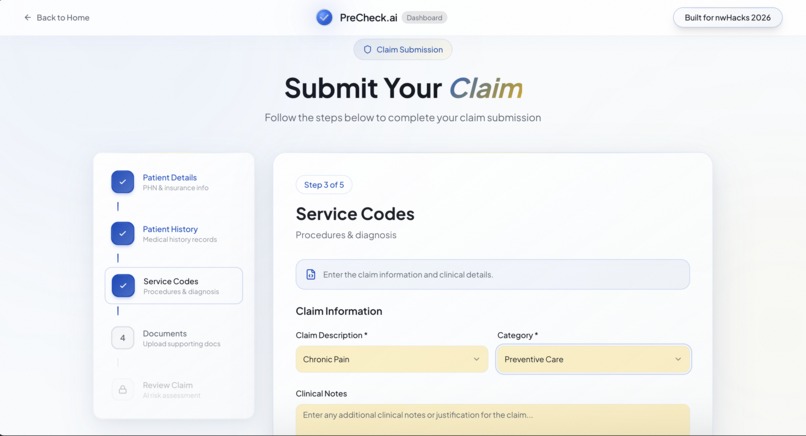
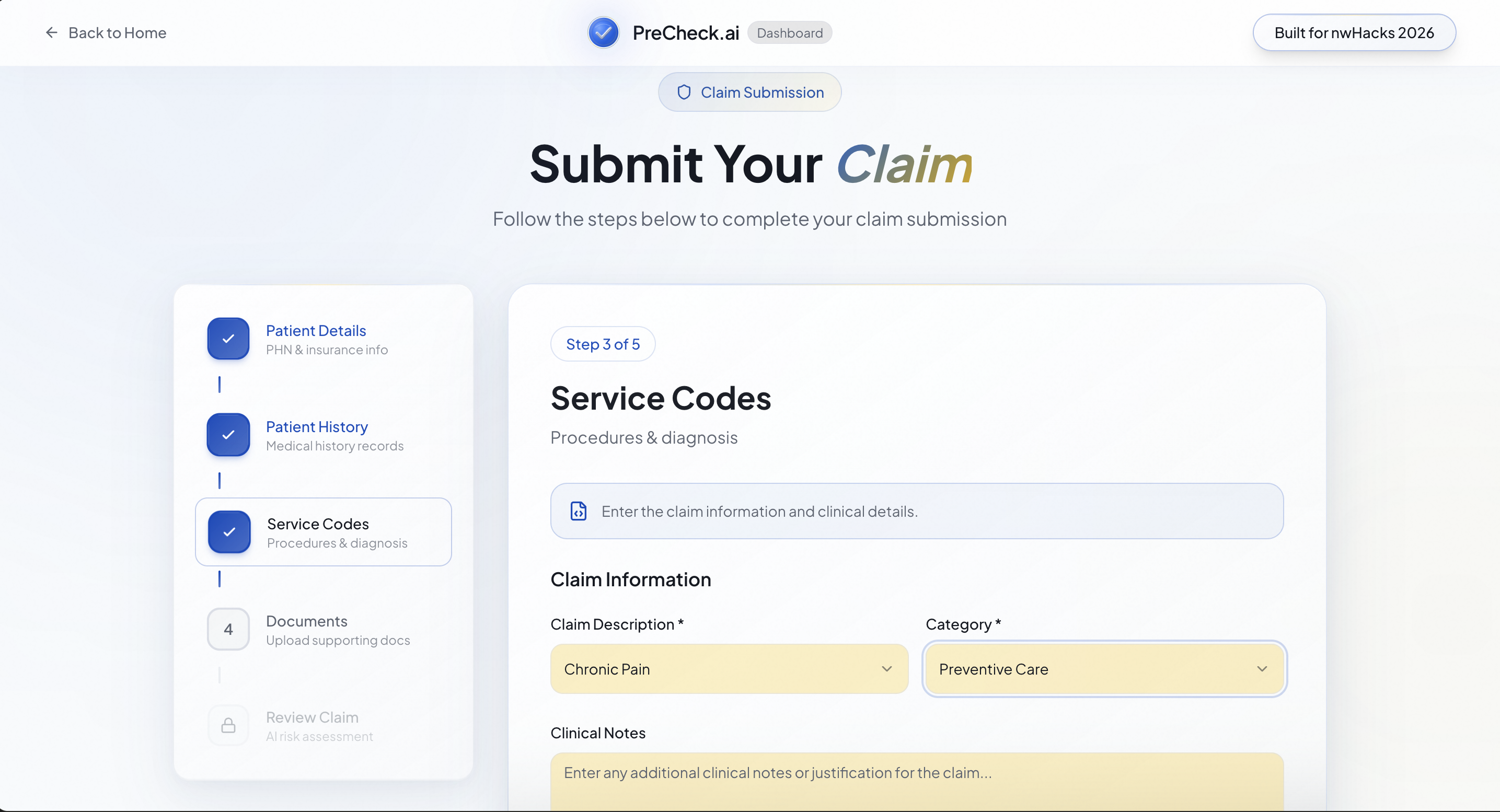
Services Codes
-
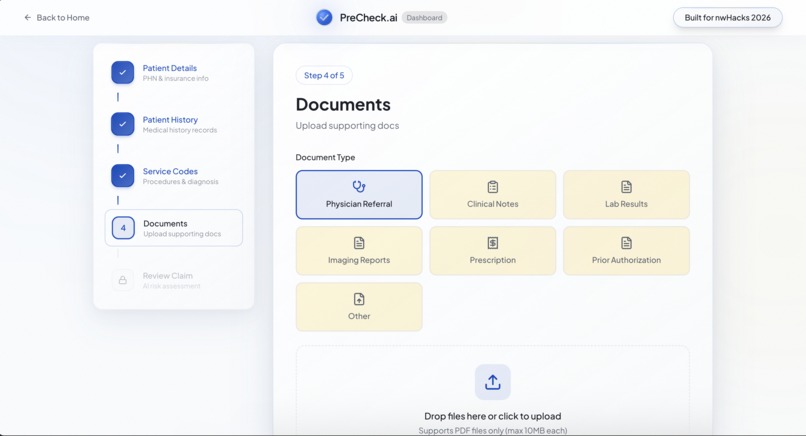
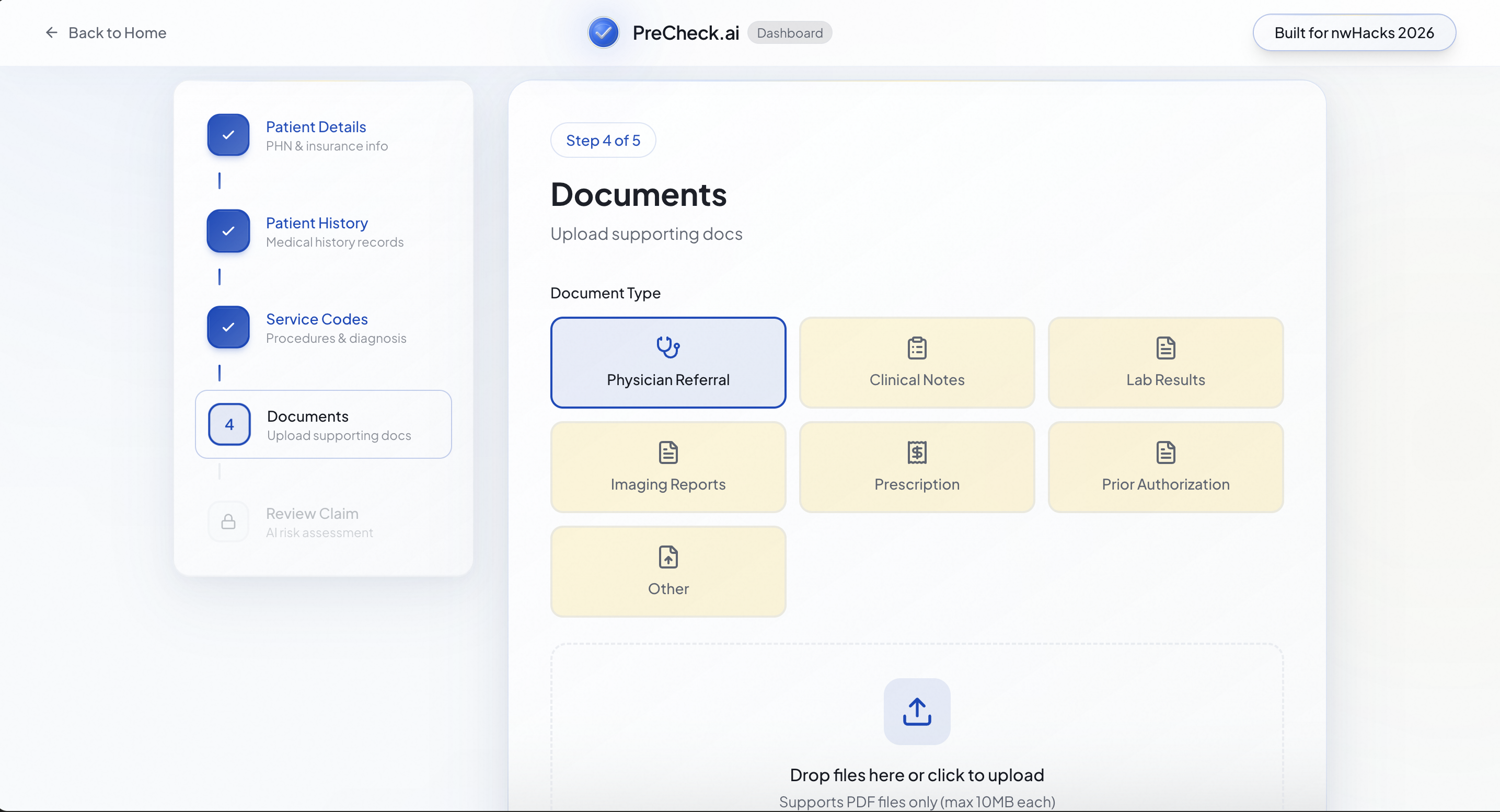
Documentation
-
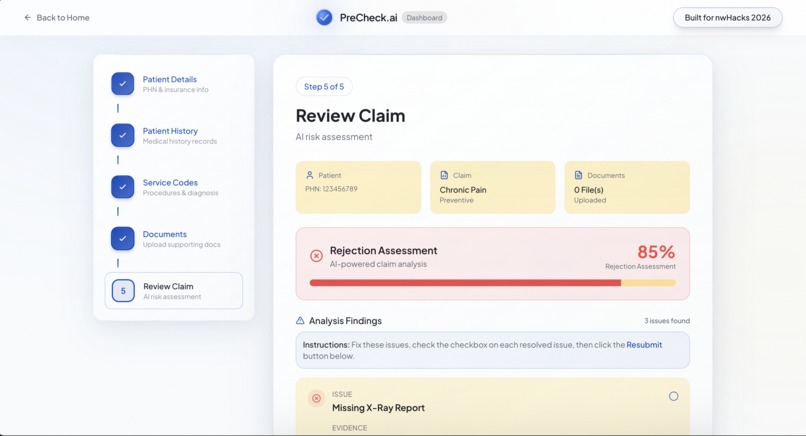
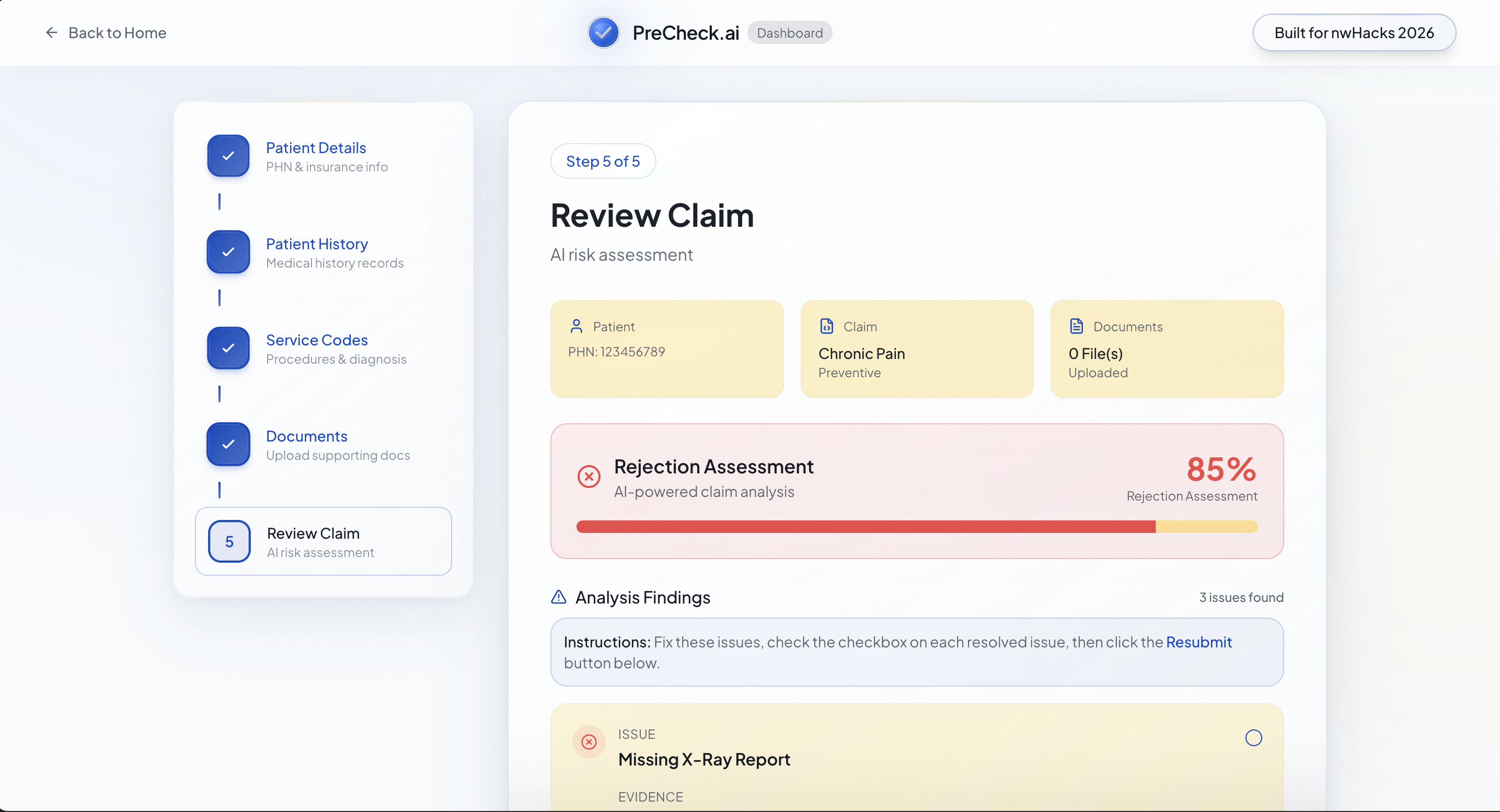
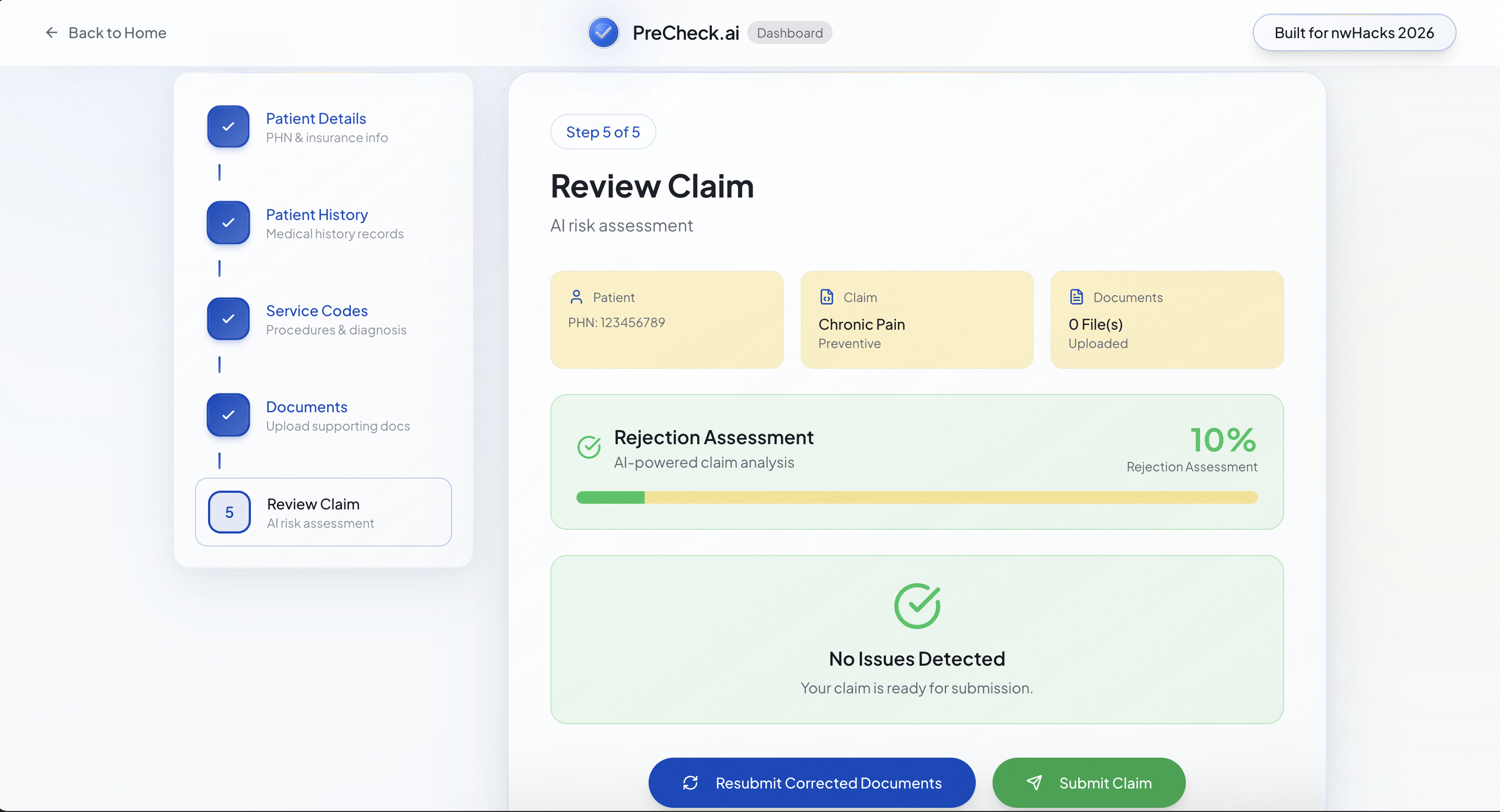
Risk Analysis
-
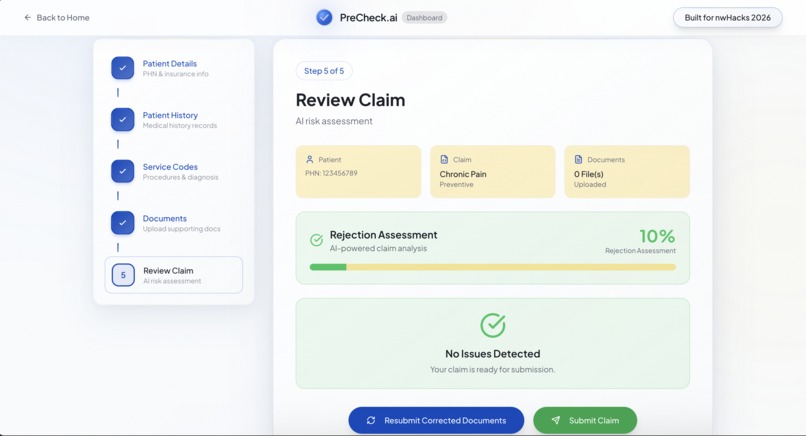
Post Resubmission of corrected documents
-
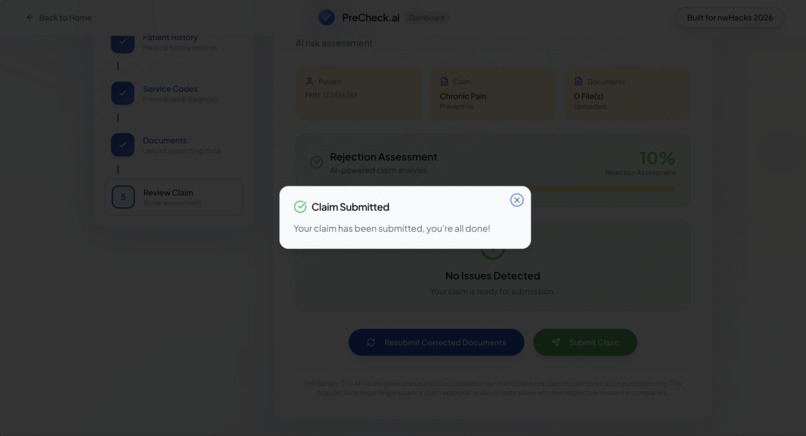
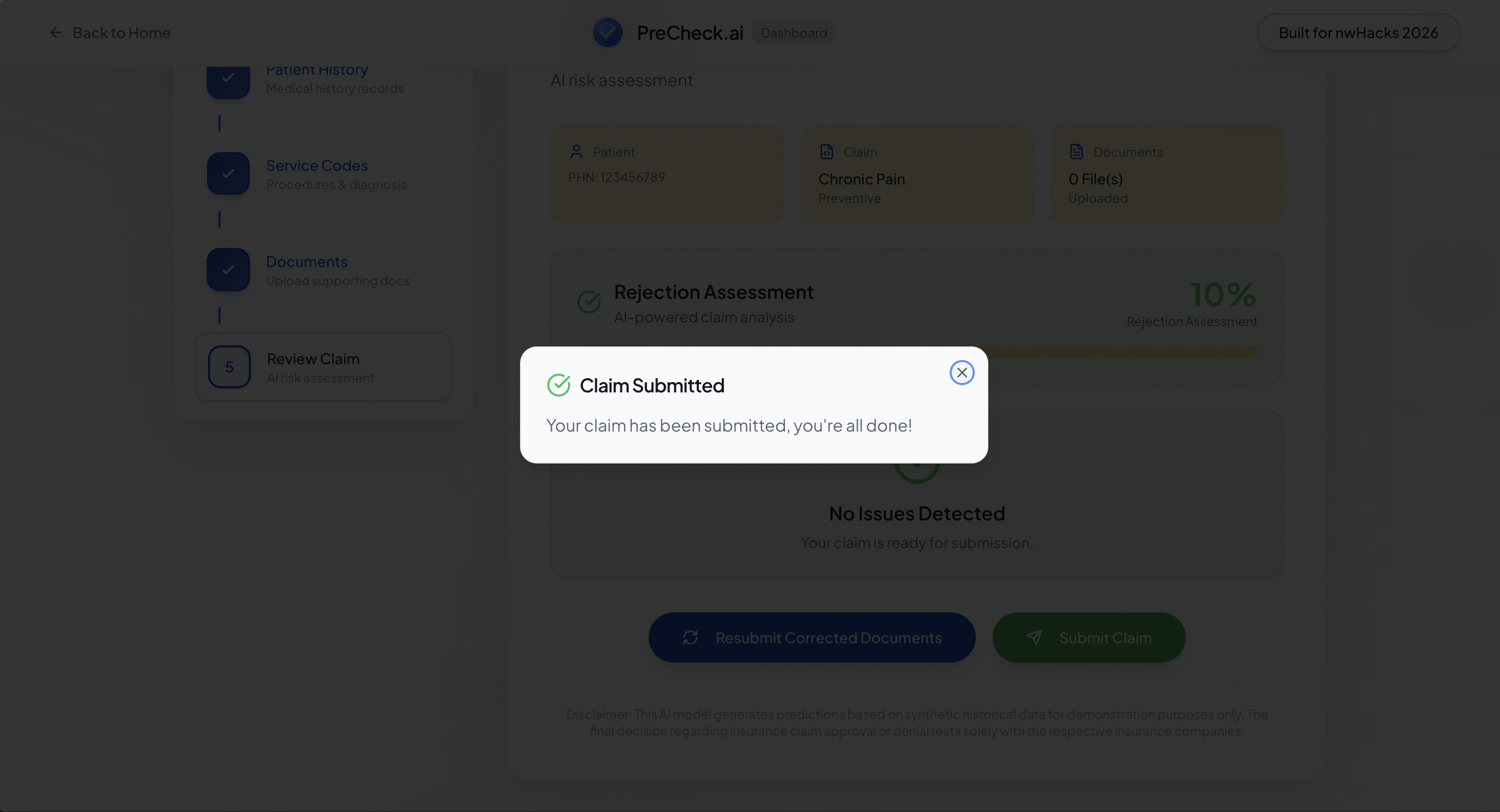
Claim Submission
Inspiration
One of our team members experienced firsthand how frustrating the insurance claims process can be. After his mother underwent a surgical procedure, the insurance claim was denied for minor technicalities—small errors that could have been caught beforehand. What followed was a lengthy appeals process, unexpected out-of-pocket costs, and added stress during an already difficult time.
This experience revealed a larger problem: millions of insurance claims are denied every year due to preventable errors like missing information, incorrect codes, or documentation mismatches. Most people don't realize their claim has issues until it's already been rejected.
We built PreCheck.ai to solve this. Our platform reviews insurance claims before submission, identifies potential issues, and helps users fix them—reducing the chance of denial and saving families from unnecessary financial and emotional burden.
What it does
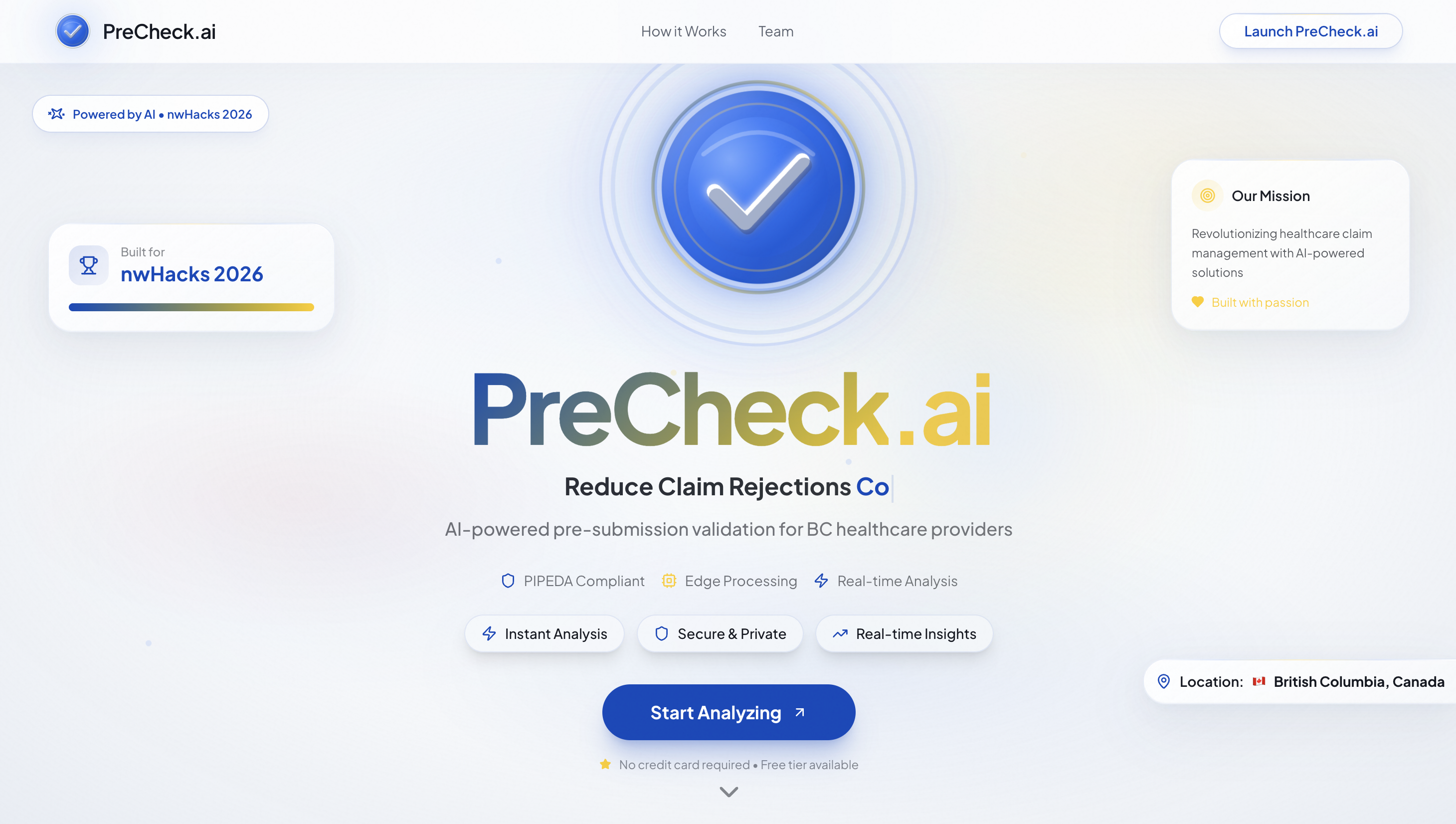
Precheck.ai.tech is an intelligent pre-submission validation engine designed to stop insurance claim denials before they happen. It acts as a sophisticated "digital auditor" for BC healthcare providers and patients, transforming the high-friction claim process into a streamlined, transparent experience.
The application executes a high-fidelity, four-stage pipeline:
Intelligent Document Ingestion: Users upload clinical notes, invoices, or referral letters. The system uses a hybrid OCR approach—combining pdfplumber for digital text and Gemini Vision for scanned images—to accurately extract patient demographics, provider IDs, and handwritten signatures.
RAG-Driven Policy Audit: Using a Retrieval-Augmented Generation (RAG) architecture, the system cross-references extracted data against a comprehensive knowledge base of BC-specific insurance policies (including MSP, Pacific Blue Cross, and Sun Life). It identifies specific policy violations, such as missing pre-authorizations or mismatched ICD/CPT diagnosis codes.
ML-Based Risk Scoring: Beyond simple rule-checking, the system utilizes a HistGradientBoosting machine learning model. By analyzing a 7-feature vector (including signature presence, invoice counts, and code density), it calculates a precise 0-100% denial probability based on historical claim patterns.
Actionable Remediation Dashboard: Instead of a simple "pass/fail," users receive a color-coded risk assessment with specific, step-by-step instructions on how to fix identified issues (e.g., "Add a physician referral to reduce denial risk by 35%").
By catching clerical errors and policy mismatches in real-time, precheck.ai.tech ensures that claims are submitted correctly the first time, accelerating reimbursements and reducing administrative burnout.
How is this different from a regular LLM
ChatGPT / Regular LLM:
- You paste text and ask "is this claim okay?"
- No structured workflow — just freeform chat
- No policy knowledge base — relies on general training data
- No file upload processing with validation
- No risk scoring or probability calculations
- No persistent tracking of issues or resolutions
PreCheckAI.tech:
- Guided 5-step workflow — walks users through patient info, history, clinical details, document upload, and analysis
- Policy-specific knowledge base — cross-references claims against actual BC insurer requirements (MSP, Pacific Blue Cross, Sun Life, etc.) with section and page citations
- PDF document processing — extracts text from uploaded medical documents and validates against claim data
- ML-based risk scoring — trained model predicts denial probability based on document completeness, field validation, and code checks (ICD-10, CPT)
- Actionable issue tracking — identifies specific problems with checkboxes to mark as resolved before resubmitting
- Domain-specific — built specifically for BC healthcare insurance claims, not general-purpose
How we built it
- Used the first 3 hours as a brainstorming phase where we iterated on multiple ideas based on problems we faced in our lives. After recognising the broken healthcare system as a common theme, we decided to keep narrowing down the scope of our discussion until we could come up with a problem statement.
- Once we decided on the problem statement, we tried to determine the functional requirements. Looking at the prize list, we decided to choose the ones that are relevant to our implementation plans. We also decided to pursue these as non-functional requirements.
- As one part of the team got our tech stack set-up (finalised on the basis of personal experience, learning goals, internet recommendations, project scope, etc.), the other part kept iterating on the user workflow and journey so that we could have our system architecture and interface in mind.
- We kept having to reduce our scope as time went on and challenges were discovered. After a long, long, LONG coding sprint. We came up with an MVP that we are truly proud of. We decided to get an early start on working on our presentation so that we weren't scrambling last minute. A lot of our processes were iterative, constructive (and occasionally destructive), and reformative (in the sense we would have to change up our entire codebase at times). Still proud of the project we've made.
Challenges we ran into
- RAG Implementation: Getting the architecture right was the hardest part. Prompt after prompt, YouTube tutorial after YouTube tutorial, we got to a place where we thought we could confidently justify our design choices given project scope.
- Project Scope: Building a B2B system for a primarily government backed entity with little-to-no open source code or transparent internal procedures was challenging to say the least. Using personal experience from co-ops at local health authorities, intensive online research, professional experience at tech firms, we were able to make smart decisions that lead to a scope pushed the boundaries of what systems can be made at 24 hour hackathons.
Accomplishments that we're proud of
-_ Scoping down from an ambitious vision_ — We started with a broad idea of "fixing insurance" and iterated through multiple concepts before narrowing down to a focused, achievable solution: pre-submission claim validation for BC healthcare providers
Effective team coordination under pressure — We divided work across frontend, backend, and ML pipelines and staying aligned through constant communication and quick decision-making
Pushing through the night — Powered through late-night debugging sessions and last-minute pivots to deliver a working product by the deadline
What we learned
_ The Power of Non-Linear Brainstorming _: During the initial phase of nwHacks, we spent significant time in a loop of 'divergent and convergent thinking.' We would deep-dive into our core idea, deviate into tangential concepts, and eventually circle back to our original premise. While this felt like a distraction at the moment, we realized it was actually a vital validation process. By exploring the 'what-ifs' of other ideas and still finding our way back to the original, we gained the conviction that our core solution was the most robust and viable path forward.
What's next for precheck.ai.tech
- Further research into internal systems
- Refactoring code for enhanced PIPEDA compliance
- Expansion for support with other type of policies
Built With
- fastapi
- framermotion
- geminiapi
- lottie-react
- lucide-react
- openrouterapi
- prompt-engineering
- python
- react
- react-query
- react-router
- scikit-learn
- shadecn/ui
- tailwindcss
- typescript
- vite


Log in or sign up for Devpost to join the conversation.