-
-
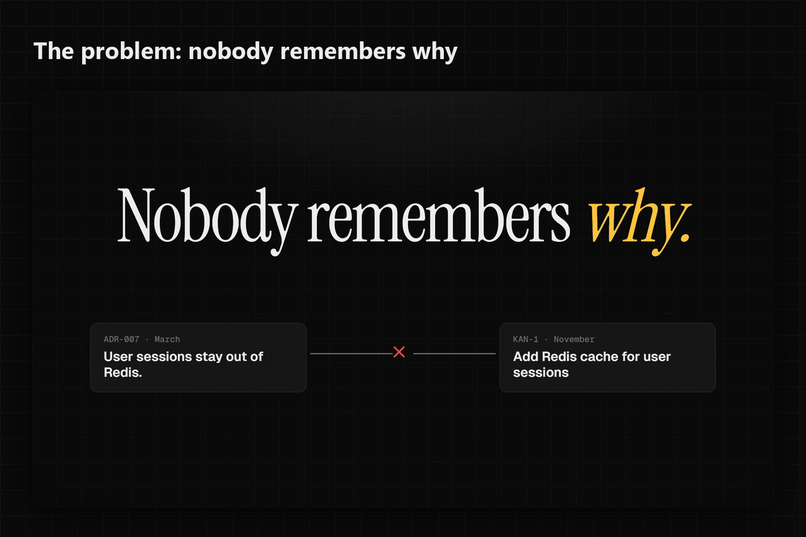
The problem: nobody remembers why
-
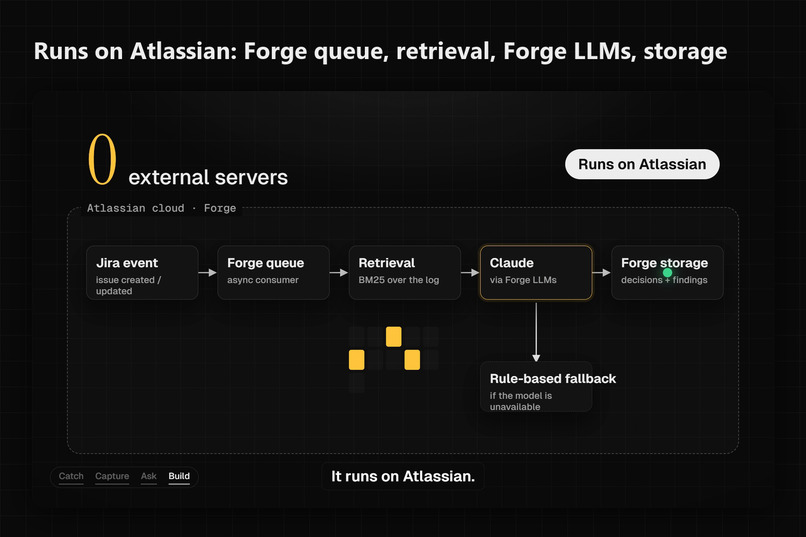
Runs on Atlassian architecture
-
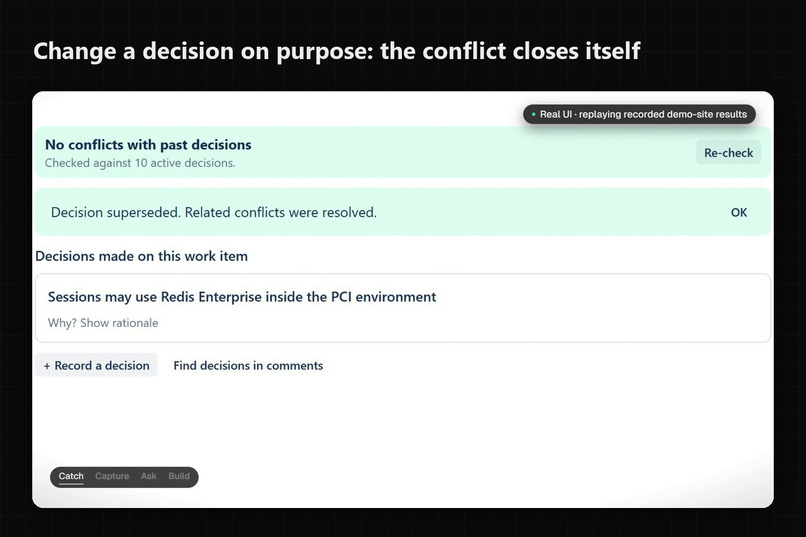
Change a decision on purpose
-
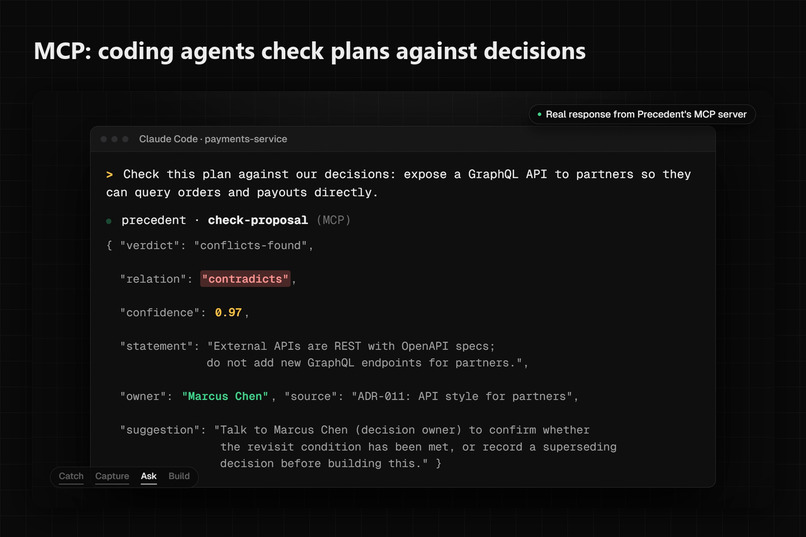
MCP for coding agents
-
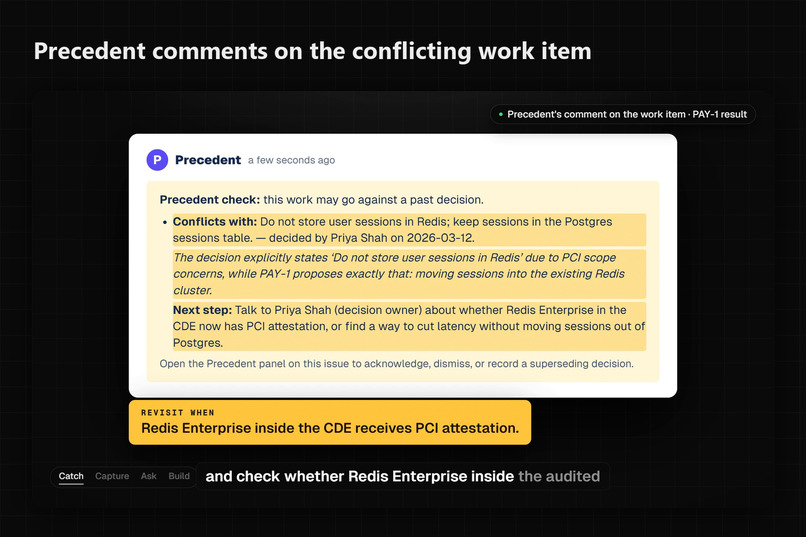
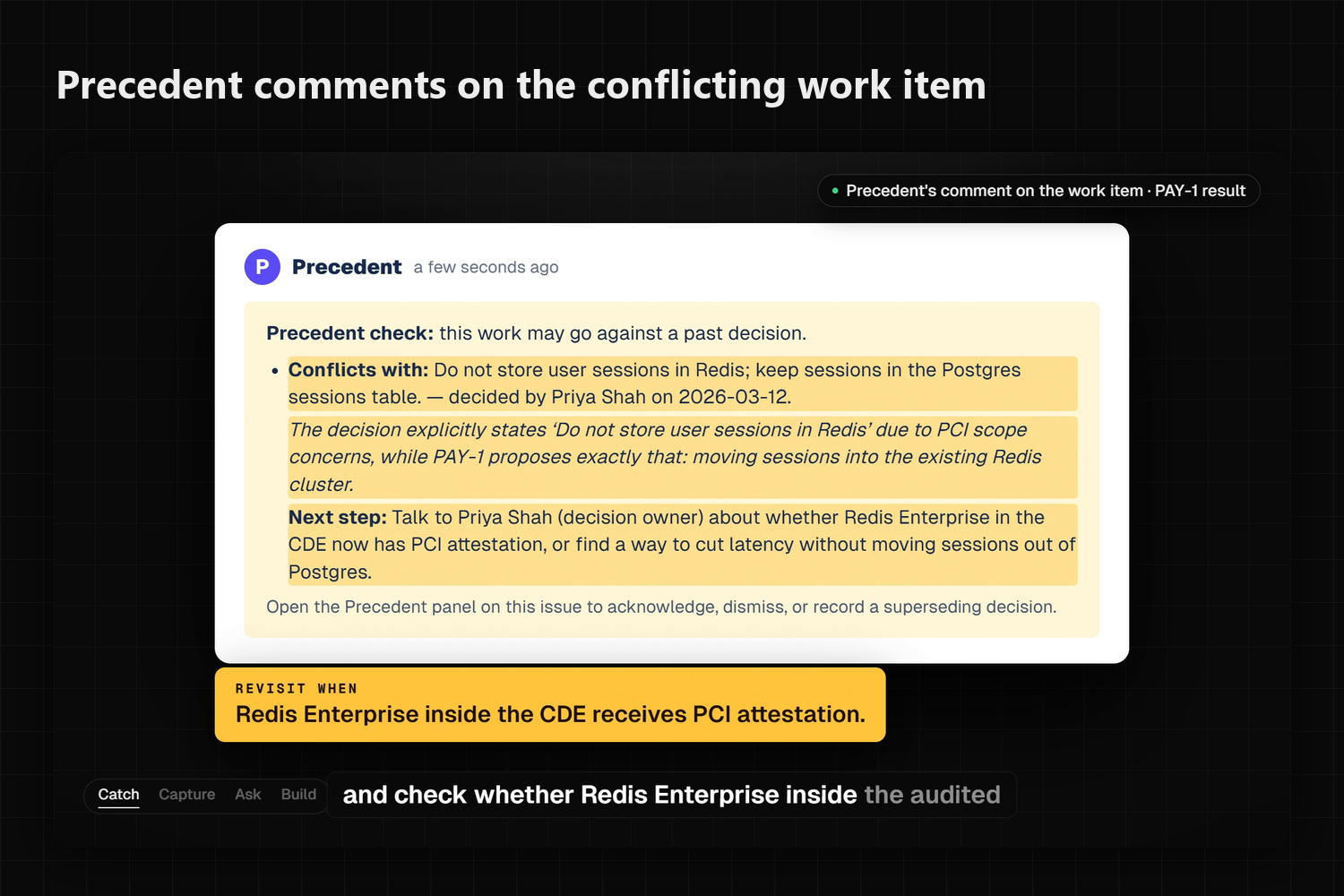
Precedent comments on the conflicting work item
-
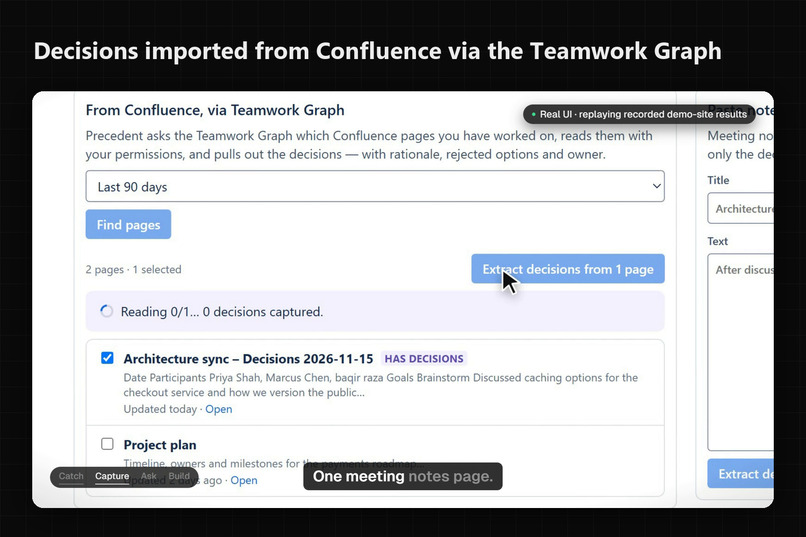
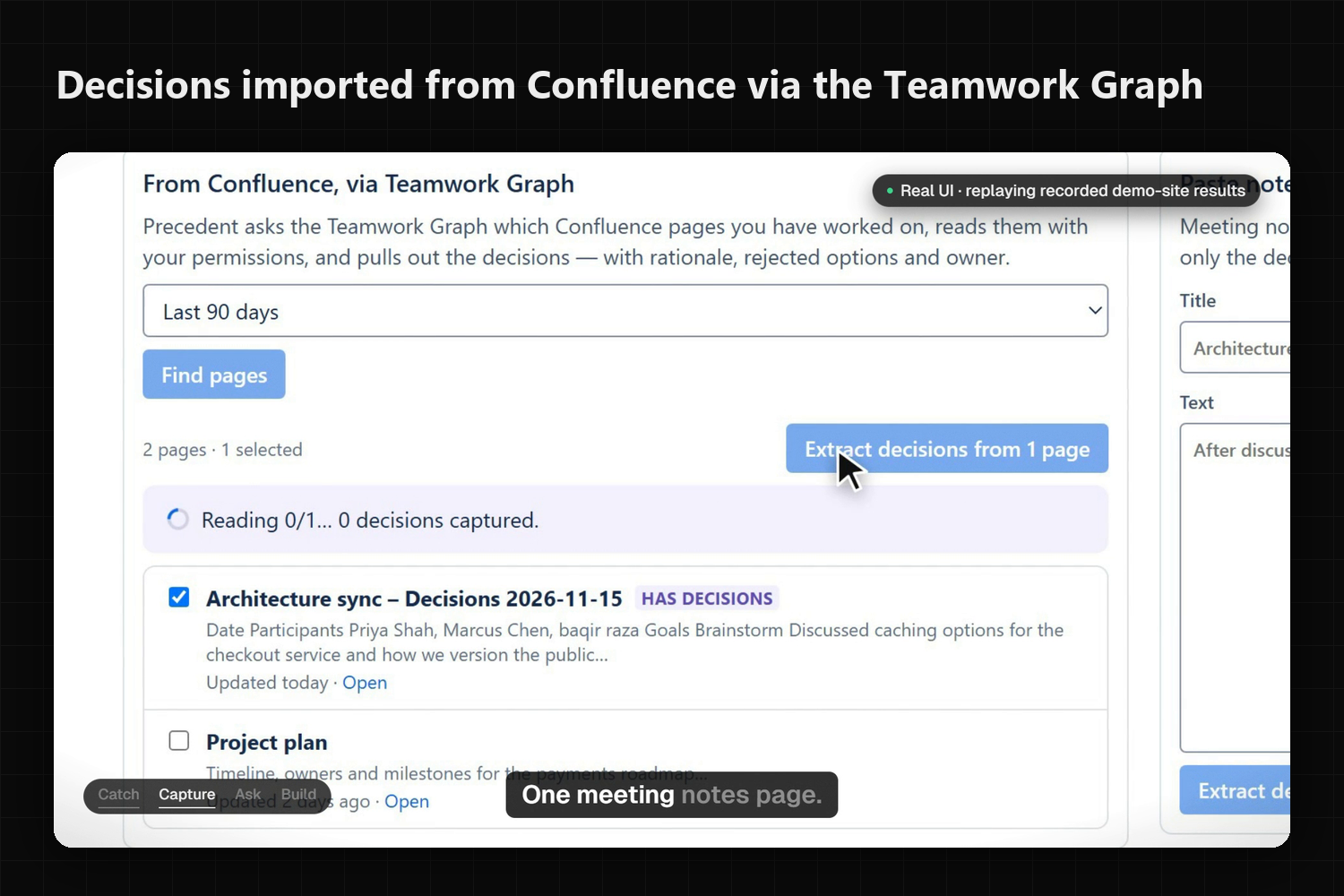
Decisions imported via the Teamwork Graph
-
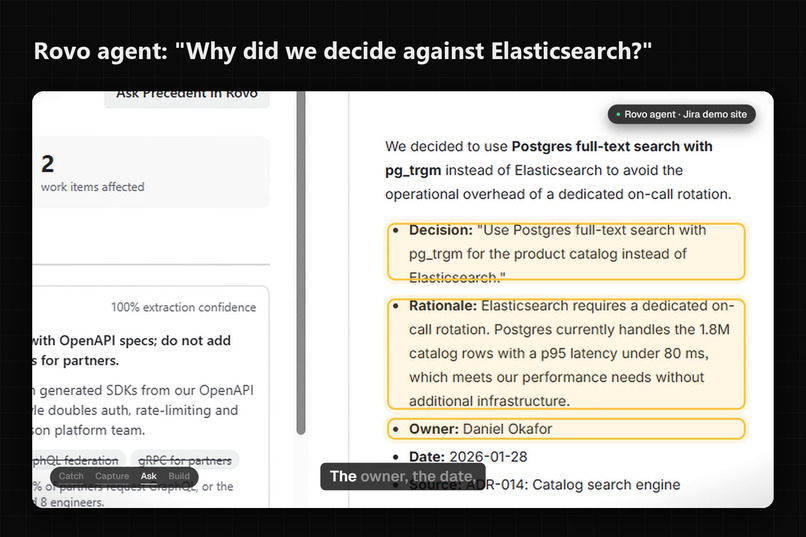
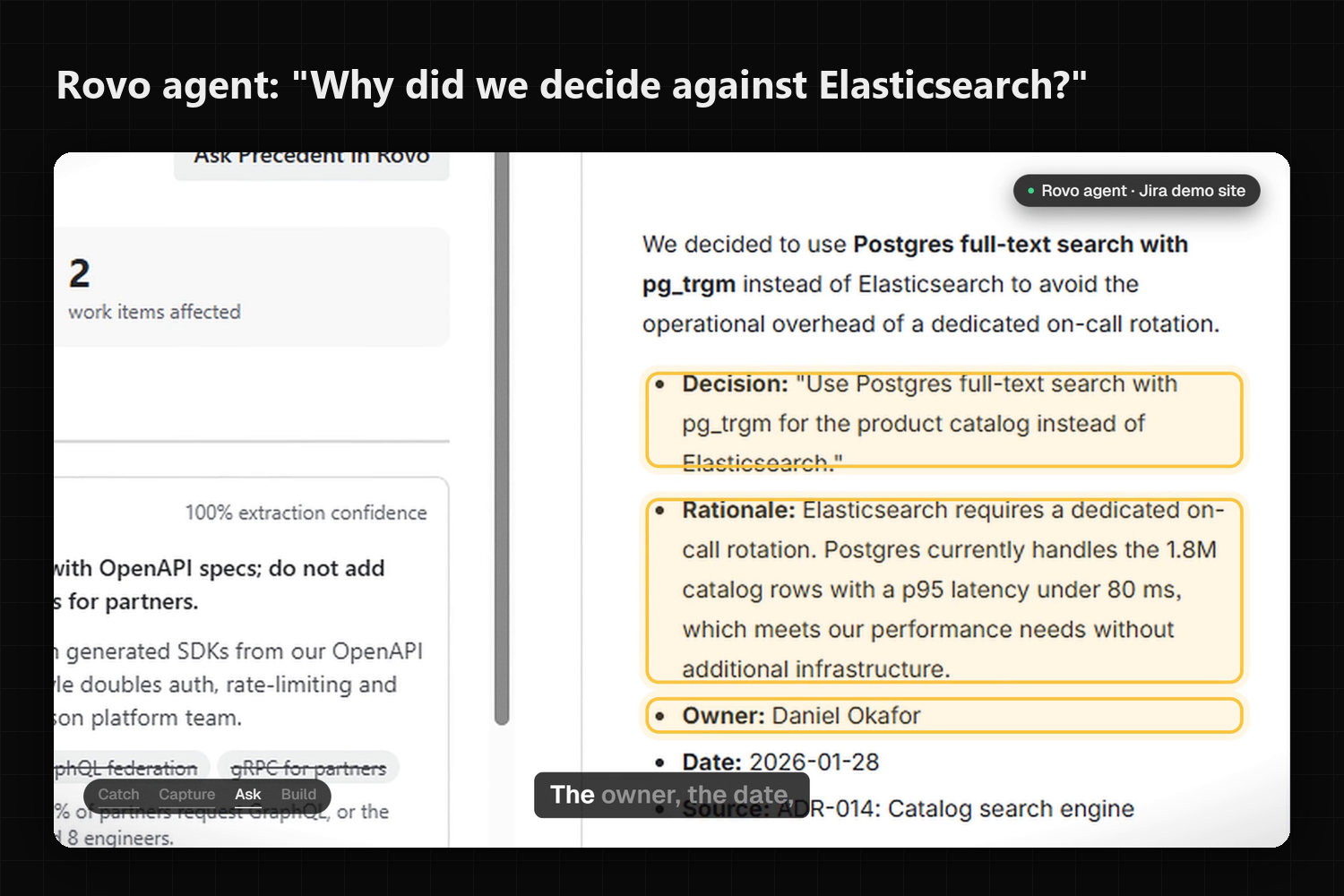
Rovo agent
-
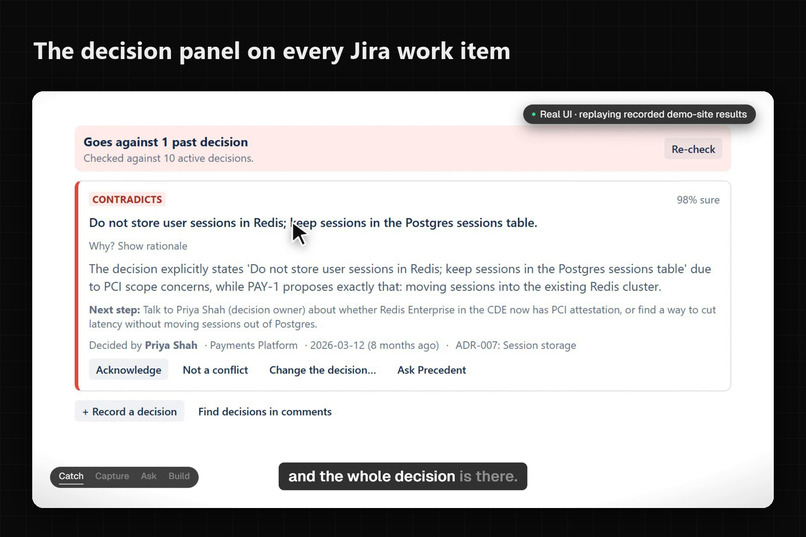
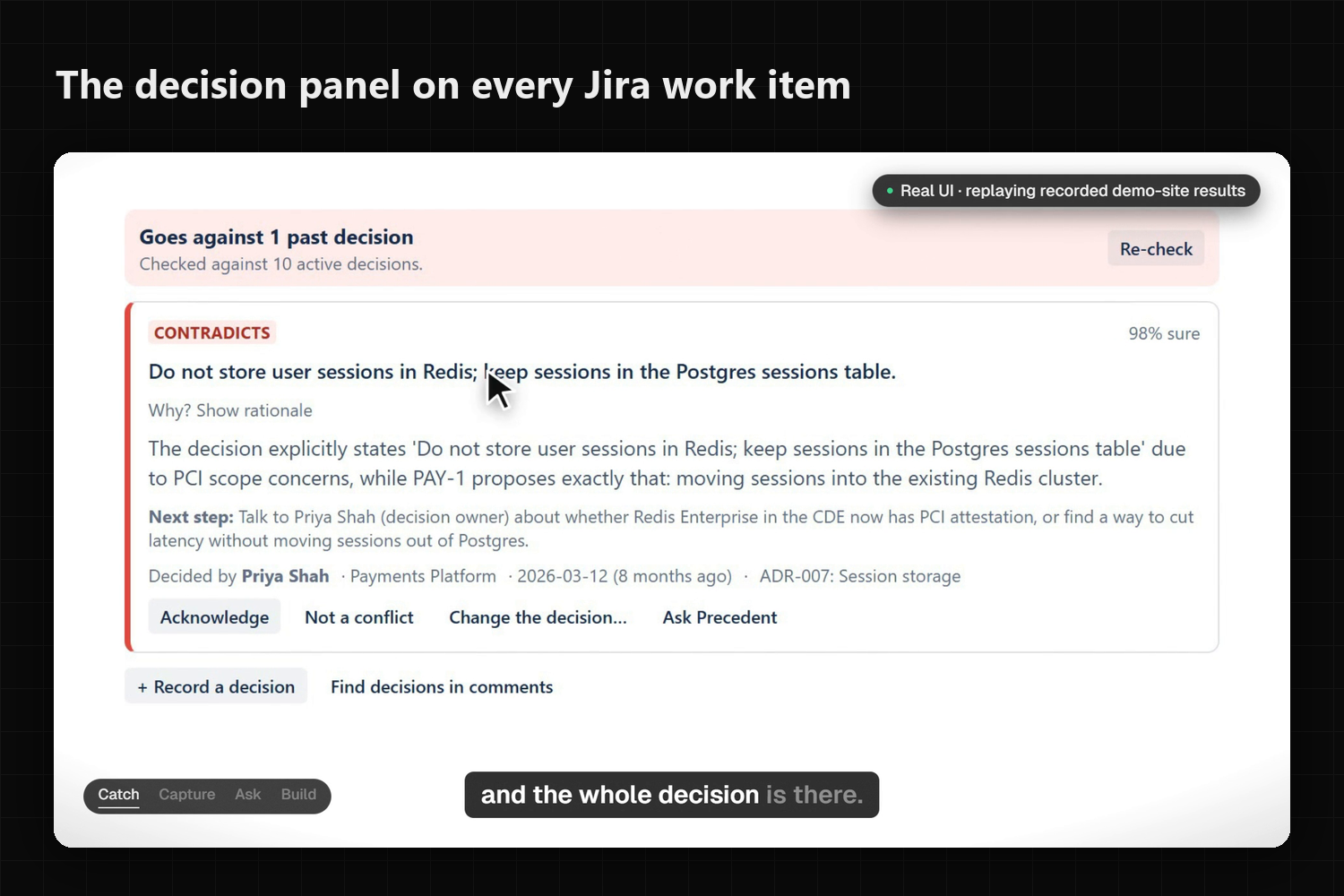
The decision panel on every Jira work item
Inspiration
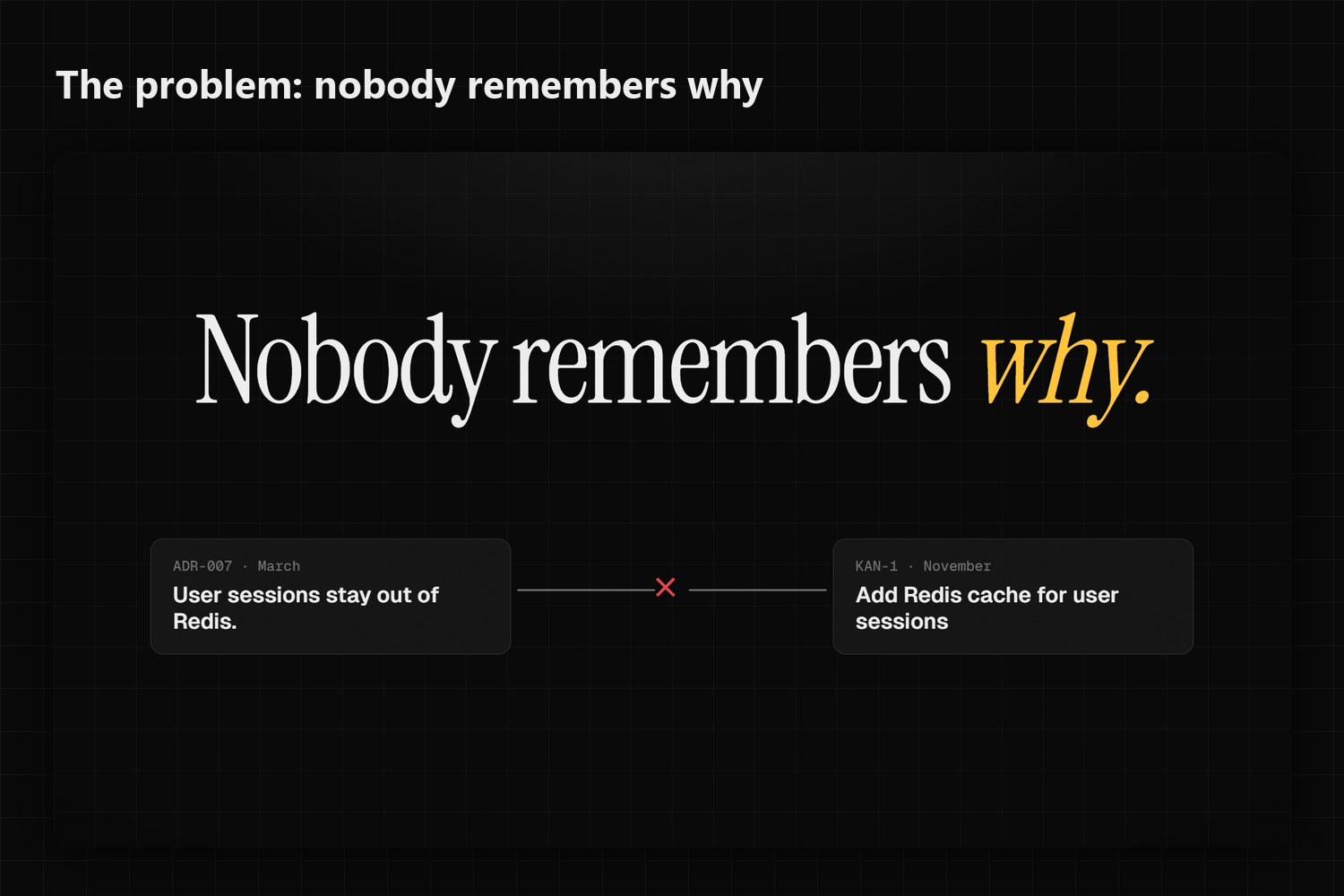
Every engineering team has a decision it has made three times. Someone proposes Redis for sessions, someone else remembers "we looked at that", nobody remembers why, and the reasoning is in a Confluence page from last spring or in the head of someone who moved teams. Either the team re-litigates it or, worse, the work ships and quietly undoes a decision that existed for a reason: an audit scope, an incident, a contract.
The Codegeist brief describes the Teamwork Graph as organizational memory: "what's already been decided". We wanted to make that memory act: check new work against past decisions at the moment work is created.
What it does
Precedent is a Forge app for Jira that keeps a decision log (statement, rationale, rejected alternatives, scope, owner, source and a "revisit when" condition) and checks work against it.
- Automatic checks. Every new or edited Jira work item is compared to the log. Findings are contradicts, revisits (the work reopens a decision, or its revisit condition now holds) or aligned. A high-confidence contradiction gets one Jira comment quoting the decision, its owner and a next step.
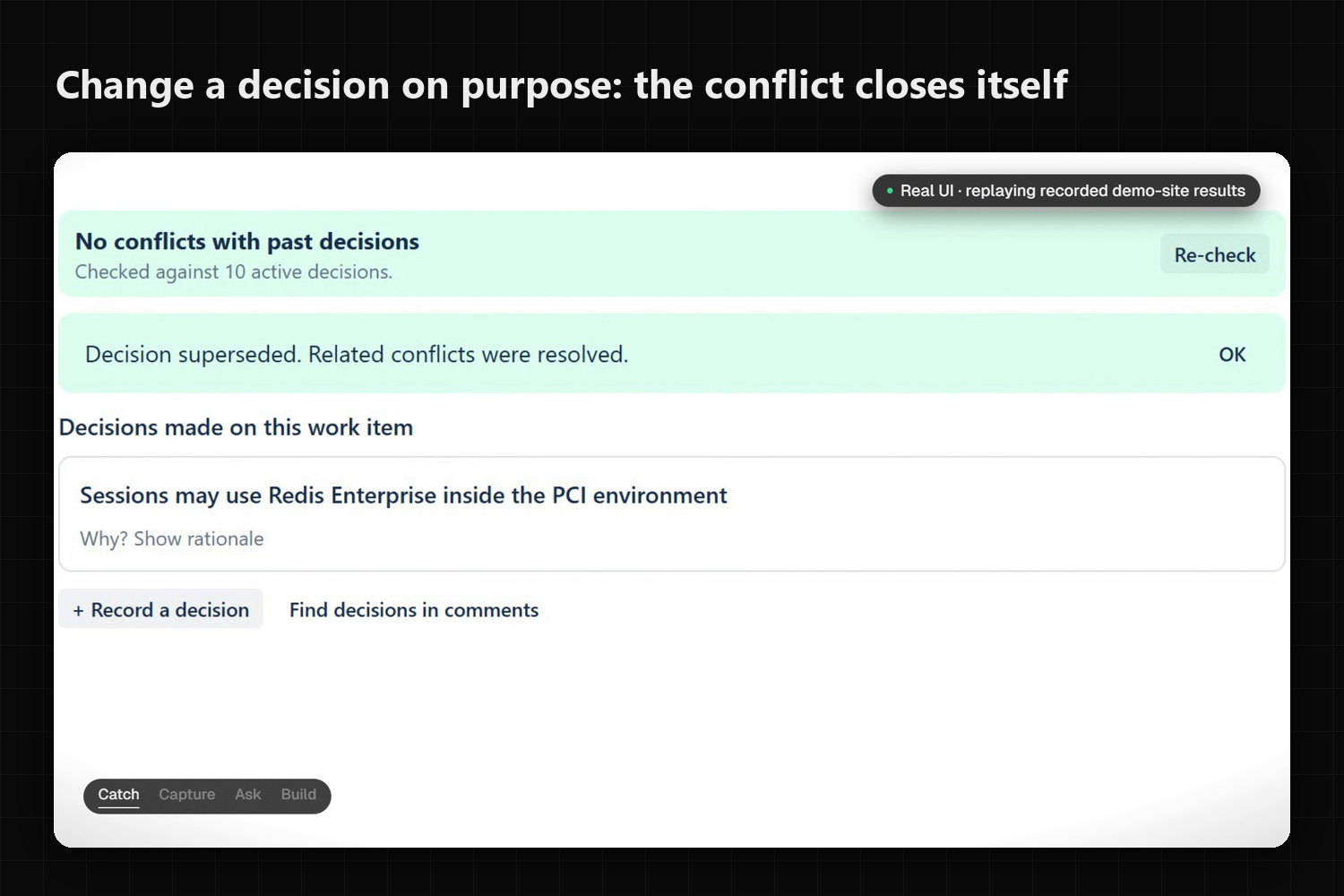
- A panel on every work item. Rationale, rejected options, the owner's teams (from the Teamwork Graph), and actions: acknowledge, "not a conflict", or change the decision — which records a superseding decision, keeps history linked both ways and resolves the open conflicts.
- Capture where decisions happen. Jira comments that read like decisions are extracted automatically. Confluence pages you have worked on are found and read through the Teamwork Graph, as you. Meeting notes can be pasted.
- Check a plan. Paste an RFC or PR description and see which decisions it touches before anyone writes code.
- Rovo agent. Precedent answers "why did we…?" with the owner, date, rationale and source, and checks proposals in chat.
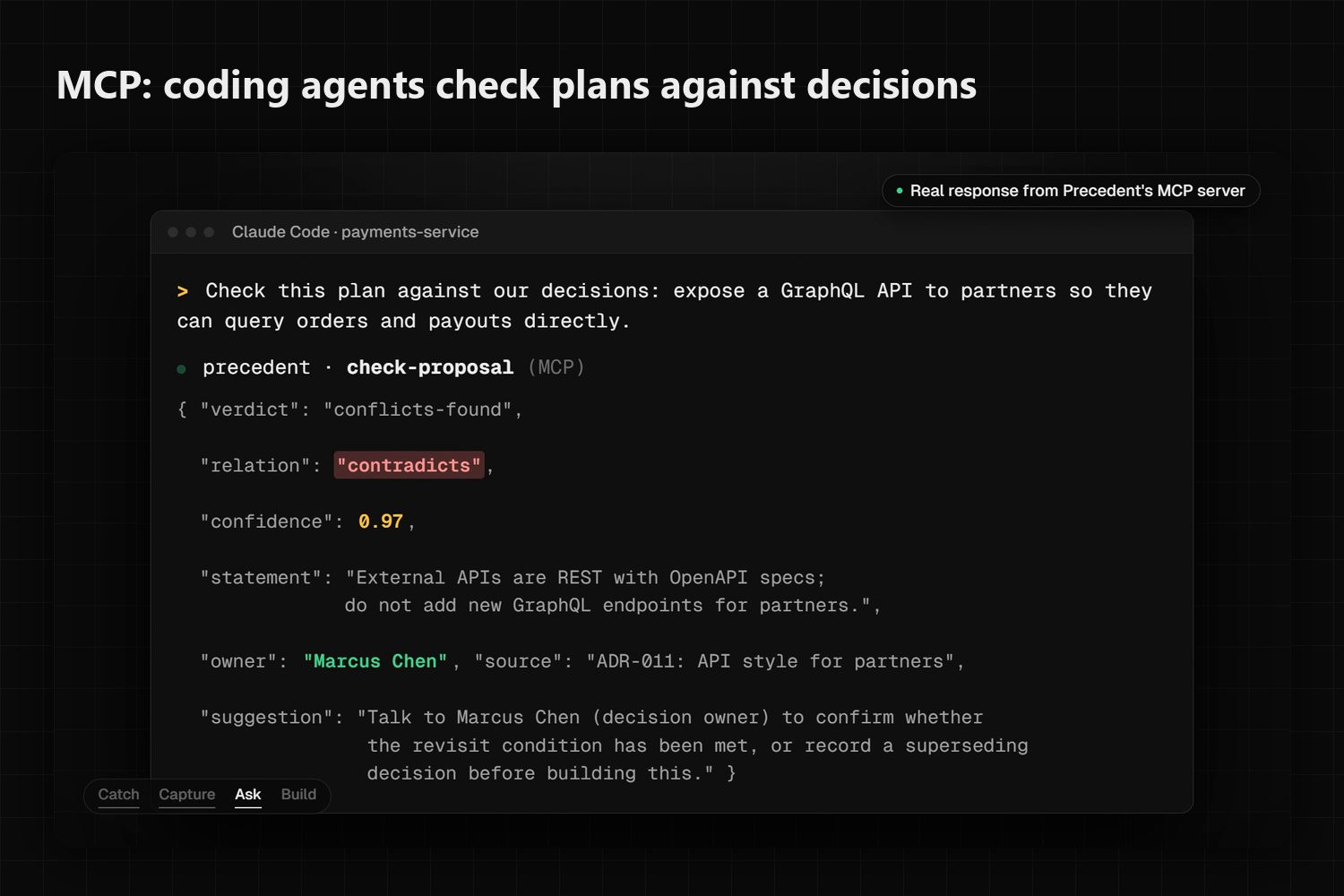
- MCP. The same five tools are exposed through
rovo:mcp, so Claude, Cursor or any MCP client can check a design against the team's decisions from the IDE.
How we built it
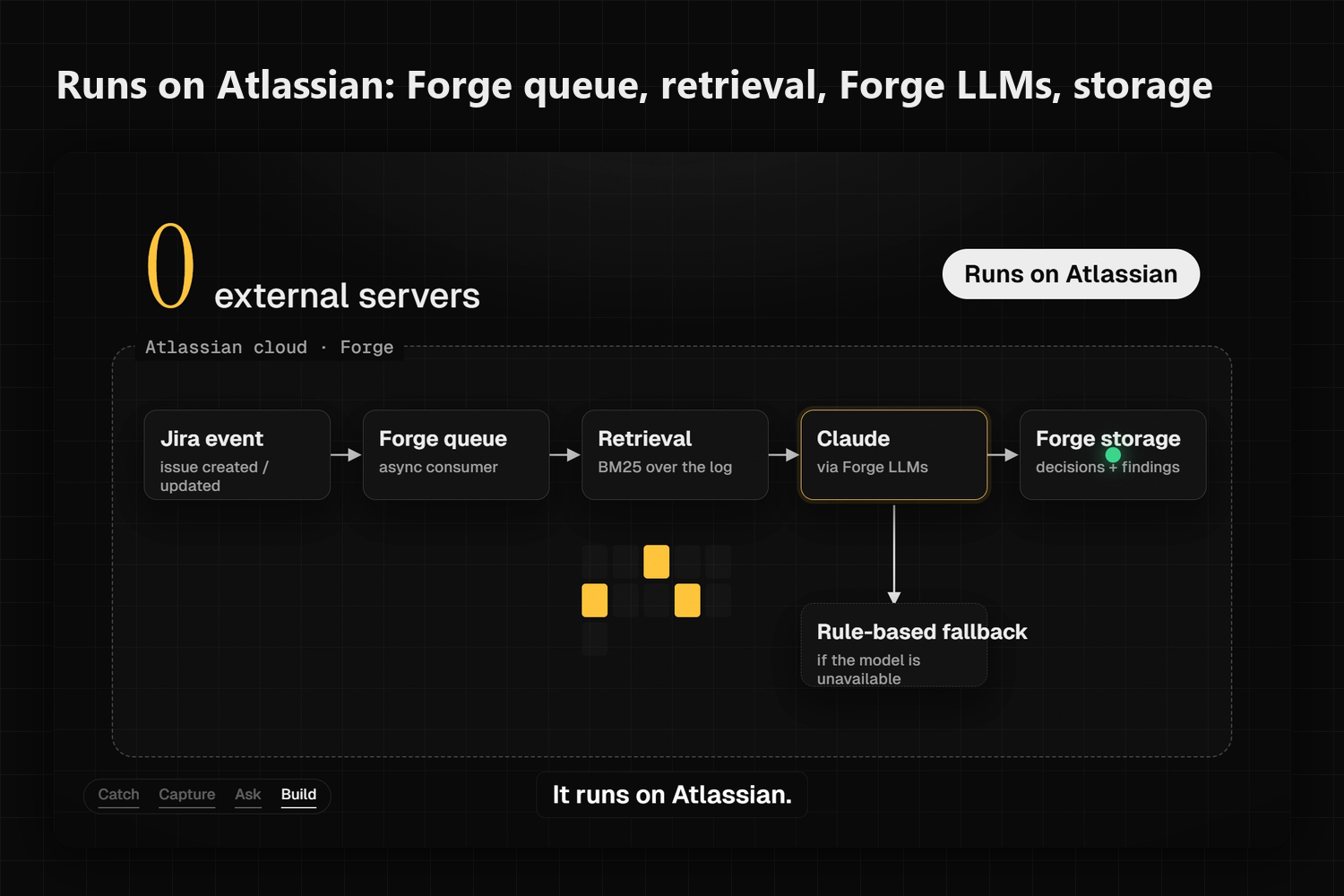
- Forge, Runs on Atlassian. No external servers or egress. Custom UI (React) for a
jira:issuePaneland ajira:globalPage. - Event-driven.
avi:jira:created/updated/commented:issuetriggers (withignoreSelf) push jobs to an Async events queue with concurrency limits, so model calls never sit on the request path. - Retrieval, then judgement. A weighted BM25 index (statement, keywords, scope, rejected alternatives) narrows the log to the 8 most relevant decisions. Only those go to Claude via Forge LLMs, which classifies each relation with a confidence, an explanation that quotes the conflict, and a next step. Work that touches no decision never reaches the model, so cost stays flat as the log grows.
- A safety net. If the model is unavailable or returns something unusable, a rule-based extractor and judge take over (rejected alternatives named in the work, prohibitions whose subject appears, revisit cues), and findings are labelled rule-based.
- Teamwork Graph.
atlassianUserRecentlyViewedreturns Confluence pages with bodies for import,confluencePageOwnersgives the decision owner andatlassianUserInTeamsshows which team to ask. All calls run as the user, so imports respect Confluence permissions. This also let Precedent stay a Jira-only app while reading Confluence. - Rovo. A
rovo:agentwith fiveactions (search-decisions,check-proposal,record-decision,decision-history,list-conflicts), and arovo:mcpmodule exposing the same actions as tools. - Storage. Forge KVS custom entities (
decision,finding) with partitioned indexes. - Trust. Every list that shows work items is filtered by the viewer's browse permission. Admin-only settings and deletes. Prompts treat work item text as untrusted data. A person's "dismissed" stays dismissed across re-checks.
Challenges we ran into
- Rovo on a free developer site. Agents and chat weren't available there; we moved to a Forge demo site.
- Storage edge cases. KVS custom entities reject empty strings, and integer attributes are 32-bit, so millisecond timestamps failed. We store seconds and restore milliseconds in the storage layer.
- Self-generated events. Work items created by the app don't fire its own triggers (by design, to prevent loops), so the demo data queues its checks explicitly.
- Precision over recall. A conflict checker that cries wolf gets uninstalled. Retrieval thresholds, a strict judge prompt, a 70% bar for comments and one comment per conflict keep it quiet unless it matters.
Accomplishments we're proud of
- The first live test caught the conflict on a fresh work item and wrote a next step that used the decision's own revisit condition ("check whether Redis Enterprise in the CDE now has PCI attestation").
- A Teamwork Graph import that turned a meeting-notes page into three structured decisions in one click.
- One set of actions serving the issue panel, the Rovo agent and external MCP clients.
What we learned
Context is only useful at the moment of action. The Teamwork Graph and Rovo make the context available. The product work is deciding when to bring it up and how to say it so people listen.
What's next
- Pull request checks through Bitbucket and GitHub, so conflicts show up in code review.
- Watching revisit conditions with live metrics ("catalog > 5M rows") and opening a review automatically.
- A Teamwork Graph connector that publishes decisions as first-class graph objects for every Rovo agent.
Built With
- atlassian-forge
- bm25
- claude
- confluence
- forge
- forge-llms
- graphql
- jira
- mcp
- node.js
- react
- rovo
- teamwork-graph
- typescript
- vite
