-
-
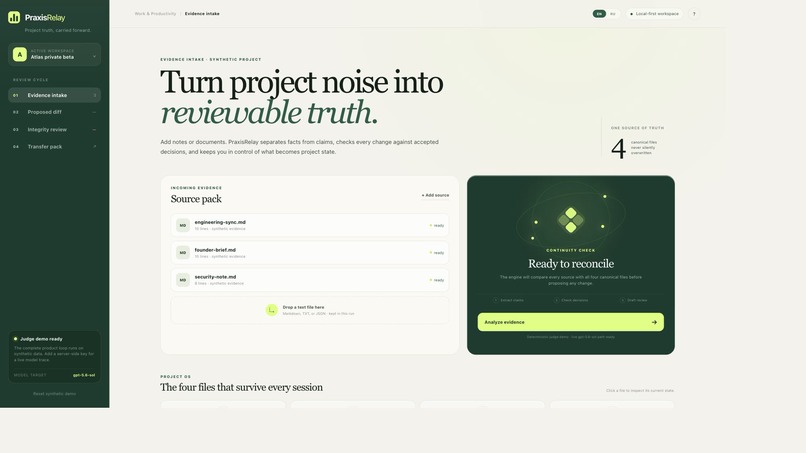
Your project has evidence. Does it still have the truth?
-
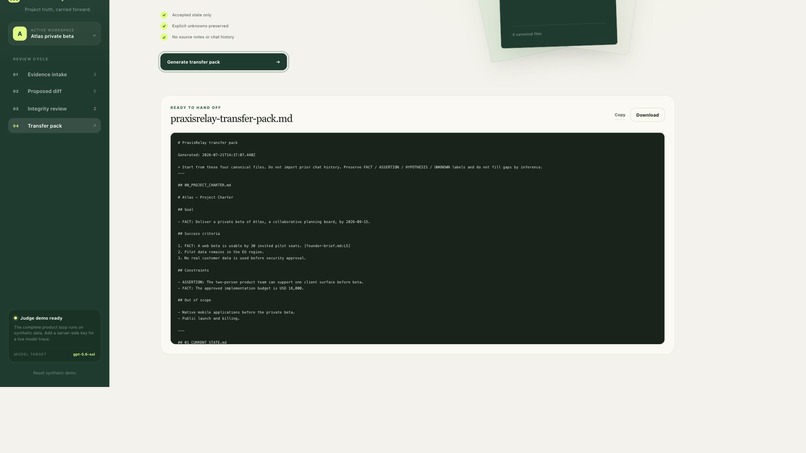
The next AI gets accepted truth — not chat debris.
-
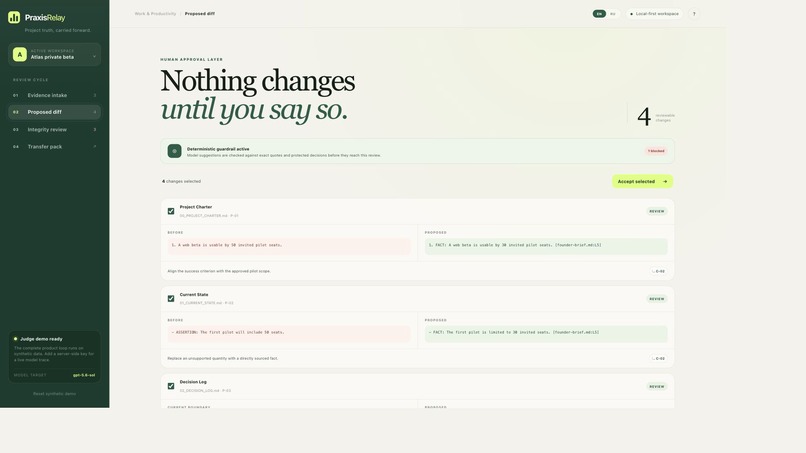
GPT-5.6 proposes. Code verifies. You decide.
-
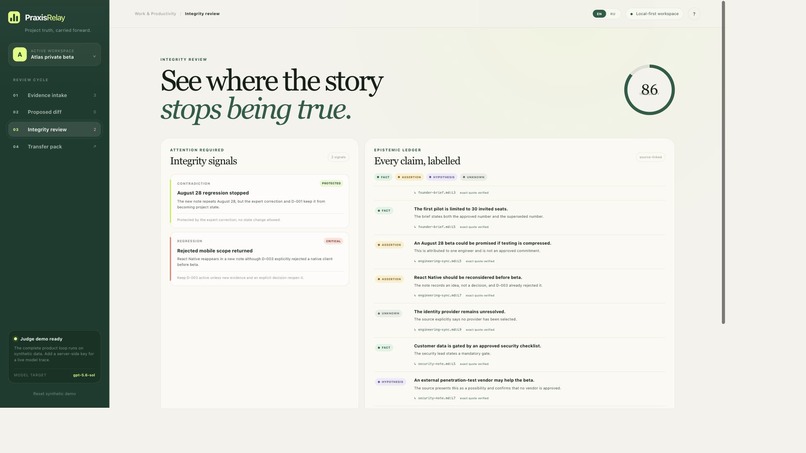
Correct it once. Stop it from returning.
-
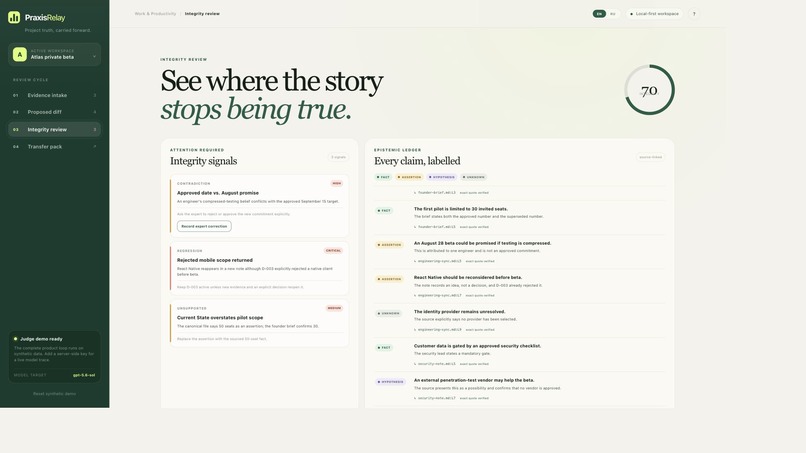
Facts carry evidence. Assumptions stay visible.
Inspiration
I am not a programmer. I came to this problem after more than a year of carrying complex legal work across AI and digital tools and watching what happened to the reasoning between them. Decisions became buried, hypotheses later returned as facts, corrected mistakes reappeared, and each transfer carried old conversational noise along with the useful work.
That experience pointed to a smaller, safer unit of continuity: four explicit files containing the project's goal, current truth, decisions, and unresolved questions. The legal work revealed the problem; the resulting core can be configured by experts in other fields. My aim is not to replace professional judgment, but to make it inspectable and durable inside AI-assisted work.
What it does
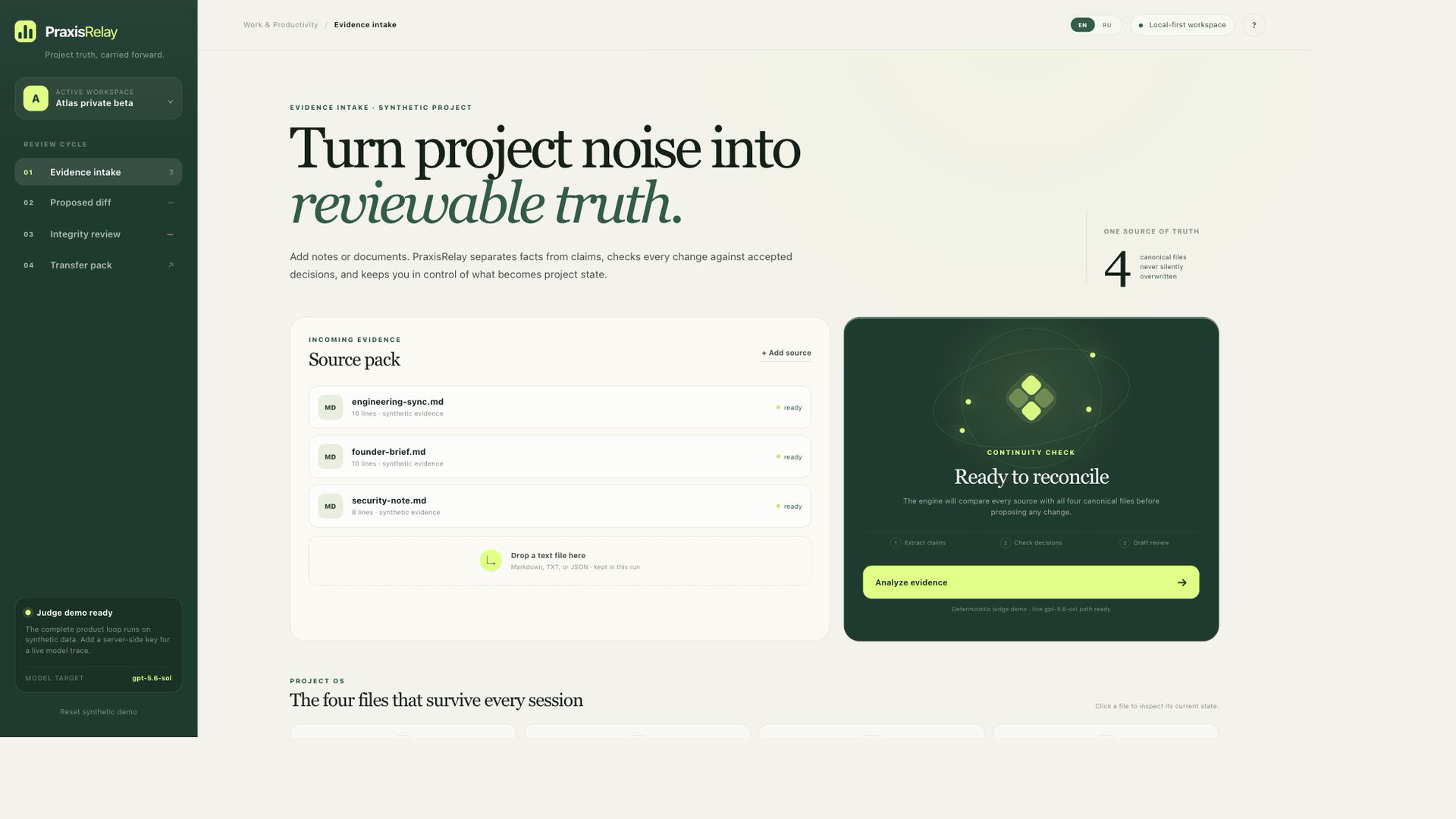
PraxisRelay ingests project notes and compares them with four canonical files: Project Charter, Current State, Decision Log, and Open Questions.
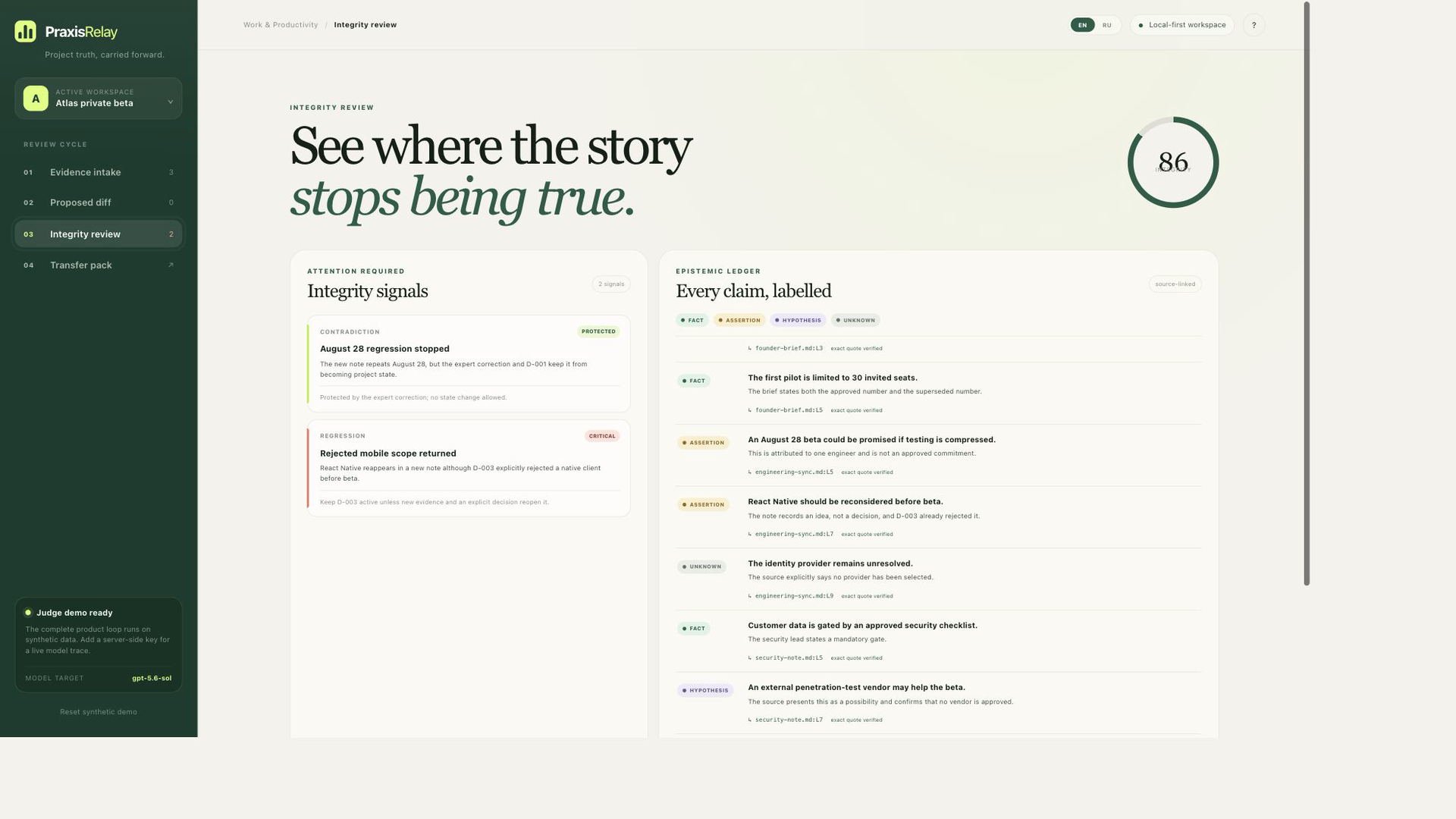
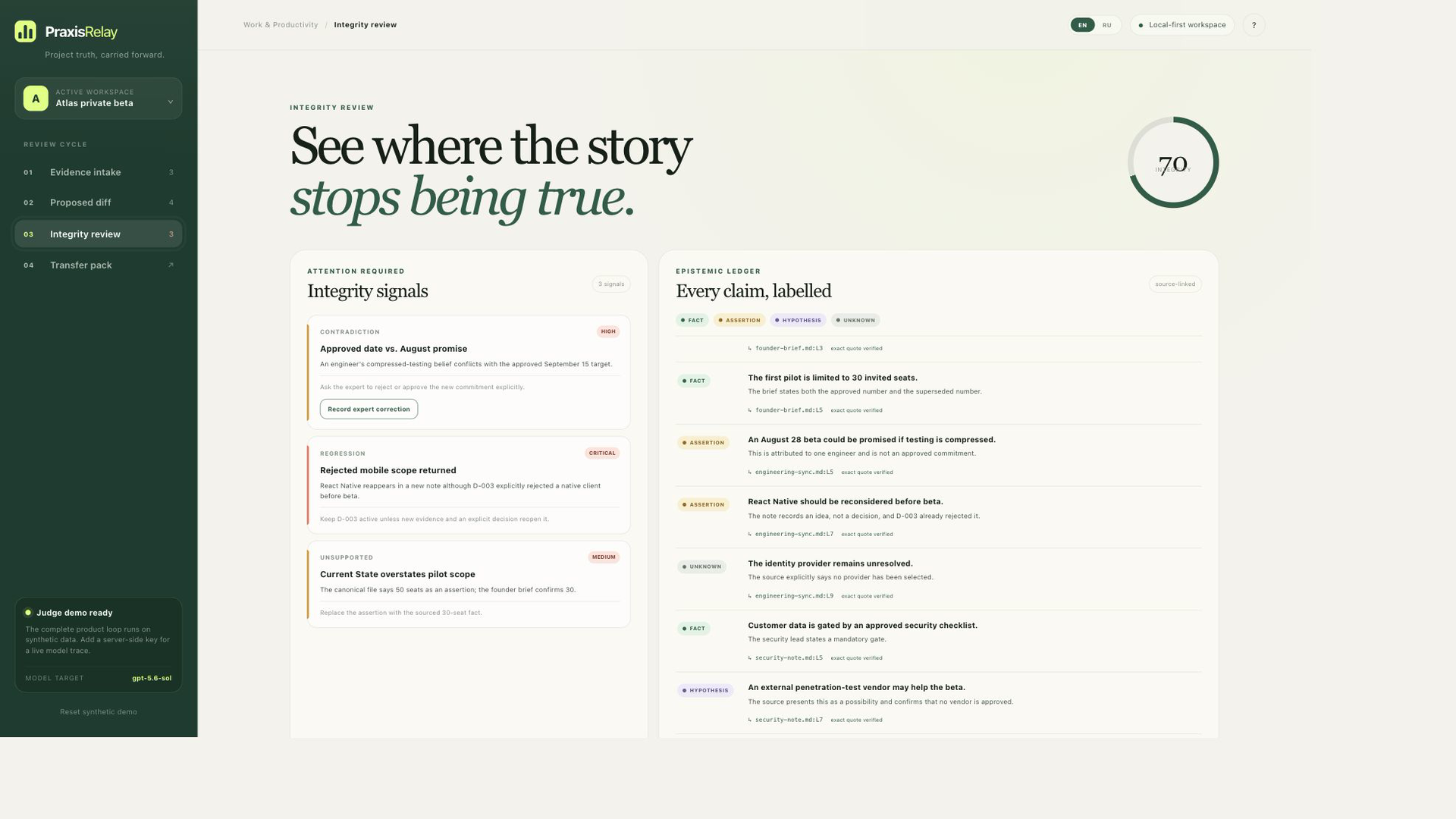
GPT-5.6 extracts material claims and labels each one as FACT, ASSERTION, HYPOTHESIS, or UNKNOWN. It identifies contradictions, unsupported statements, and attempts to revive rejected decisions, then drafts minimal, source-linked changes.
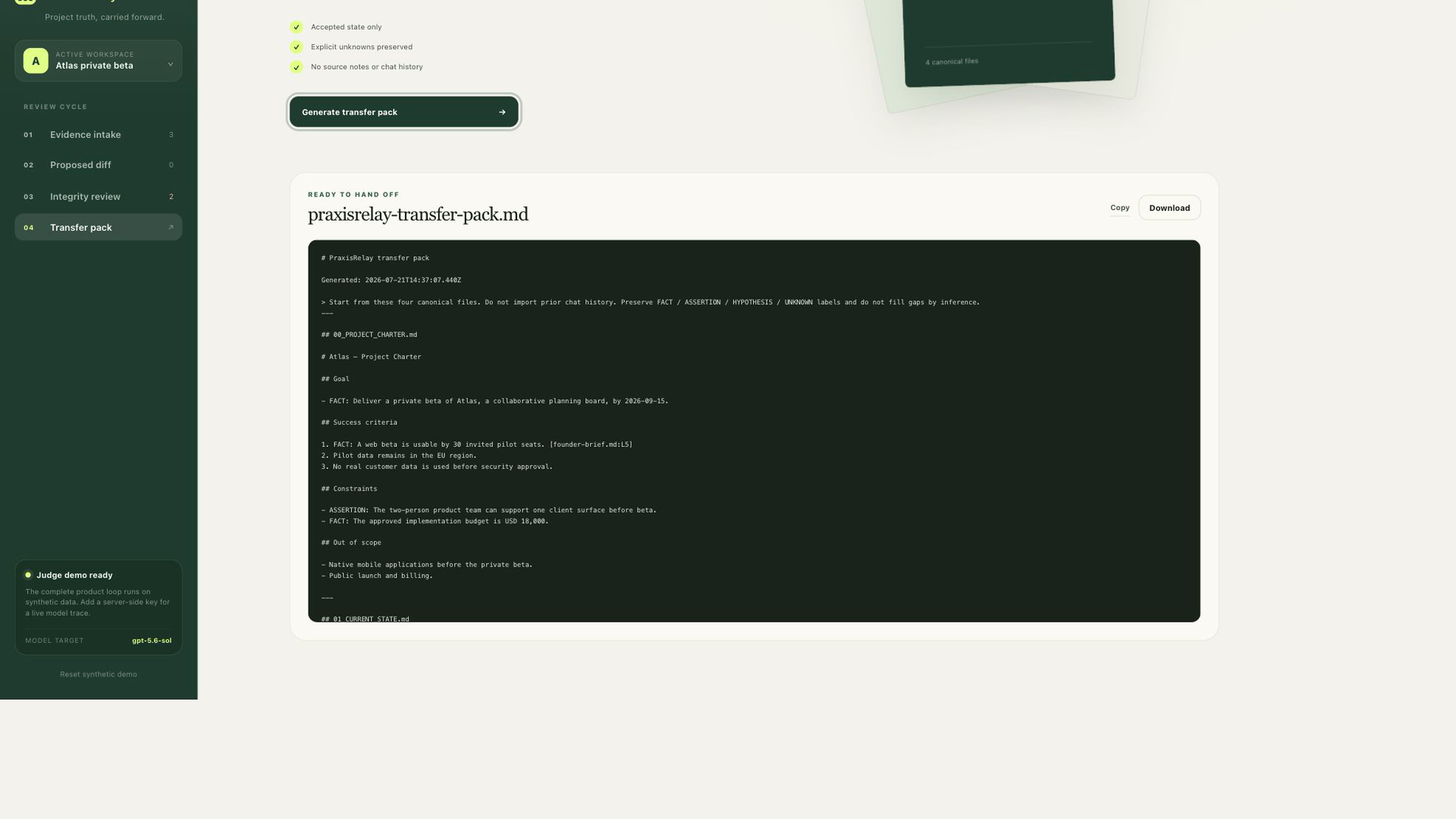
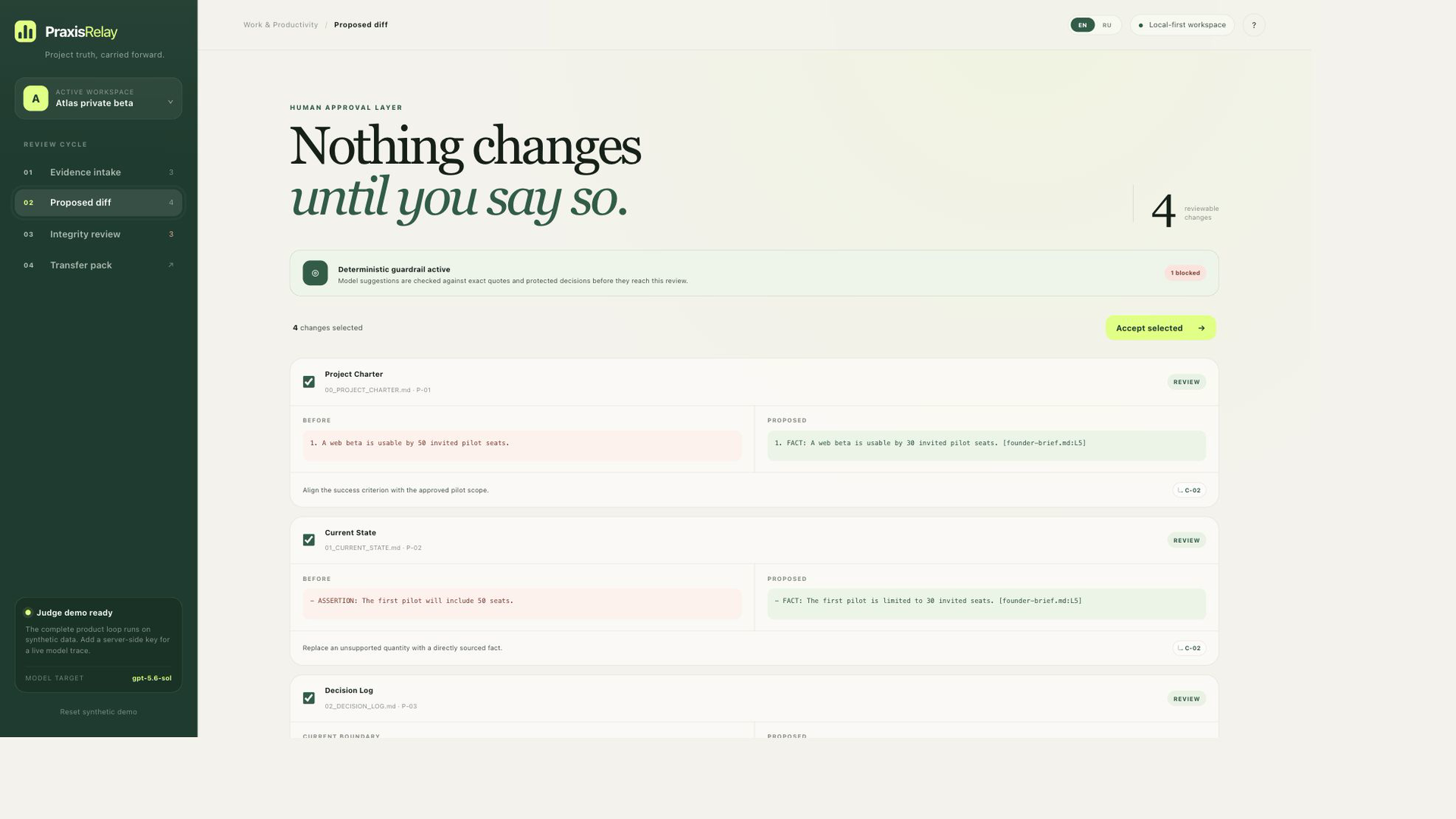
Before those changes reach the user, deterministic guardrails verify exact quotations, evidence links, protected decision terms, current replacement targets, and the four-file write boundary. A human chooses what to accept. Expert corrections become protected decisions, and a clean transfer pack carries only accepted state into the next AI session.
The full interface is available in English and Russian. Source quotes and file diffs stay in their original language to preserve evidentiary accuracy.
What makes it different
PraxisRelay focuses on the inspectable state transition. GPT-5.6 proposes an amendment from bounded source notes; deterministic code independently rechecks the quotation, line range, evidence link, protected decision, replacement target, and write boundary; the human selectively ratifies the changes; and only ratified state reaches the next session.
Most close products are built for coding agents or software teams. This interface is deliberately understandable to a domain expert who does not write code.
How we built it
The prototype is a dependency-free Node.js application with a custom browser interface and an isolated local workspace.
The live reasoning path uses the OpenAI Responses API with gpt-5.6-sol, medium reasoning effort, and strict JSON Schema output. The API key remains server-side, responses use store: false, and source text is sent only when analysis is explicitly run.
GPT-5.6 performs semantic extraction and comparison. A deterministic validation layer then verifies every quote and line range, demotes unverified facts, blocks missing evidence, protects rejected decisions, rejects stale diffs, and restricts writes to the canonical allowlist.
The repository also contains a complete deterministic synthetic demo, critical logic tests, a secret scan, judge instructions, and an under-three-minute demo video.
Challenges
The central challenge was balancing model intelligence with inspectable control. A model can recognize semantic conflicts, but a project memory system must not promote a fluent inference into accepted truth. We designed model output as a proposal, then placed exact-evidence checks, decision protection, and human approval between reasoning and persistence.
A second challenge was making the system demonstrable without depending on network conditions. The synthetic judge mode runs the identical product loop and deterministic guardrails while the live GPT-5.6 path remains available for model verification.
Accomplishments
- A complete source-to-transfer product loop in one focused prototype.
- Exact evidence and line-range verification for every factual claim.
- Human-reviewable changes across all four canonical files.
- Deterministic blocking of a returned rejected decision.
- An expert-correction loop that prevents regression.
- A full English/Russian interface.
- Zero third-party runtime dependencies and a one-command launch.
What we learned
Useful AI memory is not the largest possible transcript. It is the smallest accepted state that preserves evidence, decisions, reasons, and explicit unknowns.
Semantic model output and deterministic validation are complementary: the model finds meaning, code checks invariants, and the human owns the final judgment.
How Codex was used
The problem definition, methodology, epistemic labels, legal expansion model, and professional judgment embodied here came from my hands-on practice and more than a year of experiments. Codex helped package those ideas into a coherent product and performed the implementation work: re-checking current rules and model guidance, auditing 28 concepts across all four tracks, designing the flow, building the server and bilingual interface, integrating GPT-5.6 structured outputs, creating the safety layer and tests, running browser QA, and preparing the visuals and submission package.
I developed the concept and professional methodology in Russian, based on my real-world experience. Codex helped translate and structure the English presentation so that language would not limit participation. I reviewed the meaning in Russian and made the final product decisions. Today, this creates a unique opportunity: professionals can turn deep domain knowledge into working digital products regardless of the language they speak.
Codex also found two subtle defects through testing: a source-line matcher returned a wider range than necessary, and an expert correction did not reliably protect a related conflict. Both were fixed and covered by regression tests.
What's next
The first professional methodology built on this core would be legal work: verified authorities, accepted facts, interpretations, competing positions, branching consequences, and human-approved conclusions.
Later versions could add repository connectors, collaborative review, organization-specific decision policies, cryptographic provenance for source snapshots, and optional encrypted local indexing. The core contract remains: no silent write and no fact without evidence.
Built With
- codex
- css3
- javascript
- openai
- responses


Log in or sign up for Devpost to join the conversation.