The Problem Nobody Talks About
Most people don't struggle with money because they're bad at math.
They struggle because they've never actually made a financial decision under pressure. Every course, every app, every explainer video teaches you about money the same way — you sit, you absorb, you nod along. And then real life arrives. Your first paycheck. A market crash. A medical bill you didn't see coming.
And you freeze. Because knowing what compound interest is and knowing what to do when your savings account is sitting there and the market just dropped 18% are completely different things.
No one gives you a place to practice that. To actually feel the weight of a financial decision before the consequences are real.
I wanted to build that place.
What PRAXIS Is
Active practice over passive reading.
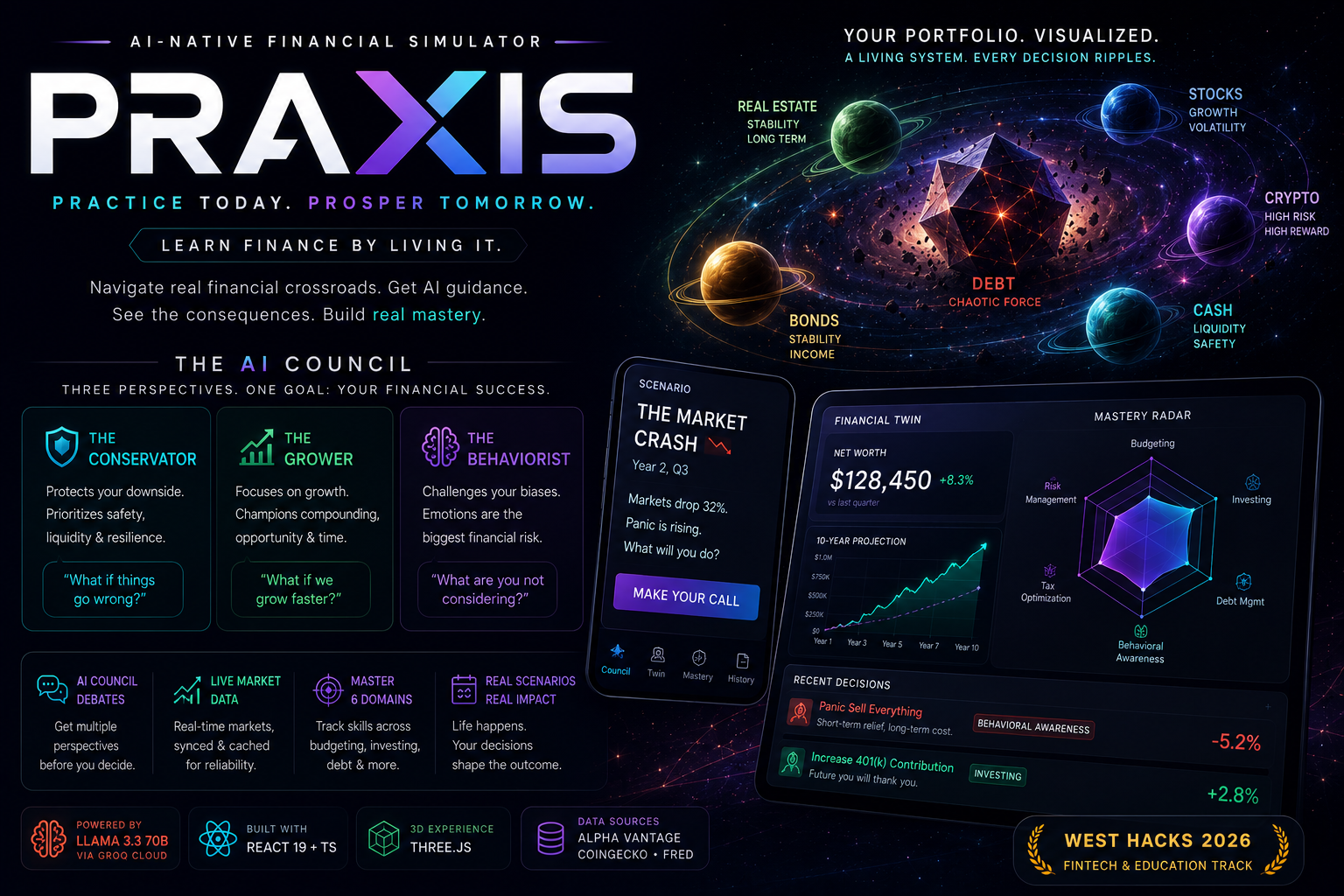
PRAXIS is an AI-native financial simulator. Not a quiz. Not a budgeting tracker. A simulator — one that puts you inside your own financial future and makes you live it.
It starts by building your Financial Twin: a personalized digital avatar constructed from your real income, debt, savings rate, and a psychological assessment that maps your actual relationship with money. Your Twin isn't a generic character. It's you — your risk tolerance, your spending instincts, your financial blind spots, all modeled and alive.
Then it drops your Twin into the scenarios that actually shape people's financial lives. Your first summer paycheck. A sudden market crash. A promotion that comes with lifestyle inflation pressure. A medical emergency. A crypto boom that everyone around you is riding.
At every decision point, you don't just pick an answer.
You watch three AI agents fight about what you should do.
Built for Everyone — Beginner to Experienced
This was a design priority from day one. PRAXIS had to work for someone who has never heard the word "liquidity" just as well as it works for someone who already tracks their net worth in a spreadsheet.
For beginners, the Quantum Lexicon is always there. Every financial term the AI Council uses — compound interest, opportunity cost, 401(k), loss aversion, tax-advantaged accounts — is defined in plain language, in context, the moment it appears. No Googling. No leaving the sim. No feeling stupid for not knowing something. The learning happens inside the experience, not before it.
For people who already know finance, PRAXIS doesn't dumb anything down. The Council speaks at full depth. The 10-year wealth projections are anchored to live macroeconomic data — real Fed Funds Rate, real CPI, real market indices — so the numbers aren't made up. The scenarios aren't hypothetical. The Behaviorist calls out real cognitive biases by name. There's enough intellectual substance here for someone who knows what they're doing to still find it genuinely useful.
The Mastery Radar grows with you. A beginner and an expert playing the same scenario will make different choices, trigger different tags, and come away with a different skill profile. The sim adapts to what you actually do, not what level you declared at signup.
The AI Council
This is the part I'm most proud of.
When you hit a decision node, a 3-Agent AI Council convenes. Each agent carries a distinct financial worldview and they don't agree.
🛡️ The Conservator is your safety-first voice. Emergency funds. Liquidity. Downside protection. The Conservator doesn't care about your 20-year wealth projection if you can't survive the next 6 months.
📈 The Grower is your future-wealth voice. Compound interest. Opportunity cost. Tax-advantaged accounts. Every month you're not invested is money you're leaving on the table, and The Grower will not let you forget it.
🧠 The Behaviorist is the one who watches you, not the numbers. Loss aversion. Lifestyle inflation. Panic-selling. The Behaviorist knows that the reason most people make bad financial decisions isn't bad math, it's bad psychology. And they know your psychology specifically, because they've read your Twin.
The Council runs a 3-phase deliberation protocol:
Phase I — Opinions. All three agents independently analyze your situation and give their honest take. You see the conflict immediately. They don't agree.
Phase II — Rebuttals. The agents argue with each other. Directly. The Grower tells the Conservator they're letting fear masquerade as caution. The Behaviorist points out that both of them are ignoring the stress load this decision will put on you. It gets heated. That's the point.
Phase III — Synthesis. After the fight, a verdict. What they agreed on, what they couldn't, the final balanced recommendation, and a list of cognitive bias warnings tailored to your Money Personality. Not generic advice. Advice that knows who you are.
The entire system runs on LLaMA 3.3 70B, with Pydantic v2 enforcing strict JSON schemas at every output so the agents can't drift, hallucinate, or break structure. And if the backend ever goes down, a Heuristic Mock Council fires automatically. The app has never crashed. Not once.
The Galaxy
Your portfolio doesn't live in a spreadsheet. It lives in space.
Each asset class is a planet. Orbit speed maps to volatility — stable bonds move slowly, crypto spins. Your debt sits at the center of the system as a chaotic, unstable geometric mass. It doesn't just sit there. It warps the orbital paths of your growth planets, pulling them inward, slowing their trajectories.
Pay off debt and watch the gravity of the entire system shift in real time.
Built with Three.js via @react-three/fiber, with a 140-node mouse-reactive
particle field as the background constellation. Every single visual property,
mass, speed, warp intensity, maps 1:1 to a real financial variable in your
Twin's live state. It's not decoration. It's a data visualization you can feel.
Everything Else
Live Market Ticker — Real-time SPY, GLD, BTC, ETH, Fed Funds Rate, and CPI pulled from Alpha Vantage, CoinGecko, and FRED. A 10-minute localStorage cache neutralizes free-tier rate limits entirely. The ticker has never gone dark.
10-Year Wealth Projection — Every choice nudges your Twin's net worth 5% toward the long-term trajectory of that decision. These projections aren't guesswork — they're anchored to live macroeconomic indicators so the math reflects the actual world you're making decisions in. Small choices compound. The butterfly effect, made visible.
Mastery Radar — Six financial domains: Budgeting, Investing, Debt Management,
Behavioral Awareness, Tax Optimization, Risk Management. Every decision you make
carries hidden tags (panic-sell, compound-interest, lifestyle-inflation).
Those tags update your radar automatically. You can't game it. It just watches
what you actually do.
Money Personality Archetypes — Five profiles (Guardian, Builder, Explorer, Strategist, Visionary) derived from your onboarding assessment. Your archetype feeds directly into how the Behaviorist interprets your decisions and what biases it watches for.
Quantum Lexicon — A living financial dictionary built into the sim. Every term the Council uses is defined in plain language, in context, the moment you need it. It's what makes PRAXIS work for a complete beginner without ever talking down to someone who already knows their stuff.
Diegetic UI — The interface itself is part of the experience. A
QUANTUM_COUNCIL_ONLINE indicator in the navbar shows live system status.
Synthesized audio tones fire on hover and click — no external libraries, pure
Web Audio API. Everything feels intentional because it is.
The Hardest Parts
Making the Council feel like a debate, not a report.
Three agents with genuinely opposed worldviews, producing structured outputs that
actually collide in the rebuttal phase — that required deep prompt architecture.
The instinct of every LLM is to agree, to hedge, to synthesize prematurely. I
had to engineer disagreement. Pydantic v2 was the backbone — strict schemas meant
every AgentOpinion and AgentRebuttal was structurally locked, and the agents
had to fill the conflict, not avoid it.
Making the Galaxy accurate and beautiful.
Mapping abstract financial data to physical Three.js properties sounds clean on paper. In practice, volatility doesn't naturally translate to orbital mechanics. Debt doesn't naturally warp space. Getting those metaphors to feel true, financially and visually, took more iteration than almost anything else in the project.
Making the system unbreakable.
PRAXIS calls three external APIs, runs a multi-agent LLM backend, and maintains
complex real-time state across a 3D frontend. Any one of those can fail. I
built fallbacks at every single layer: error boundaries, mock councils, cached
market data, and graceful degradation throughout. The QUANTUM_COUNCIL_ONLINE
indicator in the navbar isn't just aesthetic. It's a live system health signal.
What I Actually Learned
I came in knowing how to write React components.
I left understanding what it means to design a system, where AI inference, real-time data, 3D physics, state management, and UX psychology all have to hold together simultaneously under real user behavior, with no single point of failure.
But the deeper lesson was about education itself. Financial literacy isn't a knowledge problem. People know they should save. They know they shouldn't panic-sell. They know compound interest is powerful.
They just haven't felt it yet.
PRAXIS is my answer to that. Every animation, every audio tone, every color shift, every Council argument was designed to make a financial decision feel like something, so that when the real version of that decision arrives, you've already lived it once.
What's Next
PRAXIS is a working simulator but the vision is bigger than what's here today.
The 10-year projection engine is next in line to get smarter — pulling deeper from macroeconomic signals to model how Fed rate decisions, inflation cycles, and market conditions actually influence a personal wealth trajectory over time. Not just a number that moves, but a forecast that breathes with the real world.
More scenarios, more decision trees, more life events that reflect the actual choices people face in their lifetime. And eventually, multiplayer — because some of the worst financial decisions people make happen because of social pressure, and that deserves its own simulation layer.
The foundation is solid. Everything else is iteration.
On the Demo Video
The demo is 28 minutes. I know.
I tried to cut it. The honest answer is that I couldn't, not without turning it into a highlight reel that shows what PRAXIS does without showing how it feels. And the feeling is the whole point.
So I left it long. If you watch nothing else, watch the Council deliberate. That's where everything comes together.
Thank you for building a hackathon that made me want to build something like this.
Built With
- alpha-vantage-api
- coingecko-api
- fastapi
- framer-motion
- fred-api
- groq
- llama-3.3
- lucide
- pydantic
- python
- react
- react-three-fiber
- recharts
- render
- three.js
- typescript
- vercel
- vite
- web-audio-api
- zustand

Log in or sign up for Devpost to join the conversation.