-
-
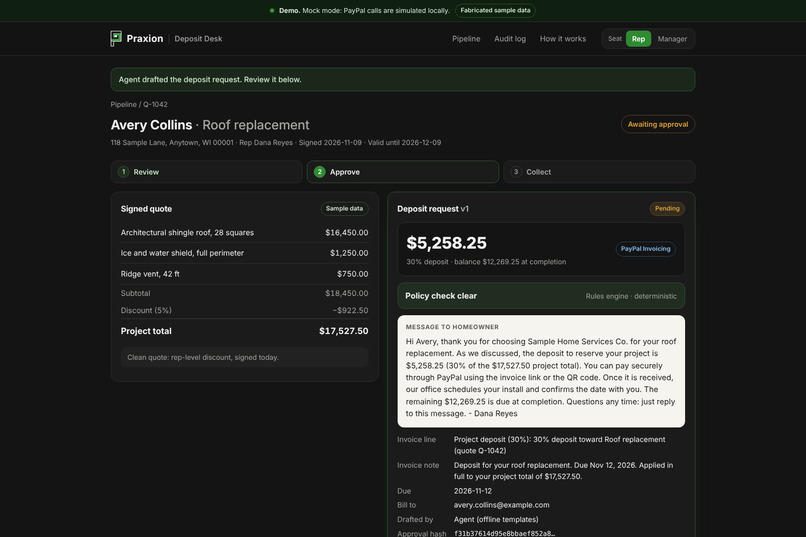
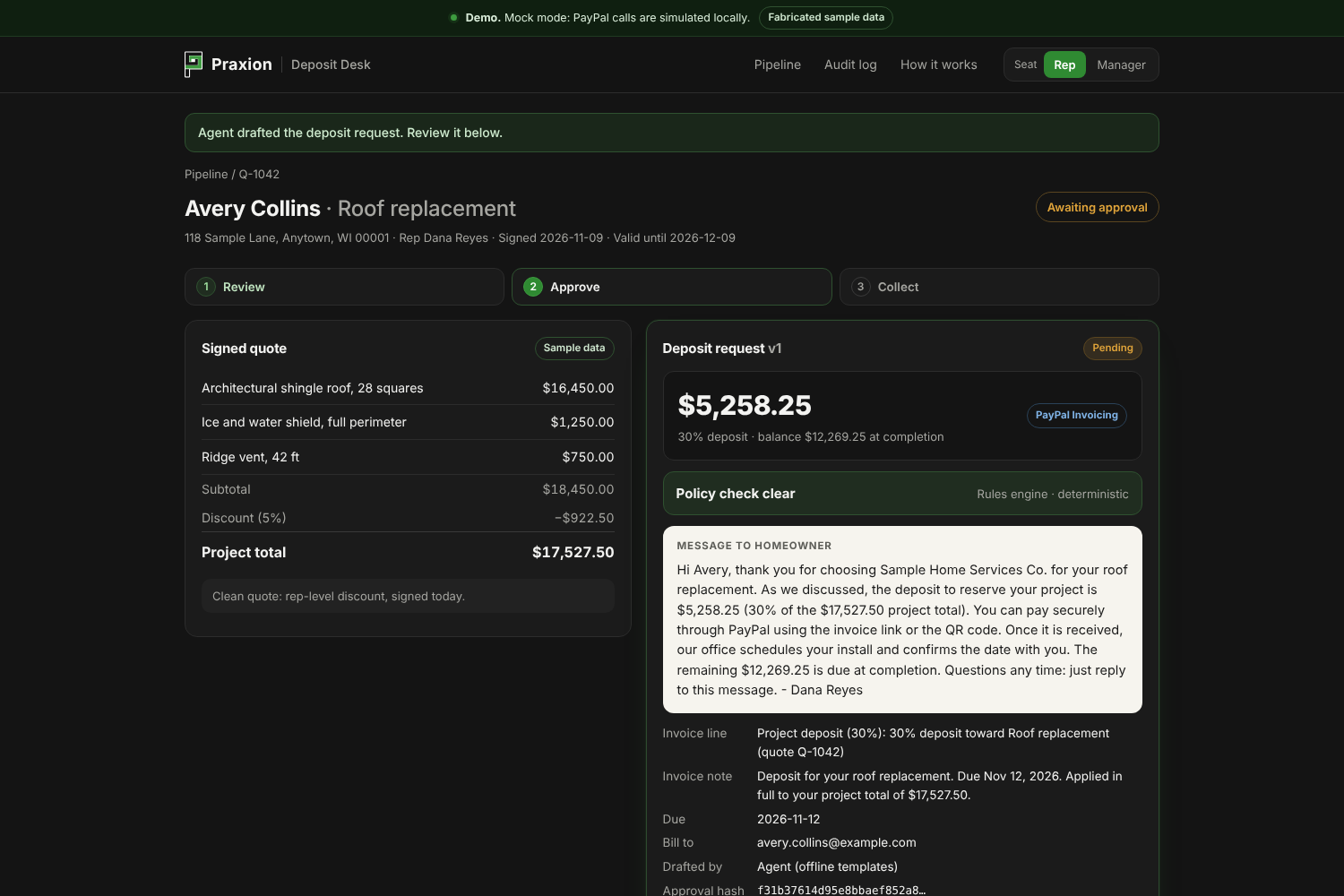
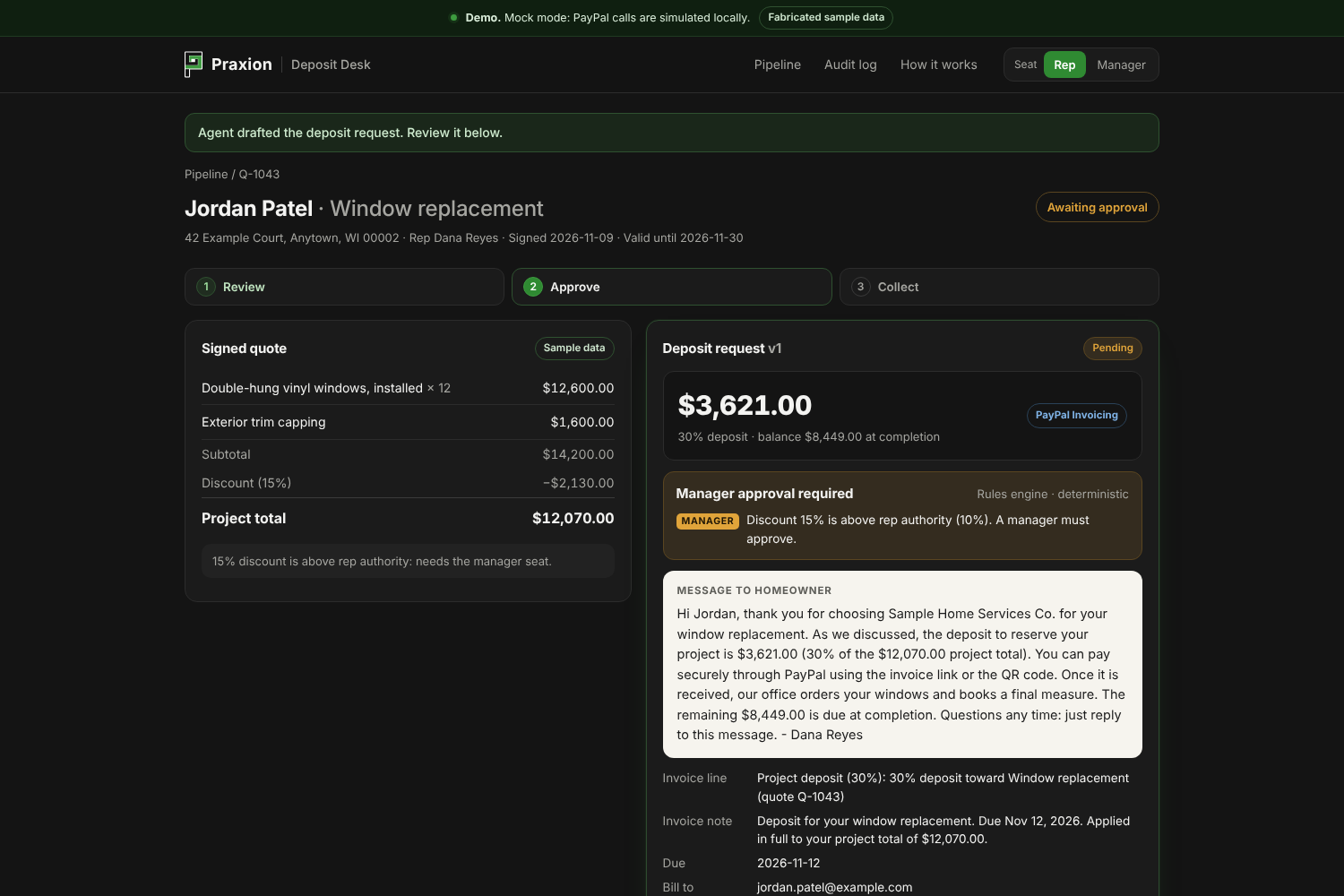
Review: the agent drafts the deposit request, the policy check is clear, and it waits for a person.
-
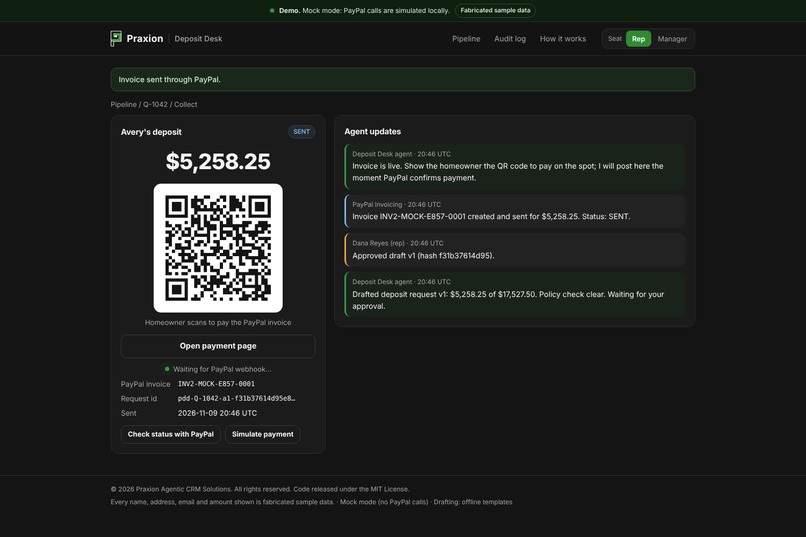
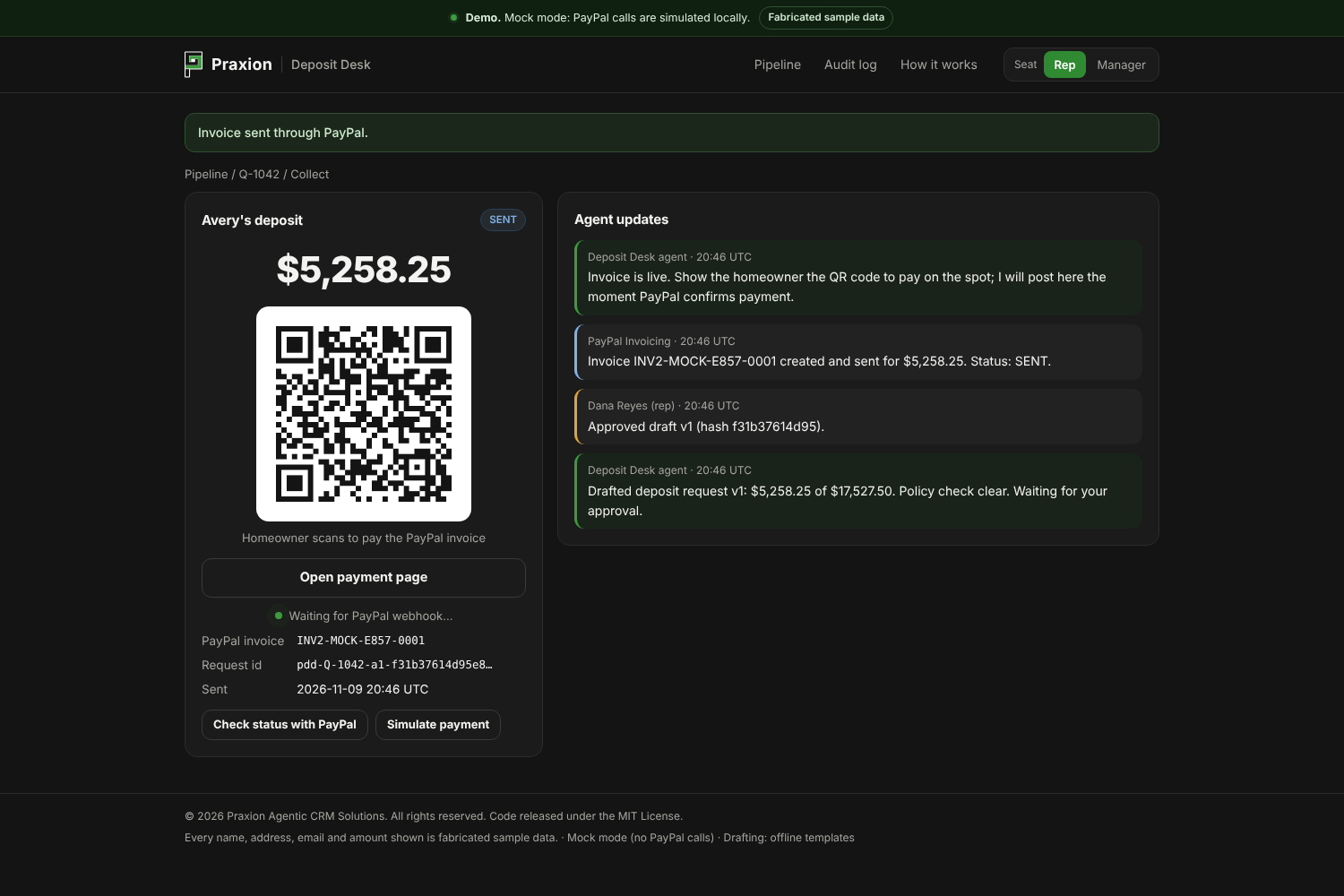
Collect: PayPal invoice sent with a QR code; the homeowner pays on PayPal's hosted page.
-
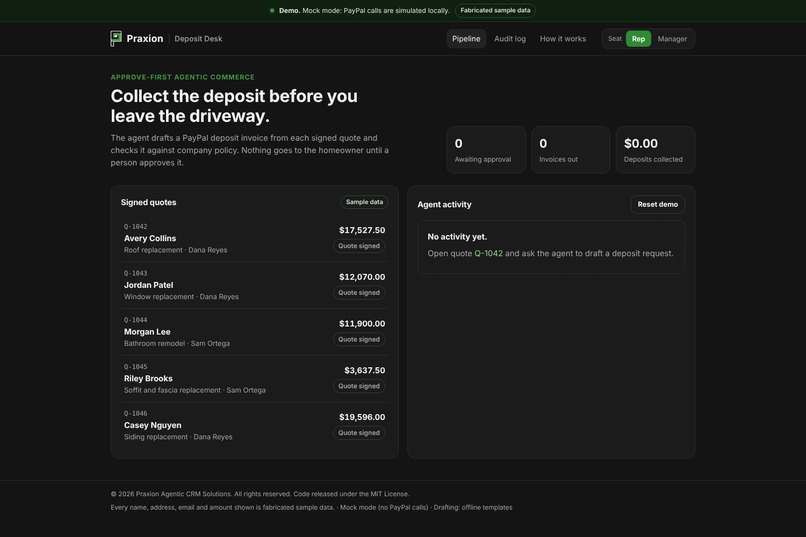
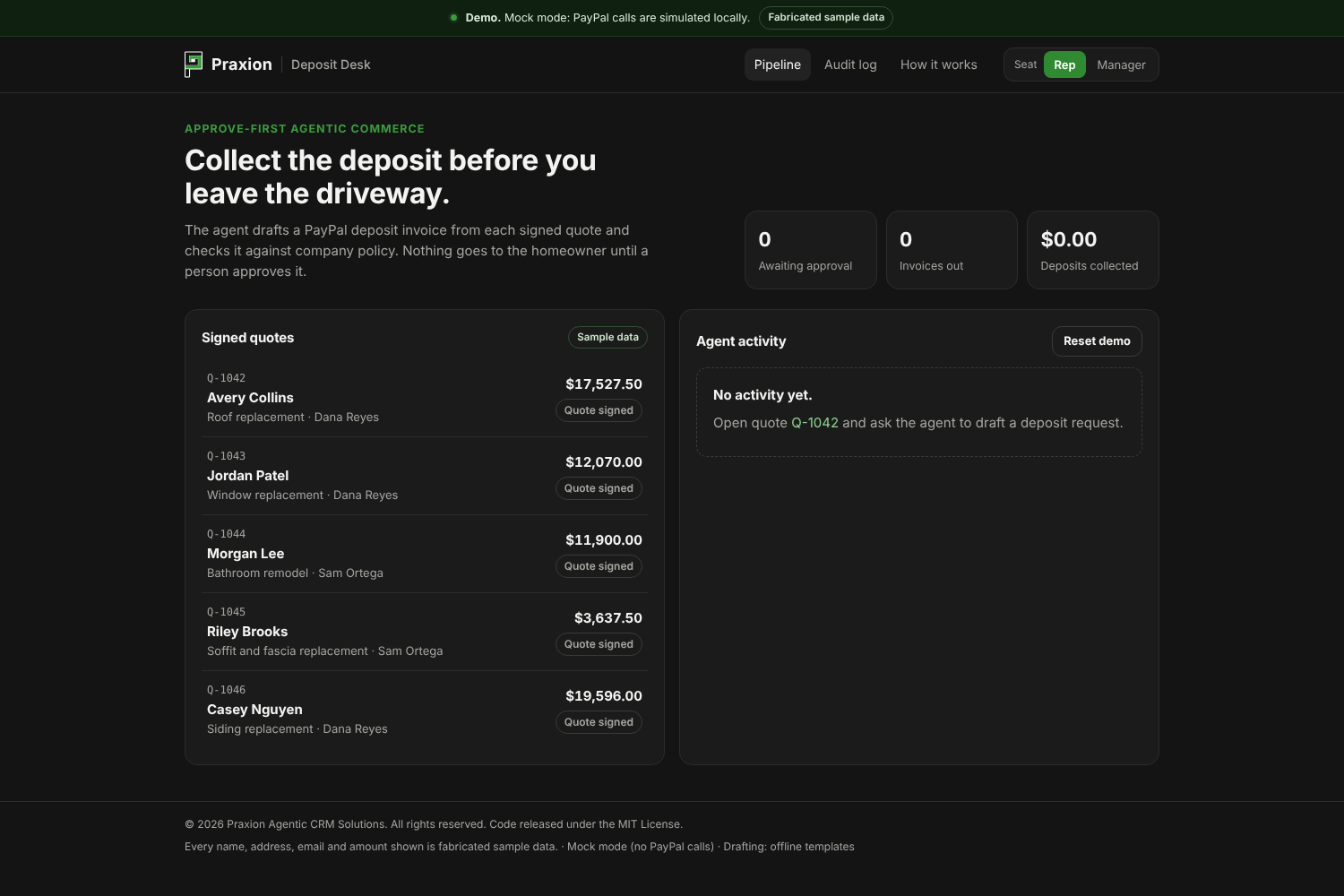
Pipeline: signed quotes ready for a deposit request (fabricated sample data).
-
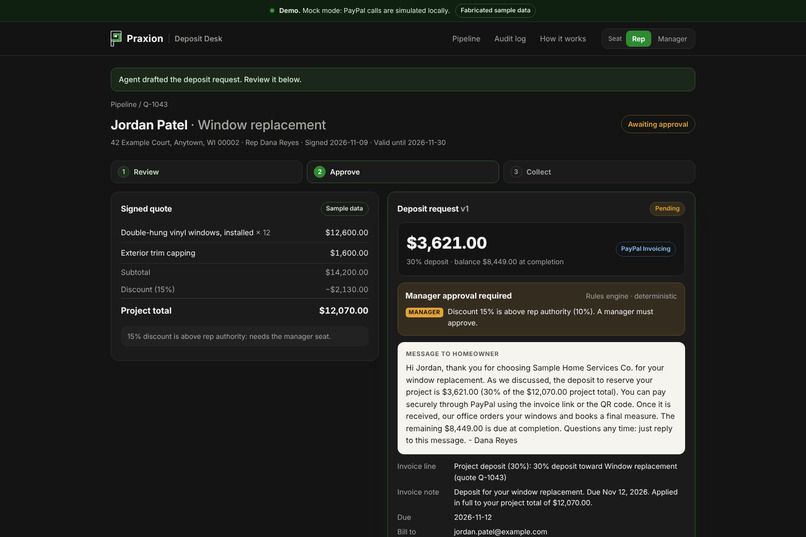
Guardrail: a 15% discount is above rep authority and needs the manager seat.
-
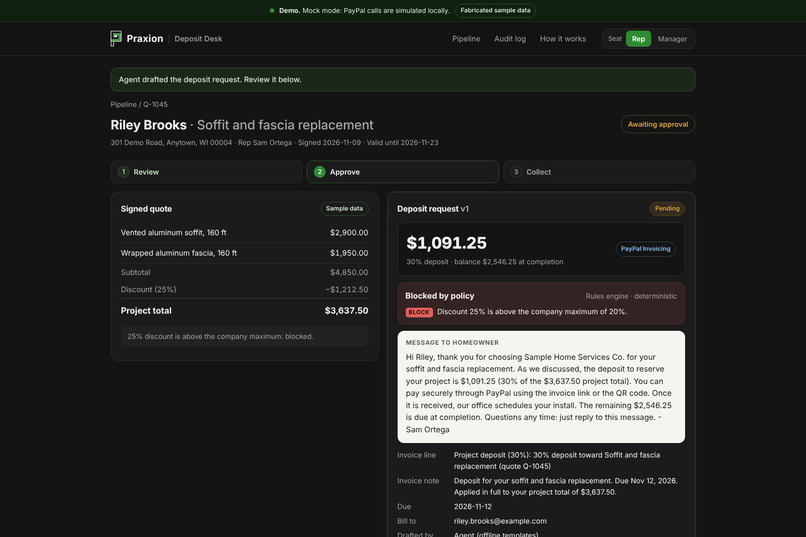
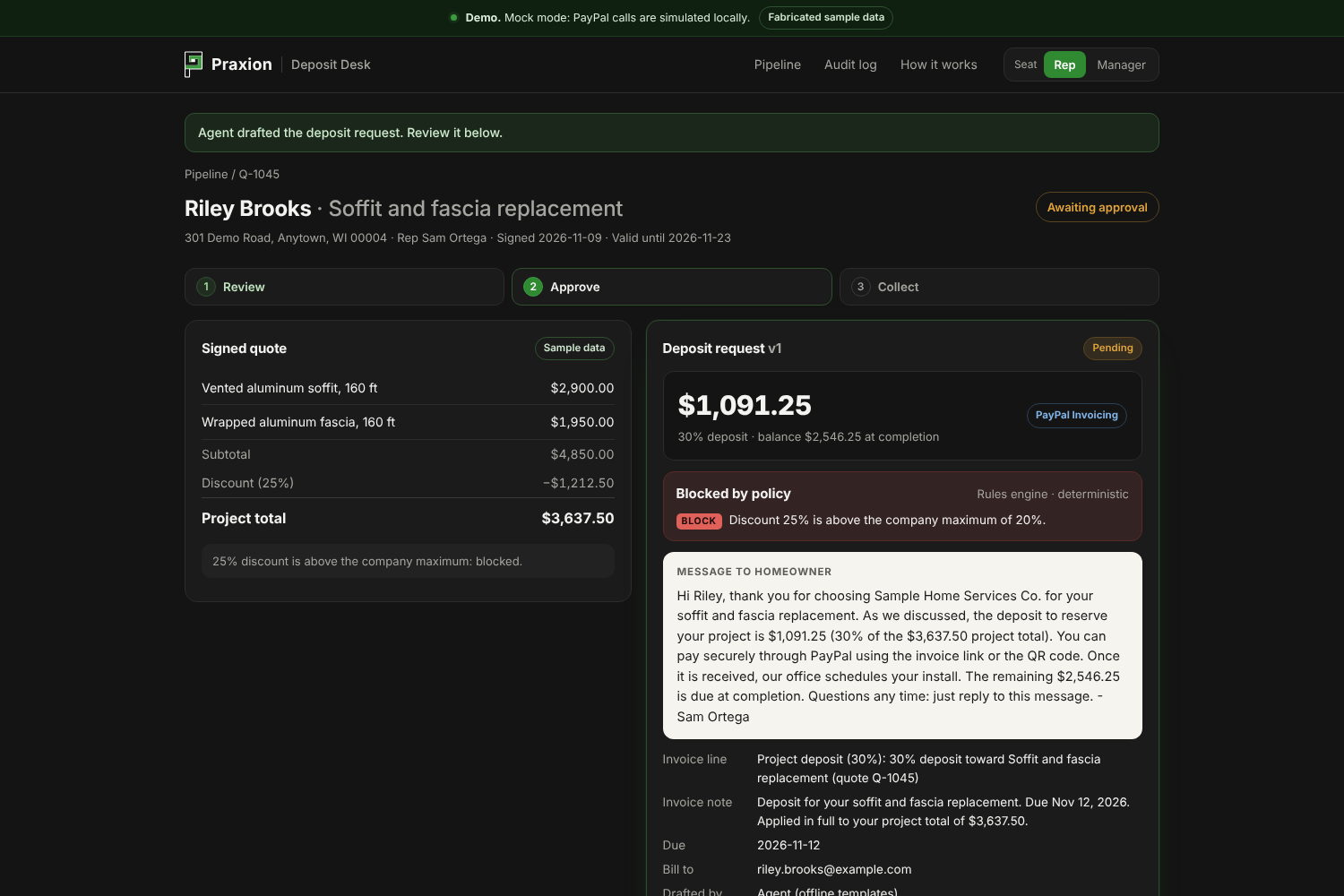
Guardrail: a 25% discount is above the company maximum, so the draft is blocked.
-
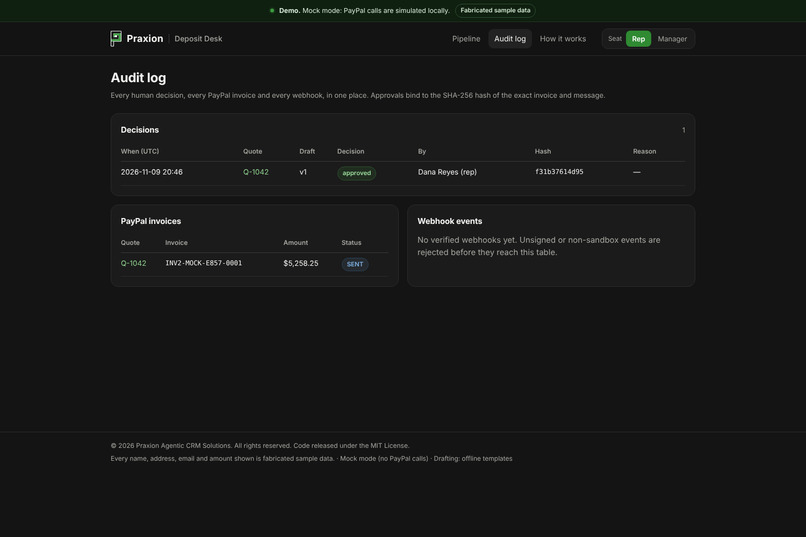
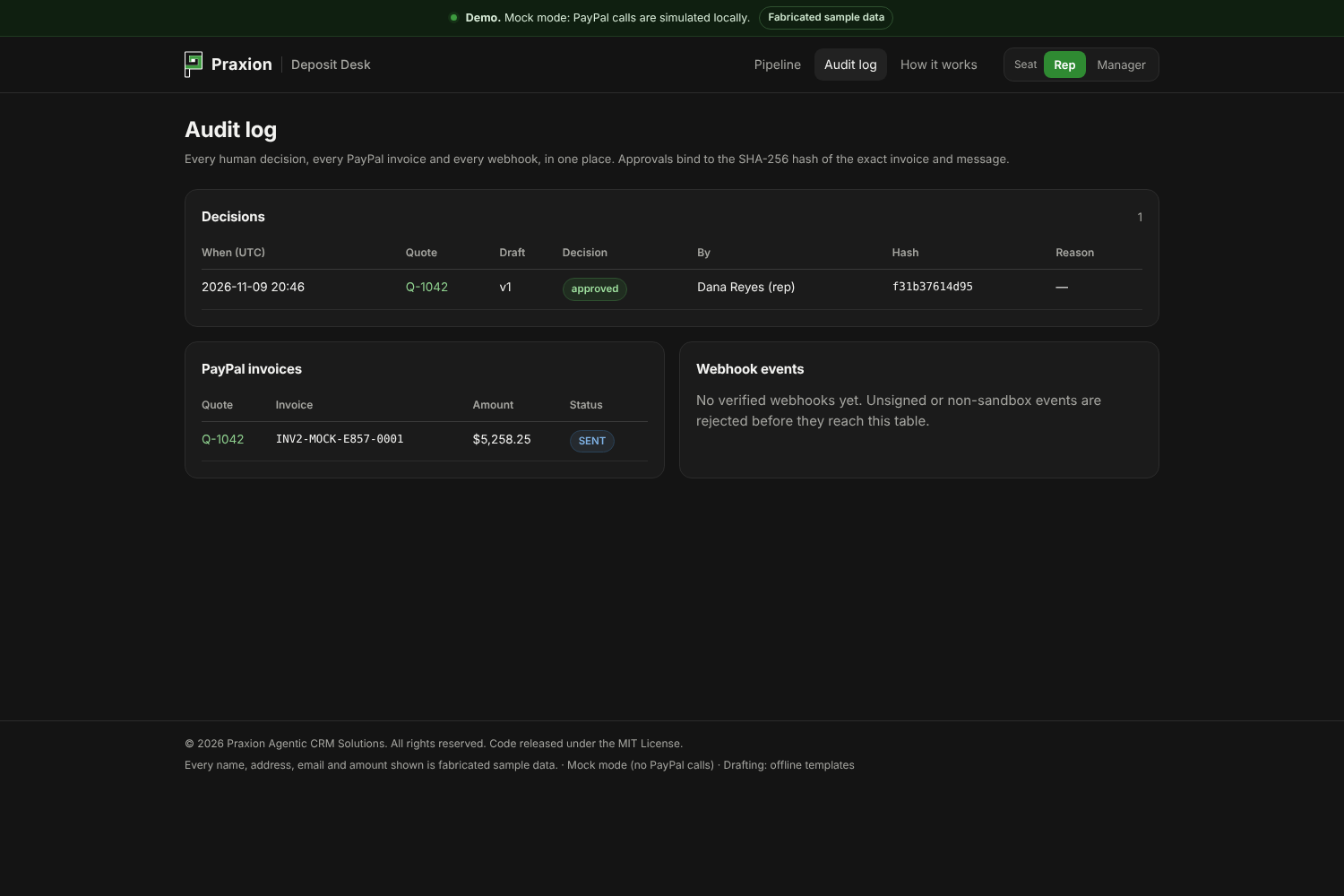
Audit log: every decision with its hash, every invoice and every verified webhook.
Inspiration
In field sales, the deal is won at the kitchen table and lost in the week after. The quote is signed, the rep promises paperwork, and the deposit request waits on an office that is already behind. Every day between "yes" and "paid" is a day a warm lead can cool off. We wanted the deposit request to go out on the spot, without ever letting software ask a homeowner for money on its own.
Deposit Desk is a standalone, open-source module from Praxion Agentic CRM Solutions, which builds agentic sales tools for exterior remodeling companies (roofing, siding, windows and doors).
What it does
- Reads the signed quote: line items, discount, region and expiry.
- Drafts the request. A rules engine sizes the deposit. A language model writes the invoice note and the homeowner message from those facts. The model never sets an amount.
- Checks policy first. It flags discounts above rep authority, blocks discounts above the company maximum, enforces the deposit range and sample region caps, refuses expired or unsigned quotes, and blocks any message whose dollar figures don't match the quote.
- Waits for a person (approve-first). Approve, edit or deny. Each approval binds to a SHA-256 hash of the exact invoice and message. Any edit voids it, and manager-level discounts need the manager seat.
- Sends through PayPal Invoicing: create, send, QR code. A
PayPal-Request-Idkeeps every call idempotent. - Collects on the spot. The homeowner scans the QR code and pays on PayPal's hosted page. No card data touches our server.
- Closes the loop with PayPal Webhooks. Paid, refunded and cancelled events are signature-verified, sandbox-only and processed once. The job updates, and the agent posts the next step and queues the office task.
- Keeps an audit log of every decision, invoice and webhook.
How we built it
- PayPal (sandbox): Invoicing v2 (
POST /v2/invoicing/invoiceswithPrefer: return=representation,/send,/generate-qr-code, andGETfor status checks); Webhooks (INVOICING.INVOICE.PAID,REFUNDED,CANCELLED) verified throughPOST /v1/notifications/verify-webhook-signature; OAuth client credentials with token caching. - AI: a large language model, called through a server-side API, receives structured quote facts and returns a schema-validated JSON draft: homeowner message, invoice note, line description and advisory notes for the approver. If the model is unavailable or returns invalid output, a deterministic drafter takes over, so the flow never stalls.
- Rules engine: decimal money math, severity-ranked policy flags, and a final check that every dollar figure the model wrote matches the quote.
- App: Python, FastAPI, SQLite and server-rendered screens, built mobile-first for one hand in a customer's living room.
- Quality: 47 automated tests covering policy rules, approve-first invariants (nothing sent without approval, tampering refused, edits void approvals), webhook verification (tampered, unsigned, wrong key, non-sandbox, duplicate), idempotency, and the sandbox client run against a faked PayPal HTTP layer. A mock gateway with the same interface lets anyone run the whole flow offline.
Challenges we ran into
- Keeping the model away from the money. Rules compute, the model writes, and the rules check the writing. A draft that mentions any amount not on the quote is blocked.
- Making approval mean something. A button click is not enough. The approval binds to a hash of the exact payload, so an edit, or a change made behind the scenes, cannot ride on an old yes.
- Webhooks you can trust. We verify signatures, reject events from outside the sandbox, de-duplicate by event ID, and added a status-check fallback for missed deliveries.
Accomplishments that we're proud of
- An end-to-end flow from quote to PayPal invoice, QR code, paid webhook and next task, with a human in control at the one moment that matters.
- Guardrails you can see: the manager seat, blocked discounts, region caps, and the words-must-match-the-money check, each shown in plain language on the approval card.
- It runs three ways: fully offline in mock mode, against the PayPal sandbox, or hosted.
What we learned
Agentic commerce gets more useful the more clearly it separates what the agent may propose, what the rules decide, and what only a person may approve. Field teams don't lose opportunities for lack of a payment link; they lose them in the gap between "yes" and "paid", so the agent's job is to close that gap without taking the decision away from a person.
What's next for Praxion Deposit Desk
- Deposit plus progress-payment schedules through Invoicing.
- Pay Later messaging on larger projects, where eligible.
- Multilingual homeowner messages.
- Reminder drafts for stalled leads, which also wait for approval.
- Connecting to the CRM a sales team already uses.
Where it fits: the Praxion platform
Deposit Desk is one module from Praxion, an agentic CRM built to run a whole field-sales operation from the first lead to the paid install, for reps, managers and regional leaders alike. Each part is a PAC (Praxion Agentic Component) that works on its own or alongside the others:
- Finding and answering leads: Praxis Seek finds people asking for help, Praxis Call Center answers inbound calls and books the visit, and the Praxis Virtual Sales Rep follows up by call, text and email.
- In the home: Praxis Quote prices every line from one sheet in front of the customer, Praxis Predictive Canvas ranks the best nearby doors after a sale, and Deposit Desk collects the deposit before the rep leaves.
- Managing the team: Praxis TruePair matches the right rep to each lead and builds the day's dispatch, Praxis Command gives managers live numbers for every rep and office, Praxis Audit checks every open deal overnight, Praxis Coach grades calls stage by stage, and Praxis Guide trains new reps from the company's own manual.
- Across regions: Praxis Podium posts sales, leaderboards and daily, weekly and monthly recaps to office, regional and VP chats.
Everything that touches a customer or money waits for one tap: an approval card with the exact draft, approve or deny, then a confirmation. Reps approve their own drafts, managers and regional leaders approve what is above a rep's authority, and every decision lands in an audit log. Deposit Desk is the payment piece of that system, built new and open source for this hackathon.
Built during the hackathon
Before Oct 1, 2026, Praxion's approve-first approach and field-sales app already existed, with quoting and approval workflows but no payment collection of any kind. Deposit Desk, the entire PayPal layer, was built after the submission period opened as a new standalone repository with its own fabricated seed data: invoice drafting and policy checks, the approval-bound send, QR collection, webhook reconciliation and the audit log. It was not funded by PayPal or Devpost.
All names, homes and amounts in the demo are fabricated sample data. Contact: [email protected]
