-
-
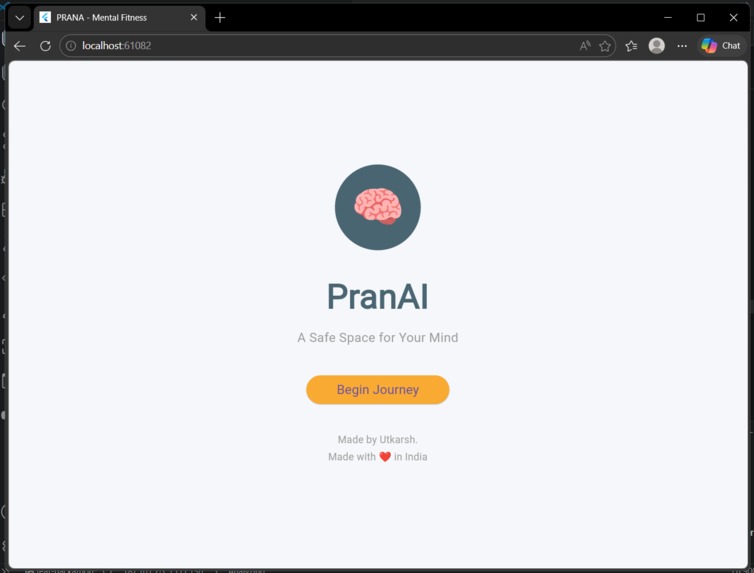
welcome_screen
Inspiration
I asked my parents a question I wasn't sure I wanted the answer to: "Don't you think those parents loved their children?" I was talking about the students dying by suicide in Kota — India's coaching capital, where thousands of teenagers go every year chasing entrance exam ranks. My mother answered without a second of hesitation. "Of course they did. We love you more than anything. Not your marks, not your career — you." I sat with that answer for a long time. If my parents — who genuinely meant it — could say something that important so easily when I asked them directly, why do so many students never hear it when they actually need it? Not because their parents don't feel it. Because nobody tells the parent that this specific night is the night their child needs to hear it. The numbers behind this aren't abstract to me. 87% of Indian students report exam-related anxiety. 1 in 4 teenagers feel persistently sad or hopeless. 70% never seek help — not because help doesn't exist, but because therapy costs ₹1,500-3,000 per session in a country where that's a week's groceries for most families, and because admitting you're struggling still feels like admitting failure. I didn't want to build another chatbot that tells students to "talk to someone." I wanted to build the bridge that actually connects them to the someone who already loves them — their own parents — in a way that doesn't feel like surveillance, and doesn't feel like silence either. That conversation with my mother became PranAI. It means "Intelligence that nurtures your life energy"
What It Does:
PranAI — Sanskrit for "life force" — is an AI-powered mental wellness companion built for Indian students aged 13-23. At its core is something I call the Parent Bridge: a system where students get a completely private space to feel whatever they actually feel, and parents get something they almost never get from their teenagers — an honest, real-time understanding of how their child is actually doing. For Students:
🤖 24/7 AI Companions — four distinct personalities (Alex, Jordan, Taylor, Casey), each with a different emotional register, so support feels like talking to someone, not something 🎮 Gamified Wellness — shells for healthy habits, daily streaks, small wins that build into real consistency 🌊 Calming UI — an ocean-themed interface designed to lower anxiety the moment the app opens, not add to it
For Parents:
👨👩👧👦 Real-time Alerts — the moment a concerning emotional pattern emerges, parents are told. Not the exact words their child wrote — never that — but enough to know their child needs them, right now 📊 Daily Summaries — AI-translated wellbeing insights with one specific thing the parent can actually say, instead of generic advice they don't know how to use 🛡️ Safety System — four-level detection logic with emergency helpline integration built directly into the most severe tier
The 5-Tier Alert System:
🎉 Celebration — when something good happens, parents should celebrate it too 📊 Low Concern — a single mention of stress, logged quietly ⚠️ Attention — repeated stress or withdrawal, surfaced gently 🆘 Support — sustained distress, parents notified with guidance on how to approach it 🚨 Urgent — high-risk language, immediate alert, helplines surfaced instantly
A student who writes "I hate everything, I failed my test" never has those exact words reach their parent. What reaches their parent is: "Your child had a difficult day emotionally. Here's something you could say tonight." Parents never see what their child writes. Only what their child feels. How We Built It I built PranAI alone, over six months, while completing my own Class 12 board examinations — which is, honestly, also where the cost of this project shows up most clearly. I chose this over coaching classes more nights than I can count.
🏆 What We're Most Proud Of
Here's what I'm genuinely proud of:
🔗 The Parent Bridge The hardest problem wasn't technical. It was deciding exactly how much a parent should see. Too little, and the alert becomes useless — vague reassurance that doesn't tell a parent anything real. Too much, and it breaks the one thing that makes a student trust the app in the first place: that this is their space, not a surveillance feed for their parents.
What we built instead is a system where:
Parents get translated emotional insight — not raw conversations
Students get complete privacy — their words stay theirs
The alert still lands with enough clarity to act — specific, actionable, and human
Every design decision in the Parent Bridge came from sitting with that tension and refusing to take the easy way out on either side.
🛠️ Built to actually run This isn't a Figma mock or a slide deck. Every screen you see in the demo works — authentication, chat, parent alerts, notifications, dashboard, gamification. It's a fully wired, executable codebase.
❤️ The Impact is Already Real When I first showed the prototype to my parents, my mother asked: "Is this really what students go through?"
She'd been a parent for eighteen years and had never seen it framed that way.
If PranAI can do that — can take something parents feel but never have language for, and give them words to reach their own child — then it's already doing something I'm proud of. Everything else is just code.
Example: ** What the Student Says to AI:
Student: "I have 3 exams next week. I'm so scared I'll fail. I can't sleep. My head hurts. Mom will be so disappointed."**
What the Parent Receives: text
**🌊 PRANAI - Parent Insight
Utkarsh seems to be under significant exam pressure.
He mentioned feeling scared about upcoming exams and
worries about disappointing you.
🫂 TONIGHT, TRY THIS:
No lectures. No pressure. Just say:
"I love you no matter what marks you get❤️.
And remember YOUR failure story from college?"
Sometimes knowing you've been there too
means more than any study tip.
You're doing great. 🤍
⏱️ This insight is AI-generated.
Not a diagnosis. Just a gentle nudge.**
Tech Stack:
Frontend: Flutter (Dart) — cross-platform mobile development Backend: Firebase (Authentication, Firestore Database) with a dual-consent privacy architecture so no student or parent data is exposed without explicit permission Notifications: FCM + Local Notifications for real-time parent alerts AI: Mock AI Responses (Demo) / GPT-5.4 Mini API (Planned) — the rule-based responses you'll see in this demo are a deliberate placeholder; the architecture is built to plug in live AI once the cost-optimization layer is finalized
Architecture:
lib/ ├── screens/ │ ├── ai_chat/ # AI companion chat system │ ├── parent/ # Parent dashboard & alerts │ ├── chat/ # Student peer chat system │ └── auth/ # Authentication flows ├── services/ # Firebase, AI, Notifications ├── models/ # Data models └── widgets/ # Reusable components
🚀 How to Run PranAI Locally
Because this is a Flutter prototype, getting the app running is straightforward. You only need a development environment and a few commands.
Prerequisites You'll need these installed on your machine:
Flutter SDK (version 3.x or higher) — Install Flutter
Android Studio or VS Code — with the Flutter and Dart plugins enabled
An Android emulator, iOS simulator, or a physical device with USB debugging enabled
Step 1: Clone the Repository bash git clone https://github.com/Utkarshh-07/PranAI.git cd prana Step 2: Install Dependencies This downloads all the packages the app depends on — everything from Firebase SDKs to the UI libraries used in the ocean theme.
bash flutter pub get Step 3: Run the App bash flutter run The app will compile and launch on your connected device or emulator.
📱 Demo Credentials Since this is a prototype, you can use these test accounts to explore both sides of the app:
Role Email
👨🎓 Student test@test.com password: test123
👨👩👧 Parent test@test.com password: test123
Note: These are demo accounts for testing. All data shown is mock data.
🧪 What to Test Once the app is running, here are a few flows worth walking through:
Feature What to Try Student: AI Chat Open the chat with Alex → type: "I'm really stressed about my upcoming exams" → see the response Parent: Notification After the student message, switch to the Parent Dashboard → view the insight that was generated Parent: Alert Types From the Parent Dashboard, test the "Exam Stress", "Loneliness", and "Urgent" alert presets Student: Dashboard Explore the ocean-themed dashboard, shell collection, and daily streak tracking ⚠️ What's Still Mock The version you're running is a demo/prototype. These parts are simulated:
AI responses are rule-based, not powered by a live LLM
Parent alerts are triggered by keywords (not semantic analysis)
All data is mock data — no real user data is stored
The architecture is already structured to replace these with live AI and production data when the time comes.
🔧 Troubleshooting If you run into issues, these usually fix most problems:
bash flutter clean flutter pub get flutter run If you see flutter: command not found, Flutter isn't in your system path. Follow the Flutter installation guide first.
📂 Full Repository All source code is available here: 🔗 https://github.com/Utkarshh-07/PranAI
Challenges We Faced
The hardest problem wasn't technical. It was deciding exactly how much a parent should see. Too little, and the alert becomes useless — vague reassurance that doesn't tell a parent anything real. Too much, and it breaks the one thing that makes a student trust the app in the first place: that this is their space, not a surveillance feed for their parents. Every design decision in the Parent Bridge — what gets translated, what stays private, what triggers an alert versus what stays logged quietly — came from sitting with that tension and refusing to take the easy way out on either side. The second real challenge is one I'm still solving: building an AI system that remembers who a student actually is over weeks and months, not just what they typed in a single conversation. Right now, every session starts from zero. That gap is the next thing I'm building toward.

Log in or sign up for Devpost to join the conversation.