-
-
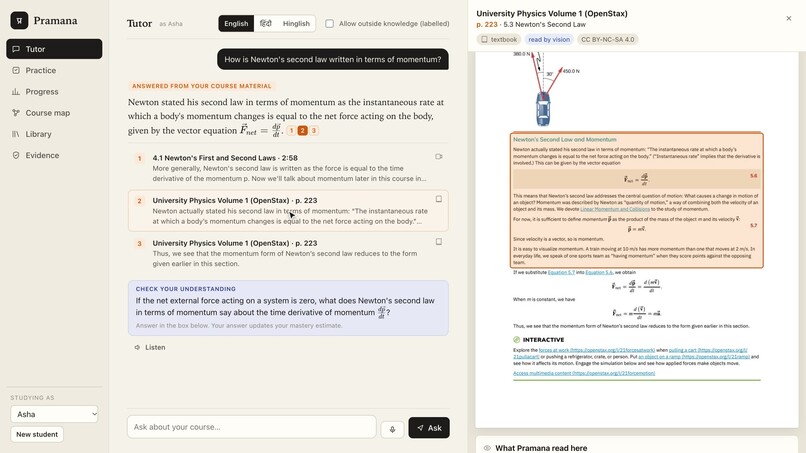
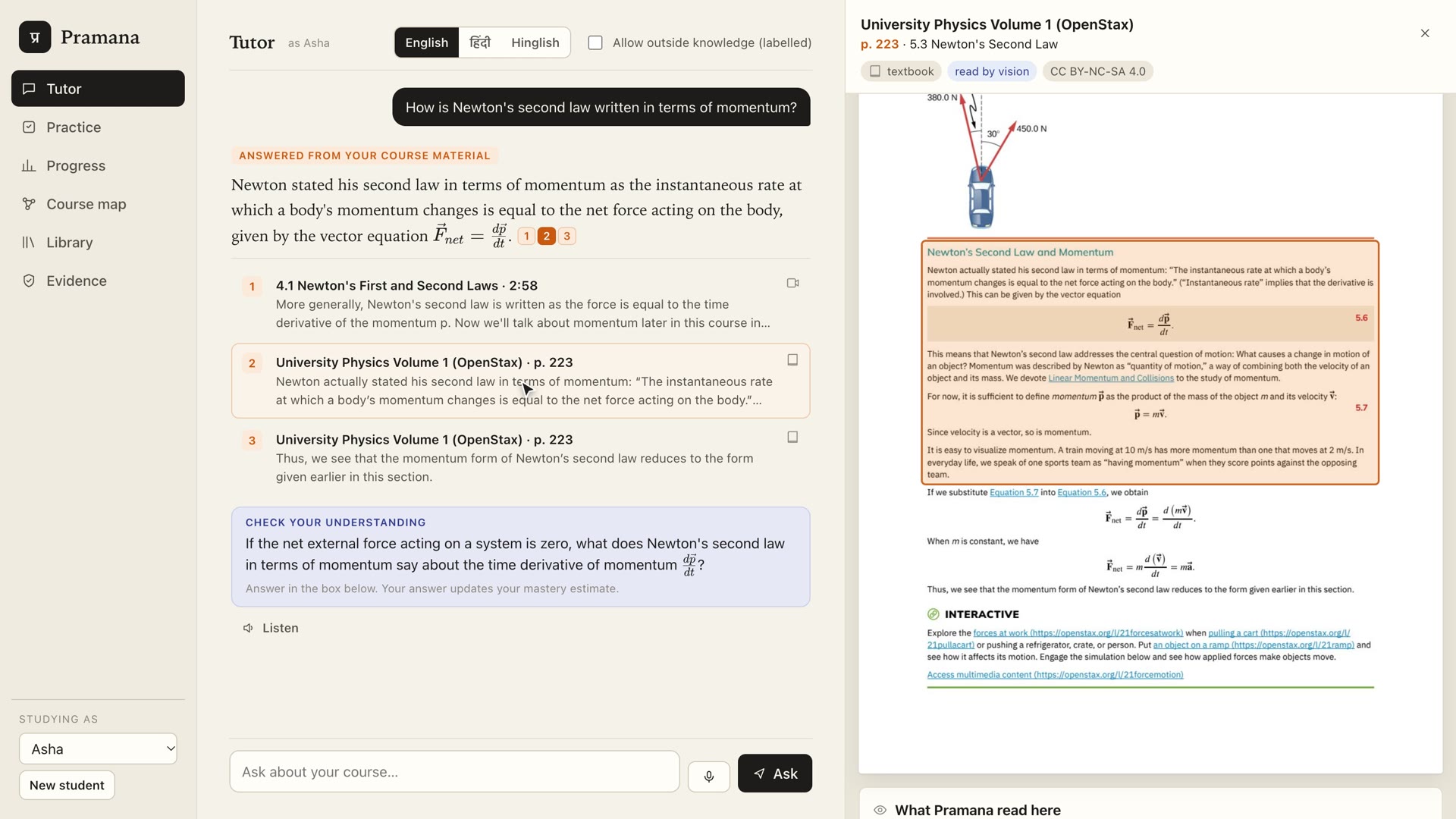
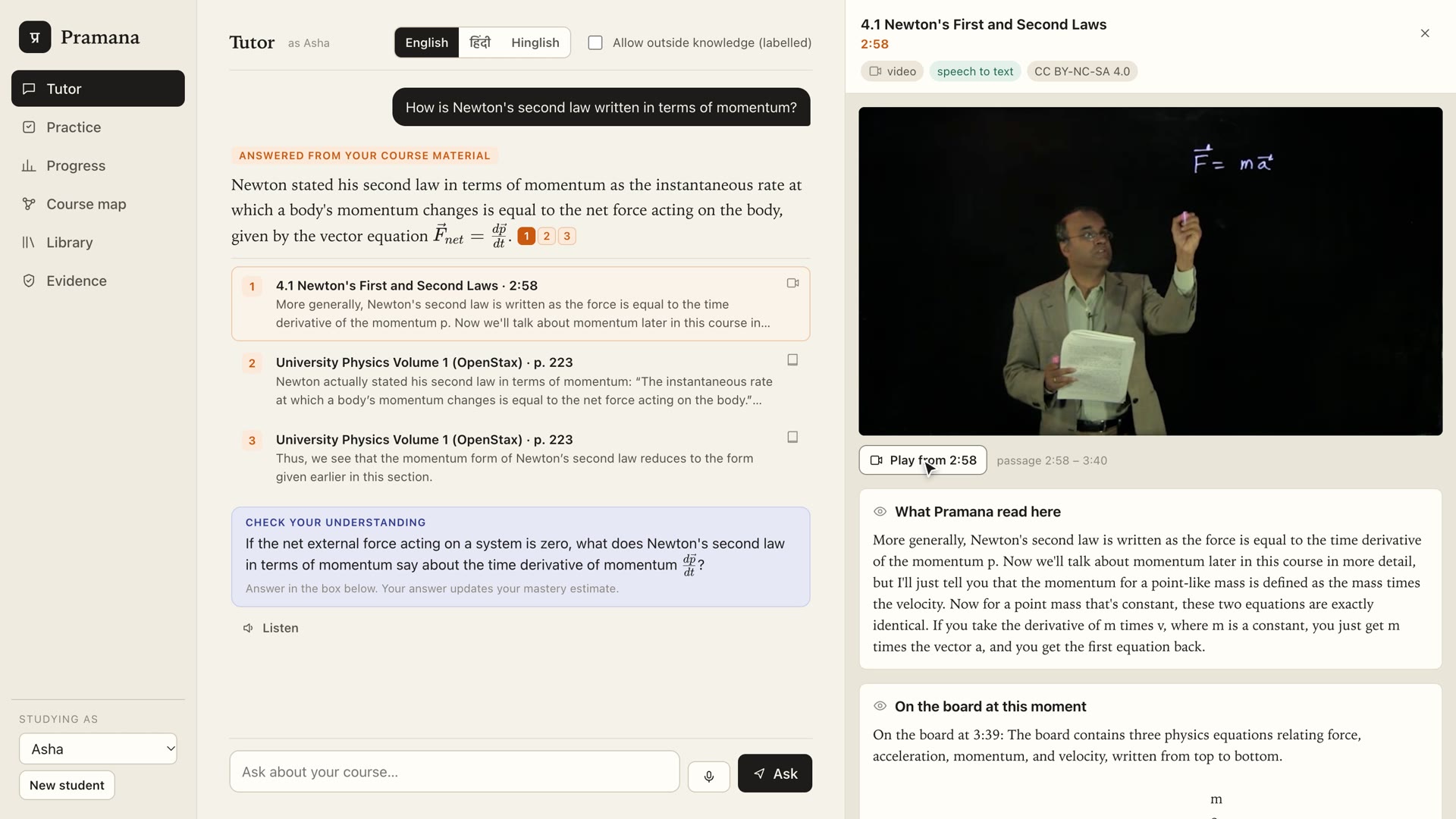
Every sentence carries a number. Clicking it opens the textbook page with the passage outlined.
-
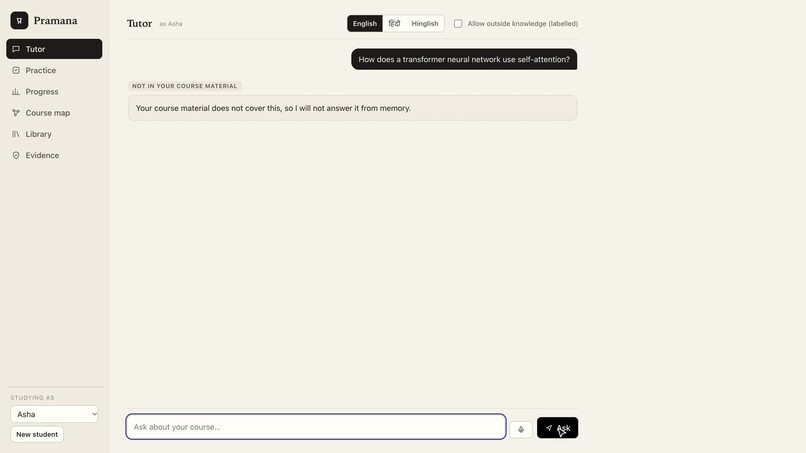
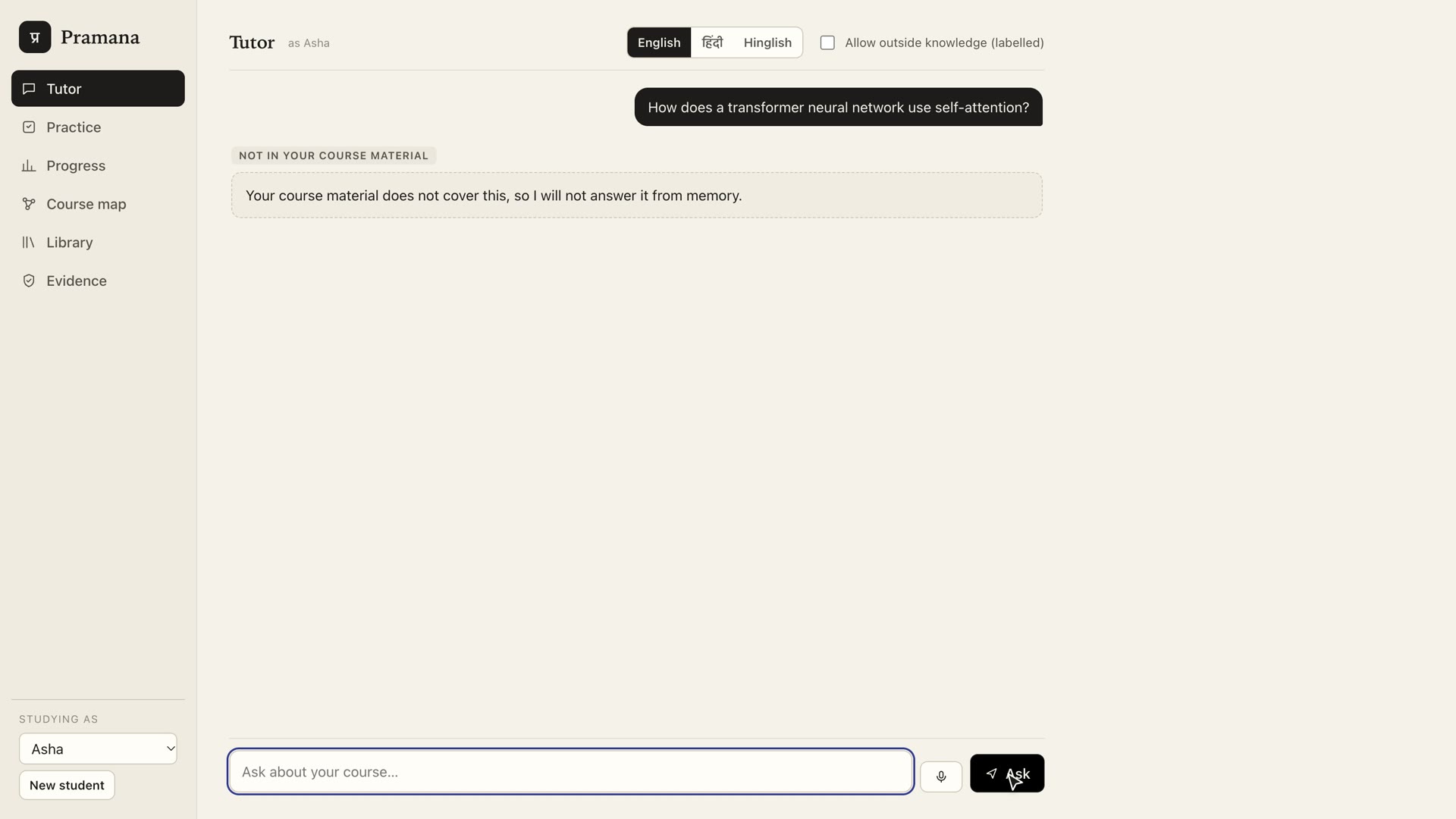
Asked what the course does not cover, it says so instead of answering from memory.
-
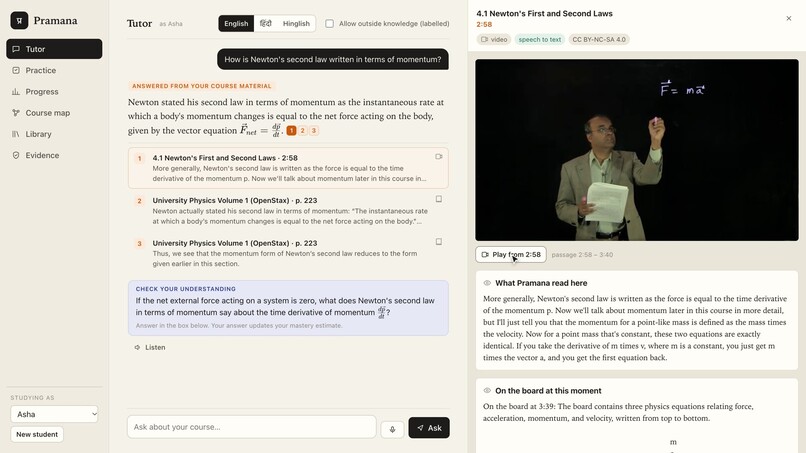
The same answer, cited to a lecture: the video opens at the second it was said.
-
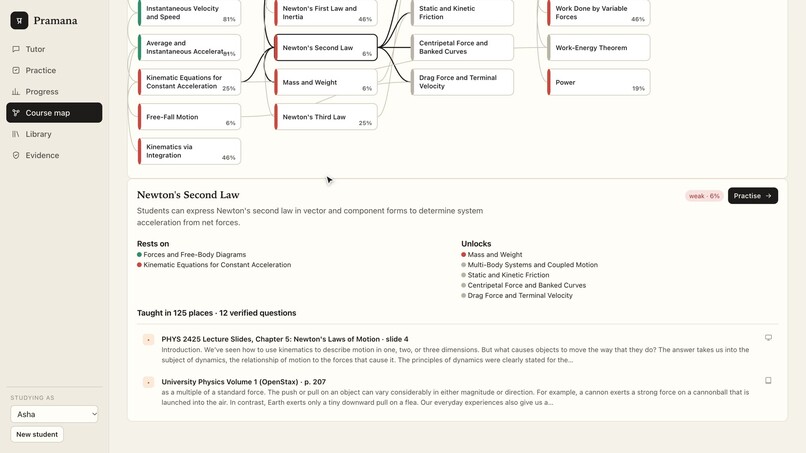
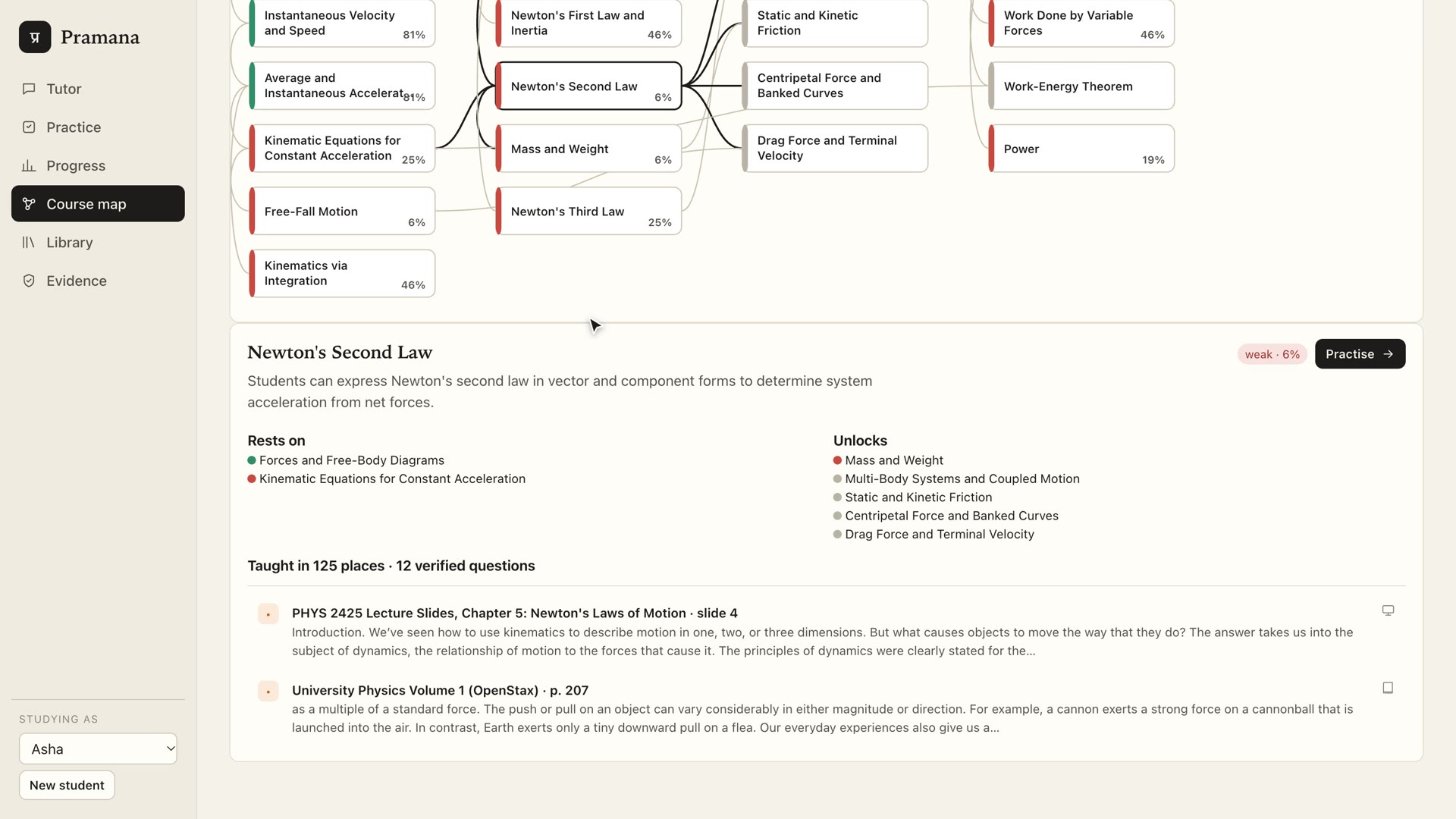
The course map: 19 concepts and their prerequisites, coloured by this student's mastery.
-
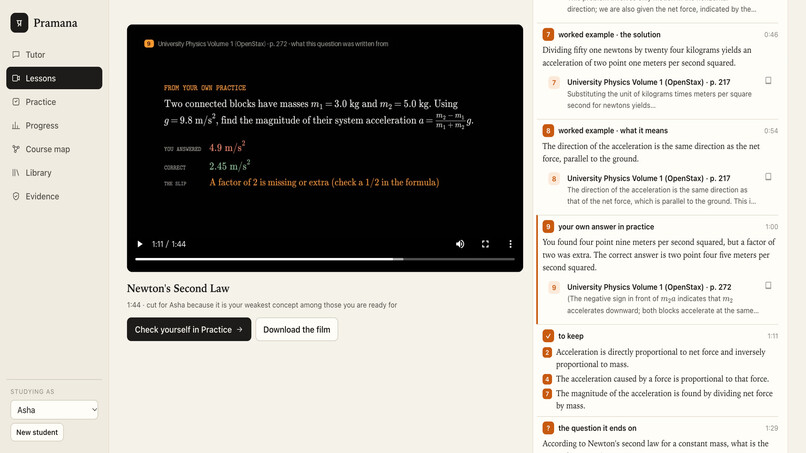
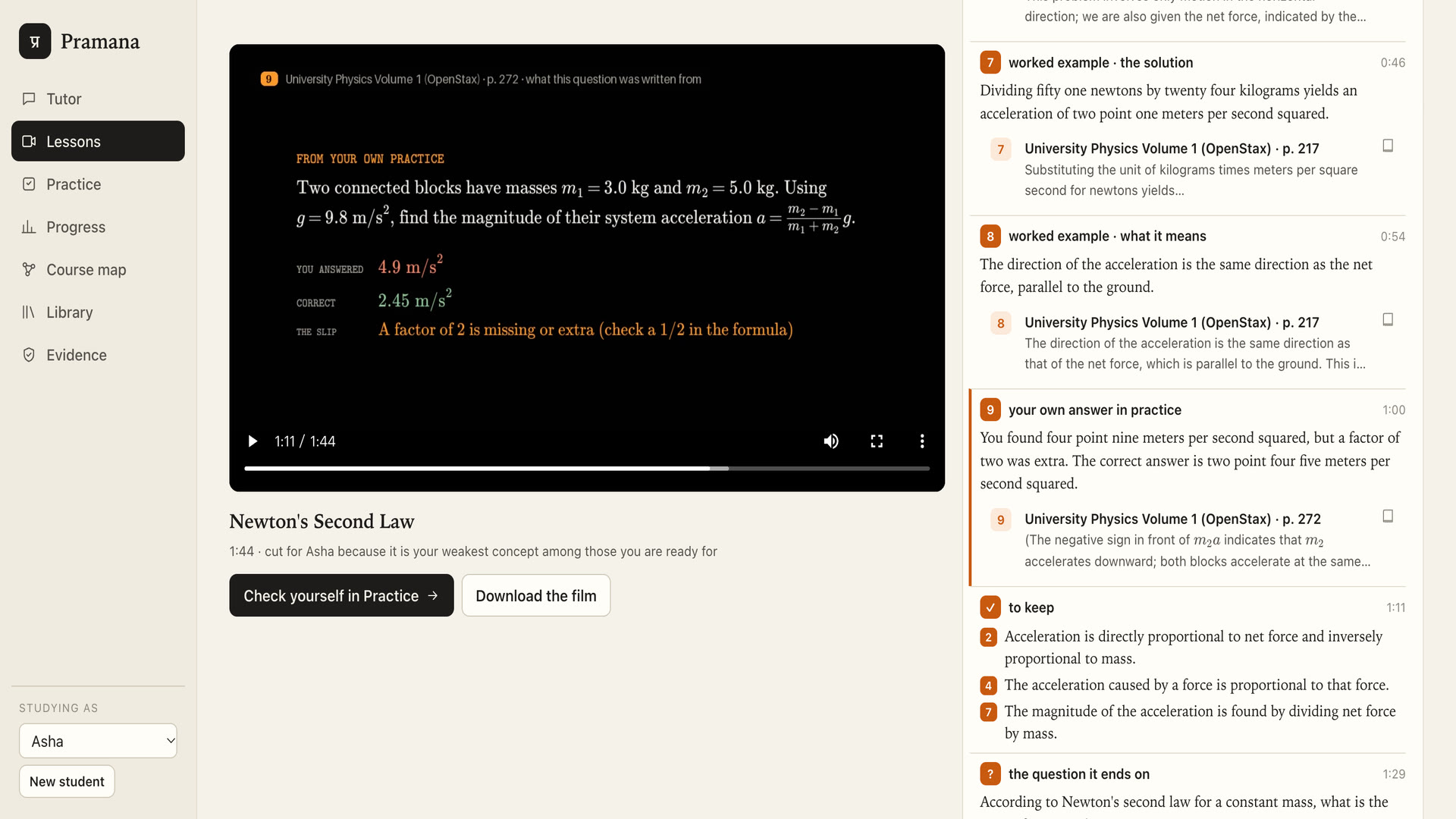
A teaching video generated for one concept, here taking up the student's own wrong answer; each scene lists its source.
-
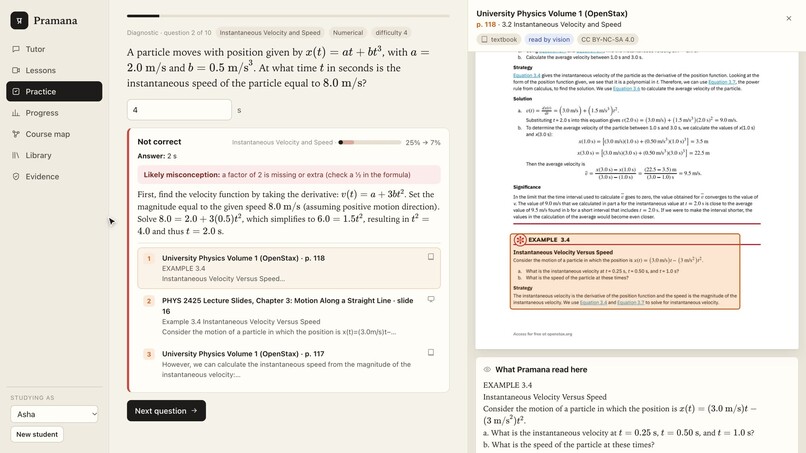
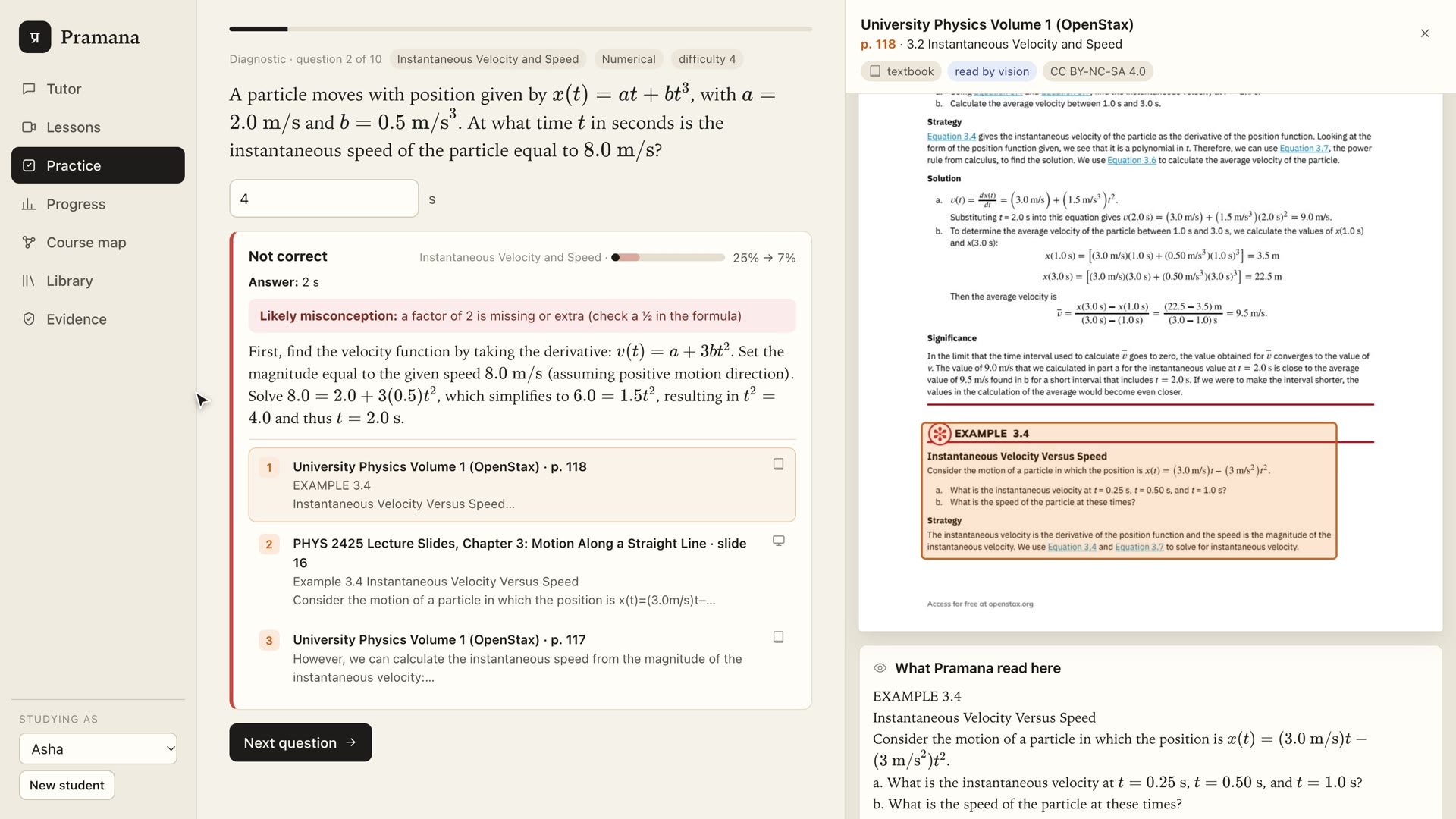
A wrong answer is read, not just marked: the likely misconception, and the page that settles it.
-
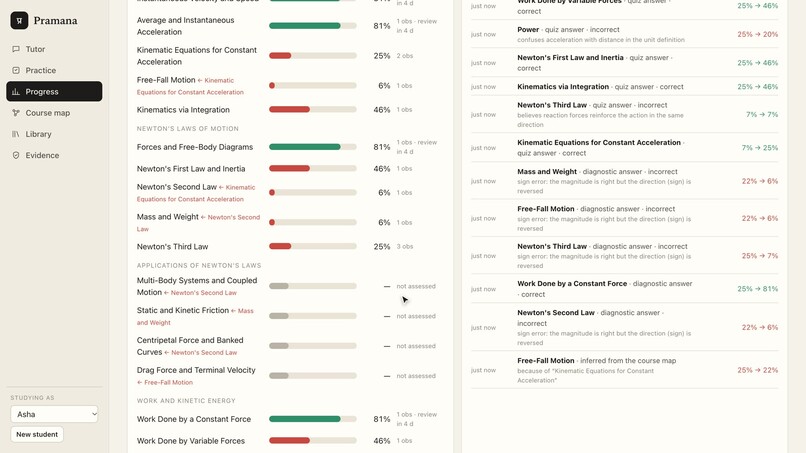
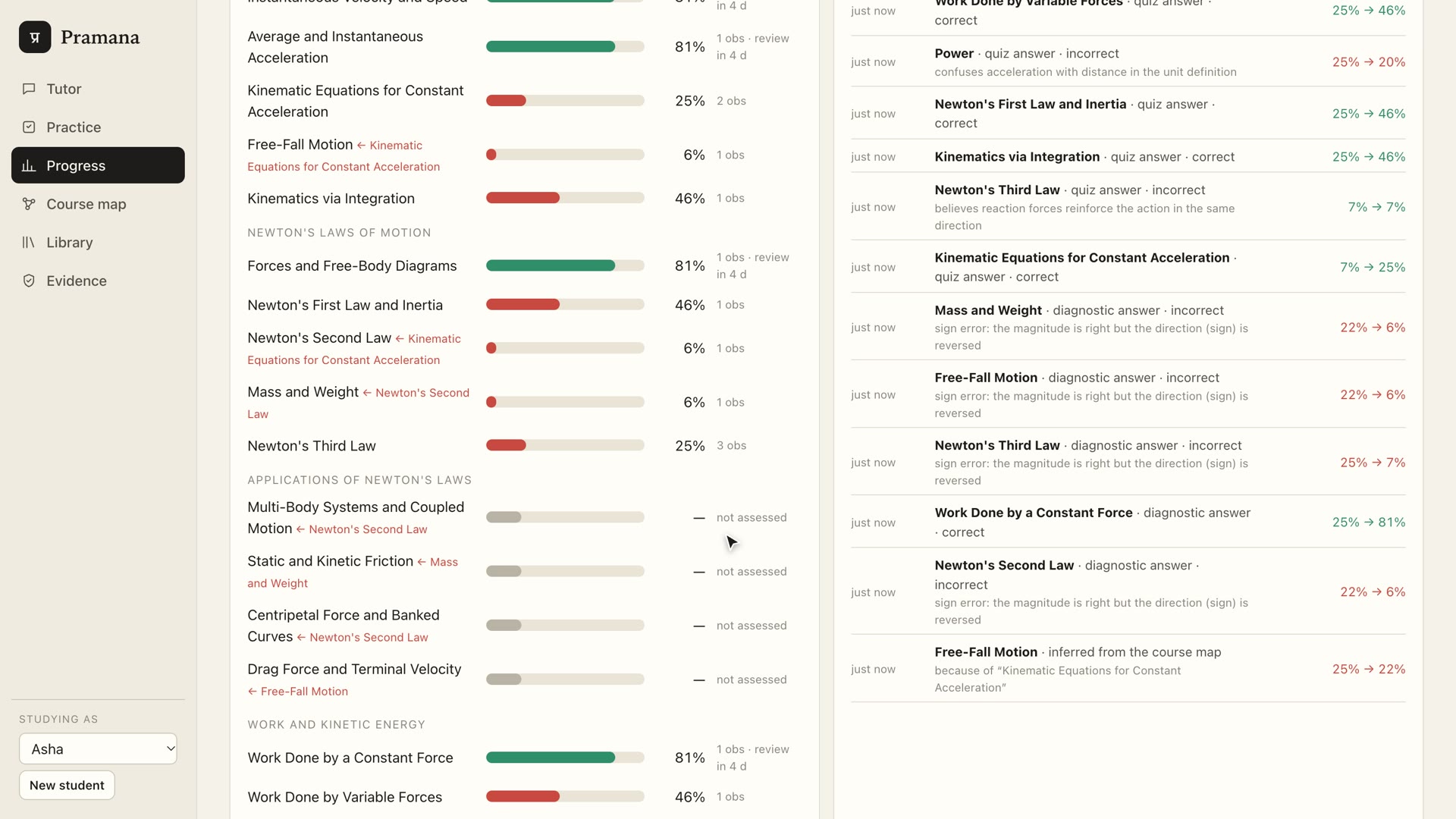
The learner model: mastery per concept, and the evidence behind every change.
Track D: Personalized Tutoring & Adaptive Learning. Every number below is in the repository with the command that reproduces it.
Give it a concept and it makes the teaching video. For any concept of the course, the one the learner model says you most need or one you pick, Pramana writes, voices and cuts a narrated lesson film of about two minutes, on your own laptop, in about half a minute. The film is built only from your course: the textbook page with the passage outlined and the quoted words lit, the slide, the lecture in your lecturer's own voice. It teaches the idea, walks through the textbook's own worked example step by step, takes up a mistake (your own wrong answer, once you have made one), says what to keep and ends on a checked question. No generated imagery, no stock footage, and every scene opens its source. It made one for each of the 19 concepts of the sample course; the demo video shows one being made at 2:59.
Try it without an API key. git clone https://github.com/yy5652-hash/pramana && cd pramana, then make setup, make fetch, make course, make serve and open http://127.0.0.1:8000. Every model reply the sample course needs ships in the repository, so the suggested tutor questions, practice, lesson films, progress and the course map all work without a key; a free Gemini key adds questions of your own.
Inspiration
A course says everything three times: on the board, in the textbook, on a slide. A student revising at midnight remembers that it was explained somewhere and cannot find where. A general chatbot will answer the question fluently, from somewhere else entirely, in a notation the course never used, and with no way to check it.
Pramāṇa is Sanskrit for proof: the means by which something is known. We wanted a tutor that is not allowed to say anything it cannot point to.
What it does
Pramana reads a course's textbook, slide decks and lecture videos with no preparation, and then tutors and tests a student from that material alone.
- Every answer shows its proof. Each sentence of an answer carries a number. Clicking it opens the textbook page with the passage outlined, the slide, or the lecture video at the second it was said.
- It generates a teaching video for any concept. Choose a concept, or let the learner model choose the one you are weakest on and ready for, and it produces a narrated film of about two minutes that teaches it: an MP4 you can play in the app or download. The film has an arc: the idea and the rule on your own page, slide and lecture; the textbook's worked example, one step at a time; a mistake, which is your own wrong answer from Practice once you have made one; up to three points to keep; and one checked question you have not met. One model call writes the storyboard; code keeps only what it can tie to a source; the narration is voiced locally; the film is drawn and encoded on your machine, about half a minute in all. It opens with the prerequisite if yours is shaky and follows your level on the concept.
- It declines. If the material does not cover a question, it says so and points to the nearest thing the course does cover. Outside knowledge appears only if the student asks for it, in a separate labelled block.
- It tests with checked questions. MCQ, short-answer and numerical questions are generated from the course and enter the bank only after arithmetic recomputes the key and a second model, solving blind, agrees. 228 were drafted; 21 were rejected.
- It reads a wrong answer. Each distractor is written with the misconception it catches; wrong numbers are matched against slip signatures such as a reversed sign or a km/h–m/s mix-up. The report traces a weak topic to the prerequisite underneath it.
- It models the learner. Bayesian knowledge tracing with item-aware guess and slip, forgetting, and evidence that flows along a prerequisite map. It updates after every quiz answer and every conversation, and every update is shown with its reason.
- And the rest: a course map coloured by mastery, cited flashcards with an audio brief, a study plan built from weak topics and forgetting curves, answers in Hindi or Hinglish, voice input.
How we built it
Ingestion. The textbook's PDF has no equations in its text layer; they are vector drawings. The slide decks keep theirs in Office Math blocks that standard extractors skip. So every page, every slide with a picture or an equation, and one frame per spoken passage of each lecture is read by a vision-language model, which restores the maths as LaTeX and describes each figure. Speech is transcribed locally with word timestamps. The result is 961 citable units, each remembering its page and rectangle, its slide, or its second. 64 % of them could not have been read without vision.
Grounding by construction. The tutor model must answer in segments that each name their sources. Code deletes any segment without a valid source, and an answer with no surviving segment becomes a refusal. Retrieval is BM25 plus dense vectors, fused and re-ranked, all local.
Assessment and the learner model. A concept map (19 concepts, 22 prerequisite links) is extracted from the course outline and forced into a DAG. Questions are generated per concept from that concept's own passages. The selector picks the next question from the learner model: the weakest concept the student is ready for, at a difficulty they should get right about 85 % of the time.
Lessons as film. One model call writes a storyboard: which sources to show, what the narrator says over each, the steps of the textbook's worked example, a few sentences on the student's mistake, and what to keep. Code then keeps only what it can tie to a source: the words to be lit on a page must be in that passage word for word, the stretch of lecture to be heard must be found in the word-level transcript, the example's steps must follow the textbook's order, and a point of the recap is written on the scene whose source states it. The mistake and the closing question come from the question bank and the student's own attempts, not from the model. The page is re-rendered from the PDF for a sharp close-up, the quoted words are located by the PDF's own character positions, formulas on the cards are set with the KaTeX fonts by a small typesetter of our own, the narration is voiced locally (Kokoro), and the film is drawn with Pillow and encoded with PyAV. No Manim, no TeX, no stock footage.
One model client. Any OpenAI-compatible endpoint works. Every reply is cached, and in replay mode the knowledge base, the question bank and the whole evaluation rebuild from the committed cache without an API key.
Challenges we ran into
- The equations were not there. The first text-only ingestion produced a physics course with no formulas in it. That finding reorganised the whole pipeline around vision.
- A free-tier model budget. The larger models allowed about twenty requests a day. The system had to be built so that a small fast model does the volume and every call is cached, rate-limited and able to fall back.
- Making adaptivity earn its place. Tracing simulated students one answer at a time showed that the first selector read one easy correct answer as mastery and let one wrong answer collapse its belief. With both fixed, the adaptive policy gains 62 % more than random selection, and for novices it is ahead of plain syllabus order as well.
- LaTeX inside JSON. Models double-escape backslashes or drop them (
\fracarrives as a form feed followed by "rac"). A repair step now runs on every parsed reply.
Accomplishments that we're proud of
- A citation that opens a lecture at the second the professor writes the formula.
- A teaching video generated from the course itself for every one of its 19 concepts. 17 walk through the textbook's own worked example; all 19 take up a mistake and end on a checked question; no scene was dropped by the grounding check; 98 % of 194 spoken lines were judged fully supported by what they rest on (the example's steps and the words about the mistake: 100 %). Given a student who had just answered wrongly, the lesson found that answer and took it up for 19 of 19 concepts.
- A measured evaluation that anyone can rerun. RAGAS on 39 questions with known source locations: faithfulness 0.96, answer relevancy 0.91, context precision 0.92, context recall 1.00 (0.77 with vision switched off). All 14 off-material questions declined and none of the 39 course questions declined by mistake. 98 % of 58 cited sentences fully supported by the passage they cite, by a judge that calls 0 % supported when the passages are swapped. And 720 simulated students: the adaptive policy gains +0.098 in true proficiency against +0.061 for random selection, and for novices +0.197, ahead of syllabus order (+0.172).
- No build step, no Docker, no office suite:
make setup && make serve.
What we learned
That "multimodal" is not a feature to add at the end. For this course it was the difference between having the content and not having it. And that measuring early, while the design can still change, is what made the product better.
What's next for Pramana
Lesson narration in Hindi; fit the learner model's parameters to real answer logs; estimate each student's own pace and memory; a second course in a different subject; a classroom pilot.
AI assistance
Stated plainly, as the rules ask. Claude Code (Anthropic) wrote the code, the tests, the documentation and the demo film's pipeline; I chose the track, set the direction and decided what was submitted. Gemini models run inside the product (vision reading, tutoring, question writing, judging) and drafted 35 of the 53 test questions; Claude Code checked each draft against its source and wrote the rest. Whisper, bge-small, MiniLM and Kokoro-82M run locally. The README has the full list.
Built With
- claude-code
- fastapi
- fastembed
- faster-whisper
- gemini
- javascript
- katex
- kokoro
- numpy
- pillow
- pyav
- pypdfium2
- python
- python-pptx
- ragas
- remotion
- sqlite

Log in or sign up for Devpost to join the conversation.