Inspiration
At a border, a skilled welder and an unskilled labourer look identical on paper. The market resolves that ambiguity the only way it can, by paying both of them as unskilled.
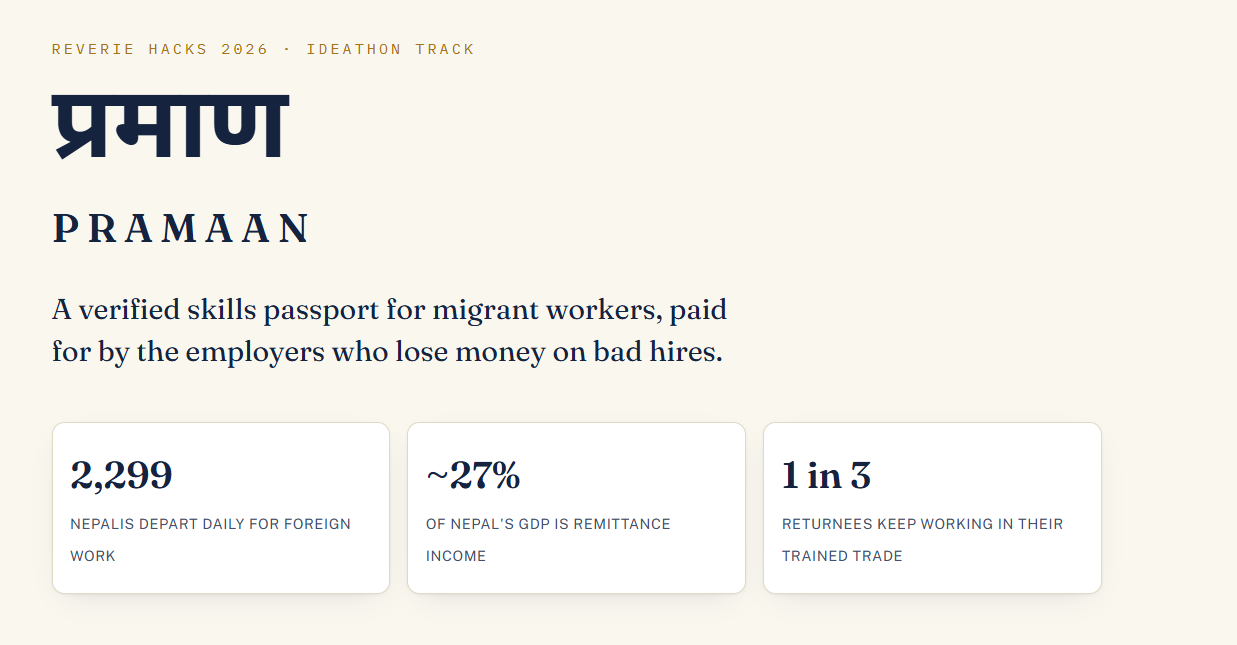
What made us want to build this was finding out that Nepal has already tried to fix it and admitted the fix does not work. The Ministry of Labour grades departing workers by skill level, and the share marked skilled climbed from 32.6 percent to 69.5 percent in four years. Then the Ministry's own Joint Secretary told a reporter that the label comes from pre-departure paperwork rather than a test, and does not align with any international skill standard.
So the label exists. Nobody has a reason to believe it. Roughly 2,299 people a day get on planes carrying it.
What it does
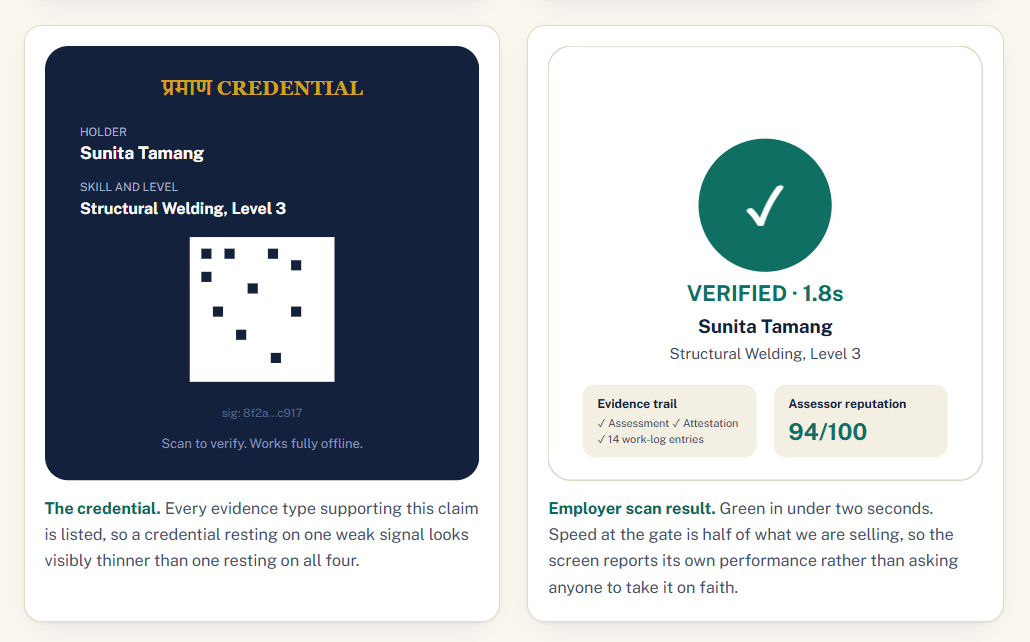
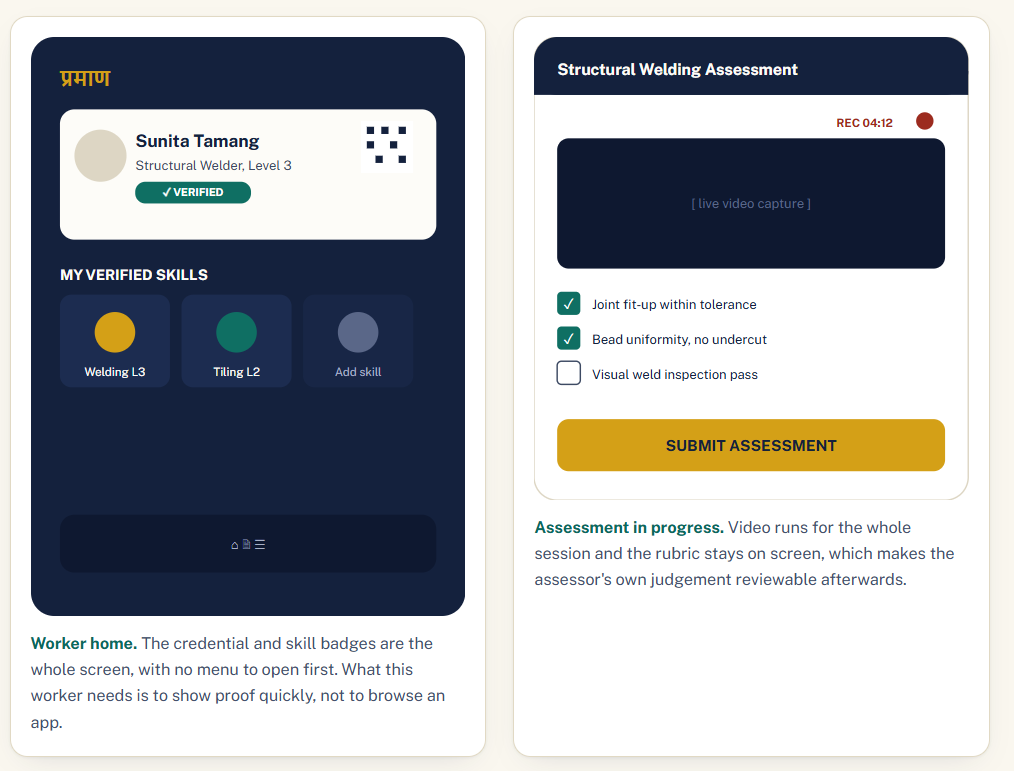
PRAMAAN is a portable skills credential assembled from four independent kinds of evidence: a rubric-based practical assessment that is video recorded, a cryptographically signed attestation from a former employer, timestamped work evidence that is hashed at capture so it cannot be back-dated, and an assessor reputation system that down-weights and eventually removes assessors whose passes correlate with later employer complaints.
The credential lives on the worker's phone and verifies by QR code in under five seconds with no connectivity, because site gates in destination countries frequently have no signal. It is sold to the party that carries the cost of an unverified hire, which is the employer. Workers never pay, and we have written that as a permanent constraint rather than an early-stage position.
How we built it
This is an Ideathon entry, so the deliverable is a business rather than a codebase. We produced an eighteen page project plan containing a complete Business Model Canvas across all eight boxes, an illustrative unit economics model with the break-even arithmetic worked through on both sides of the transaction, a four phase go-to-market plan anchored on a single measurable Phase 1 metric, six annotated product mockups drawn as vector screens, and one architecture diagram covering the offline verification flow built on W3C Verifiable Credentials.
Every statistic is sourced and cited beneath the figure it supports. Sources include the Department of Foreign Employment's Nepal Labour Migration Report 2024, World Bank and Nepal Rastra Bank remittance data, the KNOMAD-ILO Migration Costs Survey, and a 400 respondent survey of returnee migrants.
Challenges we ran into
The hardest problem was resisting the temptation to solve everything at once. Rubric-based practical assessment works well for trades with an inspectable output, such as welding, electrical work, plumbing and tiling. It works badly for care work, hospitality and domestic work, which happen to be the sectors where women migrants are most concentrated. We decided to name that gap in the risks section and track coverage of women migrants as an explicit metric, rather than quietly claim a breadth we do not have.
The second problem was a missing number. We wanted to state how much more a verified worker earns than an unverified one, and no credible study exists that measures it. Rather than estimate something plausible, we built Phase 1 of the go-to-market plan specifically to produce that number, and wrote down that a null result would mean abandoning the model rather than reshaping it.
Accomplishments that we are proud of
Finding the Joint Secretary's quote changed the whole submission. It turned our central claim from an assumption we were asserting into something the government has already conceded on the record.
We also worked out the argument that actually sells this. Placing one Nepali worker in a Gulf job costs a median of about $1,100, and under the Employer Pays Principle that cost is shifting from the worker onto the employer. A $10 verification is nine tenths of one percent of that. It only has to prevent about one bad hire in a hundred to pay for itself. That is the case we lead with, and it is arithmetic rather than enthusiasm.
What we learned
The technology is the easy half. Verifiable Credentials and offline signature checking are well understood and a competent team could build them in a few months. The difficult half is keeping assessors honest at scale, which is why the assessor reputation loop rather than the credential format is the real product. No ledger has ever fixed a dishonest assessor.
What's next
Phase 1 is one corridor, either Nepal to Qatar or Nepal to Malaysia, one trade, two training centres and one committed employer partner, testing one question. Do PRAMAAN-verified workers get placed at a higher grade or wage than a matched unverified cohort?
If the answer is yes, Phase 2 adds trades and brings training institutes onto a revenue share. If the answer is no, we publish the result and stop. That commitment is written into the plan rather than added here.
Built With
- business-model-canvas
- figma
- market-research
- momen
- social-impact
- verifiable-credentials


Log in or sign up for Devpost to join the conversation.