-
-
Hero
-
Result
-
Data
-
Audit
-
Architecture
Prakira — AI-Powered Personalized Weather Risk Assistant
Inspiration
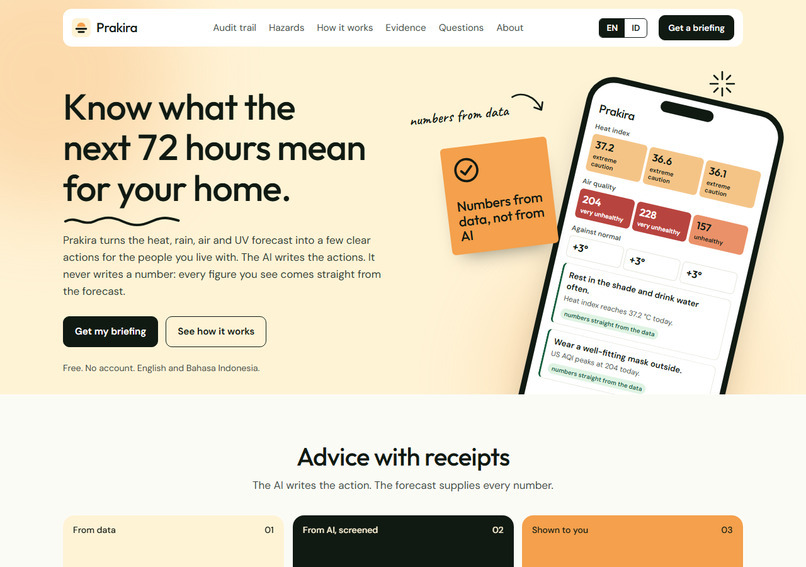
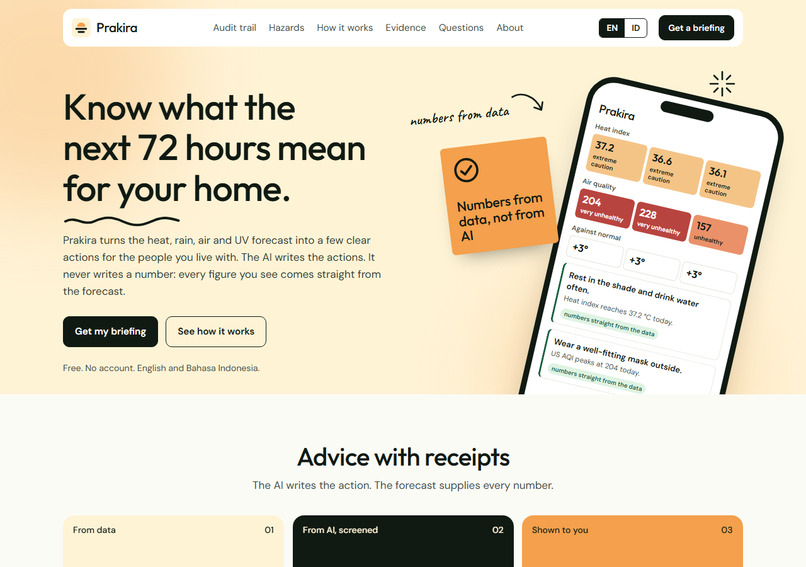
A weather forecast might tell us that the heat index will reach 37°C or that the air quality index is 204. But those numbers alone don't tell us what matters most: What does this mean for the people living in my home, and what should we do about it?
A hot day can mean something very different for an outdoor worker, a grandmother, a toddler, or someone living with asthma. Yet, most public weather warnings communicate risks in the same way to everyone.
That gap inspired us to build Prakira, an AI-powered weather risk assistant that transforms complex forecast data into simple, personalized actions for individual households.
But we also recognized a critical challenge: while AI can explain risks in natural language, it can confidently produce incorrect numbers or misleading safety recommendations. In a safety-focused application, that is a risk we cannot ignore.
So we built Prakira around one central principle:
Let AI explain the risk, but never let AI invent the facts.
What it does
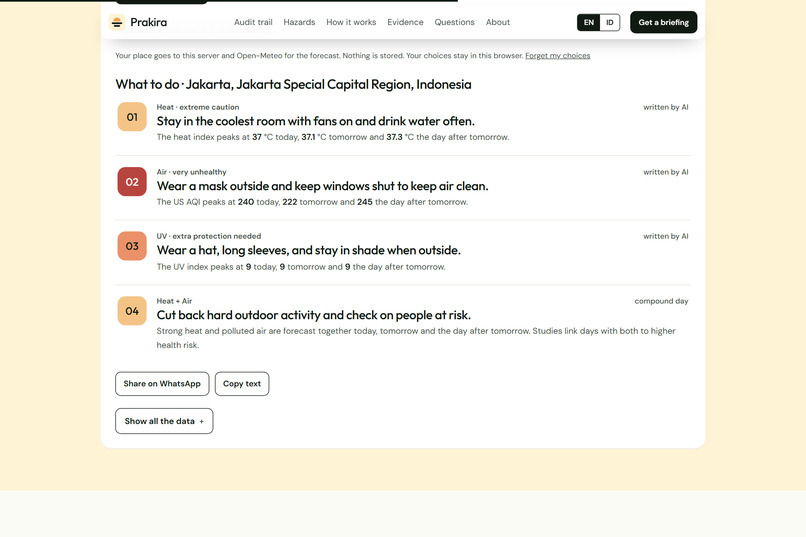
Prakira converts weather forecasts into personalized, easy-to-understand guidance based on the people and conditions in a household.
Users select a location and identify relevant household circumstances, including older adults, young children, outdoor workers, pregnancy, asthma or other lung conditions, flood-prone homes, and the absence of air conditioning.
Prakira then provides:
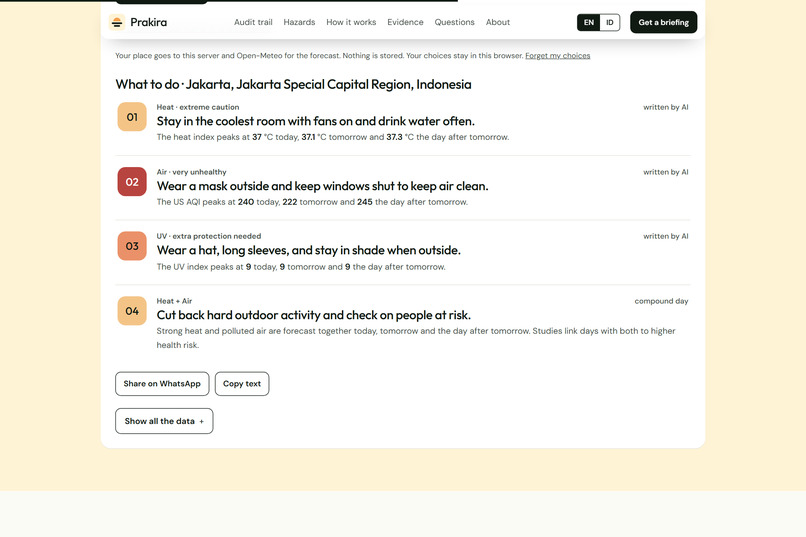
- Personalized risk alerts: Short, actionable recommendations based on the hazards that matter most to the household.
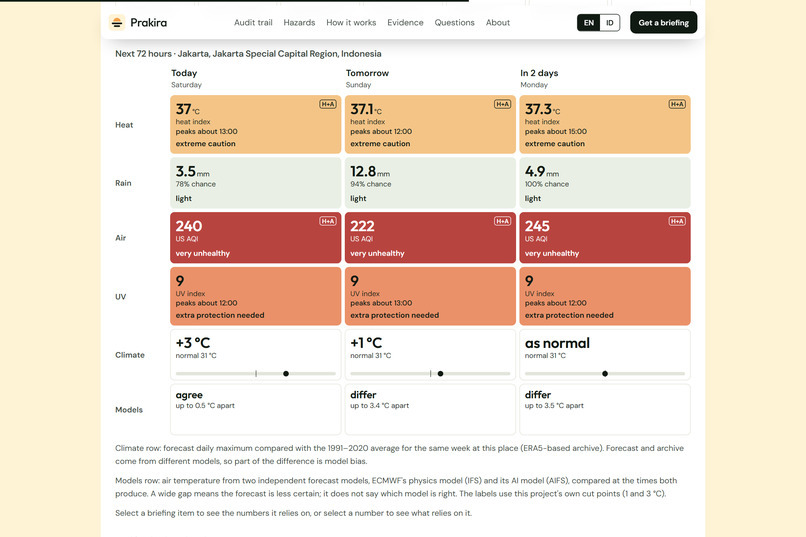
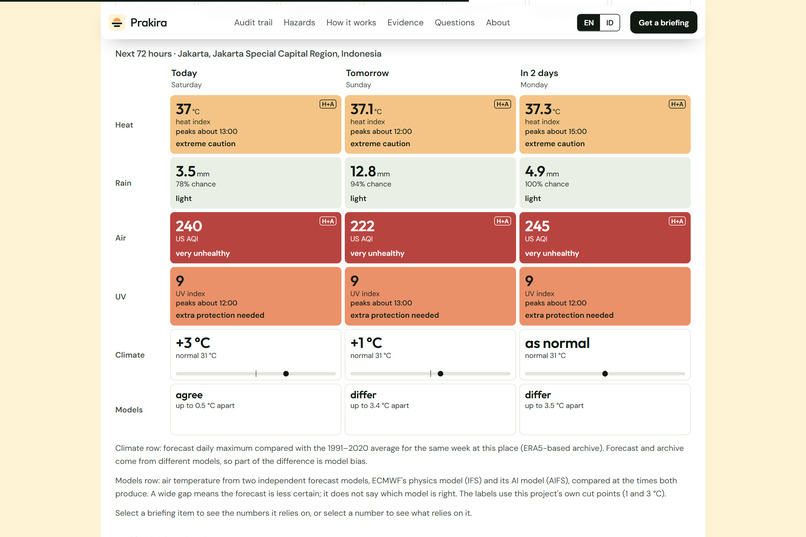
- Multiple hazard monitoring: Heat index, rainfall, air quality, and UV exposure, with risk levels assigned through predefined rules.
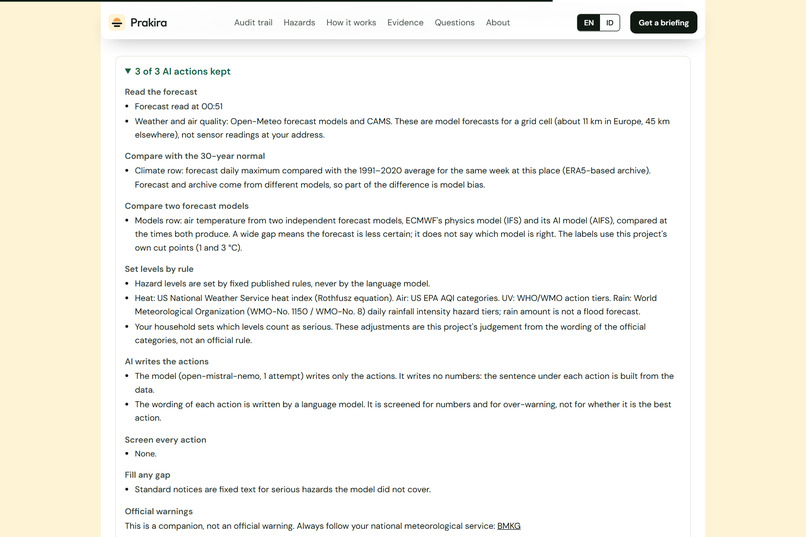
- Transparent evidence: Every recommendation connects to the forecast values behind it, allowing users to understand why an alert appeared.
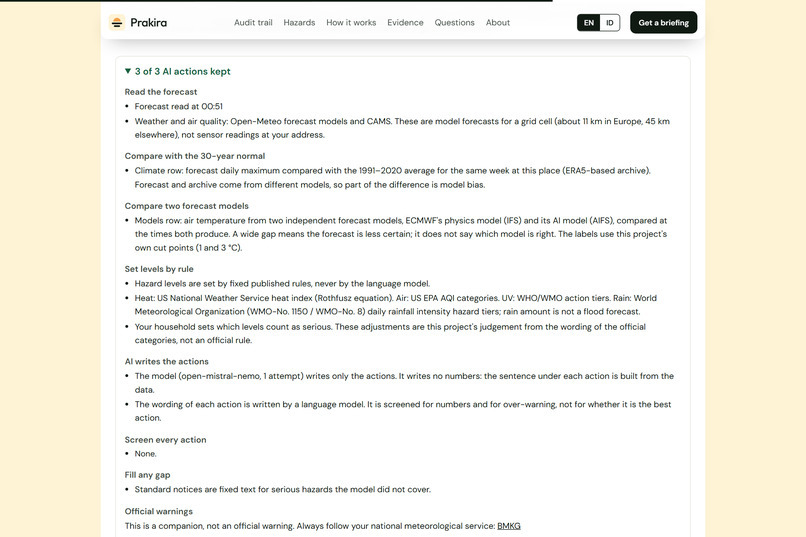
- AI accountability: Users can inspect which AI-generated actions were accepted or rejected and see the reasons.
- 72-hour forecast insights: A detailed view of upcoming conditions, climate comparisons, and agreement between forecast models.
- Climate context: Historical climate averages and longer-range projections of hot days.
- Natural-language household setup: Users can describe their household in a sentence, and AI maps the description to supported profile options for confirmation.
- Bilingual accessibility: An interface available in English and Bahasa Indonesia.
- Easy sharing: Users can copy recommendations or share them through WhatsApp.
If no hazard reaches the configured serious-risk threshold, Prakira does not generate unnecessary warnings. If AI fails to cover a serious hazard, a predefined safety notice fills the gap.
Prakira is designed to complement official weather warnings, not replace them.
How we built it
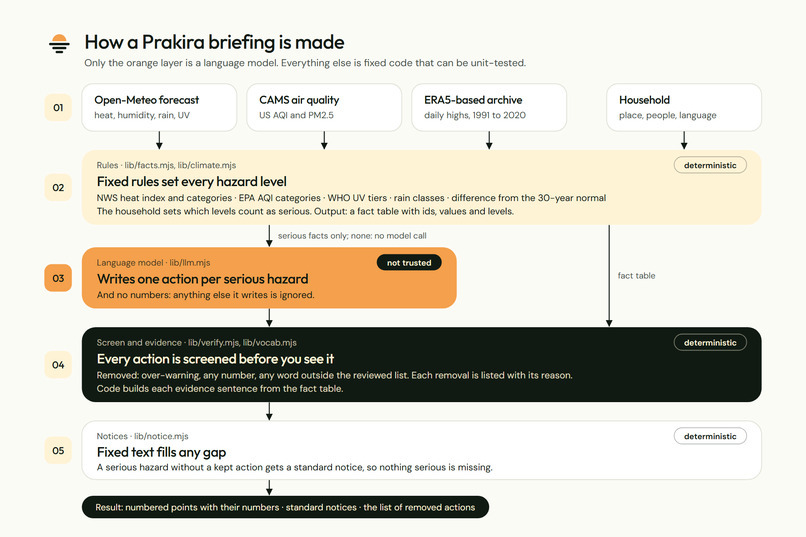
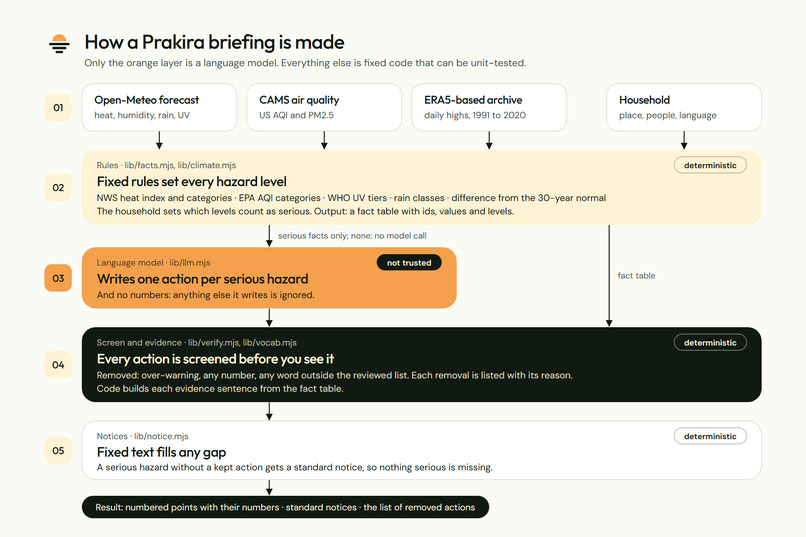
We designed Prakira as a five-layer system in which the language model is only one component of a larger, rule-driven pipeline.
1. Forecast and climate data
We integrated Open-Meteo forecast data, including ECMWF IFS and AIFS models, alongside Copernicus Atmosphere Monitoring Service (CAMS) air-quality forecasts. Historical climate data comes from an ERA5-based archive, with NASA POWER providing an alternative source when needed. We also incorporated CMIP6 climate projections.
2. Deterministic risk engine
Instead of asking an LLM to interpret raw measurements and decide how dangerous they are, we implemented fixed rules in code. These calculate the heat index using the NWS Rothfusz equation and assign hazard levels using established heat, air-quality, and UV classification systems, alongside defined rainfall thresholds.
The system then evaluates those levels against the selected household circumstances.
3. AI-generated recommendations
We used Mistral's open-mistral-nemo model to generate short actions for serious hazards. The model returns structured hazard-and-advice pairs rather than complete weather reports. It is explicitly instructed not to generate numbers.
4. Verification and evidence
Every generated action passes through a strict screening process. Code checks whether the action corresponds to a serious household hazard, contains prohibited digits, uses approved vocabulary for that hazard, and avoids inappropriate recommendations at lower risk levels.
Accepted actions receive their numerical evidence directly from forecast data through code. Rejected actions are recorded, with predefined notices covering any serious hazards that remain unaddressed.
5. Lightweight, transparent architecture
The backend uses Node.js 20 and built-in modules, while the frontend is implemented in a single HTML file with vanilla JavaScript and CSS. Server-sent events display the actual processing stages and their durations.
We also implemented caching, request limits, 43 offline unit tests, and a live evaluation script covering tuned and held-out cities. The application is hosted on a home tablet through Cloudflare Tunnel.
Challenges we ran into
The most important challenges were not simply getting an AI model to generate text. They were ensuring that the entire system remained trustworthy when the output could influence real-world safety decisions.
Getting the science right
Our initial version incorrectly applied heat-index categories to a different temperature measure and used incorrect thresholds. We revisited the National Weather Service guidance and added unit tests reproducing its published examples.
Preventing unnecessary warnings
An early version advised a London household to stay indoors even when the air-quality risk did not justify that recommendation. We refined the household-specific risk logic and introduced additional screening rules to reject disproportionate advice.
Discovering the limits of AI verification
One of our most significant failures involved a recommendation that displayed the right numerical values against the wrong days. The verifier still marked it as verified. We also discovered problems involving Indonesian decimal commas and incomplete sets of forecast values.
These failures changed our approach completely. Rather than endlessly improving a system that checked AI-generated numbers, we removed the model from numerical generation altogether.
Now, AI writes only the action, while deterministic code supplies the figures and their supporting evidence.
Balancing simplicity and reliability
We experimented with prompts to make recommendations easier to understand. One adjustment improved the English reading-grade estimate from 8.4 to approximately 3.5, although the model's screening pass rate varied throughout development.
Working within resource constraints
Free-tier model limitations meant we could not rely on larger models. We therefore focused on a smaller model, lightweight infrastructure, caching, and deterministic safeguards instead of depending on expensive inference.
Accomplishments that we're proud of
- Zero AI-generated numbers displayed to users. Every displayed numerical value comes from forecast data or deterministic calculations.
- 100% serious-hazard coverage in the evaluation after fallback notices were added. The AI alone covered 84.2% of serious hazards in both supported languages; predefined notices covered the remaining gaps.
- Evaluation beyond development locations. We tested the system on 15 held-out cities that were not used while tuning the application.
- Bilingual functionality. Prakira supports English and Bahasa Indonesia, including screening that handles Indonesian number formatting.
- Auditable recommendations. Users can trace advice to the underlying data and inspect rejected AI actions.
- A lightweight implementation. The system uses a small backend, a single-page frontend, public data sources, and a free-tier language model.
In our live evaluation on October 8, 2026, the screening system accepted 23 of 27 English actions (85.2%) and 22 of 27 Indonesian actions (81.5%). These figures measure screening acceptance, not the medical correctness or overall quality of the advice.
We are proud not only of the successful results but also of documenting the limitations and failures that helped shape the final architecture.
What we learned
Our biggest lesson was that the strongest way to verify an AI-generated fact can be to stop asking AI to generate that fact in the first place.
We initially tried to verify the model's numerical claims. However, testing revealed that even a seemingly successful verifier could approve a sentence that associated a correct number with the wrong day. Removing numerical generation from the model was a simpler and stronger architectural solution.
We also learned that correct numbers do not automatically guarantee good advice. In an earlier design, a review of 22 actions identified two questionable recommendations, including suggesting morning activity on a day with a heat index of 47°C.
This reinforced an important distinction: technical validation can establish whether an action follows certain rules, but it cannot by itself establish that every recommendation is appropriate for every real-world situation.
Prakira still needs review by qualified people, including a health professional, as well as user testing. We believe transparency about those limitations is essential when building AI for safety-related applications.
What's next for Prakira
We want to make Prakira more reliable, accessible, and useful for the people who need it most.
Our next priorities are:
- Expert review: Work with health professionals and other qualified reviewers to evaluate the safety and usefulness of recommendations.
- Conflicting-hazard reasoning: Improve guidance when risks interact, such as extreme heat combined with poor air quality in a home without air conditioning.
- More languages: Expand access while creating dedicated screening rules and tests for each supported language.
- Better personalization: Refine how household circumstances influence risk prioritization without creating unnecessary alarm.
- Real-world evaluation: Conduct user studies to assess clarity, usefulness, accessibility, and whether people can act on the recommendations.
- Stronger public-warning integration: Continue developing Prakira as a transparent companion to official meteorological warnings.
Our long-term vision is to make weather information more understandable and actionable for every household, especially those with people who face greater risks from extreme conditions.
Prakira is built on a simple belief: forecasts provide the numbers, rules determine the risks, and AI helps people understand what to do next.
Built With
- artificial-intelligence
- climate-data
- copernicus
- css3
- ecmwf
- html5
- javascript
- mistral
- nasa-power
- natural-language-processing
- node.js
- open-meteo
- server-sent-events
- weather-forecasting

Log in or sign up for Devpost to join the conversation.