-
-
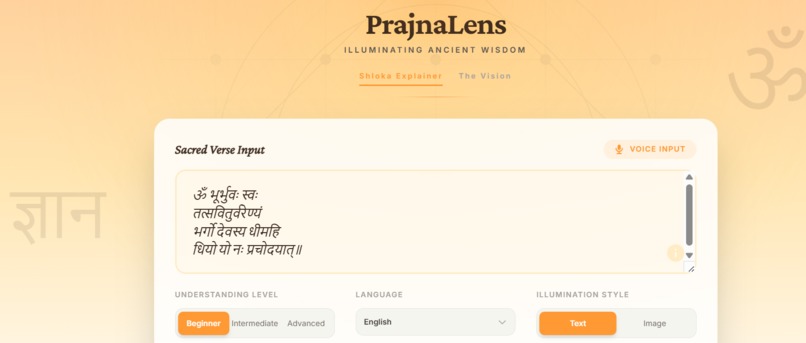
PrajnaLens
About the Project — PrajnaLens
🌱 Inspiration
My journey with Sanskrit began with reading powerful shlokas like:
कर्मण्येवाधिकारस्ते मा फलेषु कदाचन
While the verse felt profound, I struggled to truly understand, remember, and apply its meaning in daily life. Simply reading or memorizing shlokas was not enough. Without knowing the Padārtha (word meanings), Anvaya (sentence structure), and deeper context, the wisdom remained difficult to grasp and retain.
This gap inspired PrajnaLens — a tool designed to transform Sanskrit shlokas from memorized lines into clear, practical concepts that can guide everyday thinking and actions.
🚀 What I Built
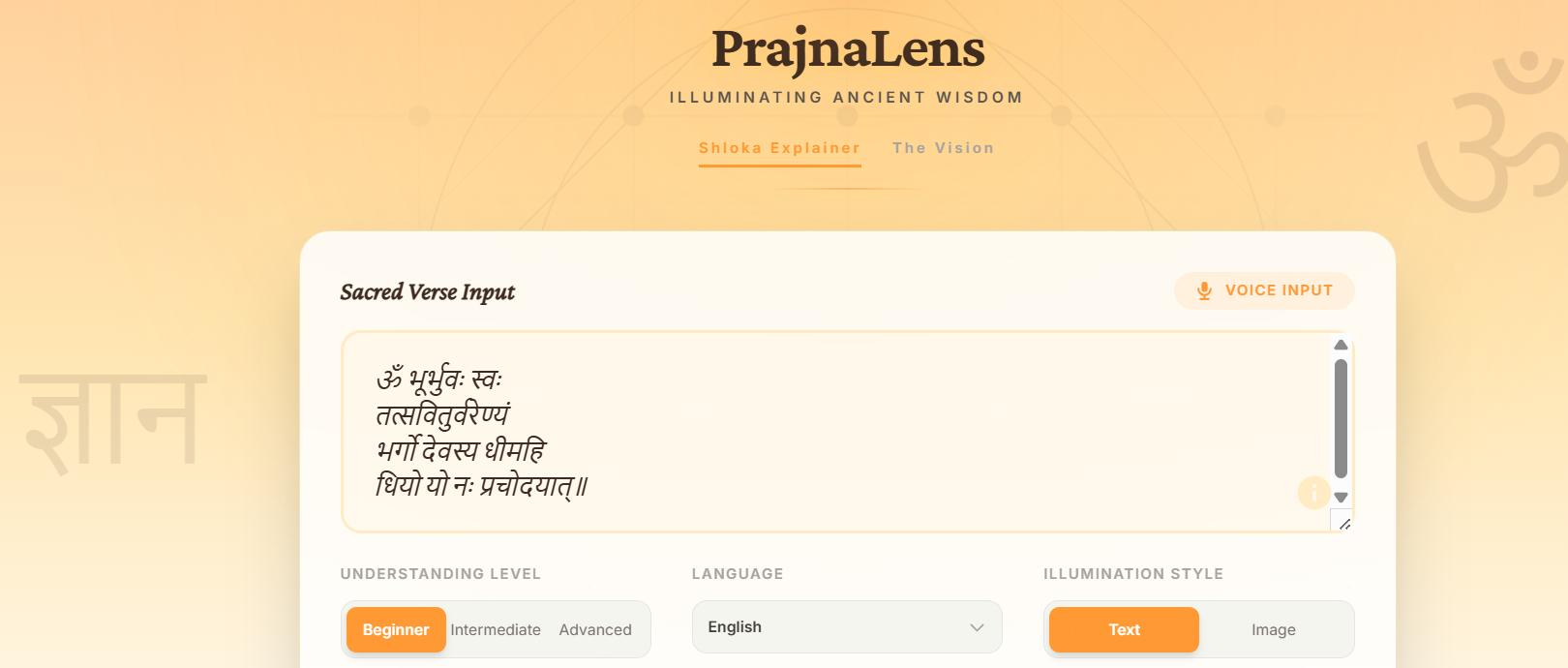
PrajnaLens is an AI-powered platform built using Google AI Studio, focused on helping users deeply understand Sanskrit shlokas by automatically generating:
- Padacheda – Word separation
- Padārtha – Word-by-word meaning
- Anvaya – Logical sentence construction
- Conceptual explanation – Practical interpretation for modern life
The goal is not just translation, but true comprehension and retention.
🔍 Why PrajnaLens Is Different
While many general-purpose AI tools can generate Sanskrit explanations using carefully crafted prompts, this approach assumes that users already know what to ask, how to ask, and how Sanskrit analysis works.
PrajnaLens removes this complexity.
Instead of relying on repeated or complex prompts, PrajnaLens encapsulates scholar-level prompting into a guided experience. Users simply input a shloka, and the system consistently produces structured outputs like Padacheda, Padārtha, Anvaya, and conceptual meaning — without requiring any prior knowledge of Sanskrit grammar or prompt engineering.
This makes PrajnaLens a purpose-built companion, not just an AI response generator.
🧠 Vision of PrajnaLens
“Prajna” (प्रज्ञा) signifies wisdom,
“Lens” represents a modern perspective.
PrajnaLens bridges eternal Vedic wisdom with the digital age, allowing ancient truths to be viewed clearly through contemporary technology.
🎯 Mission
Sanskrit is not merely a language — it is a vibrational map of consciousness.
PrajnaLens aims to democratize access to Sanskrit literature by providing clarity, context, and meaning for the modern seeker, without compromising its philosophical depth.
🛠️ How I Built It
- Built using Google AI Studio
- Powered by the Gemini 3 Series
- Designed structured prompt flows to automate traditional Sanskrit analysis
- Focused on usability, clarity, and consistency over raw generation
⚙️ Technological Soul
Powered by the Gemini 3 Series, PrajnaLens automates scholar-level analysis traditionally done by experts, including:
- Linguistic breakdown with cultural sensitivity
- Semantic understanding beyond literal translation
- Synthesis of traditional Sanskrit grammar with cutting-edge AI
This fusion preserves the aesthetic and philosophical integrity of Sanskrit while making it accessible through modern tools.
🧩 Challenges & Learnings
- Initially faced difficulty understanding Google AI Studio
- Learning React programming concepts alongside AI development was challenging
- Designing prompts that balance accuracy, depth, and simplicity required multiple iterations
Through these challenges, I learned:
- How to work effectively with AI-first development tools
- The importance of prompt abstraction and structured outputs
- That technology can be a meaningful bridge to preserve ancient wisdom
🌟 Outcome
PrajnaLens transformed my own relationship with Sanskrit — from memorization to meaningful understanding.
This project is both a personal learning journey and a step toward making timeless Sanskrit wisdom relevant and usable in everyday life.


Log in or sign up for Devpost to join the conversation.