-
-
cover_photo.jpg
-

-

Inspiration
Prayer has been present in some of the most pivotal moments of my life, but often the prayers that affected me most were not my own.
They came through someone else praying over me.
During one of the darkest periods of my life, that experience brought me a peace that I can only describe as transcending understanding. The circumstances around me had not suddenly changed, but something inside me had.
That stayed with me.
There is something very different about asking for prayer online and having someone pray with you in person.
Online, we might post that we're struggling and receive a few short comments: “Praying for you,” a heart, a prayer-hands emoji, maybe a few encouraging sentences. Those responses can be sincere and meaningful, but they rarely feel the same as sitting across from someone, hearing their voice change as they pray for you, hearing the pauses, the emotion, and the words they find when you might not have any left yourself.
In person, prayer can feel like someone stepping into the weight of a moment with you.
I kept wondering why so little of that feeling survives when prayer moves online.
At the same time, prayer can be deeply personal. Some things belong with the people you trust, not on a public feed for the entire internet to hear.
That led to the idea behind Praize:
What if you could speak what was genuinely on your heart, choose who you trusted enough to share it with, and actually hear someone pray with you in return?
Praize is my attempt to bring more of the presence of in-person prayer into the digital world, without asking people to give up the intimacy and boundaries that prayer sometimes requires without language or time or location becoming a barrier to that.
What it does
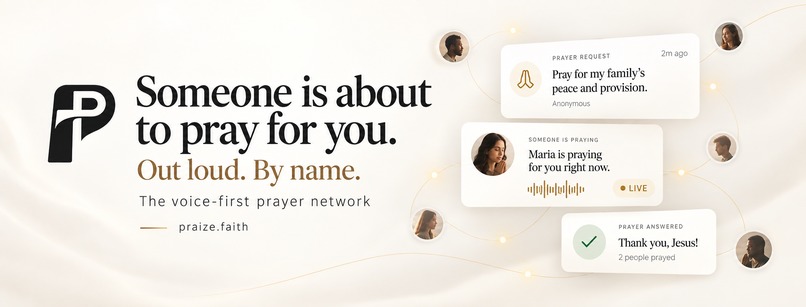
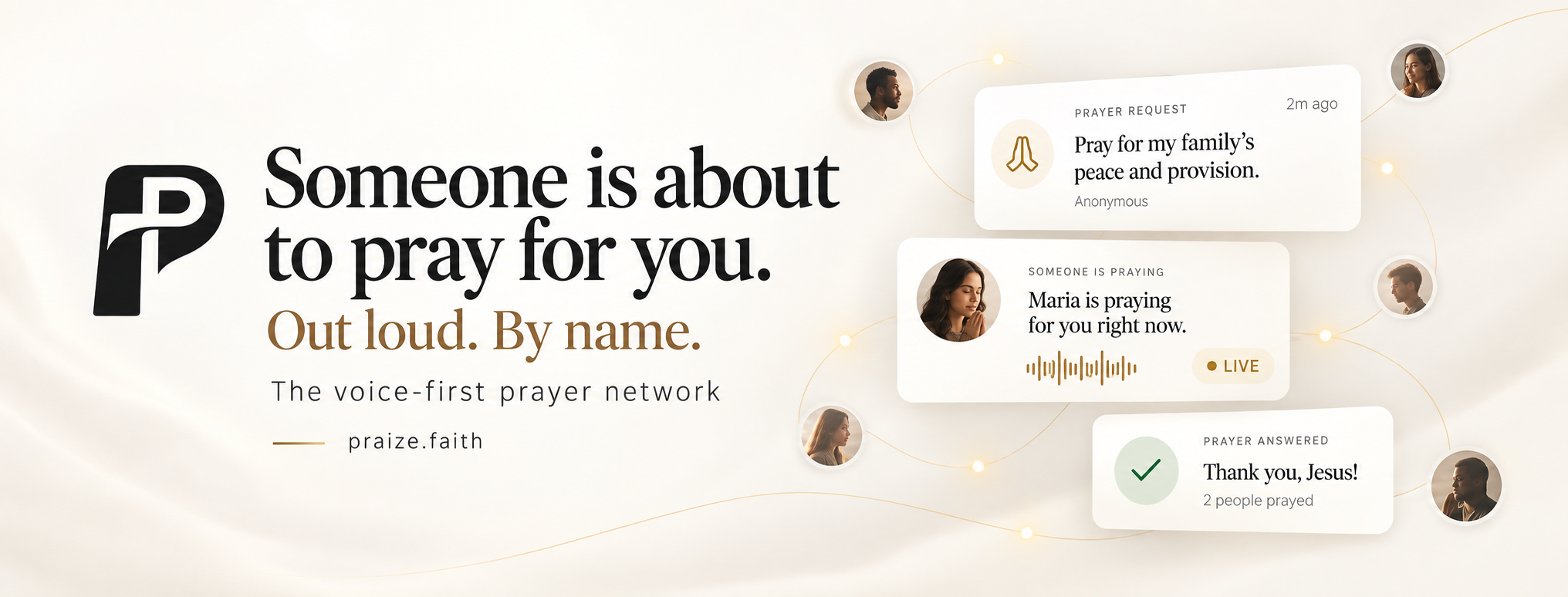
Praize is a voice-first prayer community built around participation, presence, and trust rather than passive consumption.
Someone can speak a prayer request in their own words and decide where it belongs. A prayer might be something they are comfortable sharing more broadly, or something deeply personal that they only want to share with a particular circle of people they trust.
Praize lets people choose the circles they want to share with instead of treating every prayer as something that should automatically be broadcast to everyone.
The people within those circles can listen and respond by lifting that prayer up with their own voice.
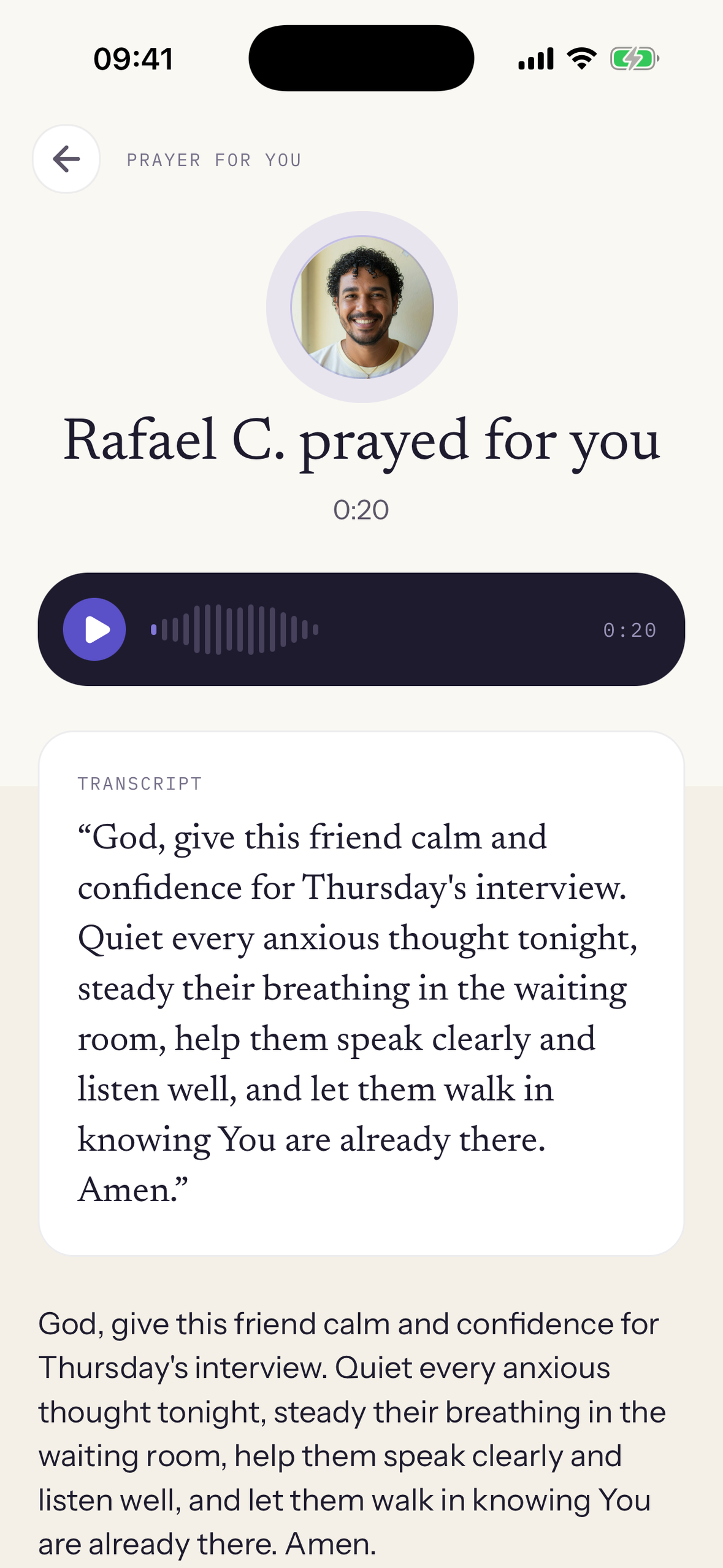
Instead of posting something vulnerable and receiving a collection of likes, reactions, or short “praying for you” messages, you can actually hear the person who chose to stop, listen to what you were going through, and pray for you.
You hear their voice.
You hear the pauses.
You hear that another person has taken your situation seriously enough to spend a moment lifting you up.
The experience is designed around a simple loop:
Speak → Share with the people you trust → Be heard → Be prayed for → Return when the prayer is answered.
In short, Prayer → Praise.
Praize also uses transcription and translation to reduce language barriers, helping prayer move between people who might otherwise struggle to understand one another.
When something changes, prayers can become answered prayers, turning moments that began in uncertainty into something the people who walked alongside you can celebrate with you.
The goal is not to create another infinite content feed.
It is to bring some of the presence, intimacy, and humanity of praying together in person into a medium where people may be separated by distance.
How we built it
Praize is built as an audio-first mobile experience, with the architecture designed around fast voice interaction, reliable media delivery, privacy boundaries, and the ability to grow into a global community.
The mobile application is built with React Native and Expo, while the backend uses Elixir and Phoenix for highly concurrent, real-time workloads.
Audio is treated as a first-class part of the system rather than an attachment to text. Praize handles recording, upload, playback, transcription, and the processing needed to make spoken prayers usable across the application.
Sharing is also designed around context. Rather than assuming everything belongs on one public feed, Praize is built around circles so people can control which communities are appropriate for a particular prayer.
AI is intentionally kept behind the experience. It can help with tasks such as transcription, translation, safety, and making prayers accessible across languages, but it is not meant to replace the person praying.
RevenueCat powers Praize's monetization layer, allowing the app to support paid membership while keeping the core prayer experience accessible.
The larger system is designed around a simple principle:
technology should make human connection easier without becoming the connection itself.
Challenges we ran into
The hardest challenge was designing a social product around something as personal as prayer without accidentally turning it into conventional social media.
Many of the mechanics that make social applications grow, likes, follower counts, engagement loops, popularity rankings, public-by-default sharing, and endless feeds, felt wrong for the experience I wanted Praize to create.
Prayer also creates a difficult design tension: community is valuable, but so is privacy.
Some prayers are things you might happily share with a wider community. Others may involve grief, relationships, fear, family, health, or moments of vulnerability that you only want a small group of trusted people to hear.
That meant Praize couldn't simply ask, “How do we help more people see this?”
It also had to ask, “Who should be allowed into this moment?”
That question shaped the circle-based sharing model and became just as important as designing discovery itself.
Audio created its own technical challenges as well. Voice is much richer than text, but it also introduces storage, bandwidth, processing, transcription, moderation, playback, and latency concerns that a text-first product largely avoids.
Another challenge was deciding where AI belonged.
Praize benefits enormously from AI for things like understanding and translating spoken language, but prayer itself needed to remain human. Finding that boundary became one of the most important product decisions in the project.
And finally, there is a tension at the heart of Praize itself: asking someone to record something deeply personal in their own voice can feel far more vulnerable than typing out a prayer request. That challenge will never disappear entirely, and perhaps it shouldn’t. But I believe this is precisely where the Church is uniquely positioned to help. Communities already built on trust, relationship, and care can make that vulnerability feel safer, more natural, and worth taking.
Accomplishments that we're proud of
The thing I am most proud of is that Praize has developed a clear identity.
It did not become another social network with a Christian theme layered on top of it.
The fundamental interaction remains something unusually simple:
one person speaks, chooses who they trust with that moment, another person listens, and then responds with prayer.
I am also proud of building the product around voice from the beginning rather than treating voice as a later feature. That decision affected nearly every part of the design and technical architecture, but it is also what gives Praize its character.
The circle model is another important part of that identity. Praize doesn't require someone to choose between keeping something entirely to themselves and broadcasting it publicly. Different prayers can belong in different communities.
Building transcription and translation around that experience has also opened up an idea I find especially meaningful: a prayer spoken in one language should not necessarily stop at the boundary of that language.
And finally, getting Praize from an idea rooted in a deeply personal experience to a real application people can use has been an accomplishment in itself.
What we learned
Building Praize taught me that restraint can be just as important as adding features.
There were many opportunities to make the app more addictive, more public, more measurable, or more similar to existing social platforms. But optimizing for engagement is not necessarily the same thing as optimizing for meaning.
I also learned how important medium is.
A written message saying, “I'm praying for you,” communicates information.
Hearing someone actually pray communicates presence.
Their voice carries things that text often loses: hesitation, compassion, emphasis, emotion, and the sense that another human being has genuinely stopped what they were doing to enter the moment with you.
I also learned that privacy isn't simply a settings problem. For a product centered on vulnerability, deciding who gets to hear something is part of the experience itself.
On the technical side, I learned a great deal about building an audio-first system: media pipelines, mobile recording and playback, asynchronous processing, AI-assisted transcription and translation, and designing infrastructure where those systems can operate without making the experience feel complicated.
Most importantly, I learned that AI is sometimes most useful when the user barely notices it is there.
For Praize, the technology works best when it helps two people understand one another and then gets out of the way.
What's next for Praize
The next step is making Praize feel increasingly global without losing the intimacy and trust of its core interaction.
That means improving translation so people can pray across languages more naturally, making circles better suited to the different communities people already pray within, and helping prayers reach the right people rather than simply the largest possible audience.
I also want to continue refining answered prayers so that the people who were present during a difficult moment can later share in what happened afterward.
Over time, I want Praize to support the many different shapes prayer communities can take, close friends, families, churches, small groups, and wider communities; while allowing the person sharing a prayer to decide how far that moment should travel.
Longer term, I want Praize to become a place where someone can open the app during a difficult moment, speak honestly about what they are going through, choose the people they feel safe sharing it with, and know there is a real possibility that another human being will stop what they are doing and pray with them.
Not just send a reaction.
Not just write “praying.”
Actually pray.
If Praize can make that kind of presence a little more accessible to someone else than it was for me, then it will have accomplished what I originally built it to do.
Built With
- ansible
- docker
- elixir
- expo.io
- kotlin
- phoenix
- react-native
- swift
- terraform
- typescript

Log in or sign up for Devpost to join the conversation.