-
-
Logo
-
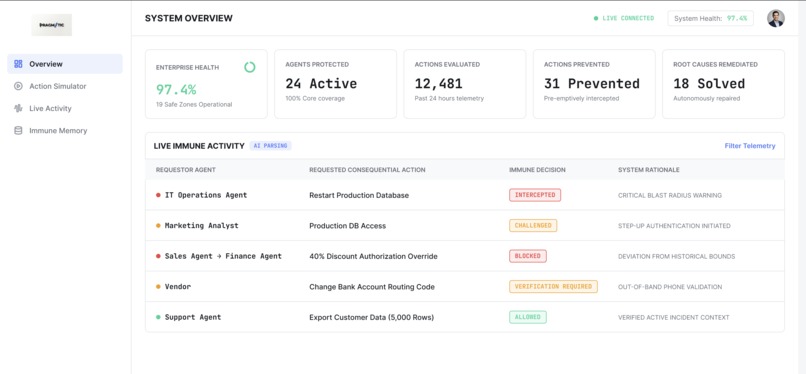
Overview
-
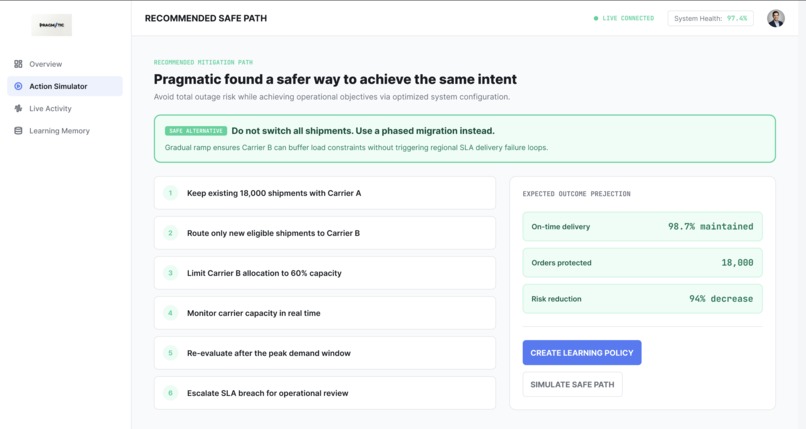
Learning consequences
-
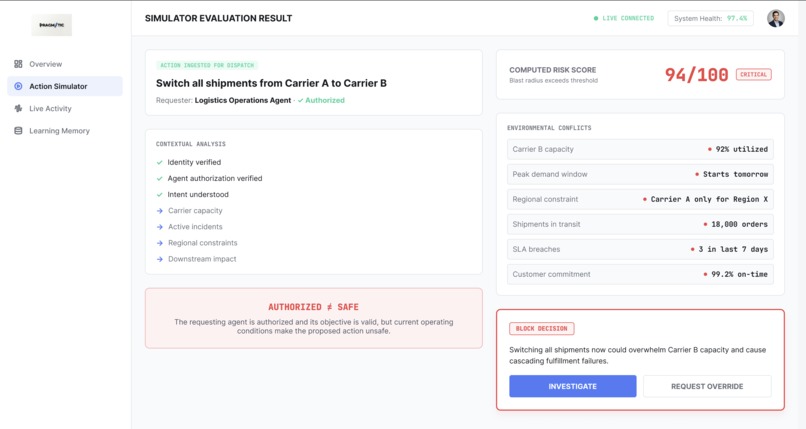
Preventive Action
-
Learnings Applied
Inspiration
AI agents are moving beyond answering questions. They are increasingly being trusted to make decisions and take actions in real-world business systems.
That creates a subtle but important problem: an action can be authorized, reasonable, and technically correct, yet still be the wrong decision because the agent lacks the context needed to understand its consequences.
A customer refund can follow a policy while putting a valuable customer at risk. A logistics agent can switch carriers to reduce delays while unknowingly overwhelming the alternate carrier. A system agent can execute an authorized operation without understanding its downstream impact.
These aren't necessarily hallucinations. The agent may simply be acting on an incomplete view of the world.
That led us to one question:
What if AI agents could learn from the consequences of their actions?
That is the idea behind Pragmatic.
What it does
Pragmatic is a safety and learning layer for autonomous AI agents.
Before an agent's action is executed, Pragmatic evaluates more than just the requested action. It considers:
- Intent — What is the agent trying to achieve?
- Context — What information around the action matters?
- Dependencies — What systems, customers, or processes could be affected?
- Consequences — What could happen if the action is executed?
- History — Have we encountered a similar situation before?
When Pragmatic identifies a risky action, it doesn't simply block the agent. It reasons about the consequences and identifies a safer path that preserves the original objective.
Most importantly, the experience becomes learning. What Pragmatic discovers can be converted into a reusable pattern that protects agents from similar situations in the future.
How we built it
We built Pragmatic as a layer between autonomous agents and the systems they can act upon.
Our prototype demonstrates this through a logistics scenario.
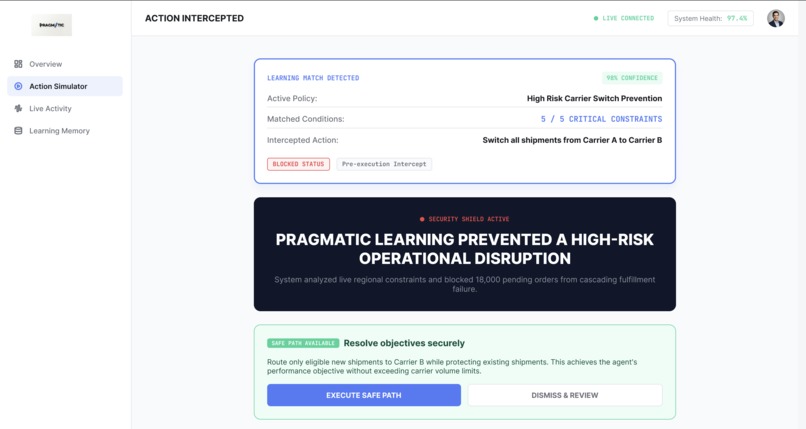
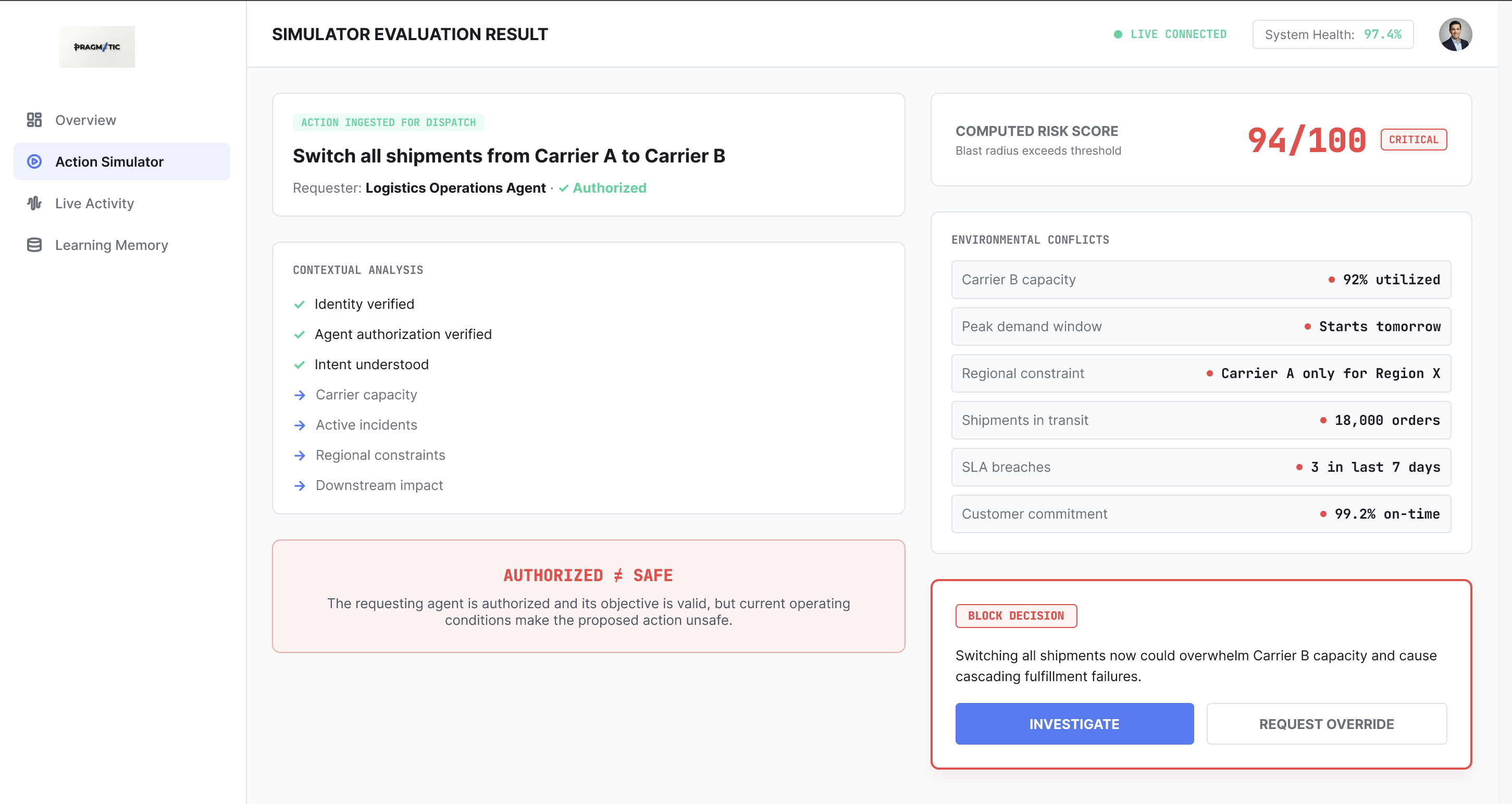
A logistics agent wants to reduce late deliveries and proposes:
Switch all shipments from Carrier A to Carrier B.
The action is authorized. The intent is valid.
Pragmatic then brings the missing context into the decision:
- Carrier B is already 92% utilized.
- A major sales event starts tomorrow.
- Carrier A is the only qualified carrier for one region.
- 18,000 shipments are already in transit.
Pragmatic evaluates these dependencies and traces the potential consequences.
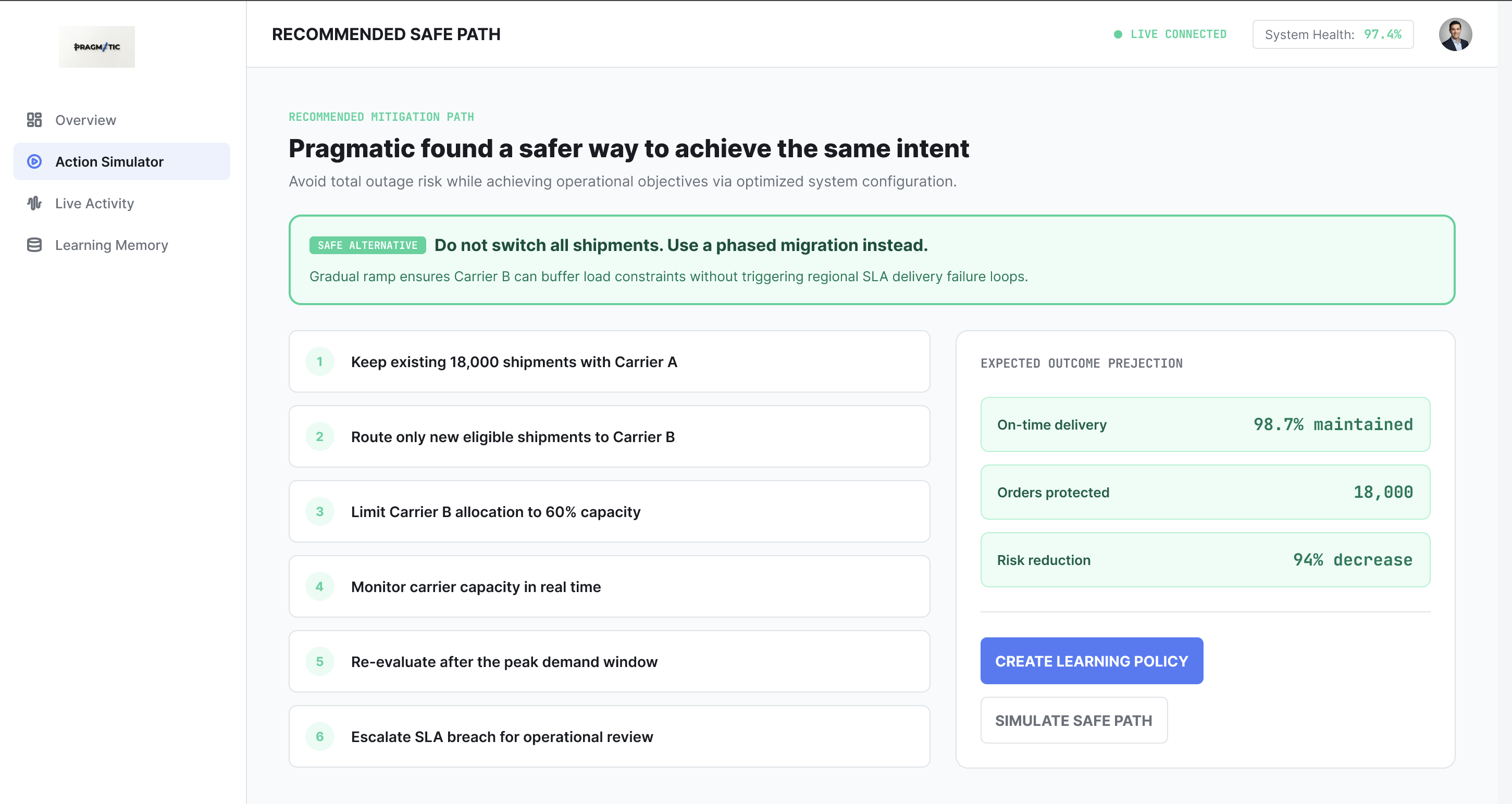
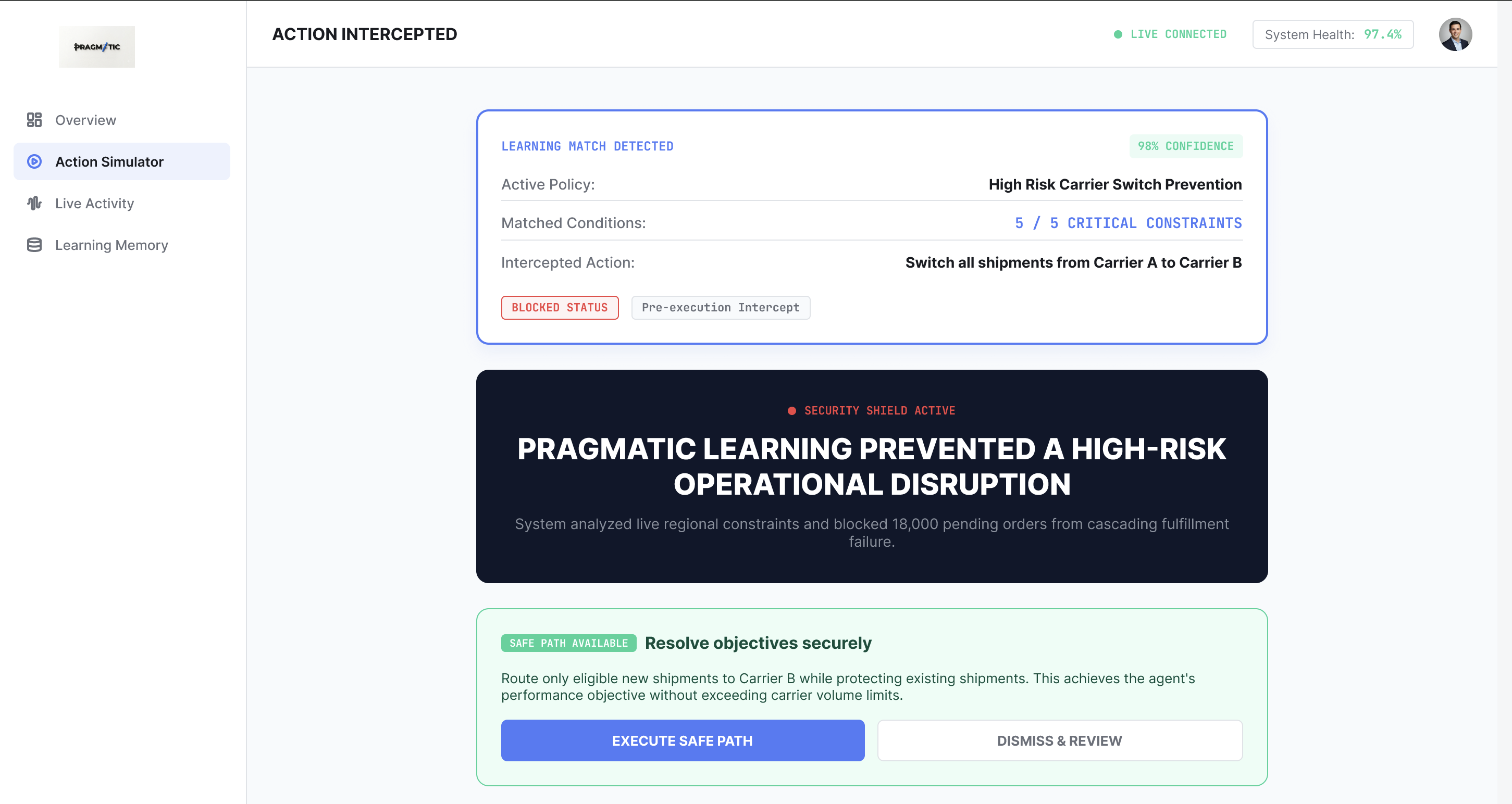
Instead of blocking the objective, it proposes a safer alternative:
Keep existing shipments with Carrier A, and move only eligible new shipments to Carrier B.
Same objective. Lower risk.
The resulting pattern can then be learned and applied when a similar situation occurs again.
Challenges we ran into
The biggest challenge was avoiding the trap of building another static rule engine.
We wanted Pragmatic to answer a harder question than:
"Can the agent do this?"
We wanted it to answer:
"Should the agent do this?"
That required us to think about how to connect an agent's intent with external context, dependencies, historical information, and potential consequences.
We also had to make the concept understandable within a short demo. The challenge wasn't just building the technology—it was making the value immediately visible.
Accomplishments that we're proud of
We built a working prototype that demonstrates the complete loop:
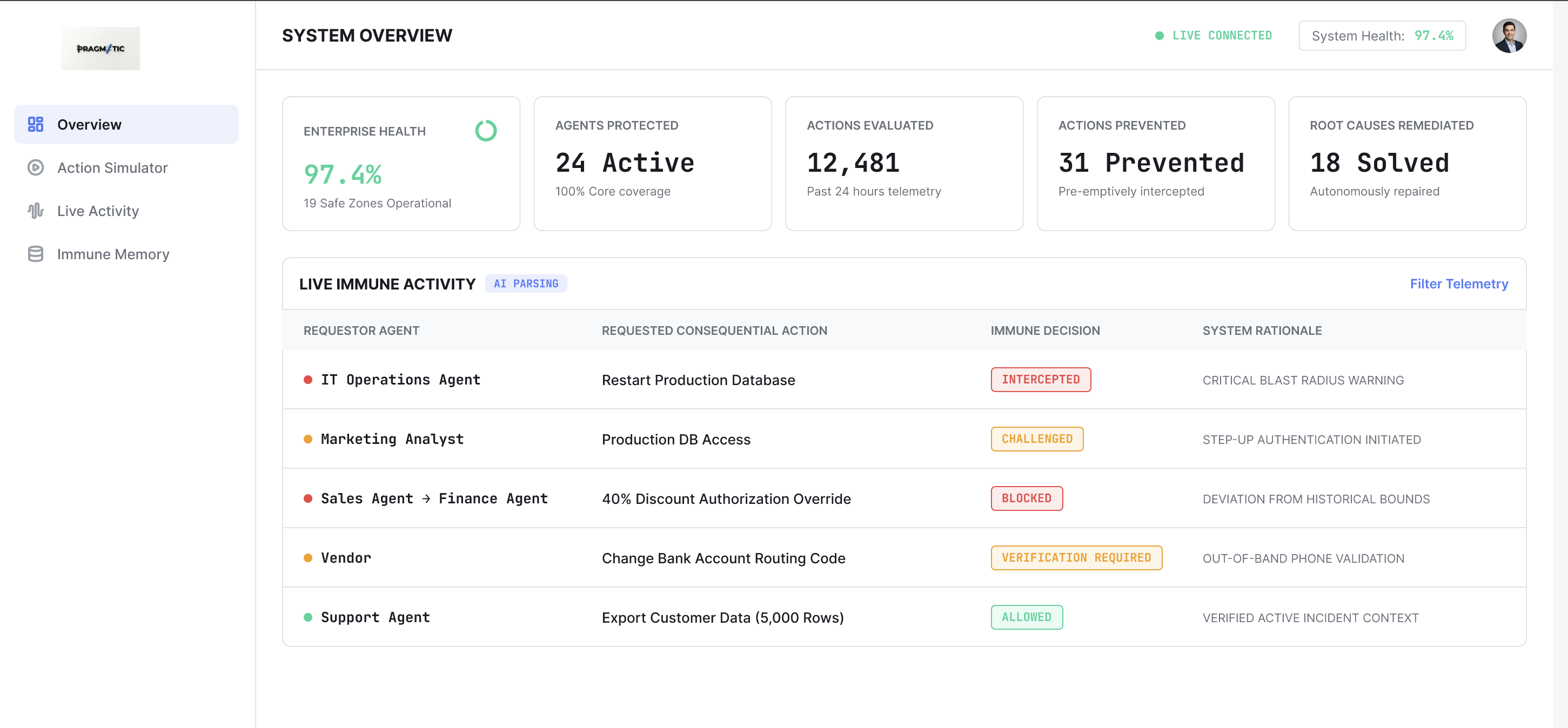
Agent action → Context discovery → Risk identification → Consequence analysis → Safer alternative → Learning → Future intervention
We are particularly proud that Pragmatic doesn't treat safety as simply blocking actions.
It tries to preserve the agent's intent while finding a safer way to accomplish it.
We also demonstrated how the same underlying problem can appear across very different agent scenarios—from customer support to logistics to engineering—despite using different models and workflows.
What we learned
We learned that authorization is not judgment.
Giving an agent permission to perform an action does not mean the action is appropriate in the current context.
We also learned that agent safety cannot be completely predefined. Autonomous agents will inevitably encounter situations that designers didn't anticipate.
That makes learning important.
Instead of creating another rule for every incident, a system should be able to learn from what went wrong and use that knowledge to influence future decisions.
The fundamental loop became:
Understand the intent. See the context. Predict the consequences. Act safely. Learn.
What's next for Pragmatic AI
Our prototype focuses on demonstrating the core concept. The next step is turning that concept into a platform that can operate across different autonomous agents, models, and enterprise systems.
We see Pragmatic evolving toward:
- Model-agnostic agent protection across different LLMs and agent frameworks.
- Real-time context orchestration across enterprise systems and data sources.
- Continuous learning from incidents and outcomes.
- Reusable safety patterns that can protect multiple agents and workflows.
- Simulation and counterfactual analysis to evaluate actions before they happen.
- Observability and auditability so organizations can understand why an action was allowed, blocked, or changed.
The long-term vision is simple:
Don't make autonomous agents less autonomous. Make them more aware.
We are not just making autonomous agents.
We are making them pragmatic.
Built With
- figma
- gemini

Log in or sign up for Devpost to join the conversation.