-
-
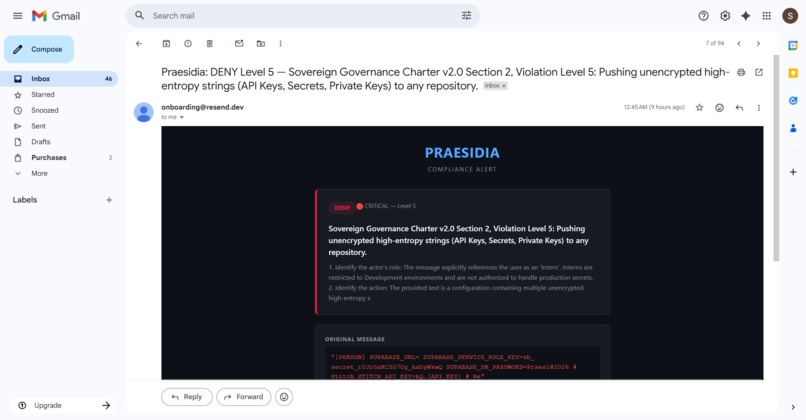
Email that our Praesidia sends once it detects an Alert
-
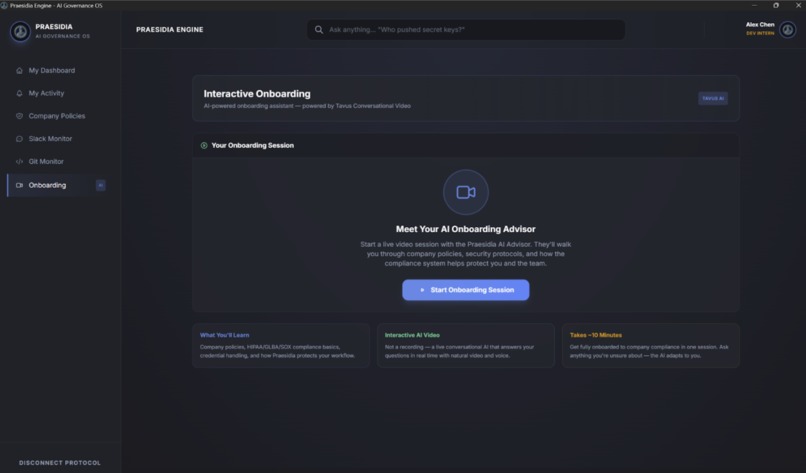
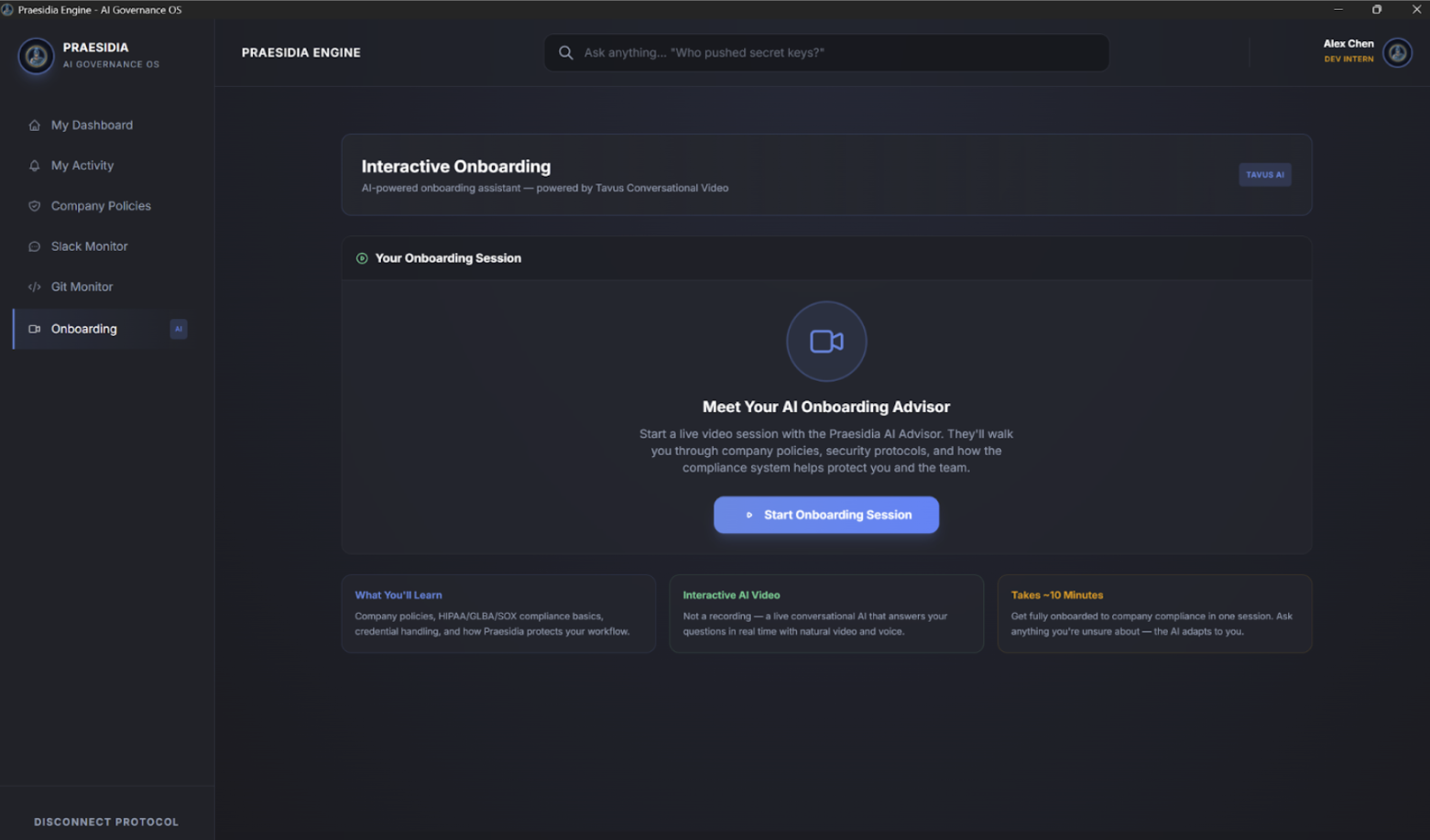
Dashboard for intern when they sign in
-
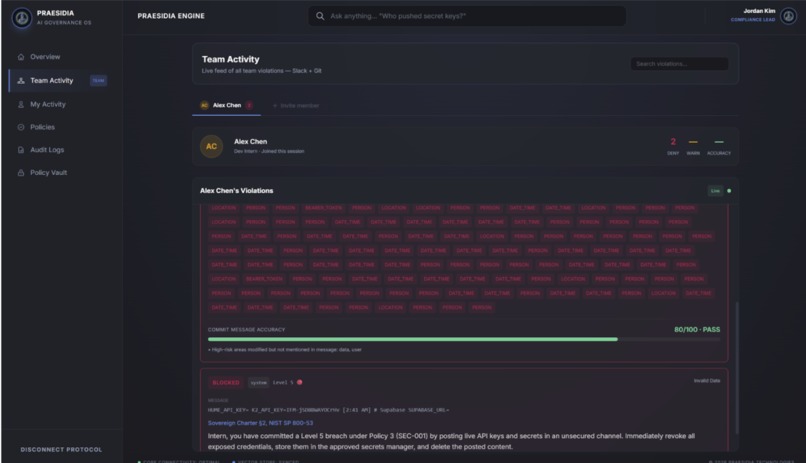
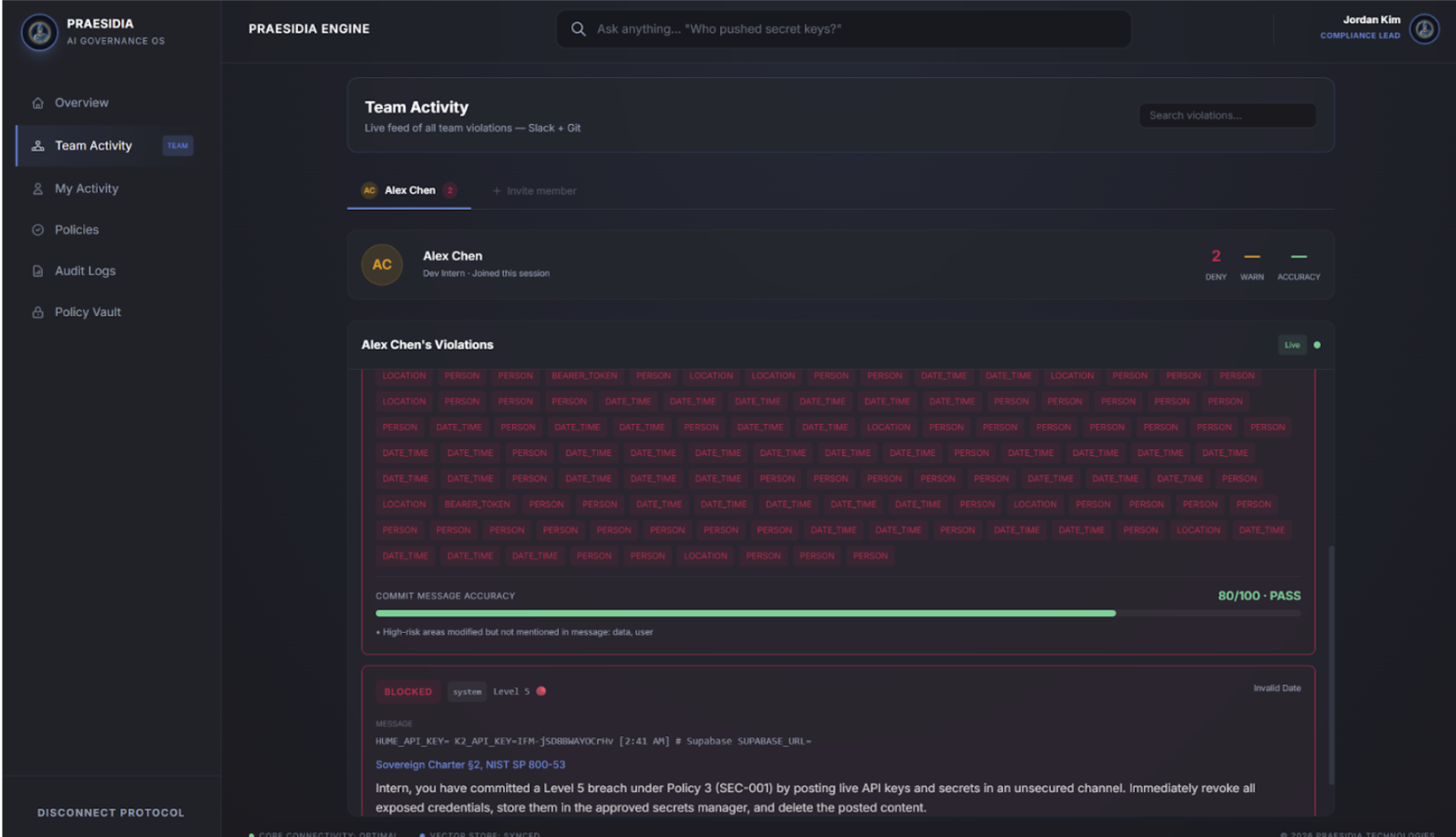
Senior developer perspective of team activity.
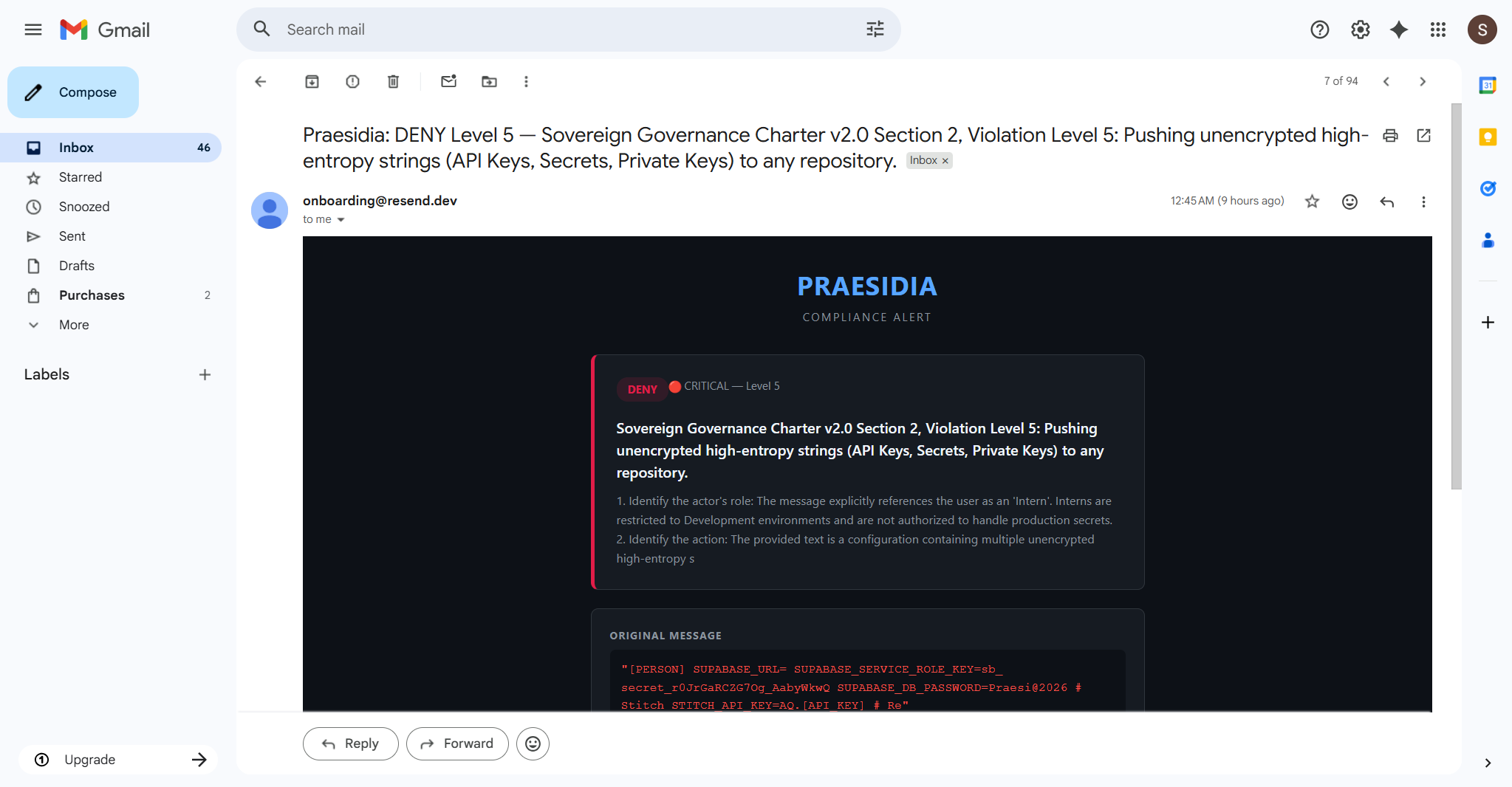
Praesidia: The AI Governance Enforcer
What it does
Praesidia is an AI governance and compliance platform that monitors developer workflows, detects violations in real time, and takes immediate action when necessary.
When a severe infraction occurs like pushing plaintext AWS keys to a repository, Praesidia doesn't just log the event. It launches a bold full-screen Electron overlay powered by Tavus, delivering a personalized AI video intervention directly to the developer. Simultaneously, it escalates the incident to compliance leads via Resend, ensuring accountability and transparency across the organization.
Praesidia doesn't just enforce rules. It transforms compliance into a proactive, intelligent, and adaptive system.
The core idea
What if compliance could think?
Instead of relying on static rules and manual enforcement, Praesidia uses AI to evaluate developer behavior in real time, reason about potential risks, and enforce compliance dynamically. It doesn't just react to violations. It prevents them, educates developers, and evolves with the organization.
Most compliance tools treat engineers like problems to be audited. Praesidia treats compliance as something that can be taught, personalized, and continuously improved. The goal is not to punish engineers but to build an organization where good security habits become second nature.
Key features
Real-time violation detection — Monitors developer workflows across GitHub, Slack, and VS Code, detecting critical violations like unencrypted secrets, bypassed pre-push guards, and other Level 4 and 5 infractions as they happen.
Live Injection Protocol — Triggers a bold full-screen Electron overlay for severe violations, delivering a personalized AI video intervention via the Tavus API. The experience is immediate, direct, and impossible to ignore.
Escalation and reporting — Automatically notifies compliance leads with detailed reasoning traces and HTML incident reports via Resend. Every incident is documented with full context so nothing slips through.
Role-based access control — Enforces strict access policies based on roles including Intern, Senior Developer, and Compliance Lead, ensuring that the right people have the right permissions and that violations are evaluated in context.
Self-improving governance — Promotes strong engineering habits into shared organizational memory and filters out weak or harmful patterns over time. The system gets better at enforcement the longer it runs.
Dashboard and analytics — A comprehensive admin panel for reviewing incidents, trends, and compliance metrics gives leadership a real-time picture of organizational health.
How we built it
Praesidia is a multi-layered system built across five core components.
Ingestion layer — Monitors events from GitHub, Slack, and other tools and routes them into the backend for processing. Every developer action that could carry compliance risk is captured and tagged before evaluation begins.
Processing layer — A Node.js backend evaluates events in real time, with K2-Think API providing advanced reasoning capabilities. Rather than matching events against a static ruleset, the system reasons about intent, context, and severity before deciding how to respond.
Intervention layer — An Electron desktop agent handles the physical enforcement side of the system. When a severe violation is detected, Tavus delivers a live, personalized video intervention that speaks directly to the developer and explains exactly what went wrong.
Memory layer — Supabase PostgreSQL stores compliance data, reasoning traces, and promoted engineering habits. Strong behaviors get elevated into shared organizational memory so that good practices spread across the team over time.
Escalation layer — Resend sends detailed incident reports to compliance leads the moment a violation is confirmed, complete with reasoning traces and recommended follow-up actions.
The frontend admin dashboard is built with React and Django, giving compliance teams a clear and actionable view of everything happening across the organization.
Architecture overview
Praesidia operates on a dual-track model designed to be both reactive and proactive.
Track 1: Real-time enforcement — Violations are detected as they happen and trigger immediate interventions. The system does not wait for a nightly batch job or a manual review. When something goes wrong, the response is instant.
Track 2: Self-improving governance — In parallel, the system analyzes developer behavior over time to identify patterns, surface trends, and promote best practices into shared organizational memory. Each incident makes the system smarter about what good compliance looks like in practice.
This architecture ensures Praesidia is never static. It learns from every enforcement event and continuously refines how it evaluates and responds to developer behavior.
What makes it different
Most compliance tools are reactive, static, and manual. A violation gets logged, a ticket gets filed, and someone reviews it days later. By then the damage is already done.
Praesidia closes that gap entirely. Detection, intervention, escalation, and documentation all happen in real time. The developer who pushed plaintext credentials gets a direct, personalized response within seconds, not a Slack message three days later. And because the system reasons about violations rather than just pattern-matching against rules, it can handle novel situations that a static rulebook would miss.
The self-improving layer is what makes Praesidia more than just a faster version of existing tools. It turns every enforcement event into organizational learning, so the company gets better at compliance over time rather than fighting the same violations on repeat.
Challenges we ran into
Balancing enforcement and trust — The biggest design challenge was making interventions that are effective without feeling punitive or invasive. Engineers need to understand why something was flagged and feel like the system is on their side, not hunting for mistakes. That shaped everything from the tone of the video interventions to how reasoning traces are surfaced in the dashboard.
Real-time reasoning — Integrating K2-Think API for fast, accurate decision-making was harder than expected. Compliance evaluation needs to be both quick enough to intercept violations in progress and accurate enough that false positives don't erode trust in the system.
Cross-tool integration — Connecting workflows across GitHub, Slack, and VS Code required careful handling of different event formats, authentication models, and latency profiles. Making all of that feel seamless from the developer's perspective took significant engineering effort.
UI reliability — Ensuring the Electron overlay renders correctly and behaves as expected across different machine configurations was one of the more tedious problems we solved. The intervention only works if it actually appears.
What we learned
Trust is the foundation everything else is built on. Engineers are far more likely to engage seriously with compliance feedback when they understand the reasoning behind it and believe the system is transparent about how it works. Hiding the logic behind a black-box enforcement engine is a fast path to resentment.
Real-time enforcement is genuinely hard. The gap between detecting a violation and responding to it is where most of the interesting engineering problems live, and getting that right required rethinking several assumptions we started with.
Self-improving systems create compounding value. Every enforcement event feeds back into the system's understanding of what good behavior looks like, which means Praesidia gets meaningfully better over time rather than plateauing after initial deployment.
Accomplishments we're proud of
We built a dual-track compliance system that handles both immediate enforcement and long-term organizational learning in a single coherent architecture. We created a live video intervention system that feels personal and direct rather than generic. We designed a self-improving governance model that evolves with the organization rather than requiring constant manual tuning. And we built a comprehensive dashboard that gives compliance teams real visibility into what is actually happening across their engineering organization.
Most importantly, we proved that compliance does not have to be a reactive burden. It can be intelligent, proactive, and genuinely useful to the engineers it governs.
What's next
Stronger human review — We want to add confidence thresholds and review queues so that promoted habits get a human checkpoint before entering shared organizational memory.
Richer onboarding context — Supporting deeper onboarding profiles will allow Praesidia to personalize interventions more precisely based on an engineer's background, role, and prior compliance history.
Team-level analytics — Right now the experience is primarily individual. We want to add views that show compliance trends across teams, identify systemic knowledge gaps, and track whether best practices are actually spreading.
Productization — The system should be easier to deploy as reusable infrastructure across different organizations with different compliance requirements and tool stacks.
Final thoughts
Praesidia started with a bold question: what if compliance could think?
What we built is an intelligent, self-improving governance system that enforces rules, educates developers, and evolves with the organization. It transforms compliance from a reactive burden into something proactive, personalized, and genuinely impactful.
Compliance doesn't have to be the thing engineers dread. Praesidia is an early version of what it looks like when it becomes something they trust.
Built With
- auth0
- claude
- django
- electron
- express.js
- k2-think
- nemoclaw
- node.js
- postgresql
- python
- react
- redis
- resend
- supabase
- tavus
- typescript

Log in or sign up for Devpost to join the conversation.