Inspiration
Expert networks like GLG and AlphaSights have built billion-dollar businesses connecting institutional investors and corporations with specialized knowledge — but the supply side skews narrow. Professionals with non-traditional crossings — those who have moved across sectors, institutions, and disciplines in ways that produce rare, high-signal expertise — are systematically underrepresented. At the same time, the economy is accelerating through structural transformation: AI displacement, workforce restructuring, new sectors emerging. The demand for career navigation from people who have actually crossed hard boundaries is compounding. The gap is not a demand problem. It is a supply structuring problem. We built Practitioner Signal to create that supply before the demand fully arrives.
What it does
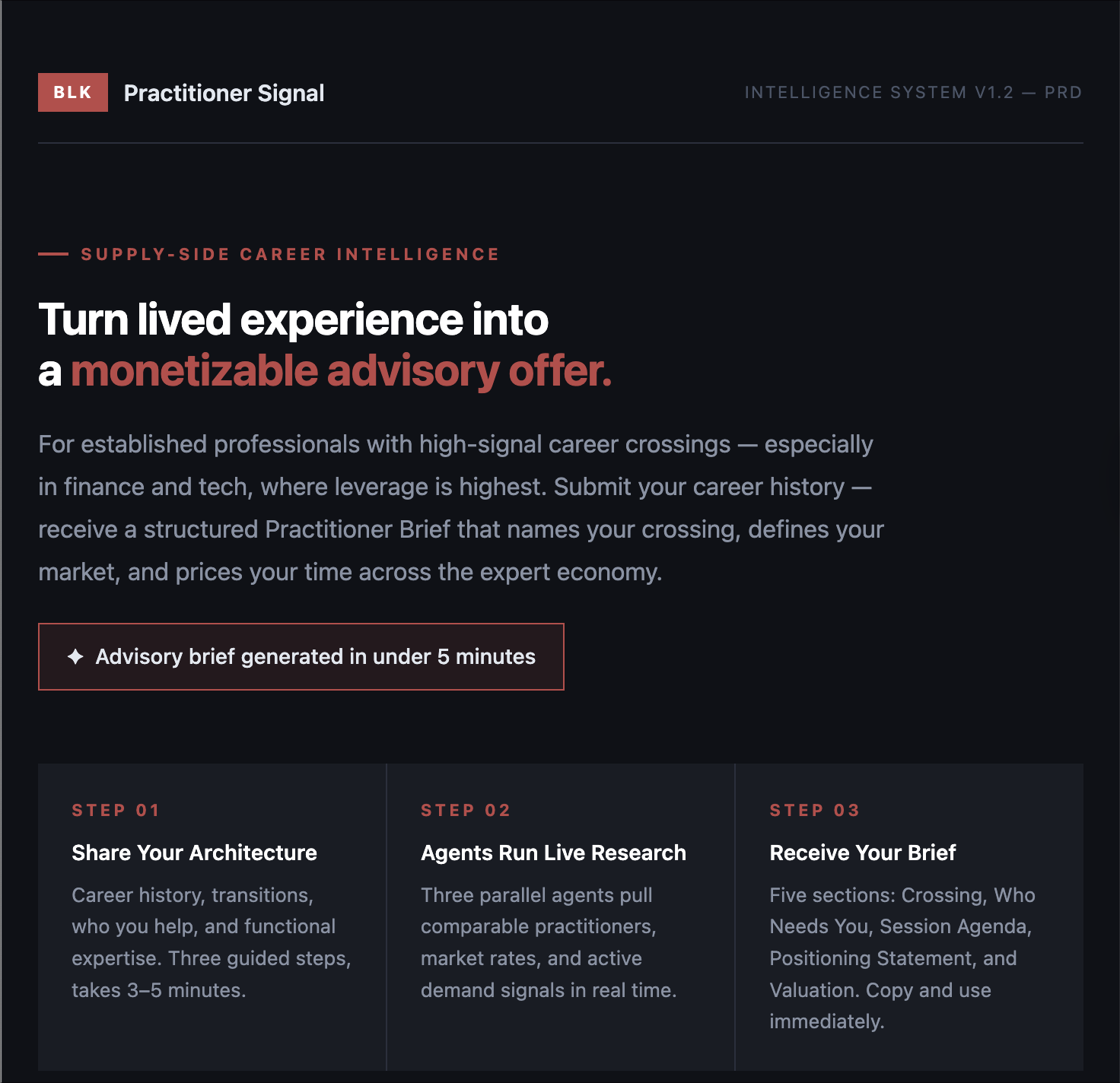
Practitioner Signal takes a professional's career history and key transitions — entered manually or parsed automatically from a resume upload — and runs three parallel AI research agents to benchmark their market position. It then produces a Practitioner Brief: a structured intelligence document that names their crossing (the specific, non-obvious career boundary they crossed), identifies their highest-value audience in three tiers, builds a session agenda for their first advisory engagement, writes a positioning statement ready to use immediately, and generates a two-tier valuation — a community rate for aspirant-facing sessions and a full market rate for institutional and corporate engagements. The brief closes with a marketplace preview card showing exactly how the practitioner would appear to aspirants on The HEN directory.
How we built it
Backend in Python (Flask) with three parallel DuckDuckGo search agents running via concurrent.futures.ThreadPoolExecutor — one pulling comparable practitioners, one benchmarking market rates across expert network fees and fractional executive benchmarks, one reading active demand signals. Results feed into an Anthropic Claude Haiku synthesis call that produces a structured JSON brief. Resume parsing handles PDF via pdfplumber and DOCX via python-docx with graceful fallbacks. The frontend is a single-page multi-step form with expertise chips, tag input, and drag-and-drop resume upload — all in vanilla JS. Deployed on Render via Gunicorn.
Challenges we ran into
Orchestrating three live search agents to run in parallel and feed a single synthesis call reliably — with graceful fallback logic when agents time out — required careful architecture. Prompt engineering to eliminate gender bias in AI output (the system never infers gender from a name under any circumstances) was a deliberate design constraint that required iteration. Building a two-tier valuation schema that serves cost-sensitive aspirants without undermining the practitioner's institutional credibility took several rounds of refinement. Getting resume parsing to produce clean, structured form pre-fill across diverse PDF formats was the most technically unpredictable part of the build.
Accomplishments that we're proud of
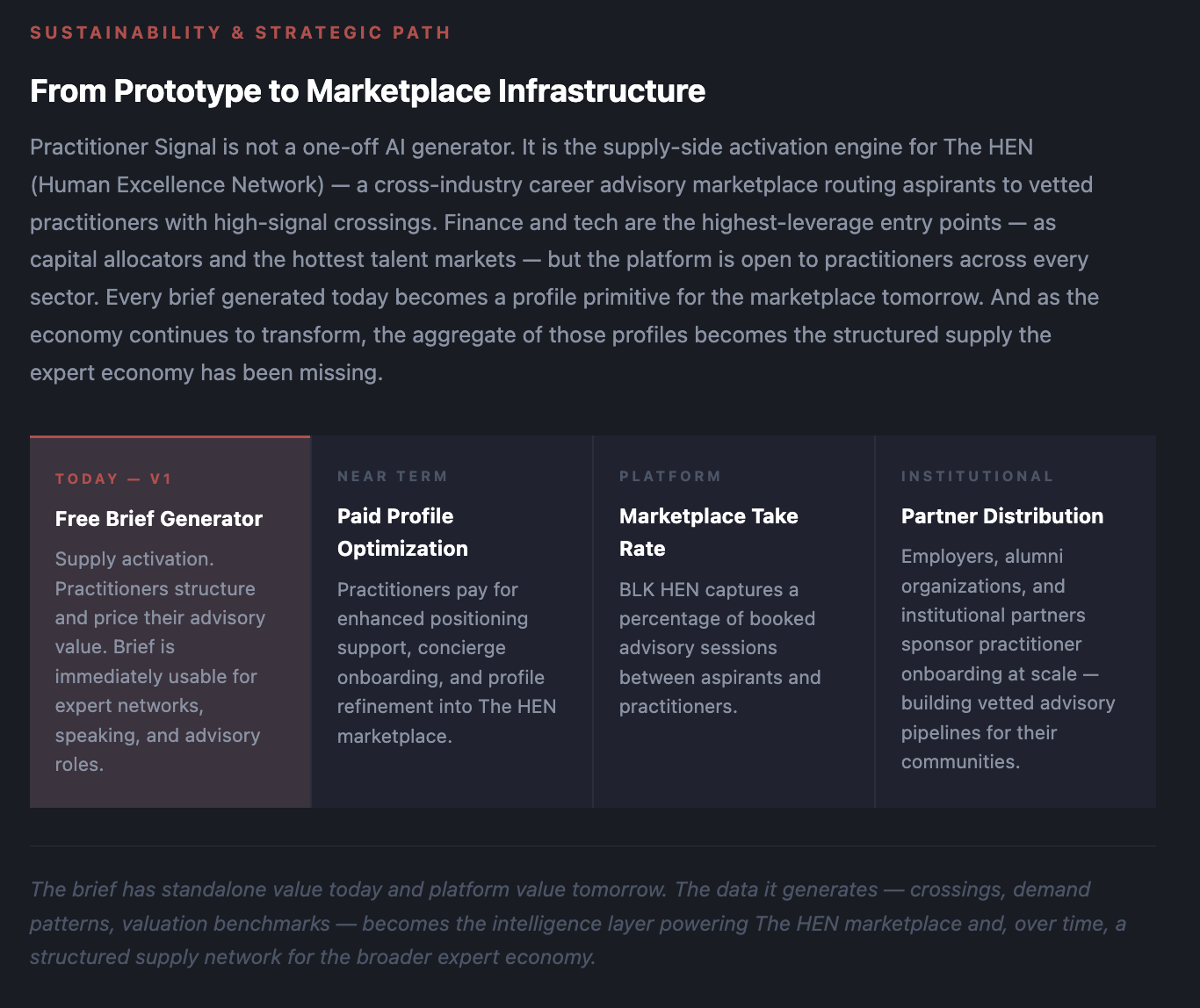
A working, deployed product that generates genuinely useful output in under 60 seconds. The parallel agent architecture running live web research on every submission. A two-tier pricing model that respects both the aspirant's budget and the practitioner's market value. The resume upload flow — drag, parse, auto-fill, generate — is the smoothest part of the experience and came together in one session. Most of all: Practitioner Signal has standalone value today as a tool any professional can use, and platform value tomorrow as the supply-side engine for The HEN marketplace.
What we learned
Prompt engineering is product design. Every decision made at the prompt level — pronoun rules, JSON schema structure, valuation framing, confidence calibration — directly shapes what the user receives. Parallel agent architecture adds real value but requires fail-safe design from the start. The hardest product problem was not technical: it was deciding what the brief should feel like to someone reading it for the first time. Intelligence, not inspiration. A dossier, not a pep talk.
Built With
- anthropic-claude
- claude-haiku
- duckduckgo-search
- flask
- gunicorn
- html
- javascript
- pdfplumber
- python
- python-docx
- render


Log in or sign up for Devpost to join the conversation.