Inspiration
While building an agentic software incubator for our own projects, we found ourselves responsible for reviewing thousands of lines of AI-generated code. Doing this through the standard GitHub PR workflow was painful. The diffs gave us no insight into why the agent had structured the code the way it did, so every review started from zero context.
As we looked into it further, we realized this isn't just our problem. The volume of AI-generated code across the industry has grown dramatically, but the tooling and experience for reviewing it have barely evolved.
What it does
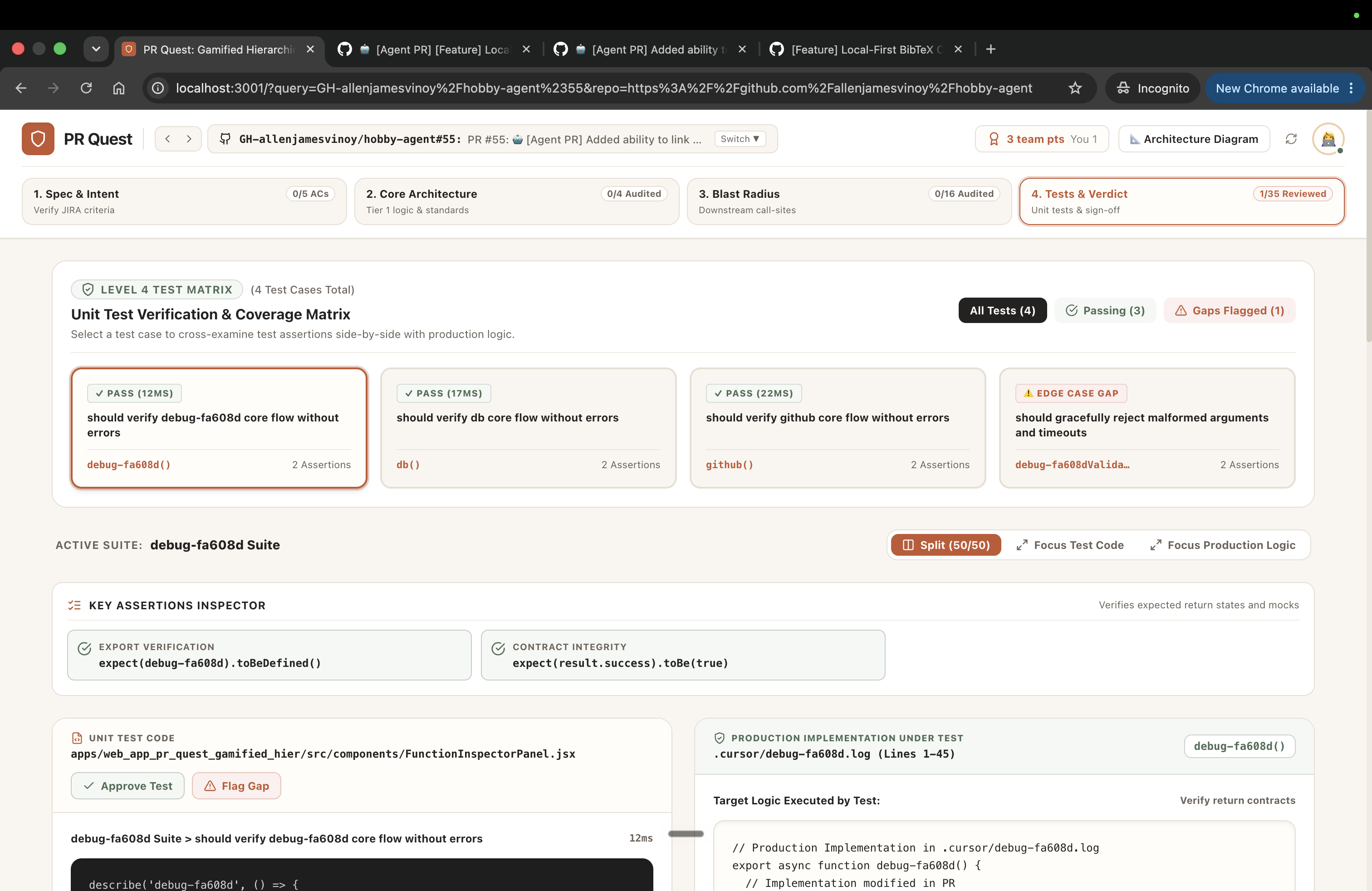
PR Quest is a gamified code review platform that lets a team review a pull request collaboratively and in a distributed way, much like an Agile team working through a sprint. The goal is to reward thoughtful review over rubber-stamping.
Two core mechanics make this work:
Chunked approvals. Large files are split into smaller blocks, and each block is approved individually. This turns a monolithic PR into units that can be divided among reviewers. Time-decayed scoring. Points decay exponentially for approvals made too quickly, so reviewers who rush through code earn less than those who take the time to understand it.
We see this as a new model for how engineering teams can operate when much of their code is written by agents.
How we built it
We designed the review flow around four dimensions we consider essential to a high-quality review:
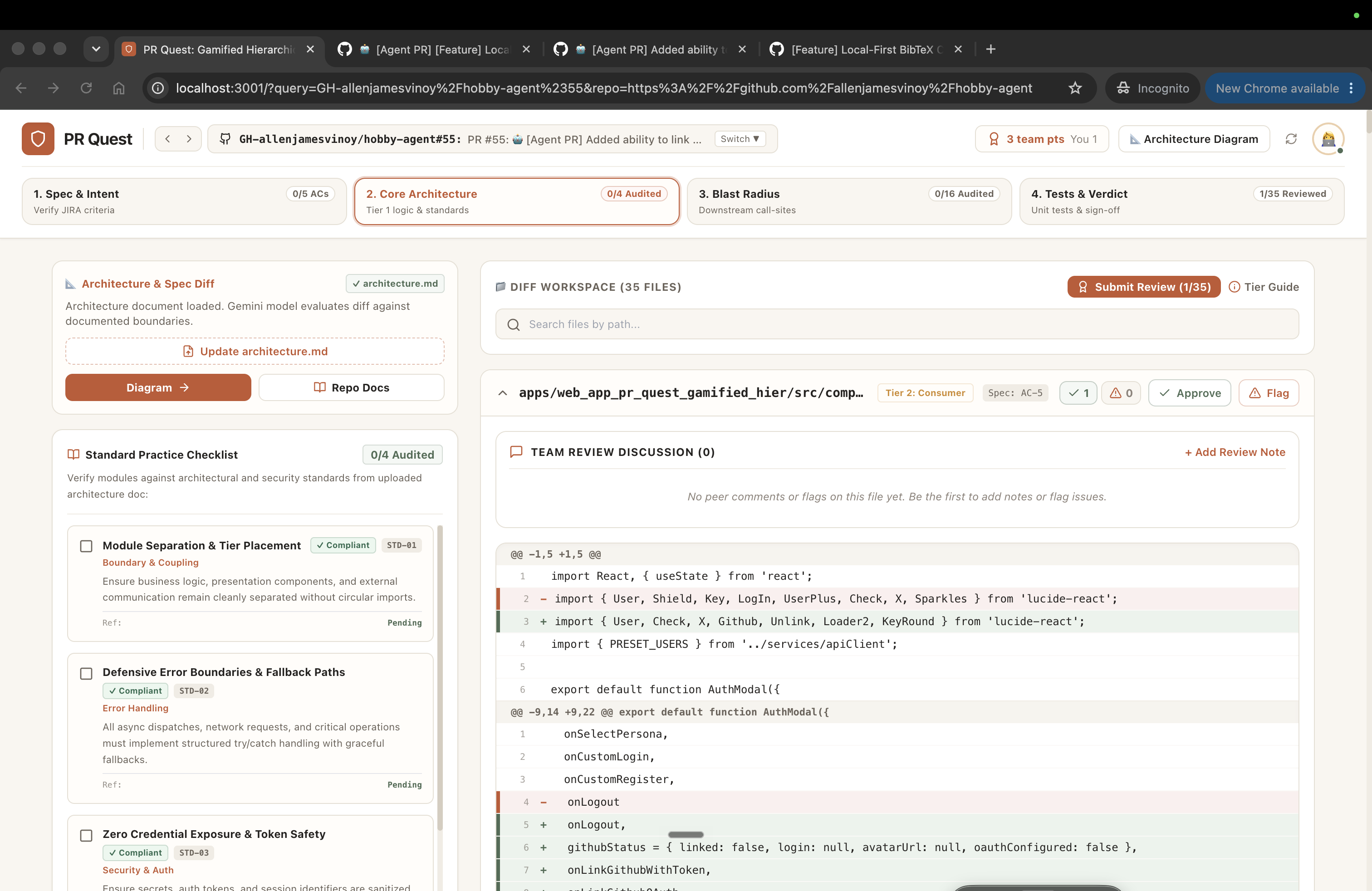
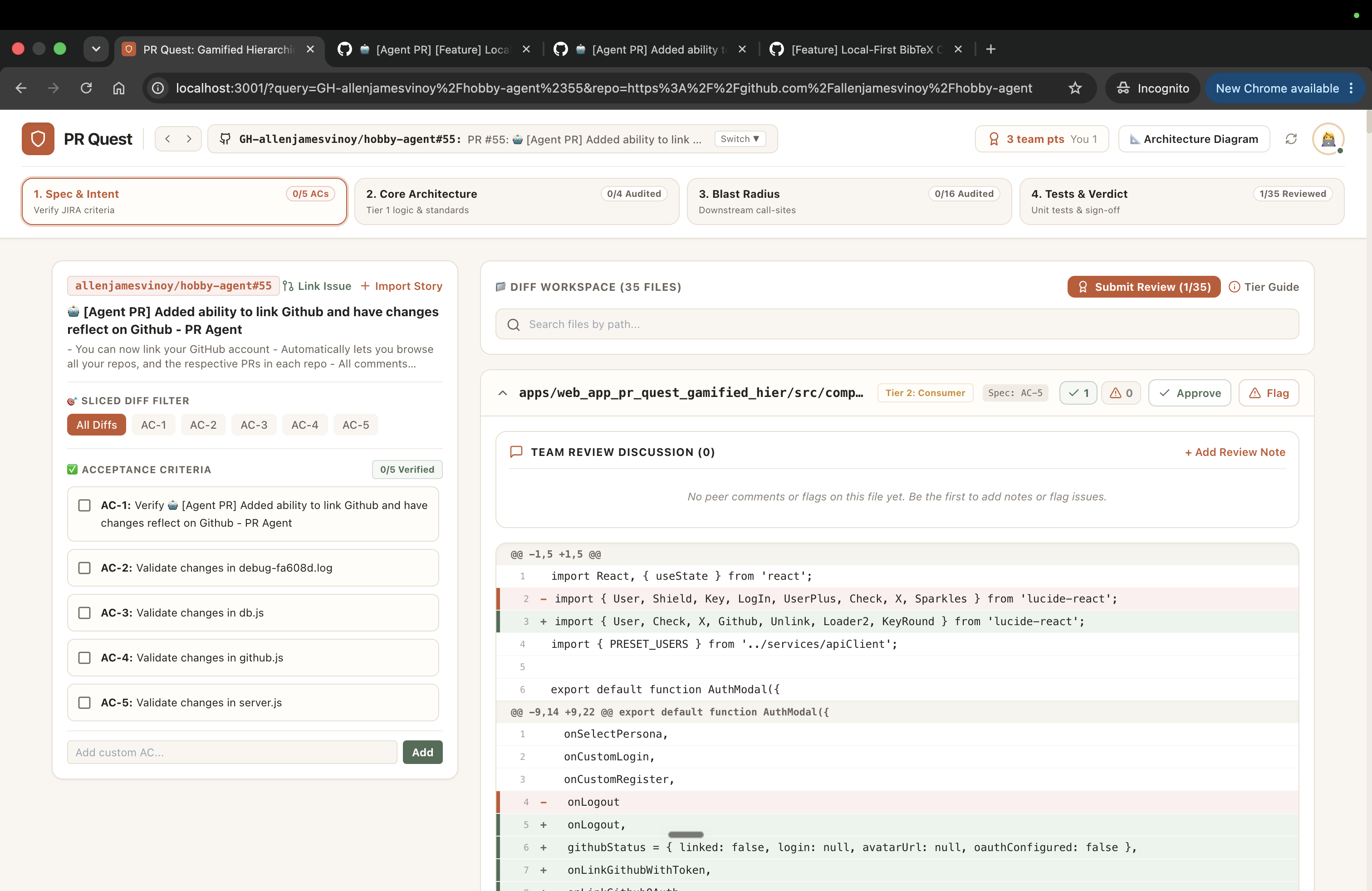
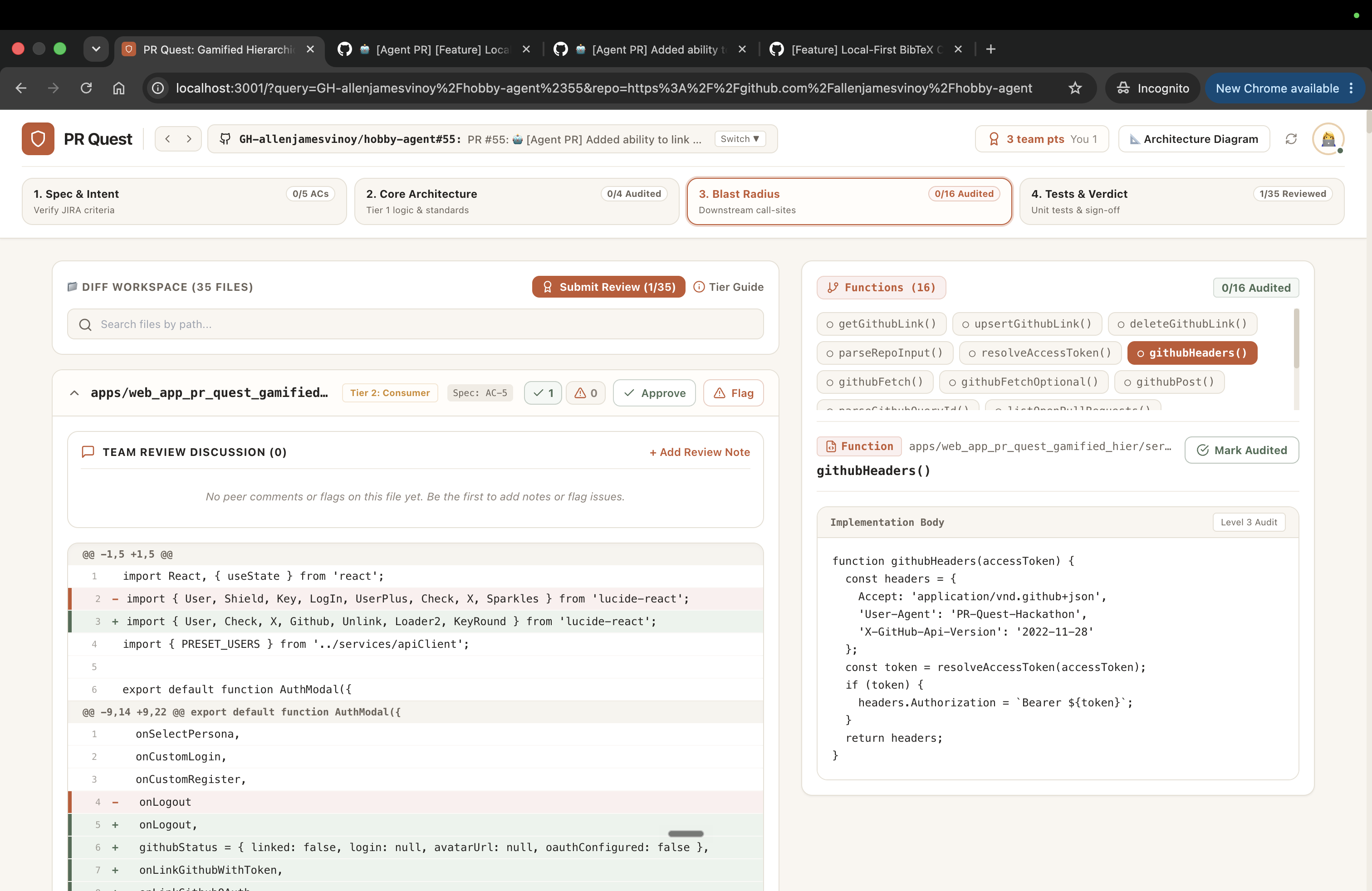
Spec verification. Reviewers check the PR against the requirements in the linked ticket (e.g., Jira) to confirm every acceptance criterion is met. Architectural review. The tool surfaces any structural changes the agent introduced that the team should be aware of. Blast radius analysis. When a function calls, or is called by, newly written code, both are shown side by side. This cross-context view makes it far easier to understand what a change actually touches. Test mapping. Each test is linked to the functional logic it covers, so reviewers can see what is really being tested.
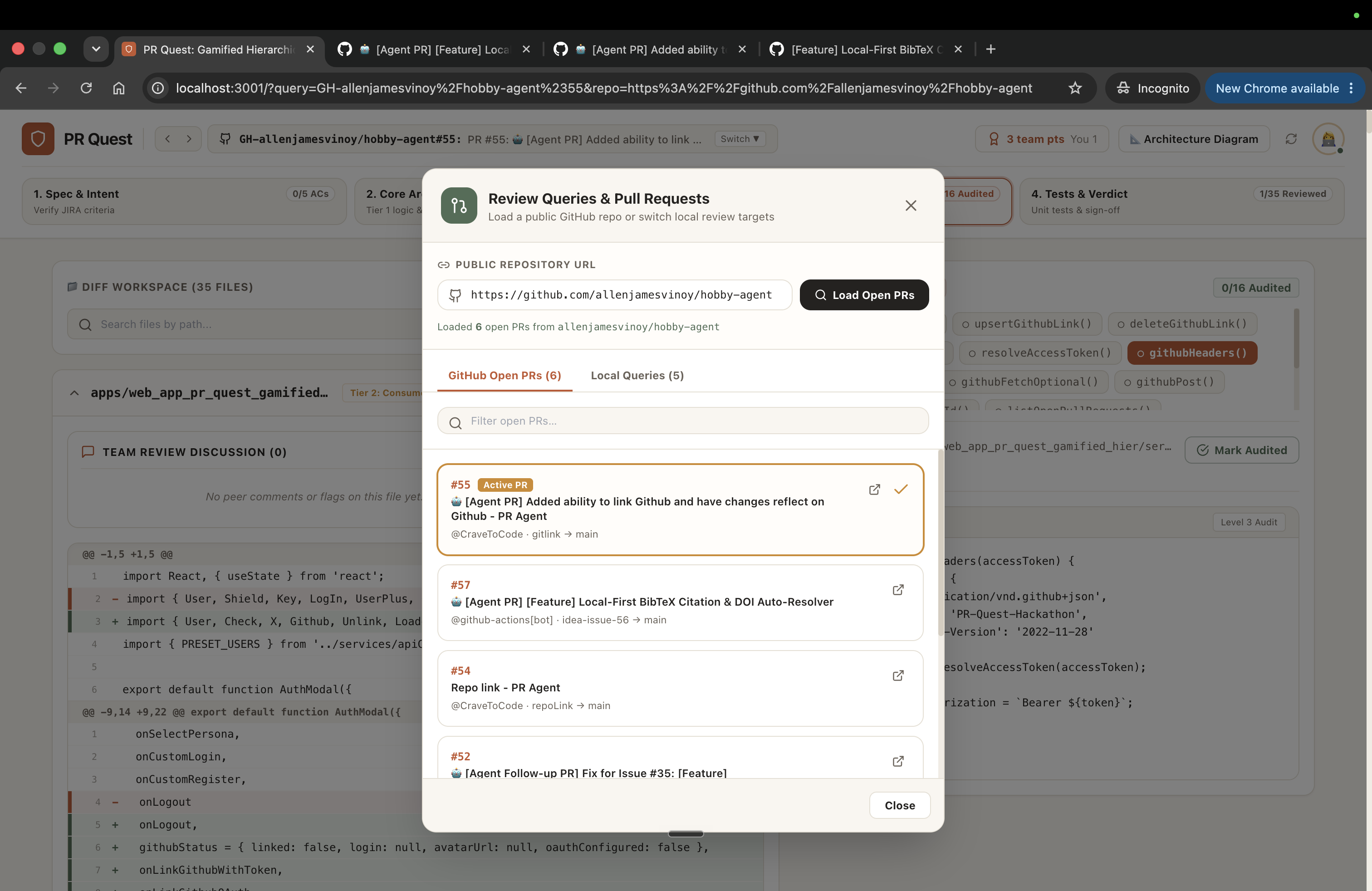
The stack is React and Node.js, with Gemini models powering the AI-assisted parts of the pipeline. When a user submits a PR link, Gemini infers the acceptance criteria from the associated ticket and any relevant architecture.md files. It also maps related functions and tests for the blast radius and test mapping views.
Challenges we ran into
Our biggest challenge was deciding what to gamify and how to define the unit of review. A single approval on an entire PR doesn't lend itself to scoring or to splitting work across a team. We settled on breaking files into smaller approvable chunks, with long files subdivided further. Getting this unit right was the foundation for the entire gamification design.
Accomplishments that we're proud of
We built a working proof of concept that brings together chunked approvals, time-decayed scoring, side-by-side blast radius analysis, and AI-inferred acceptance criteria in a single review experience. Beyond the prototype, we're proud of the vision: rethinking a workflow that is central to how software gets shipped.
What we learned
We learned how to design a product experience from the ground up while using AI tools to move quickly. Rethinking a workflow as established as code review forced us to question assumptions we had always taken for granted, and it pushed us creatively as much as technically.
What's next for PR Quest
Nearly every developer in the world takes part in code review, and as AI-generated code keeps growing, the need for a better review experience will only increase. PR Quest is the first step towards that.

Log in or sign up for Devpost to join the conversation.