-
-
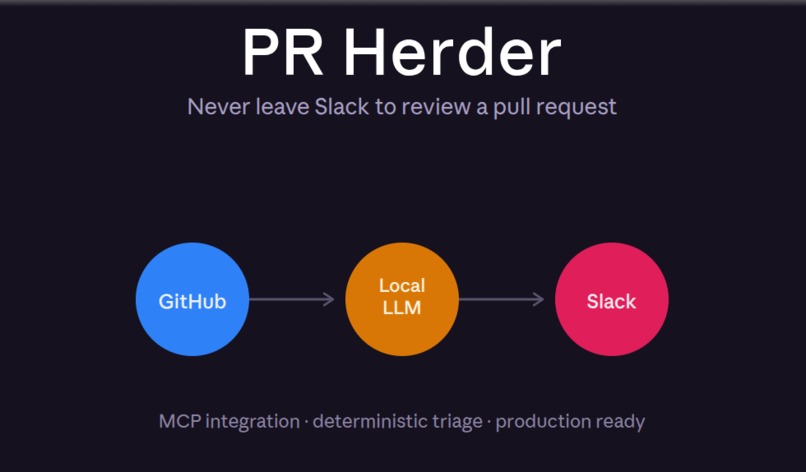
PR Herder — a Slack agent that connects GitHub, a local LLM, and Slack to triage pull requests end to end.
-
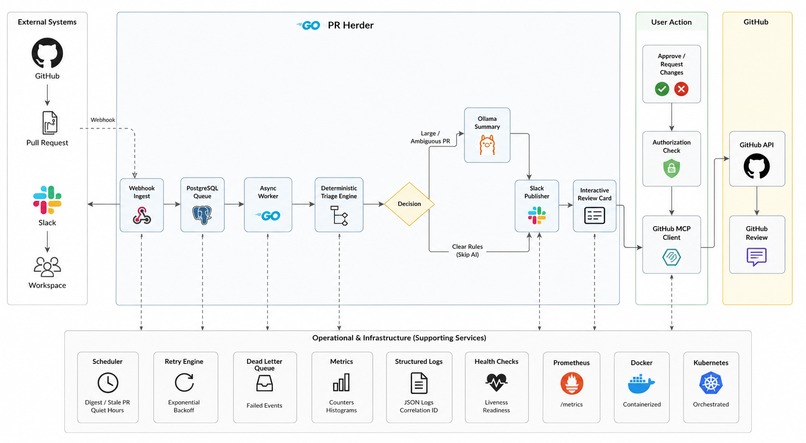
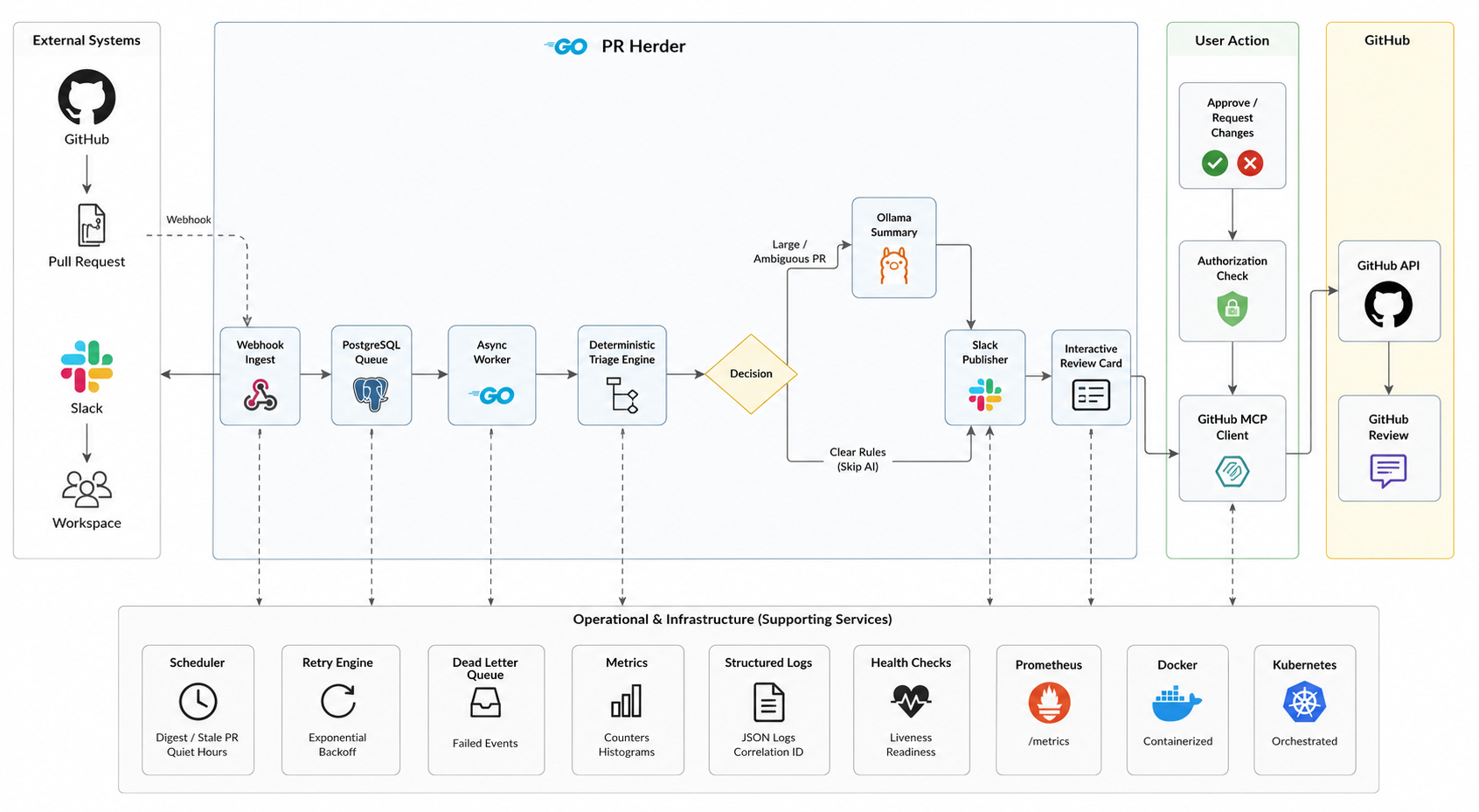
Full architecture: webhook ingest, Postgres queue, deterministic triage, Ollama summaries, Slack, and GitHub MCP execution.
-
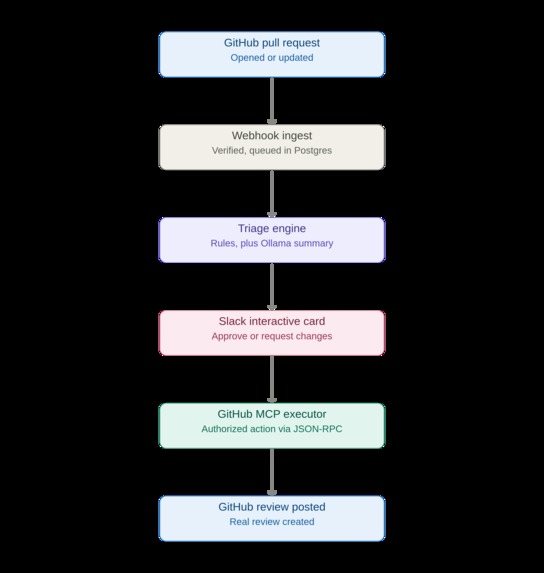
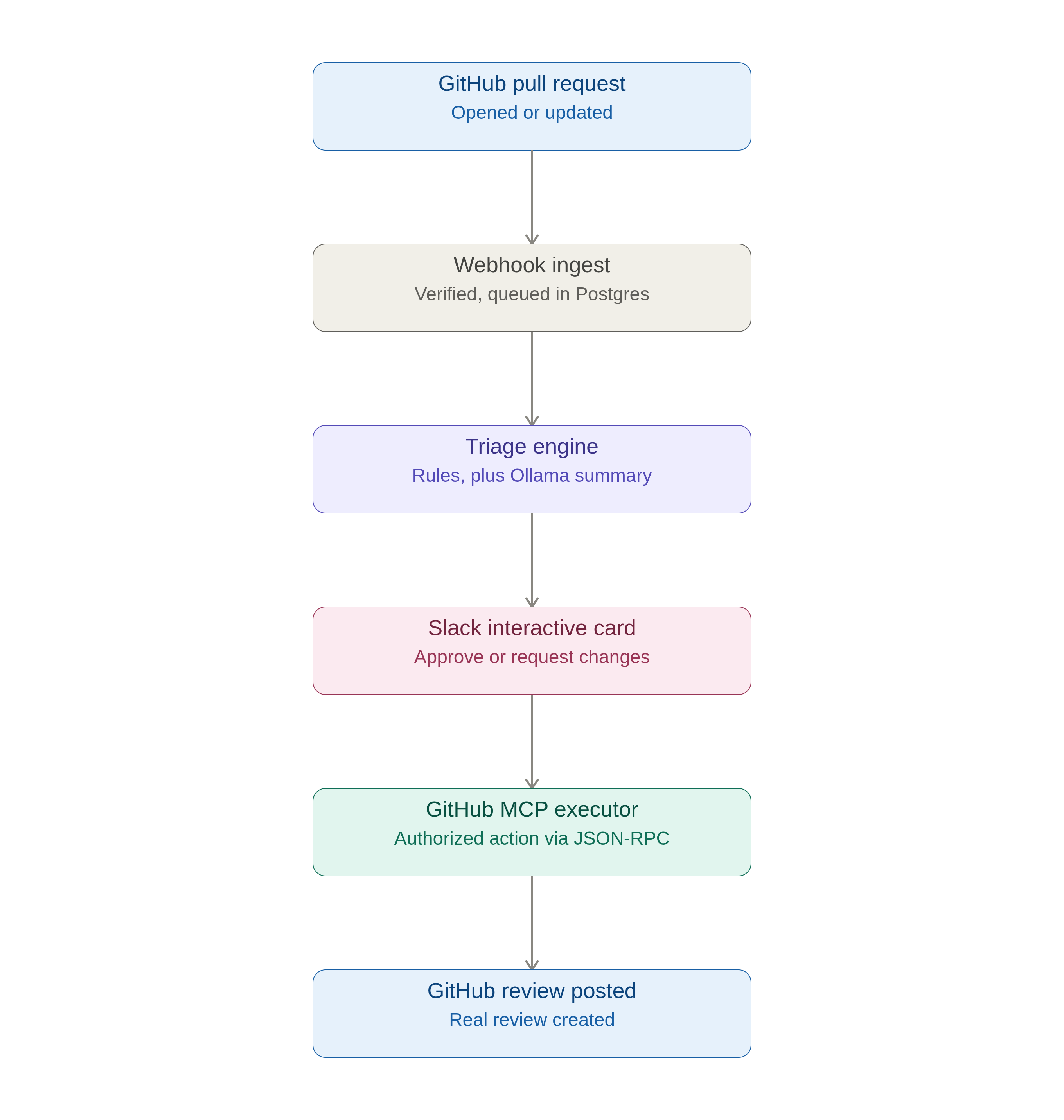
Request flow: a PR triggers triage, an optional local LLM summary, and a real GitHub review via MCP — all from Slack.
-
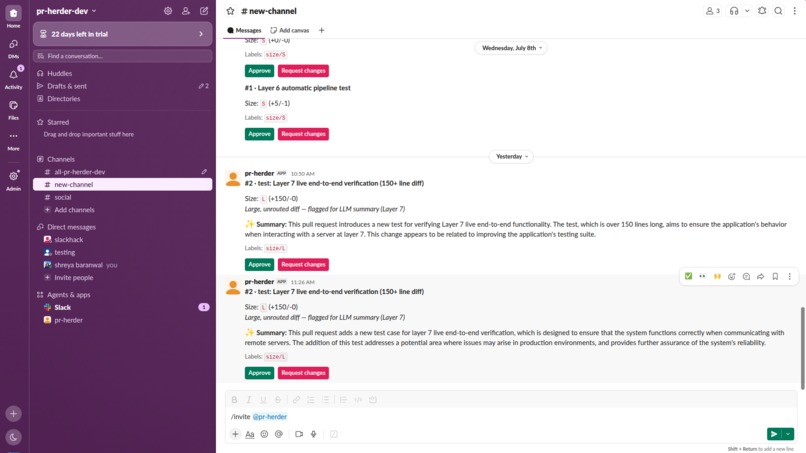
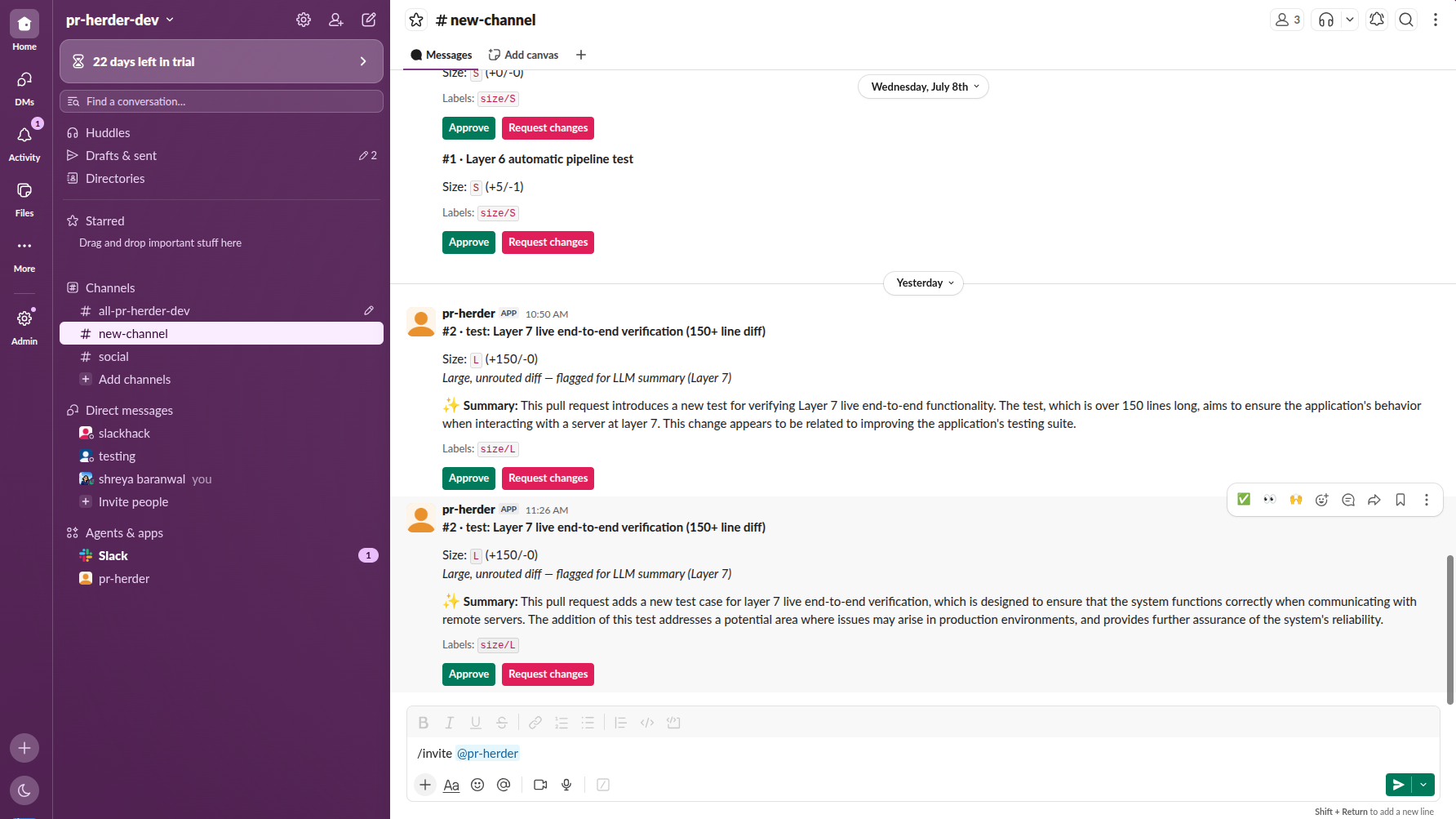
The actual Slack card: size classification, AI summary for ambiguous PRs, and one-click Approve / Request changes.
Inspiration
Every open-source maintainer and busy engineering team loses real time every day tab-switching between GitHub and Slack — checking CI status, re-reading diffs to figure out who should review something, and manually pinging people about pull requests that have gone stale. We wanted to collapse that entire loop into one surface: Slack.
What it does
PR Herder is a Slack agent that watches GitHub pull requests, triages them using deterministic rules, optionally summarizes ambiguous changes with a locally-hosted LLM, and posts an interactive card straight into Slack. Reviewers approve or request changes with a single click — the action executes on GitHub in real time through the official GitHub MCP Server, using JSON-RPC over Server-Sent Events.
It also runs a daily digest of stale pull requests, respecting configured quiet hours so nobody gets pinged overnight.
PR Herder follows a deterministic-first design: rule-based triage always makes the primary decision — routing by sensitive file paths, diff size, and contributor history. The LLM is only ever invoked to summarize a PR the rules couldn't confidently classify — never to route, approve, or decide anything security-relevant. This keeps the system predictable and auditable while still benefiting from AI exactly where it adds value.
How we built it
- Go backend, structured around clean package boundaries (
ingest,triage,slackui,githubmcp,authz,scheduler,llm) - PostgreSQL for idempotent webhook storage and processing state
- Slack Block Kit for the interactive triage cards, verified via HMAC signature checking on every interaction
- GitHub MCP Server integration — a hand-built JSON-RPC 2.0 client over Server-Sent Events, since GitHub's MCP server uses the Streamable HTTP transport rather than plain JSON responses
- Ollama, running a local
llama3.2:3bmodel, for PR summarization — no external API dependency, no billing, no quota limits - Production hardening: exponential-backoff retries on every external call, a dead-letter queue for permanently failing events, Prometheus metrics, structured JSON logging with request correlation, and liveness/readiness health checks
- Deployment: a multi-stage Docker build to a distroless image, plus a full Kubernetes manifest set (Deployment, Service, ConfigMap, Secret template, StatefulSet for Postgres)
Challenges we ran into
- GitHub's MCP server replies using Server-Sent Events framing (
event: message\ndata: {...}) instead of a plain JSON body — we had to parse and strip that framing manually before decoding the JSON-RPC response. - MCP tools are method-based rather than one-tool-per-action —
pull_request_readalone handlesget,get_files, andget_check_runsdepending on themethodargument passed in, which took real trial and error against the live server to discover. - The GitHub collaborator-permission API doesn't include the repo owner in the collaborator list, so our authorization check needed an explicit owner-check fallback before granting action permissions.
- Designing the ambiguity boundary for Layer 7 carefully, so the LLM is a strict enhancement and never a dependency the core pipeline relies on to function.
Accomplishments that we're proud of
- A complete, working GitHub-to-Slack-to-GitHub loop: real webhook in, real triage, real Slack interactivity, real GitHub review out — proven live, end to end.
- A genuinely production-hardened backend: retries, dead-letter queue, Prometheus metrics, health probes, and both Docker and Kubernetes deployment paths — not just a hackathon prototype.
- A local-LLM integration with zero external billing or quota dependency, keeping the whole system self-contained and reliable.
- Clean architectural boundaries that made every layer independently testable, one at a time, without breaking what came before it.
What we learned
- How to build a real MCP client from scratch, including SSE parsing and method-based tool schema discovery.
- How to design a system where AI assistance is additive, never load-bearing — so a model outage degrades gracefully instead of breaking the product.
- Real production-reliability patterns: idempotency via unique delivery IDs, bounded retries with backoff, and dead-lettering instead of infinite retry loops.
What's next
- Multi-repository and GitHub Enterprise support
- Smarter reviewer recommendations based on historical review patterns
- Semantic understanding of code changes beyond diff size and file paths
- Deeper GitHub Checks integration for CI-aware routing
Built With
- docker
- github
- github-mcp-server
- golang
- json-rpc
- kubernetes
- llm
- makerfile
- model-context-protocol
- ollama
- postgresql
- prometheus
- server-sents-events
- slack-api
- slack-block-kit


Log in or sign up for Devpost to join the conversation.