-
-
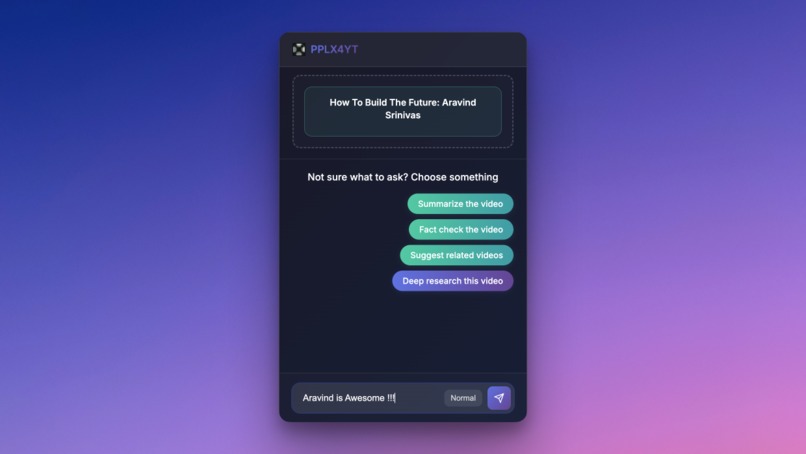
Chrome Extension
Inspiration
YouTube is an unparalleled source of information, education, and tutorials, but it’s also overwhelming. We found ourselves scrubbing through hour-long lectures to find a single answer, pausing and replaying complex tutorials, and, most importantly, questioning the accuracy of what we were learning. The rise of AI-powered search and fact-checking in text inspired us to ask: Why can’t we make YouTube videos just as interactive, searchable, and fact-checked as written content?
At the same time, we noticed Perplexity expanding rapidly across platforms like X (formerly Twitter), WhatsApp, and Telegram. That inspired us to think, what’s the next natural frontier? YouTube.
Given YouTube’s heavy use in critical knowledge domains like medicine, law, and science, we felt it was the perfect candidate to bring real-time AI assistance, fact-checking, and interactive learning to video content. Our goal: turn passive video consumption into a powerful, conversational, and verifiable experience for everyone.
What it does
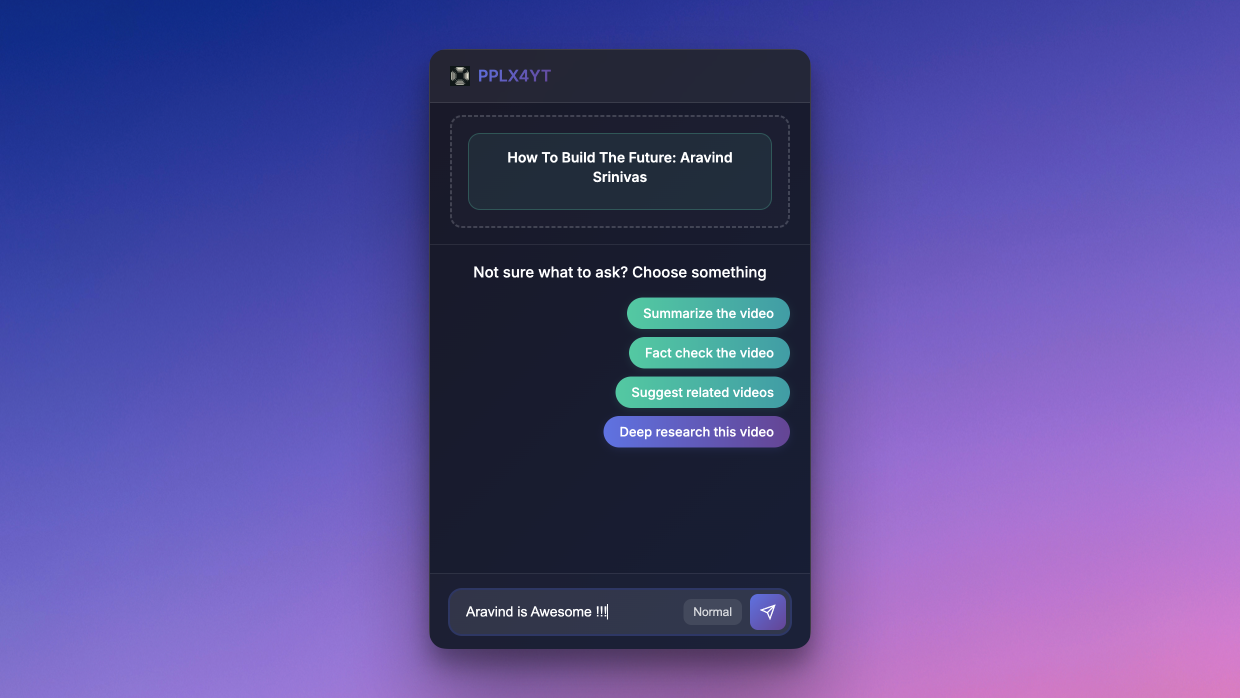
PPLX4YT is a Chrome extension with a Python backend that transforms any YouTube video into an interactive, fact-checked experience. It automatically extracts video transcripts, verifies claims using Perplexity’s Sonar API, and allows users to chat with the content: summarize, ask questions, clarify steps, and check facts, all within the YouTube interface. It works across languages, supports context-aware chat, and backs every answer with sources for easy verification.
How we built it
Frontend: We built a Chrome extension with a dual interface: a quick-access popup for summaries and a sidebar for deep-dive research, both integrated directly into the YouTube interface.
Content Scripts: Scripts detect when a YouTube video is being viewed, extract video metadata, and coordinate with the backend.
Backend: A Python transcript extraction service pulls video transcripts (with multi-language support), caches results, and acts as a reliable fallback if browser extraction fails.
AI Integration: A dedicated service interacts with Perplexity’s Sonar API to provide real-time, fact-verified answers and claim checks.
State Management: A state module manages session persistence, chat history, and context for follow-up questions.
User Experience: We focused on keeping interactions fast, intuitive, and visually rich, including text-to-speech and source visualization.
Challenges we ran into
Transcript Extraction: YouTube’s transcript API is inconsistent. Handling missing, partial, or low-quality transcripts and supporting multiple languages was a major challenge. We solved this with both backend and browser-based extraction and fallback logic.
CORS & API Security: Secure, seamless communication between the browser extension and backend required careful CORS setup and API key management.
Fact Verification at Scale: Ensuring real-time, source-backed answers (without delays) meant optimizing both backend performance and API usage.
UI Integration: Embedding a chat-like, interactive UI into YouTube without interfering with native functionality required extensive testing and iteration.
Multilingual & Global Support: Providing reliable service for users across the world with videos in many languages was both a technical and design challenge.
Accomplishments that we're proud of
Built a real-time, interactive fact-checking tool that works on any YouTube video.
Developed robust, multilingual transcript extraction with fallback systems.
Seamlessly integrated an AI-powered chat into YouTube’s interface, enabling conversational, source-backed learning from any video.
Designed a modular, extensible architecture that can easily support future features (e.g., new AI models, additional video platforms).
Achieved persistent session management and context-aware Q&A with a modern, intuitive UI.
What we learned
The importance of robust fallback mechanisms when working with real-world web data (e.g., YouTube transcript availability varies widely).
UX matters: Users want fact-checking to feel native, not bolted-on, to their viewing experience.
Building across both browser extension and backend services requires careful handling of CORS, permissions, and state management.
AI models and APIs are only as useful as their integration, reliable caching, context tracking, and clear source presentation are key to trust and usability.
What's next for PPLX4YT
YouTube Live & Shorts support: Extend transcript/chat capabilities to live streams and short-form content.
Community features: Allow users to flag questionable content, share fact-checks, and contribute improvements.
User account integration: Personalize chat history and recommendations.
Advanced analytics: Highlight misinformation, summarize video trends, and provide more granular source analysis.
Timestamp based retrieval.
Save and export conversations.
Highlight key moments.
Built With
- css3
- fastapi
- html5
- javascript
- manifestv3
- node.js
- python
- tailwind


Log in or sign up for Devpost to join the conversation.