-
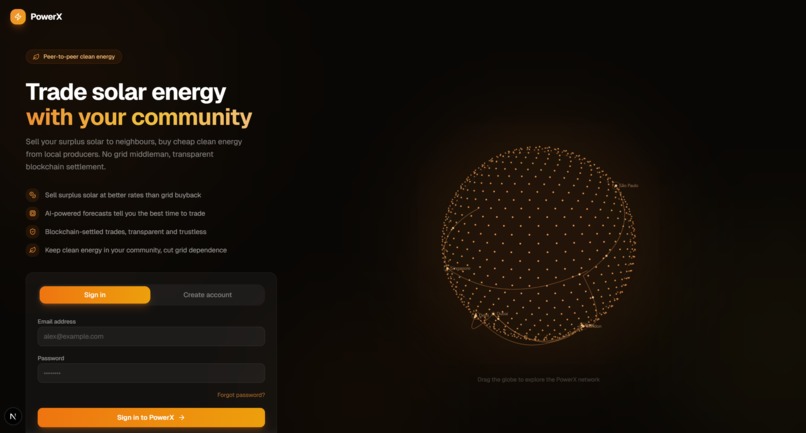
Authentication
-
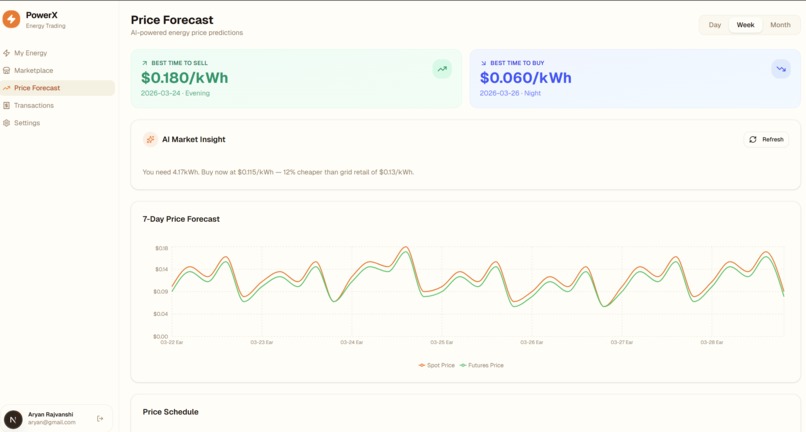
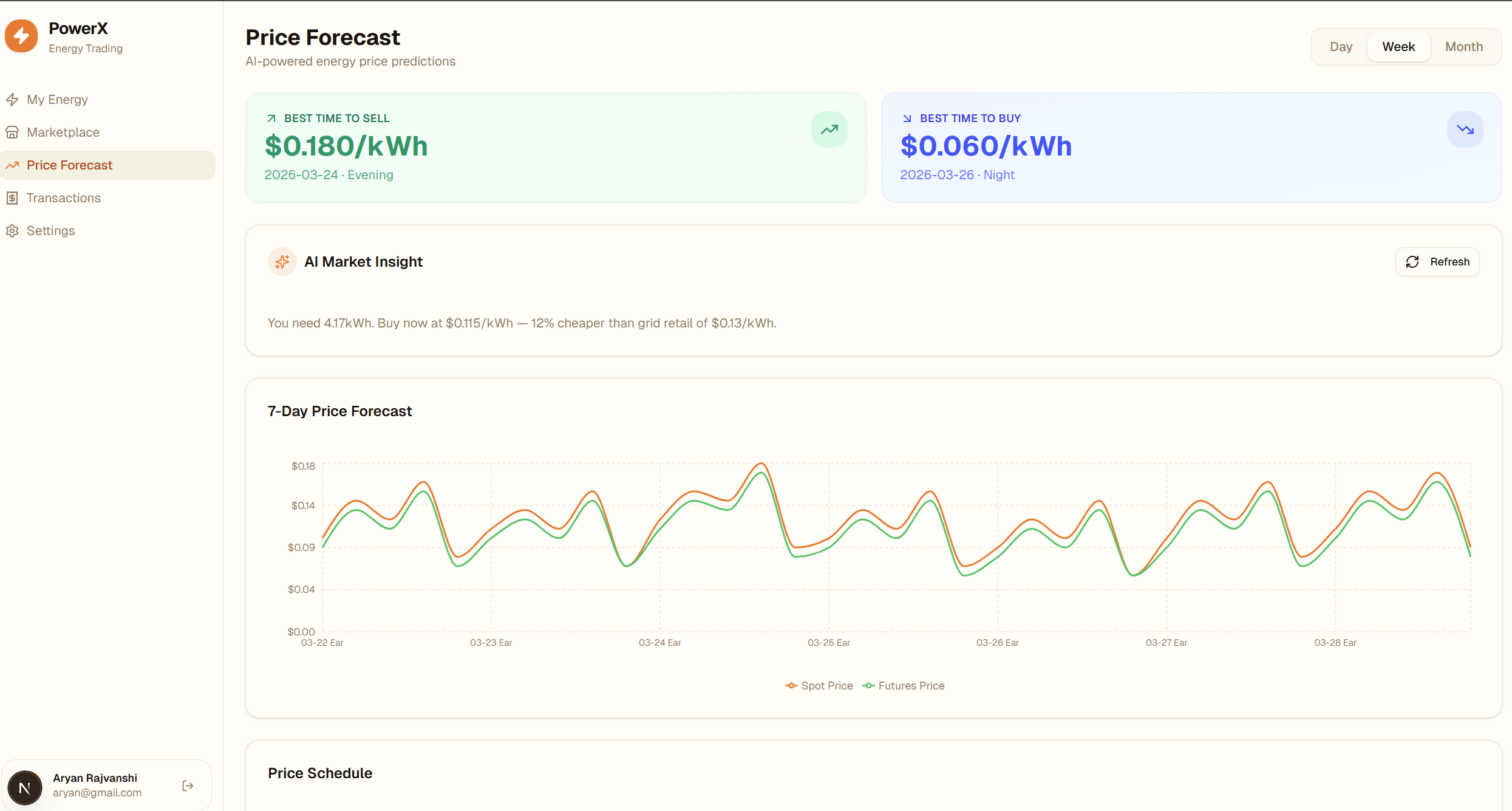
Energy Forecast
-
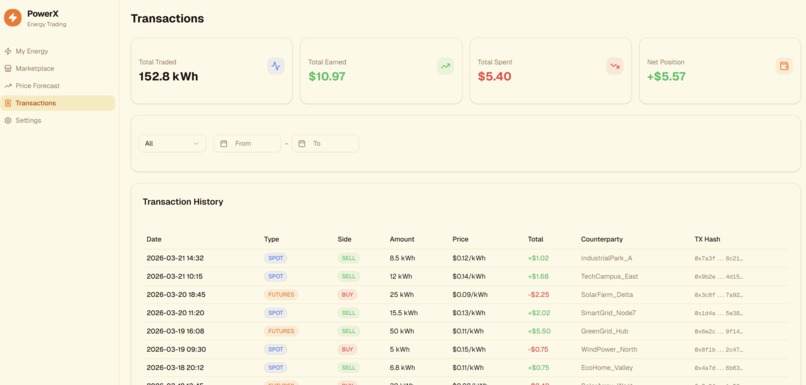
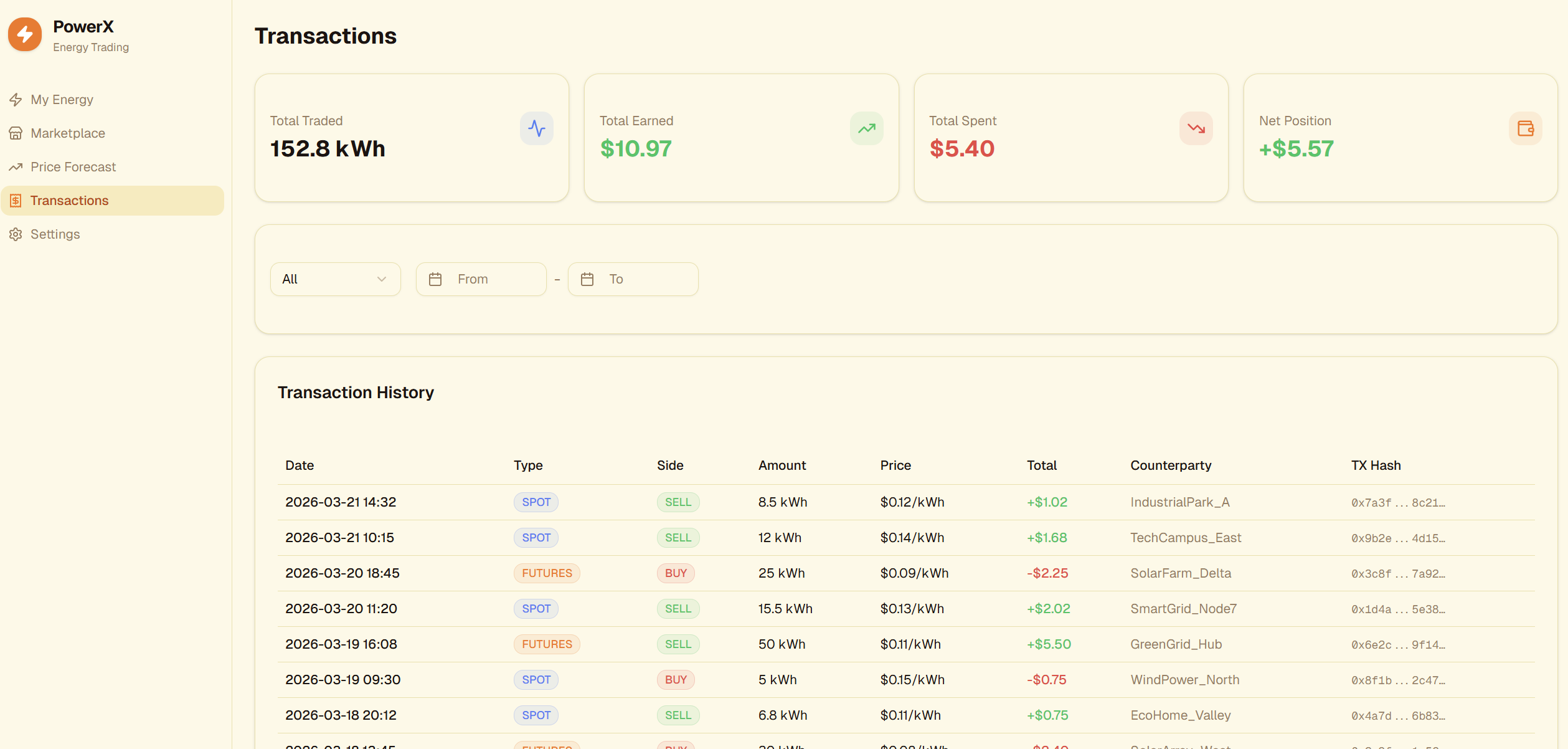
Blockchain Transactions
Inspiration
Our journey began with a focus on farmers, an underserved group living in a cycle of energy extremes. We saw hardworking families facing either crippling energy deficits during harvest or massive waste when their barn-top solar panels overproduced with nowhere to go. When we dug deeper, we uncovered a frustrating disparity: utility companies buy this surplus for 'pennies' only to resell it to the farmer's own neighbor for double the price. We built PowerX to cut out the middleman and keep that value in the community, turning a "waste product" into a peer-to-peer asset that puts the power back into the hands of the people who power our world.
What it does
PowerX is a decentralized energy trading ecosystem that combines AI-driven forecasting with blockchain-backed settlement.
Dynamic Marketplace: Users participate in a Spot Market for immediate needs or a Futures Market to lock in rates based on upcoming weather and energy forecasts.
PredictionAI: A machine learning engine forecasts home energy production and consumption using Random Forest models.
Trustless Settlement: Every trade is settled on the Solana blockchain using a custom kWh token, providing an immutable record of every transaction.
How we built it
We built PowerX as a vertically integrated "Energy OS" that bridges local production data with a global blockchain market. The backend is powered by FastAPI, which serves as the mission control for our custom Order Matching Engine. Since residential energy data is often siloed, we developed a proprietary simulation pipeline using Pandas and NumPy. This allowed us to generate high-fidelity, DOE-standard datasets to train our predictive models, ensuring the platform could function as a "digital twin" of a real-world energy grid.
At the core of our "Predictive Market" are two Random Forest models built with Scikit-learn. These models work in tandem to forecast a household’s net energy position—calculating the delta between predicted solar generation and expected consumption. By projecting these values 24 hours into the future, we enabled a Futures Market where users can lock in trades before the sun even rises.
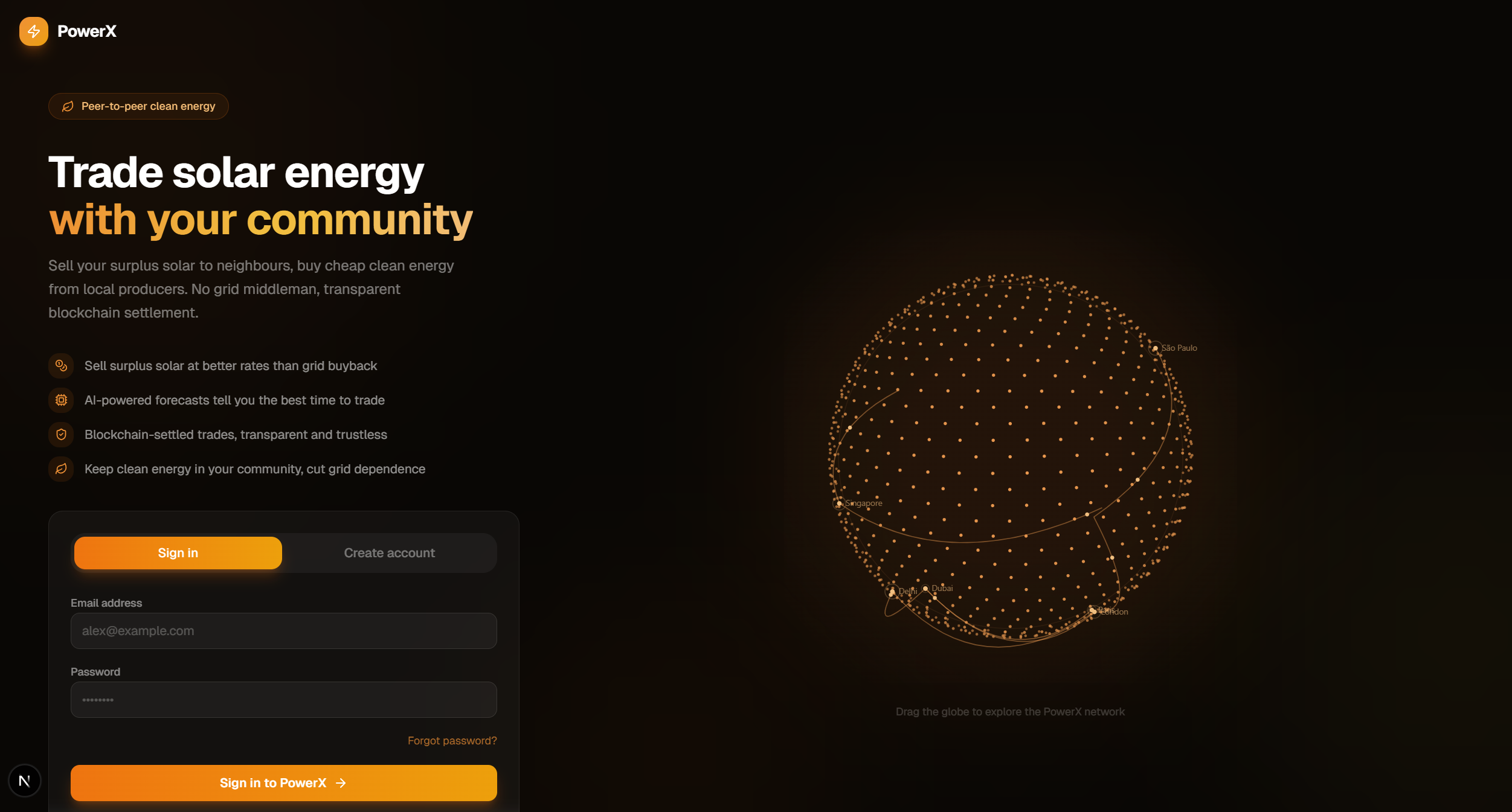
For the settlement layer, we chose Solana for its sub-penny transaction costs and high throughput. Using the Anchor framework and the Token2022 standard, we minted a custom kWh token. Every time a trade is matched by our backend, it triggers an on-chain settlement, providing an immutable ledger of every watt traded. We wrapped the entire experience in a Next.js 16 frontend, featuring a custom HTML5 Canvas interactive globe that visualizes these peer-to-peer flows across the community
Challenges we ran into
The hardest part was timing. Energy isn't like a stock; it’s produced and consumed in specific windows. Building a matching engine that could handle a trade happening now (Spot) while also managing a trade scheduled for tomorrow (Future) without double-counting the energy was a massive headache. We had to build a custom state machine to keep the database and the predictive models in sync.
We also hit a wall with data access. Real-time IoT data from solar inverters is usually locked behind expensive corporate paywalls or restrictive APIs. Since we couldn't get the live hardware access we wanted, we took a different route: we used Department of Energy (DOE) physics-based simulations to model household energy usage. We spent a lot of time engineering these simulations to account for real-world variables like roof pitch, panel efficiency, and household consumption patterns just to get our Random Forest models to a point where they actually felt realistic.
Finally, we had to balance blockchain speed vs. UX. Even though Solana is fast, you can't realistically send an on-chain transaction for every tiny micro-match without the UI feeling laggy. We solved this with a hybrid approach: matching the trades instantly off-chain and then batching them for Token2022 settlement so the app stays snappy while the ledger stays permanent.
Accomplishments that we're proud of
We’re most proud of developing a concept that doesn't just work for suburbs, but could actually empower rural microgrids and farms. Proving that a farmer can turn their "waste product" into a community asset is a massive win for us. We also managed to build a fully functional Futures Market: a complex system that lets users lock in energy trades 24 hours in advance. Finally, we’re proud of our custom data visualization engine; we built a high-performance dashboard that maps out production vs. consumption in real-time, making a complex energy grid feel simple and intuitive for any user.
What we learned
We learned that the "Smart Grid" for energy isn't about better hardware, but fair incentives. By lowering the barrier to entry for energy trading with a simple, accessible interface, we realized we could significantly increase the ROI for residential and agricultural solar. On the technical side, we got a crash course in figuring out how to sync predicted energy supply with real-time market demand without losing data integrity. We also walked away with deep experience in the Solana Token2022 ecosystem and how to handle high-frequency trading on a public ledger.
What's next for PowerX
We aren't just building a prototype; we’re building the infrastructure for a decentralized grid on Solana. Our next step is moving the entire matching engine into Anchor smart contracts. This means the blockchain won't just record the trades, it will actually run the market logic in a fully decentralized way.
We also plan to use Solana’s Token Extensions (Token2022) to handle the complex parts of energy trading. We want to use Transfer Hooks to make sure every trade follows local grid rules automatically and Permanent Delegation so that smart meters can trade energy on their own without the user having to click "confirm" every time. By moving from simulations to real hardware like Tesla Powerwalls, we want to leverage Solana's fast and cheap network to power a global, peer-to-peer electrical grid.
Built With
- anchor
- blockchain
- devnet
- fastapi
- javascript
- postgresql
- prediction-markets
- python
- railway
- recharts
- rust
- scikit-learn
- shadcn/ui
- solana
- sql
- supabase
- tailwind
- typescript

Log in or sign up for Devpost to join the conversation.