-
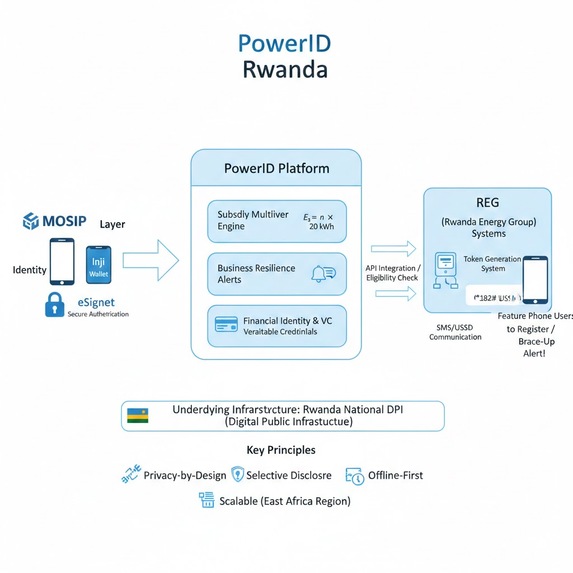
Architecture: it links MOSIP identity with REG energy systems. Using Inji Wallet, users authenticate via DPI.
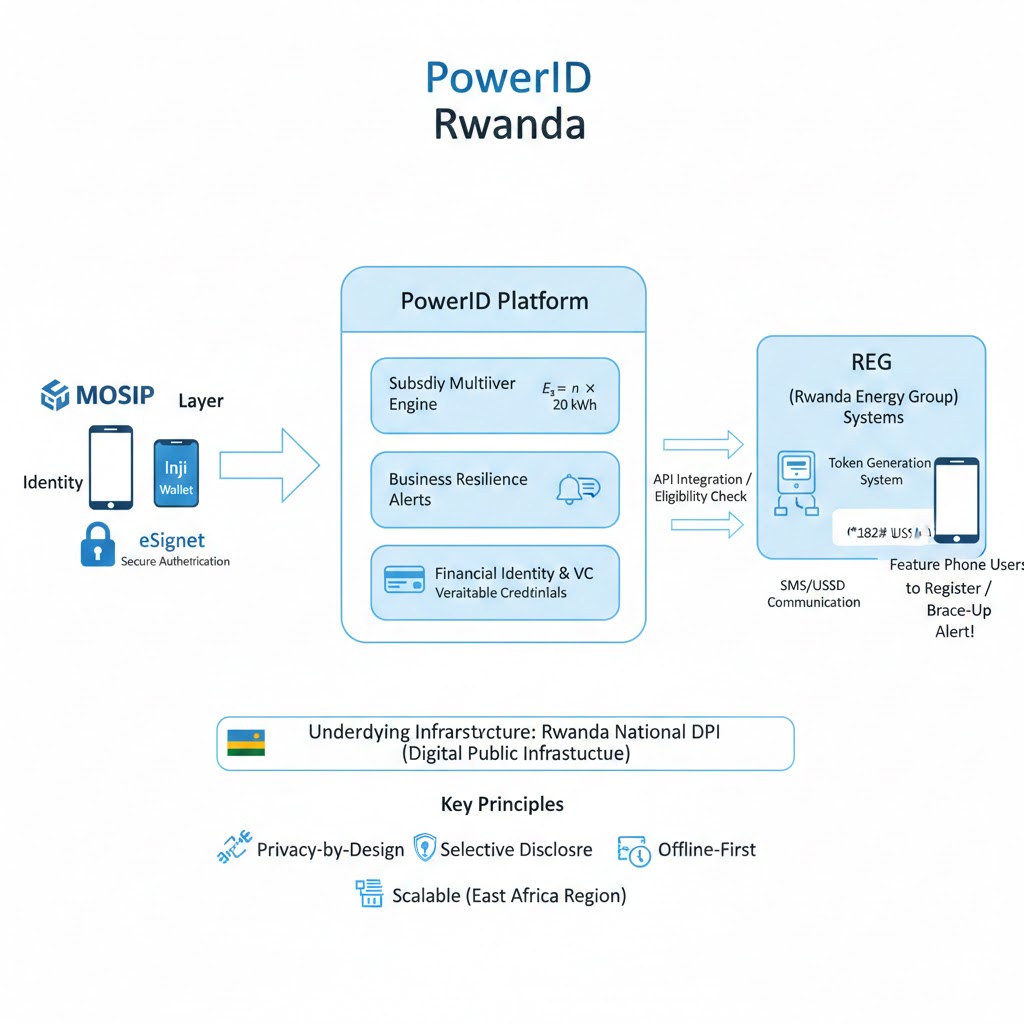
Inspiration
Our project started with a "bill shock" in October 2025. My roommates and I saw our monthly electricity cost jump from 15,000 Frw to over 60,000 Frw. We discovered the "Shared Meter Trap": because we share one meter, the system treats four students as one "wealthy" user, charging us luxury rates for basic survival. We realized the grid is "Human-Blind"—it sees a meter box, but not the people. We built PowerID to give the grid eyes using MOSIP.
What it does
PowerID Rwanda links National Digital IDs to electricity meters to ensure fair pricing and economic protection:
- Dynamic Subsidies: It multiplies government discounts by the number of verified residents on a meter.
- Business Resilience: It sends "Brace-Up" SMS alerts to small businesses 10 minutes before power outages to prevent equipment damage.
- Financial Inclusion: It turns utility payment history into a Verifiable Credential (VC) for bank loans.
How we built it
We are still on the ideation phase and this is how we plan to build this. We focused on the "African Reality"—no smartphones required.
- Identity Layer: Integrated with MOSIP eSignet for secure authentication.
- Logic Engine: We developed a "Subsidy Multiplier." If $n$ is the number of verified residents, the subsidized threshold ($E_s$) is: $$E_s = n \times 20\text{ kWh}$$
- Interface: Built a USSD gateway simulation for feature-phone compatibility.
Challenges we might run into
The biggest hurdle might be the "Identity Integrity." We have to ensure a user cannot claim subsidies on multiple meters. We will leverage MOSIP’s unique identity tokens; a user automatically gets "checked out" of one property before they can unlock discounts at a new one.
Accomplishments that we're proud of
PowerID architecture which links MOSIP identity with REG energy systems. Using Inji Wallet, users authenticate via Rwanda’s DPI. The platform’s engine calculates subsidies ($E_s = n \times 20 \text{ kWh}$) and issues Verifiable Credentials. API integration then triggers token generation via SMS/USSD for accessibility.
What we learned
We learned that Digital ID is the missing link in the energy transition. You cannot have a "Smart Grid" if the grid cannot see the humans it serves.
What's next for PowerID
We plan to pilot PowerID in high-density neighborhoods like Kimironko and expand across the East African Community (EAC) so that subsidies follow the person, not the property.

Log in or sign up for Devpost to join the conversation.