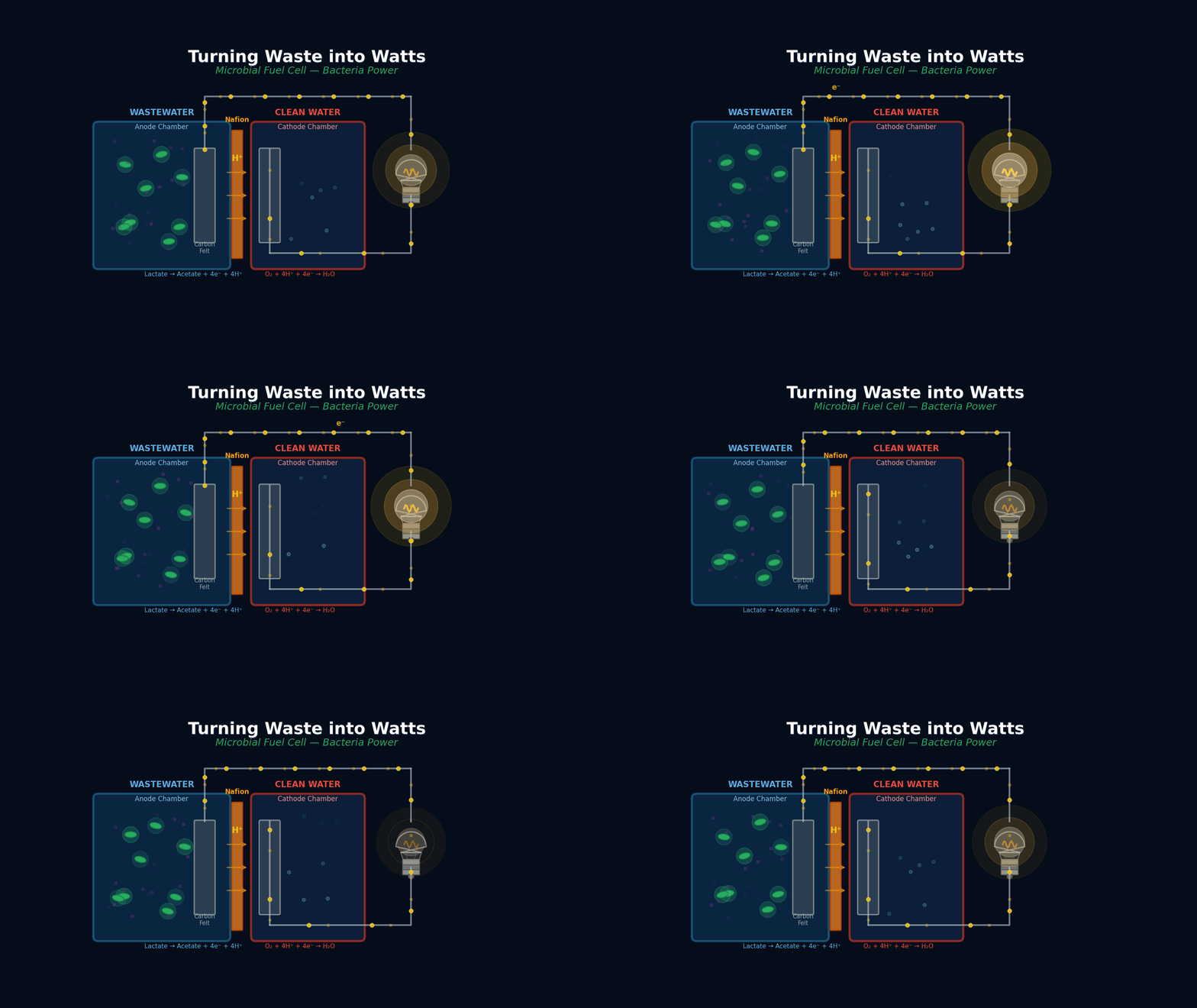
Inspiration 700 million people in Sub-Saharan Africa lack basic sanitation. Remote Indigenous communities in northern Canada pay ten times the urban electricity price just to run diesel generators. Wastewater treatment—something we take for granted—consumes 3% of all electricity on Earth and releases 342 million tonnes of CO₂ annually. That's equal to the entire carbon footprint of France.
But here's what struck us: the organic "waste" in that water isn't waste at all. It holds enough chemical energy to power itself. Microbial Fuel Cells—devices where bacteria eat pollution and produce electricity—could turn wastewater from a climate problem into a climate solution. We wanted to build a tool that lets anyone design these systems without expensive software or months of lab work, so this technology reaches the communities that need it most.
What we learned The science surprised us. Bacteria can transfer electrons directly through their cell membranes to an electrode. No chemicals added, no moving parts. Just biology doing what it does best. We read 7 published research papers and discovered that everything is connected: the type of bacteria, the electrode material, the membrane size, and the nutrient concentration—change one thing and the whole system shifts. We also learned that more bacteria doesn't always mean more power. Past a certain density, nutrients run out and cells start dying. Our simulator captures all of these real-world dynamics.
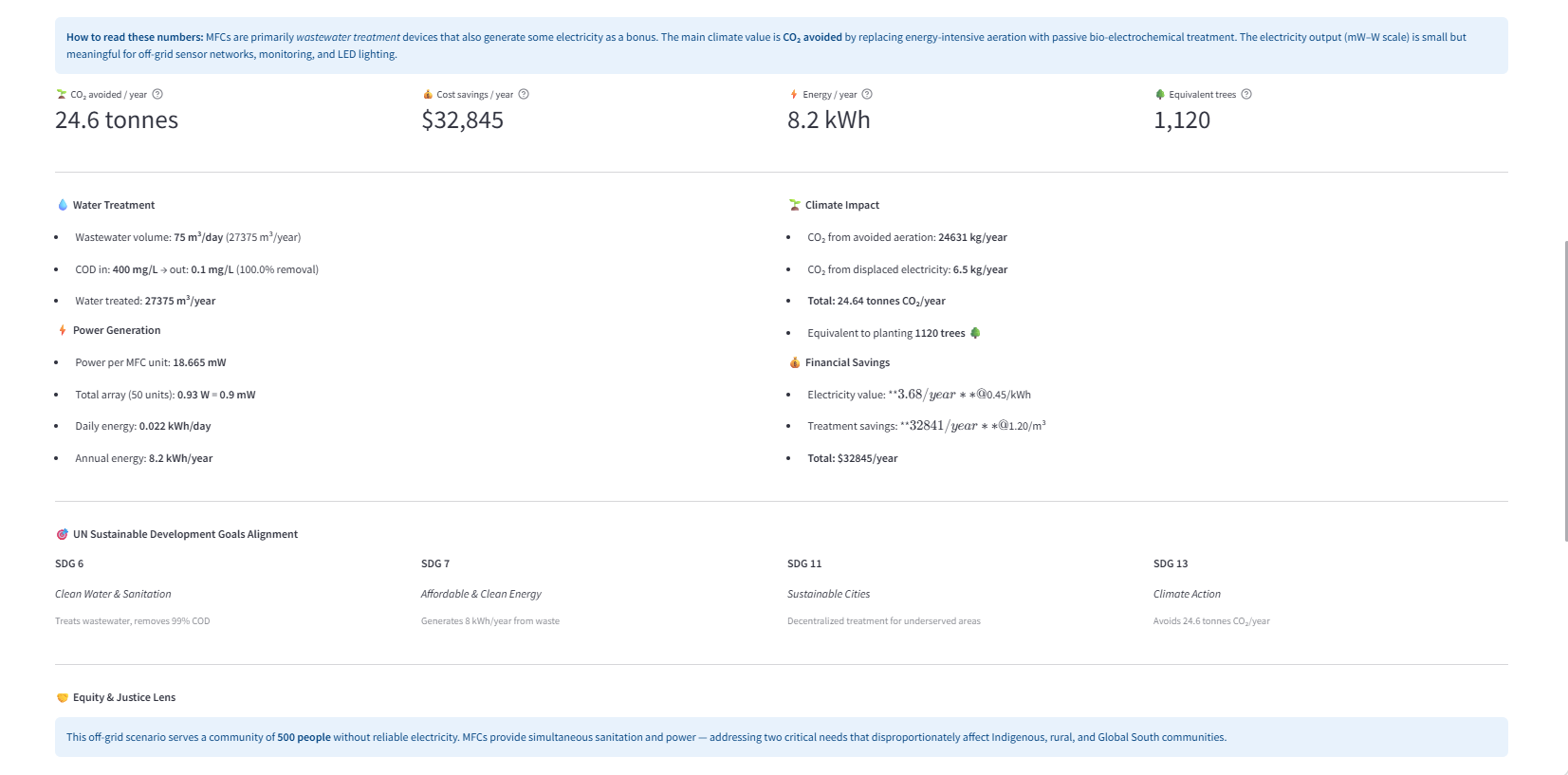
What matters most is what this means for people. For a rural community of 500, our model shows MFCs could avoid 24 tonnes of CO₂ per year and save $32,000 in treatment costs—money that stays in the community instead of being spent on diesel fuel and chemical treatment.
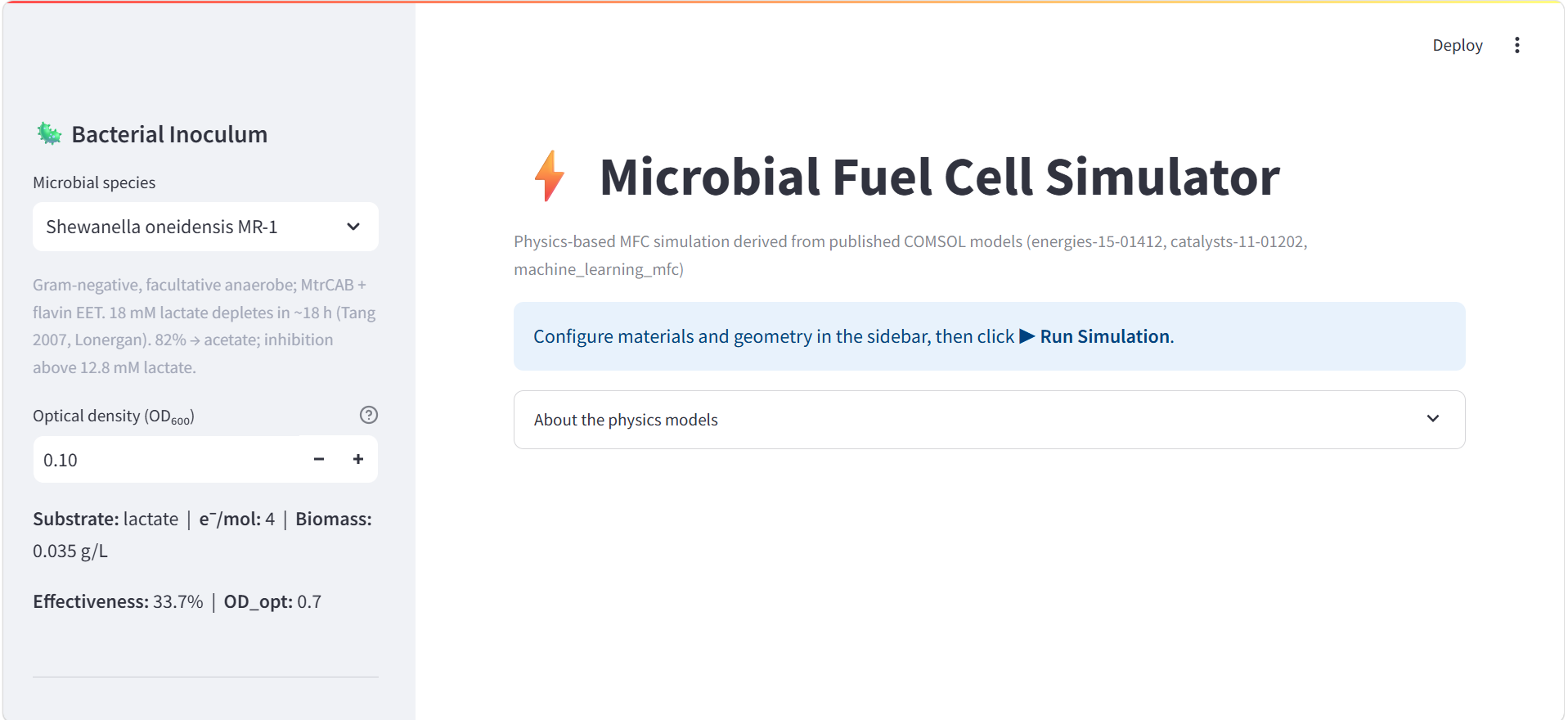
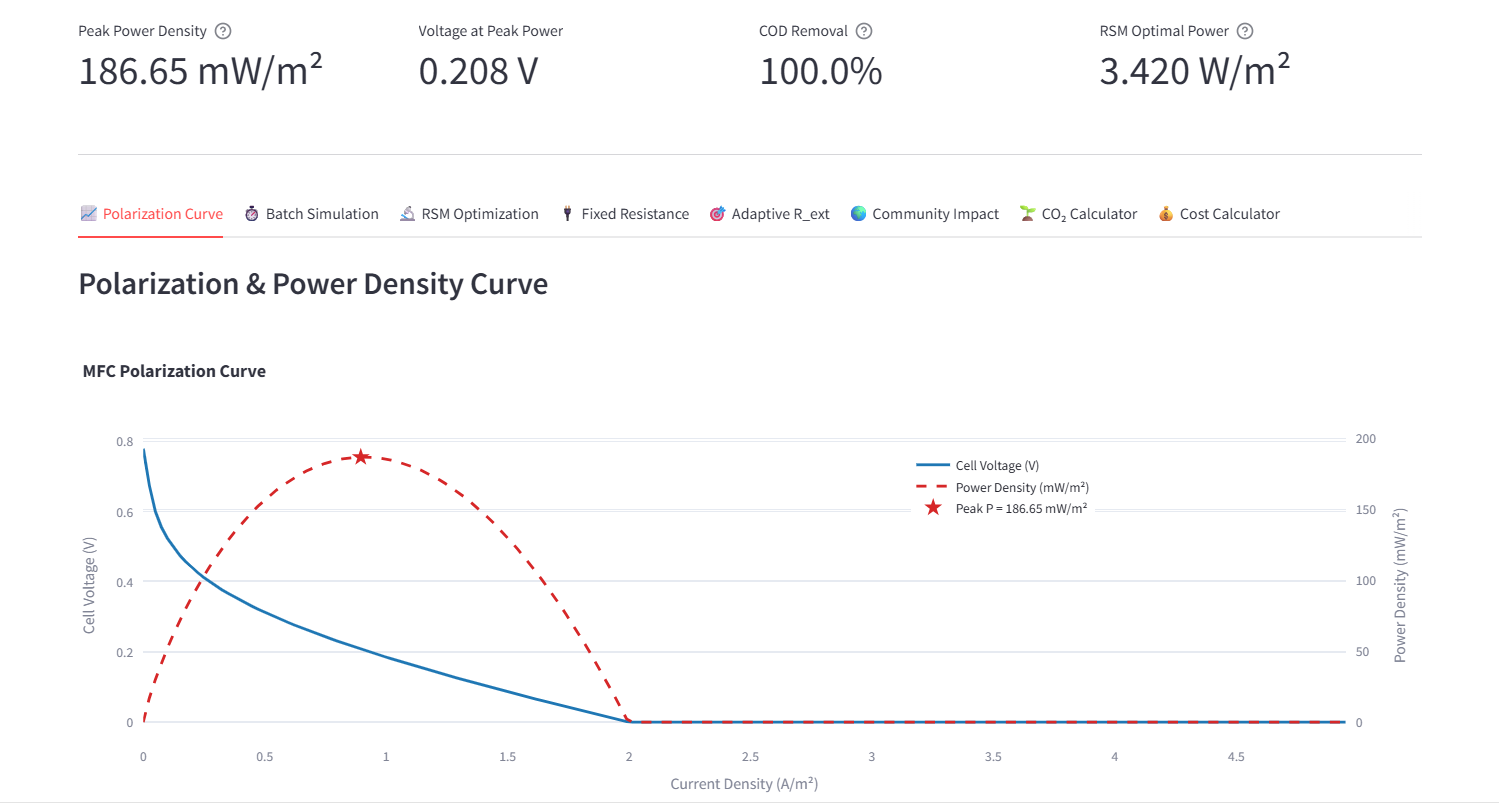
How we built it We built a web app that anyone can open in a browser—no installation, no license fees, no coding required. You pick your materials, set your geometry, choose a bacterial species, and click "Run." In 30 seconds, you get interactive charts showing voltage, power, substrate depletion, and CO₂ savings.
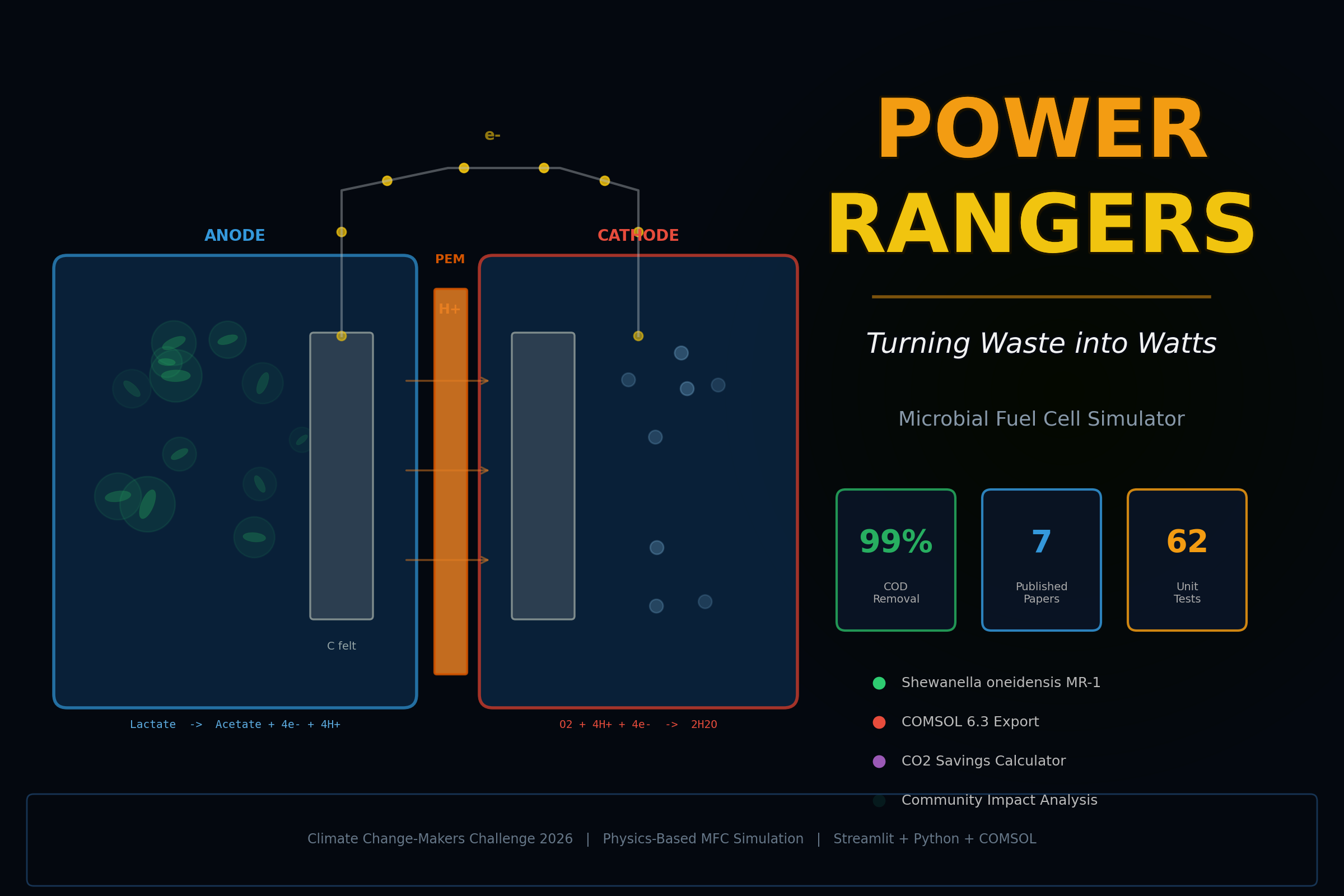
Behind the scenes, we wrote 8 Python modules covering everything from the electrochemistry to community impact. We added a CO₂ calculator that compares MFC treatment against conventional systems, a cost calculator with full lifecycle analysis and payback periods, and a community impact tool with pre-built scenarios for Indigenous communities, African villages, Indian towns, and university campuses. Every number maps back to a published paper. The simulator also exports directly to COMSOL—professional engineering software—so researchers can take our rapid screening results and refine them with detailed 3D modeling.
Our project directly supports four UN Sustainable Development Goals: SDG 6 (Clean Water and Sanitation) by treating wastewater and removing 99% of organic pollution, SDG 7 (Affordable and Clean Energy) by generating electricity from waste, SDG 11 (Sustainable Cities and Communities) by enabling decentralized treatment for underserved areas, and SDG 13 (Climate Action) by avoiding tonnes of CO₂ that conventional treatment would release.
Challenges we faced The hardest challenge wasn't technical—it was making the science honest. Early in development, our simulator showed zero voltage and zero power. It took hours to trace the problem to a single line of code where the wrong cross-sectional area was being used, making the internal resistance twenty times too high. We fixed it, but it taught us something important: a simulator that gives wrong answers is worse than no simulator at all. Every parameter had to be traceable to a real paper, every equation validated against experimental data, and every assumption stated clearly.
We also had to confront what MFCs can't do. They produce milliwatts, not kilowatts. They won't replace a power grid. Being honest about this in our pitch felt risky, but we believe the real value is in what MFCs do differently: they treat water passively, with no energy input, while producing a small but meaningful amount of electricity as a bonus. The climate impact comes primarily from eliminating the massive energy cost of conventional aeration—and that impact is real, measurable, and significant. Next we will integrate more python modules and make our system. more robust and close to present literature.

Log in or sign up for Devpost to join the conversation.