-
-
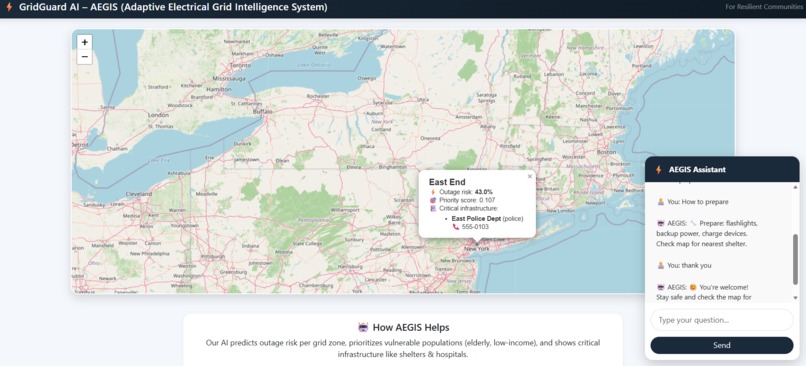
And interface of our poject
Inspiration
Every year, power outages leave millions in the dark – but the elderly and low-income families suffer the most. They do not know when power will return, where to find shelter, or how to prepare. In Ghana and across the world, grid failures are often reactive. We asked: What if we could predict outages before they happen and guide vulnerable people to safety?
That is why we built GridGuard AI with AEGIS – to turn outage response from reactive to proactive.
What it does
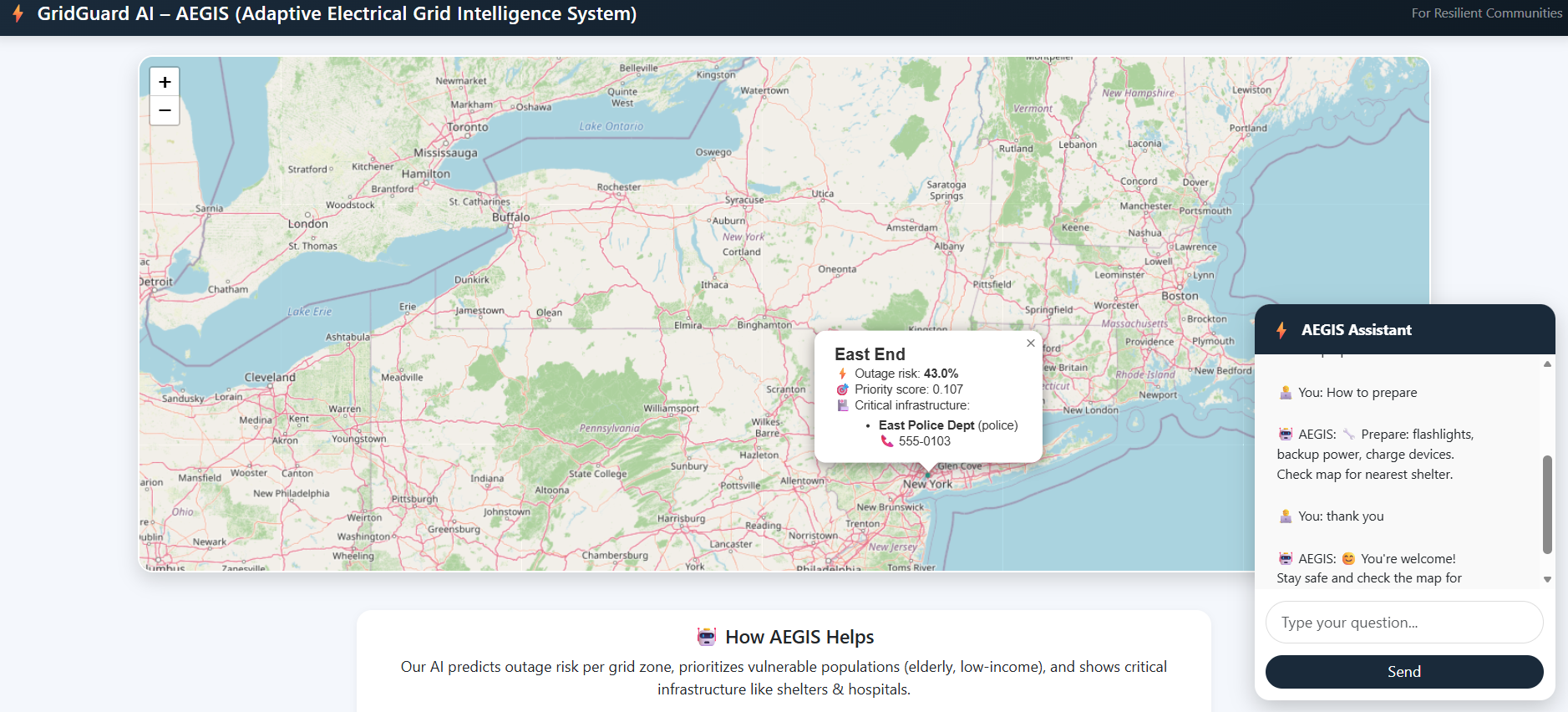
1.Predicts outage risk per neighbourhood using weather data (wind, rain, temperature) and equipment age. 2.Visualises risks on a colour-coded Leaflet map (red = high risk).
3.Answers natural language questions via the AEGIS chatbot, such as: "What is the outage risk?", "Find a shelter", or "How to prepare?"
4.Prioritises vulnerable communities using demographic data (poverty and elderly percentage).
5.Empowers utility operators to dispatch repair crews to the most critical zones first.
How we built it
Backend: Django 4.2.11 (Python) with SQLite database.
AI/ML: scikit-learn Random Forest classifier trained on synthetic outage history.
Weather data: OpenWeatherMap API for real-time wind, rain, and temperature.
Frontend: Leaflet.js for interactive maps and Bootstrap 5 for responsive user interface.
Chatbot: AEGIS uses the same trained model (outage_model.pkl), so map and chatbot answers are always consistent.
Admin panel: Full CRUD functionality for grid zones, shelters, demographics, and system configuration (toggle real/simulated weather and API key).
Data flow: OpenWeatherMap → fetch_weather management command → Django models → Random Forest → JSON API → Leaflet map and AEGIS chatbot.
Challenges we ran into
1.Chatbot integration: We ensured AEGIS calls the exact same outage_model.pkl as the map, not a separate system.
2.CSRF errors: We used csrf_exempt for the chatbot endpoint, appropriate for a hackathon prototype.
3.Pickle protocol mismatch: We retrained the model on the same machine to avoid version conflicts.
4.Feature name warnings: These do not affect predictions; we will fix them using Pandas DataFrames in future versions.
Accomplishments that we're proud of
1.Qualifier score of 80 out of 100, above the track average of 72.7 and ranked 107 out of 424.
2.End-to-end AI system, from weather API to map to chatbot, all working in a single Django application.
3.Responsible AI with a vulnerability score to protect elderly and low-income communities.
4.Addressed qualifier feedback by mapping features to outputs, documenting data flow, and justifying Random Forest over alternatives.
5.Full admin control, allowing judges to add or edit shelters, zones, and toggle real or simulated weather without touching code.
What we learned
1.Feature engineering matters: wind and equipment age are the strongest predictors.
2.Random Forest is ideal for small synthetic datasets because it resists overfitting and provides feature importance.
3.Human-in-the-loop design is essential: AI is a guide, not a decision-maker. Utility operators must confirm alerts.
4.Synthetic data is ethically sound and allows fair testing across all zones.
5.Teamwork: combining electrical engineering knowledge with software development created a unique and impactful solution.
What's next for Power Outage Predictor for Vulnerable Communities
Real-time SMS and email alerts for high-risk zones using Twilio integration orArkesel
Mobile application for offline access during blackouts.
Partnership with local utilities to train on real outage records.
LSTM models for 48-hour outage forecasting.
Scalable deployment using Docker and cloud platforms such as AWS or Heroku

Log in or sign up for Devpost to join the conversation.