-
-
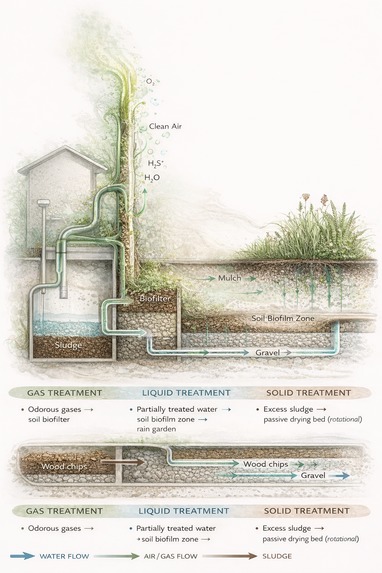
Conceptual System Diagram
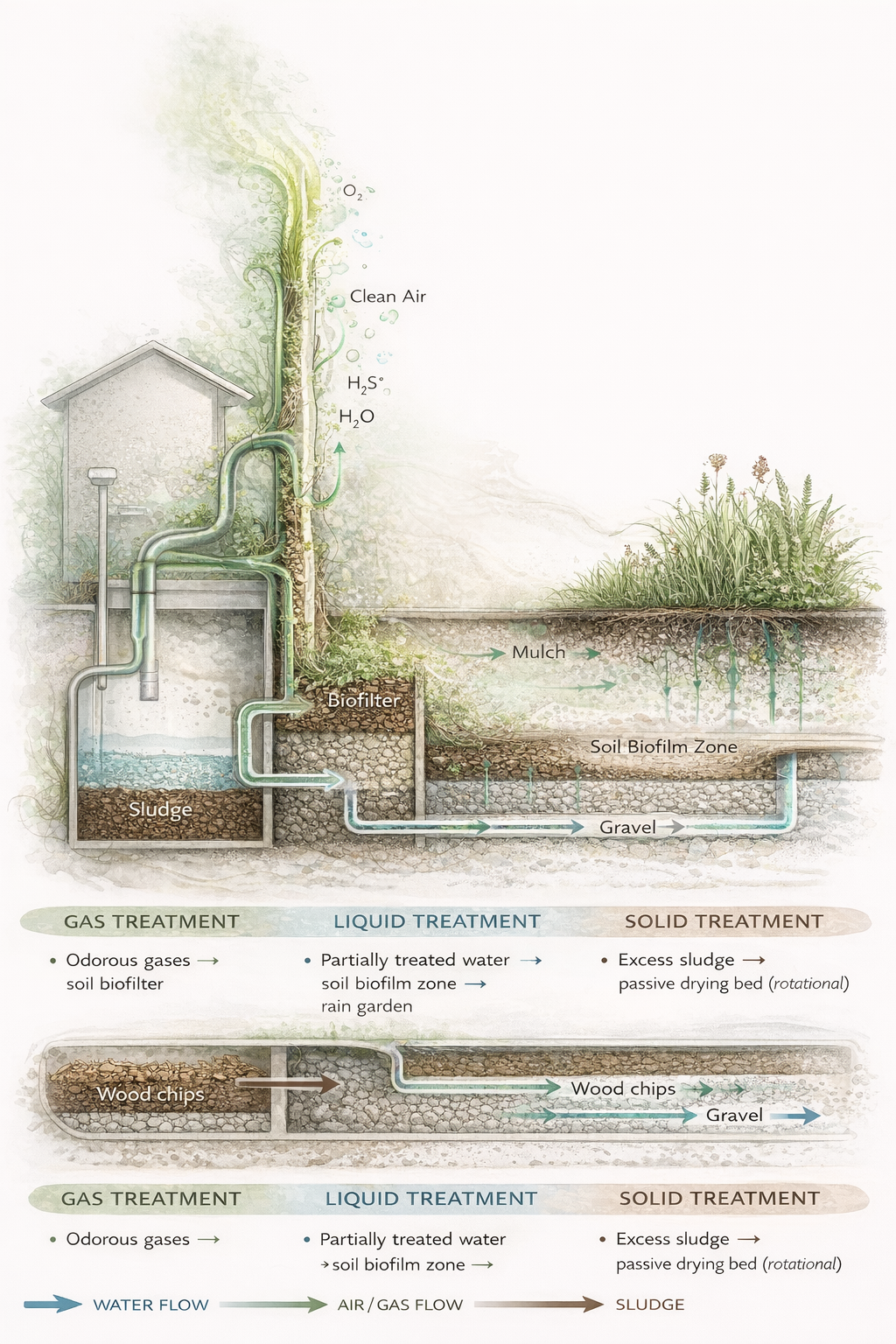
▼ Inspiration This project is inspired by several limitations of a remote setting in Northern Australia: the undeveloped environment and the small population contribute to a lack of funding, infrastructure and even stable power today. To promote sustainability and reduce environmental damage, we aim to design a wastewater treatment system that is power-independent and self-sustaining, using a blend of biofilm and a fail-safe physical mechanism.
▼ What it does The system treats domestic wastewater using a fully passive, gravity-driven process. It combines septic separation, vertical and horizontal biofilm-based filtration, and a final polishing stage. By creating different oxygen and moisture environments, the system supports both aerobic and anaerobic processes without mechanical aeration.It is designed to remain functional under unstable conditions, maintaining partial treatment even during overload or system stress.
▼ How we built it We developed the system as a sequence of treatment zones, each designed as a specific micro-environment for biofilm activity.
The design integrates: gravity-fed flow (no pumps required), passive aeration through vertical flow filtration, modular layers to reduce clogging risk, and a fail-soft overflow pathway to handle extreme loading conditions.Simple simulations and conceptual modelling were used to test flow variability and identify potential failure points.
We also built a lightweight interactive web demo to simulate variable loading conditions and show when the system enters fail-soft mode.
▼ Challenges we ran into One of the main challenges was balancing simplicity and performance. Without electricity or active control systems, improving treatment efficiency while maintaining reliability required careful design of flow paths and oxygen availability.
Another challenge was avoiding over-engineering — keeping the system realistic for remote communities with limited maintenance capacity.
▼ Accomplishments that we're proud of We successfully redefined a conventional wastewater system into a power-independent and resilience-focused design.
The system demonstrates how environmental conditions (oxygen, moisture, flow) can be used as design tools instead of relying on mechanical systems. We are particularly proud of the fail-soft strategy, which allows the system to continue functioning even when conditions are not ideal.
▼ What we learned We learned that in low-resource environments, reliability is often more important than optimal performance. Designing for failure, rather than perfect conditions, leads to more practical and sustainable solutions.
We also realised that complex technologies are not always necessary; simple, well-designed physical systems can be highly effective.
▼ What's next for Power-Independent Ecological Wastewater System Next steps include developing a simplified prototype and validating the design under different loading scenarios.We also aim to refine the predictive layer to support maintenance planning, using either low-power sensing or simplified rule-based models. In the long term, this concept could be adapted for different remote contexts and integrated with local construction practices.
Built With
- conceptual
- hand-drawn

Log in or sign up for Devpost to join the conversation.