-
-
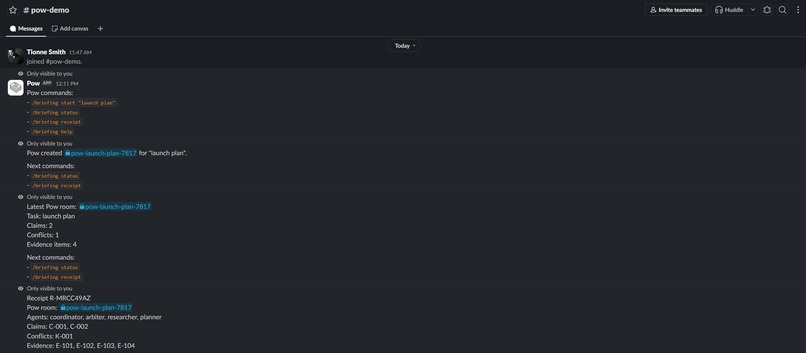
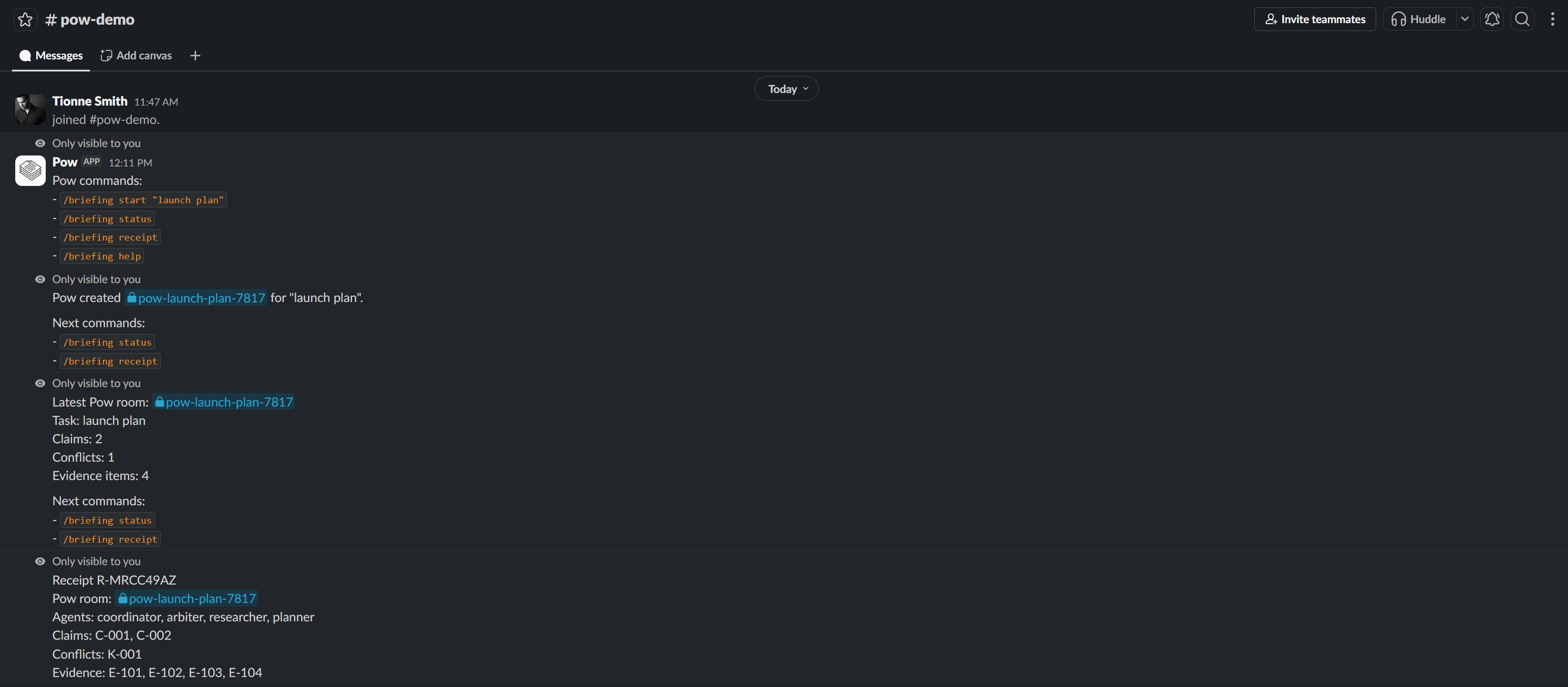
Pow demo screenshot showing Pow commands
Inspiration
Slack is where work happens, but AI agents can lose the plot quickly. One agent may find context, another may make a plan, another may answer the user, but the shared state between them is often fragile or invisible.
Pow started from a simple question: what if Slack agents had a shared space before they answered?
What it does
Pow gives Slack agents a shared space to track what they know, what changed, and who did what.
A Pow acts like a lightweight coordination room for agent work. Agents can enter the room, read the current task state, add claims, attach evidence, flag conflicts, record decisions, and produce a final receipt-backed answer.
The goal is to stop agents from forgetting context, duplicating work, or answering without showing how they got there.
How we built it
Pow is built around a structured task-state model inside Slack.
The core objects are:
- Task — the current mission or question
- Agent — the actor contributing work
- Claim — something an agent found, believes, or proposes
- Evidence — Slack context, links, files, logs, or sources supporting a claim
- Conflict — competing claims or unresolved disagreement
- Decision — accepted state
- Lock — protected state that should not be overwritten casually
- Receipt — the final trail of what happened
The Slack flow is simple:
- Start a Pow for a task.
- Agents add claims and evidence.
- Pow tracks changes and conflicts.
- The final answer includes the useful context and a receipt of the work.
Challenges we ran into
The hardest part was narrowing the idea.
“Shared memory for agents” is too broad. Pow is not trying to be a chatbot, a vector database, or a replacement for agent frameworks. The sharper idea is coordination: helping agents stay on the same page while work is happening.
Another challenge was keeping the interface simple enough for Slack. The product has to feel useful in a workspace, not like an academic agent dashboard.
Accomplishments that we're proud of
The strongest part of Pow is the framing: agents do not just need more memory. They need a shared working space with state, evidence, conflicts, and receipts.
Pow turns agent coordination into something Slack users can understand:
What do we know?
What changed?
Who did what?
That makes the system easier to trust and easier to debug.
What we learned
Agent coordination is not only a technical problem. It is also a communication problem.
If agents are going to work inside real teams, they need to leave behind usable traces of their work. A good answer is not enough. Teams also need to understand what the agent used, what changed, and where uncertainty remains.
What's next for Pow
Next, Pow should become a real Slack-native coordination layer for multi-agent work.
Planned improvements include:
- better Slack thread integration
- clearer receipt views
- conflict resolution workflows
- MCP-connected external tools
- stronger source-backed evidence trails
- reusable Pow rooms for recurring workflows
Built With
- agent
- agents
- ai
- api
- audit
- automation
- builder
- collaboration
- context
- coordination
- developer
- knowledge
- management
- mcp
- multi-agent
- node.js
- productivity
- receipts
- slack
- systems
- trail
- typescript
- workflow

Log in or sign up for Devpost to join the conversation.