
Inspiration
Pourchestra started with a sound in my head: dry sand slowly falling while a single koto string rings out and fades.
Most mobile games ask players to hurry. I wanted to make the opposite - something gentle enough to calm you down, but still interesting enough to make you think. The idea became a moonlit journey where sand is not just something you sort. Every grain becomes part of a song.
What it does
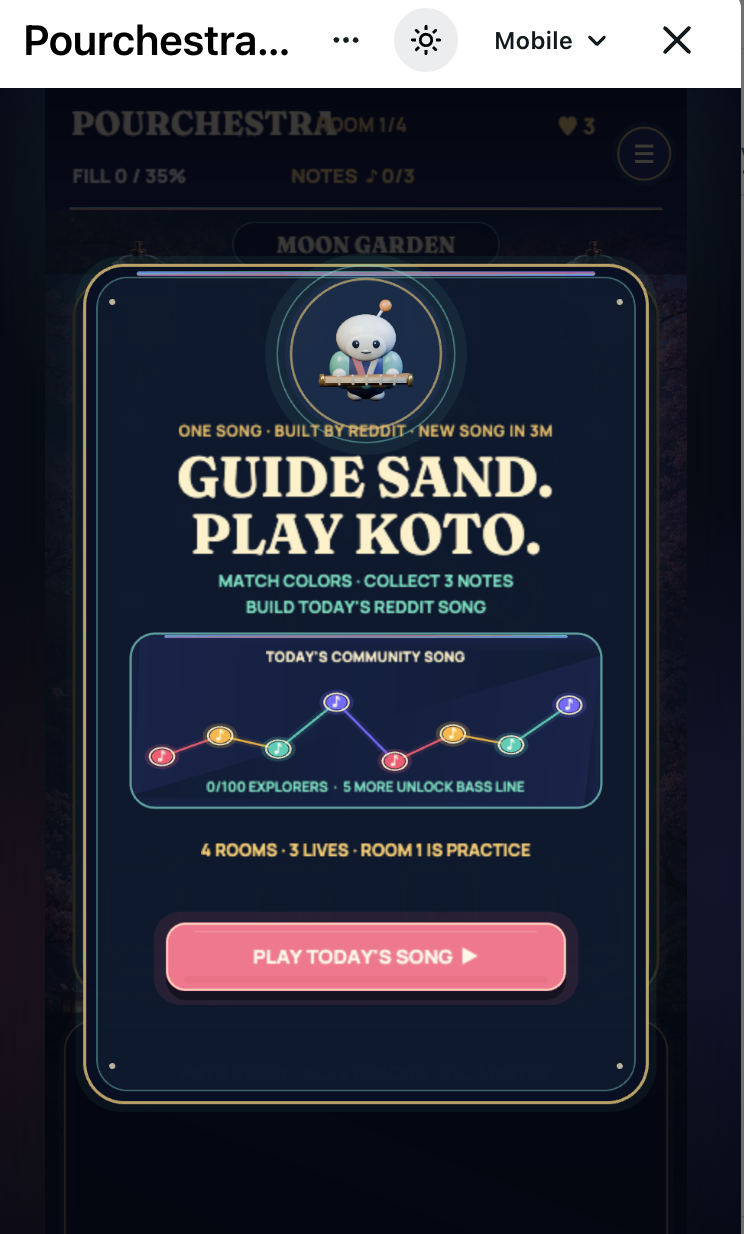
Pourchestra is a daily physics puzzle played across four moonlit rooms.
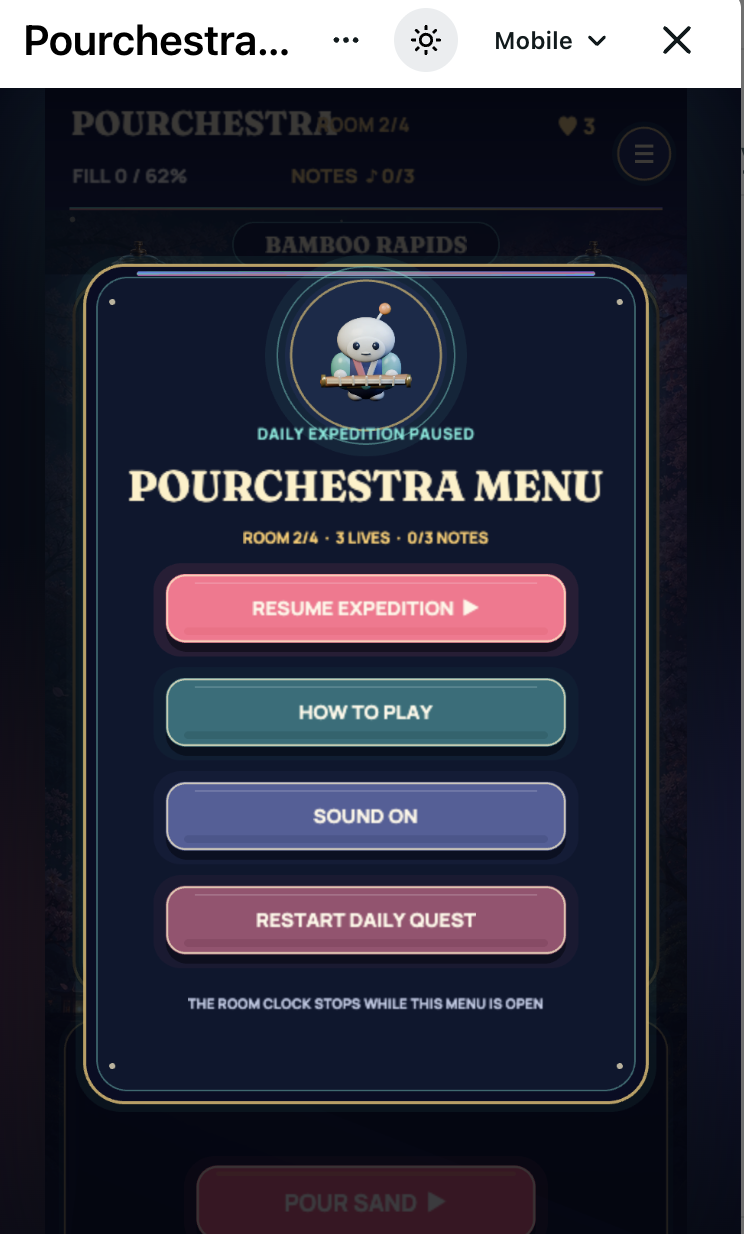
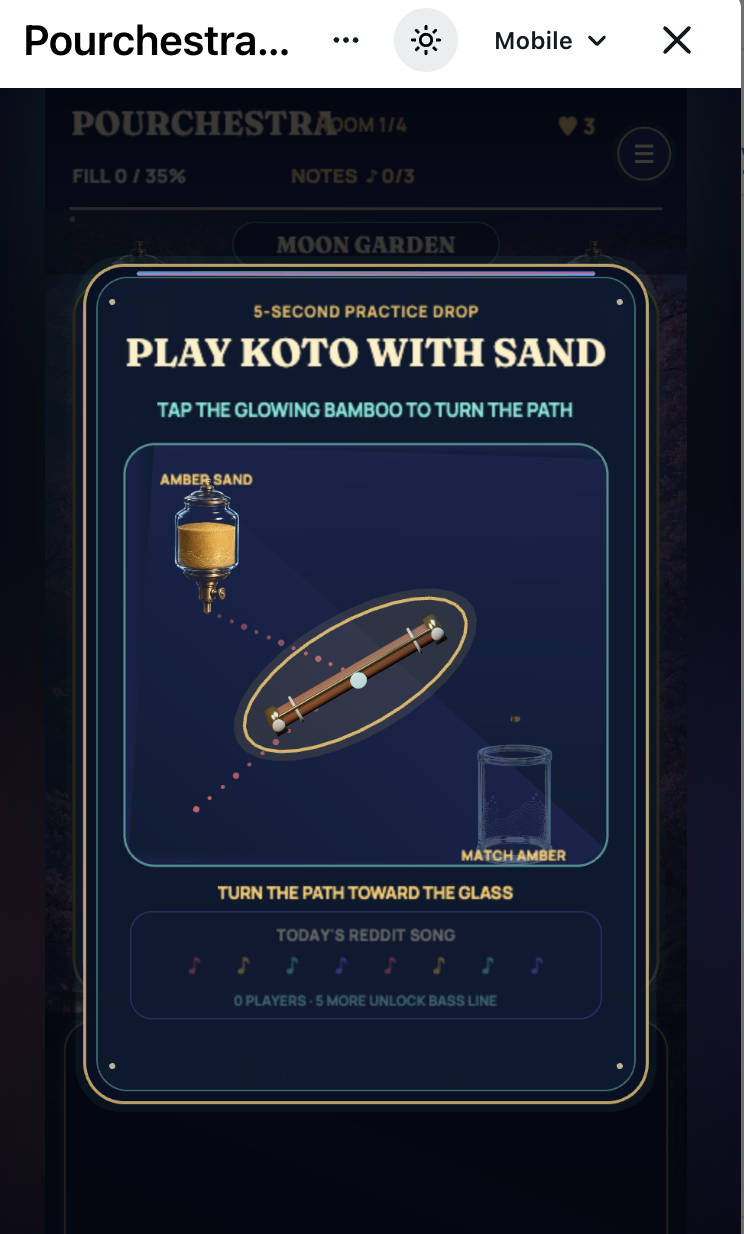
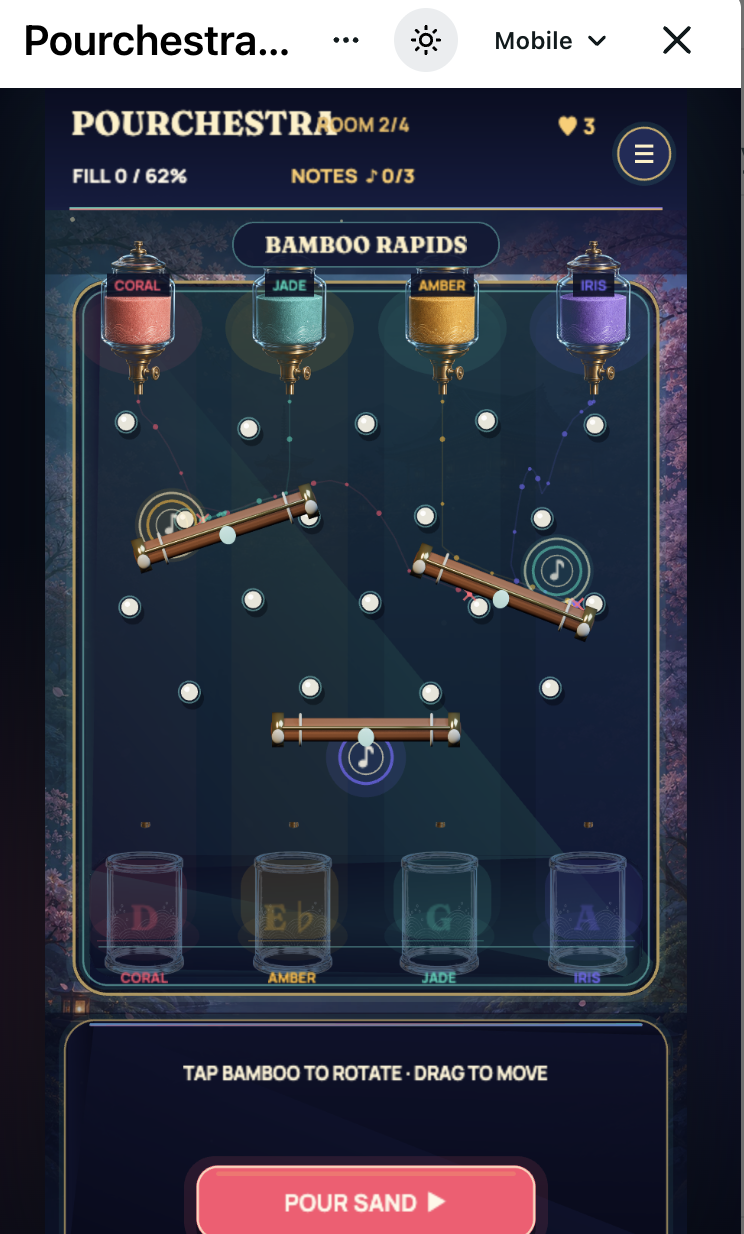
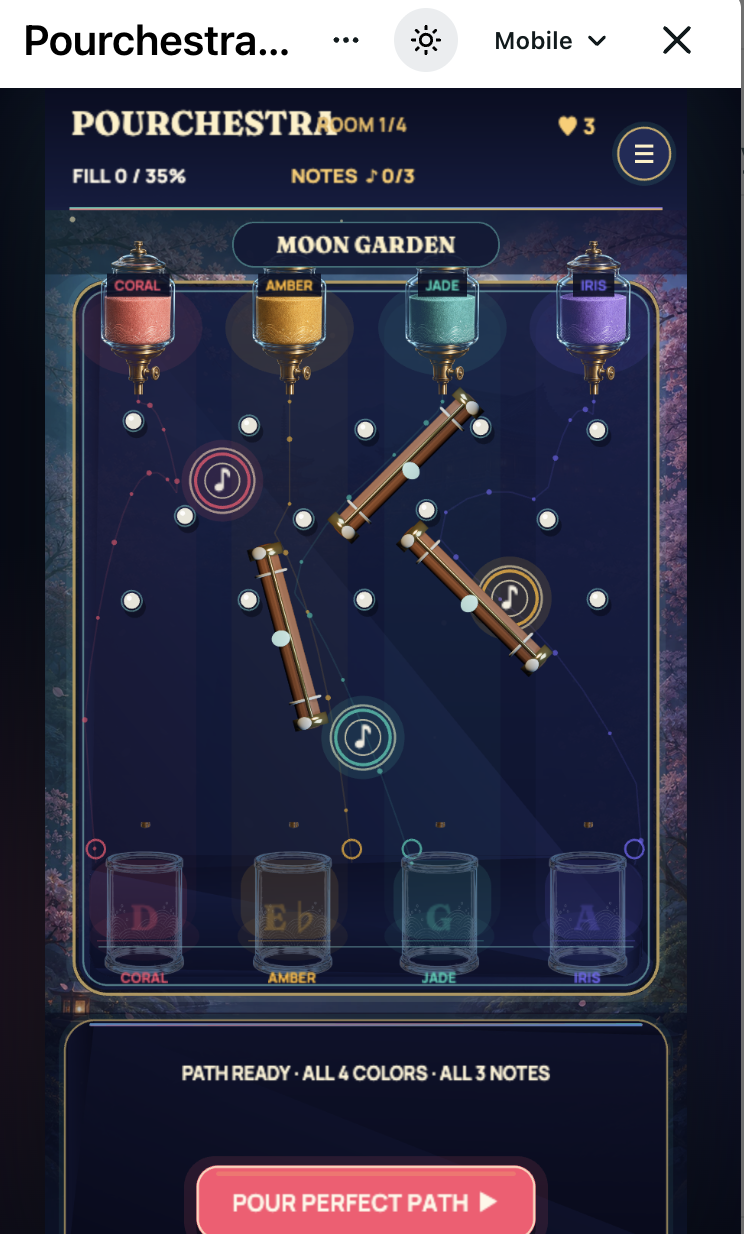
Players tilt their phone or drag the screen to guide four colors of sand into matching glasses. Bamboo bridges can be moved and rotated to change each stream’s path. Players must collect three musical notes and save enough sand before losing all their lives.
Every movement shapes the sound. Falling grains create soft, changing sand textures. Rotating a bamboo bridge plucks a koto note. As the player travels through the four rooms, these sounds slowly grow into their own melody.
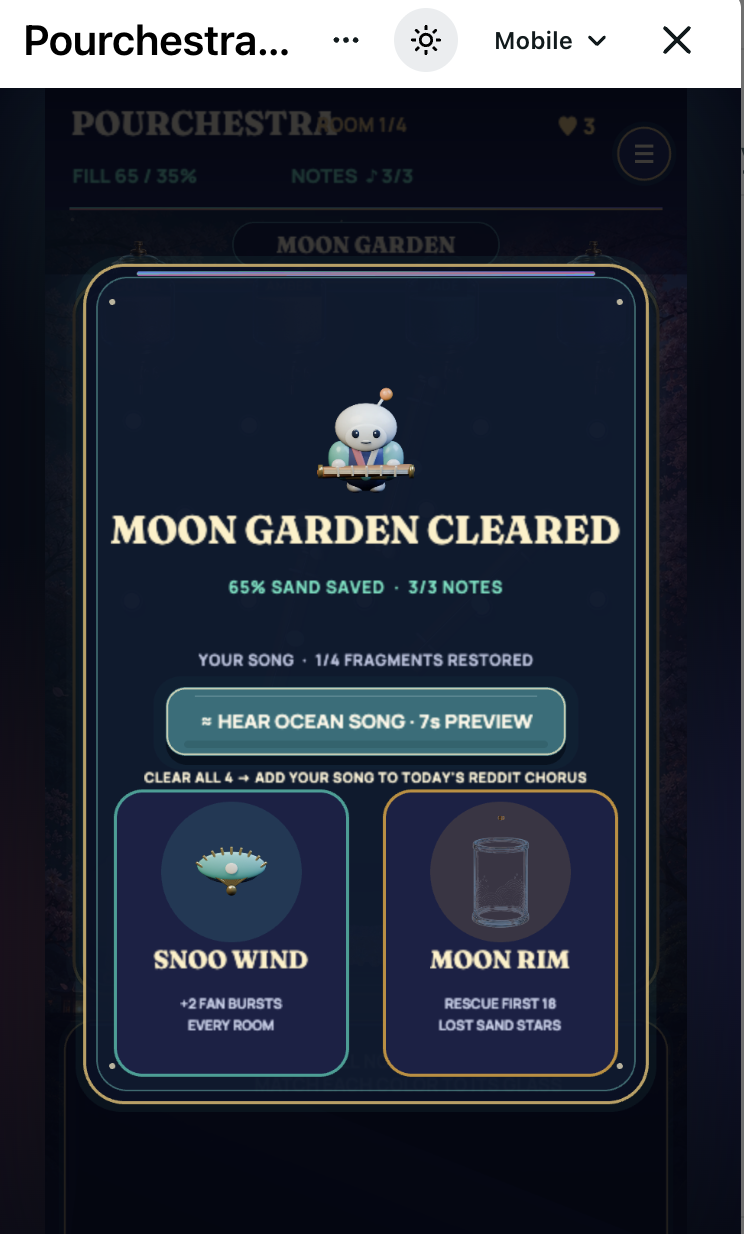
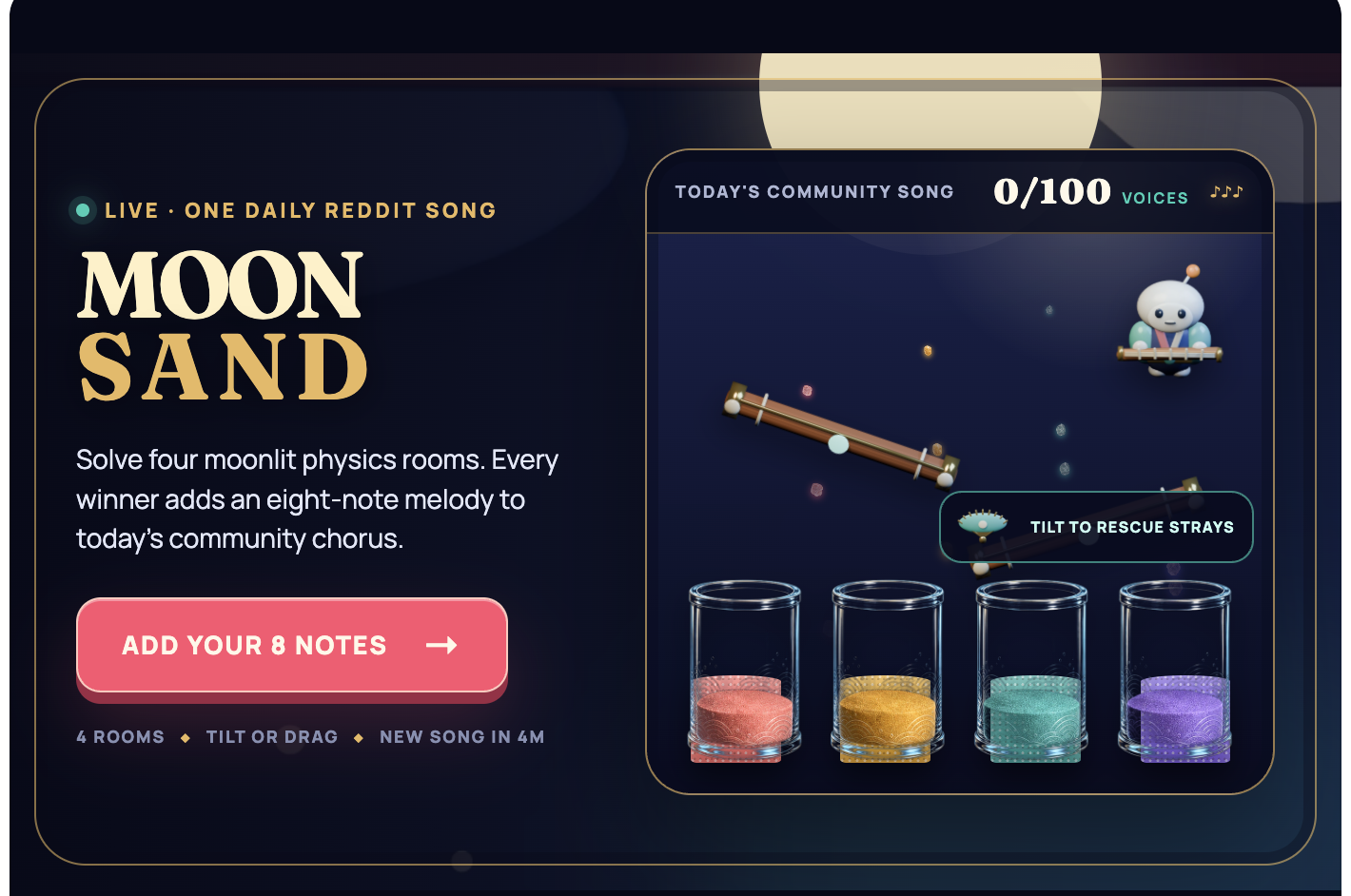
Winning unlocks the finished song and lets the player add eight notes to Reddit’s shared daily composition. One quiet journey becomes part of something created by the whole community.
How we built it
I built Pourchestra with Devvit Web, Phaser, TypeScript and Vite.
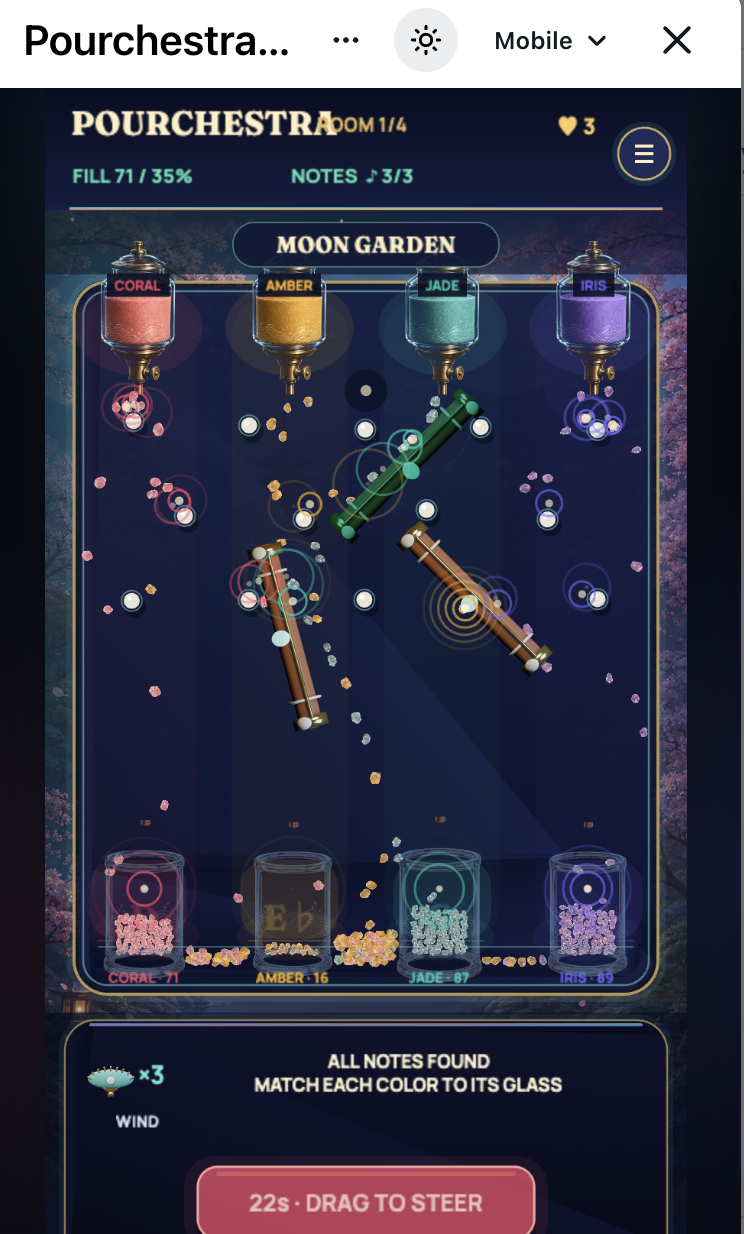
Phaser handles the sand particles, collisions, movable bamboo bridges, gravity, hazards and phone-tilt controls. When motion sensors are unavailable, dragging the screen provides the same control.
The sound is connected to the physics instead of playing as a simple background loop. The sand layer changes with the number of moving grains, their speed, collision strength and position on the screen. Koto samples respond when bridges are rotated, so touching the puzzle also feels like touching an instrument.
Devvit and Redis power the daily challenge, community melody, player scores, streaks and leaderboard. Everyone receives the same daily expedition, and each player can contribute to the community song once per day.
The glass vessels, bamboo bridges, fan and kimono-wearing Snoo guide were created as detailed rendered assets, then brought into Phaser as transparent game objects.
Challenges we ran into
The hardest part was making the sand feel real.
Too few particles looked like floating stones. Too many particles slowed the game down. The grains also needed to fall naturally, collide with bridges, spill onto the ground and pack tightly from the bottom of each glass.
Sound was another long challenge. A looping sand recording felt disconnected and noisy. I had to make it follow the actual movement of the grains. When the board becomes quiet, the sound now becomes quiet too. When more sand begins moving, the texture grows naturally.
Phone motion controls were also unreliable inside some browsers and Reddit webviews. I kept tilt as the magical version of the control, but created a complete drag-based alternative so nobody gets locked out.
The final challenge was clarity. Early versions had sand, bridges and glasses, but the player could not immediately understand how to win. The four-room journey, visible goals, lives, route preview and short opening tutorial came from repeatedly simplifying the experience.
Accomplishments that we're proud of
I am proud that Pourchestra grew from a sorting experiment into a complete little adventure.
It now has four different rooms, clear win and loss conditions, collectible notes, limited lives, power-up choices and a song that develops throughout the journey.
I am especially proud of the relationship between movement and sound. The sand is not decoration, and the koto is not just background music. They listen to what the player is doing.
The community song is also important to me. Players do not simply receive a score and leave. Their melody becomes one voice in a piece that Reddit creates together over the course of the day.
What we learned
I learned that a relaxing game still needs meaningful decisions. Calm should not mean passive.
I also learned that believable sand is not created by particle count alone. Its size, weight, density, collision, packing and sound all have to agree with each other.
Most importantly, I learned to test the game through the eyes of someone seeing it for the first time. If the goal is unclear, beautiful graphics and music cannot save the experience. Every object needs to explain its purpose through movement and feedback.
What's next for Pourchestra
I want to add more journeys inspired by Japanese landscapes, seasons and traditional sounds—rain gardens, winter shrines, ocean caves and lantern festivals.
I also want to expand the shared Reddit song so community milestones unlock new koto parts, bass layers and environmental sounds throughout the day.
The long-term dream is simple: open Reddit, take a quiet journey, create a small melody and hear how your voice changed the song everyone is building together.
Built With
- devvit
- phaser.js
- typescript


Log in or sign up for Devpost to join the conversation.