-
-
-
-
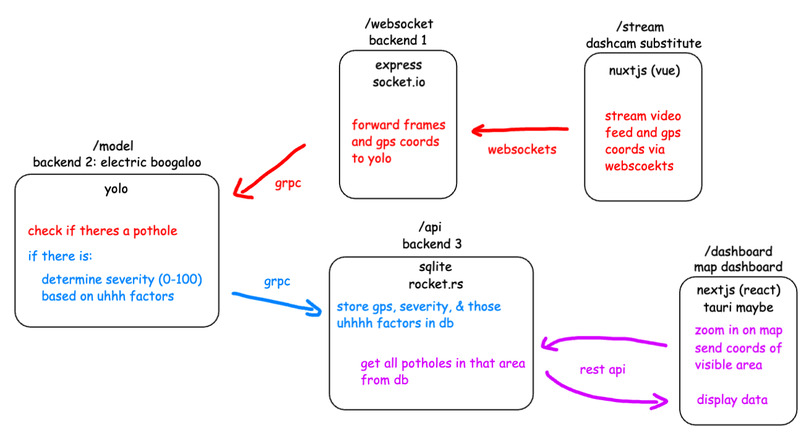
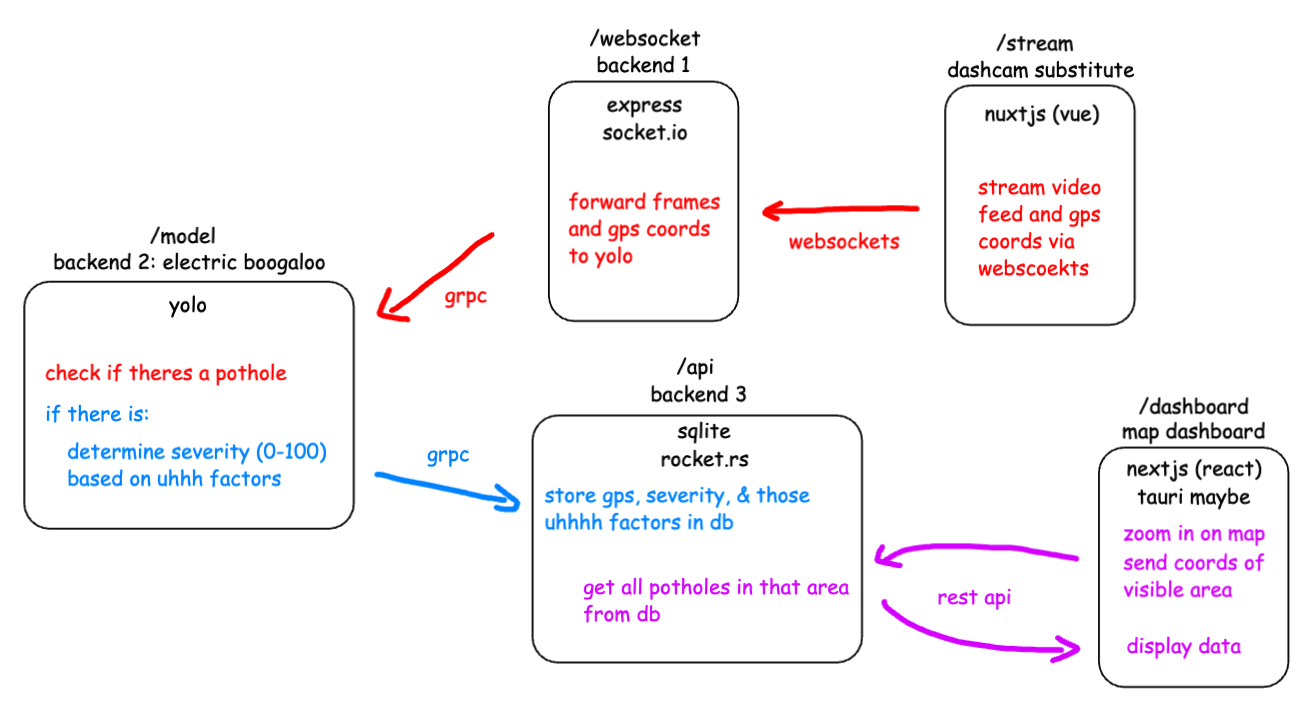
An initial high-level architecture diagram of our application. The dashboard does not use Tauri in its current state.
Pothole Patrol - NYCAIRR Hackathon Submission
Created by Kenneth Ng, Tiffany Lin, and Ryan Zhou for the NYCAIRR Hackathon.
Program Purpose
Pothole Patrol uses cameras that are already on the road to detect potholes in real-time and share the data with cities and governments to help them prioritize road repairs. After seeing the viral posts about Mayor Mamdani fixing potholes in New York City, we wanted to create a solution to help cities like New York City detect (and hopefully fix) more potholes than ever.
Program Functionality
Users connect with the camera frontend to continuously poll and stream video from their cameras to the WebSocket server. This camera serves as a stand-in for a dashcam or any other type of camera that travels on the road.
The WebSocket server recieves the video stream and forwards it, along with extra metadata used later in the process for calculations, to the model backend via gRPC.
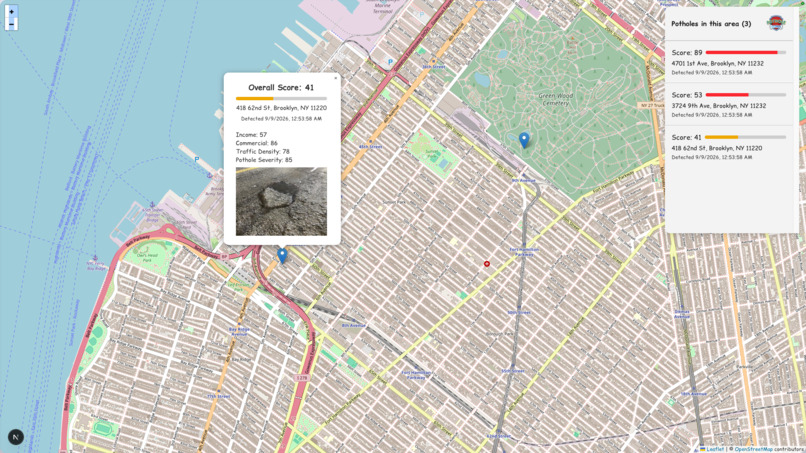
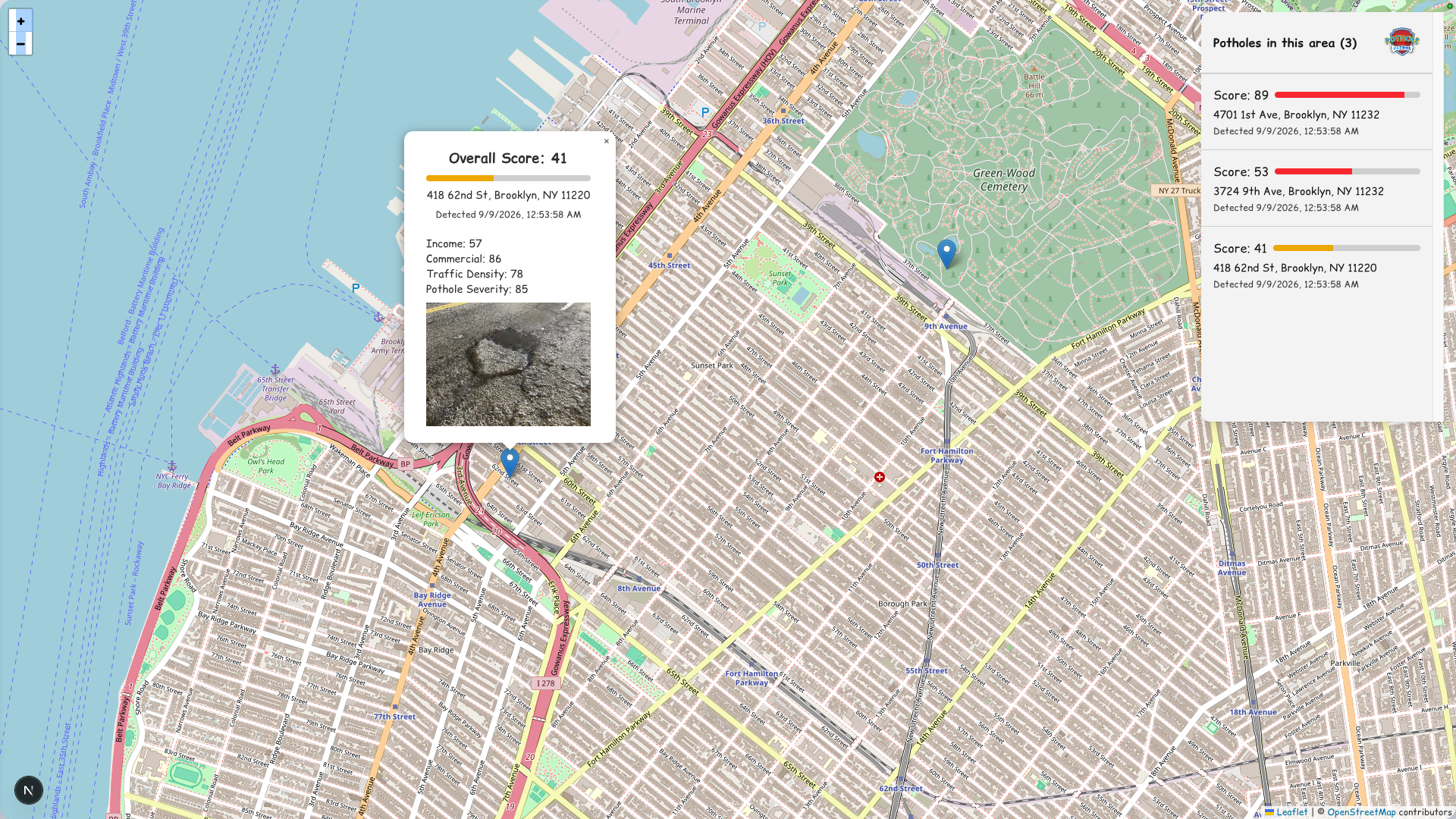
The model backend uses a YOLOv8 model to detect potholes in the video stream. Then, if a pothole is detected, several other information points are fetched and calculated, including, but not limited to:
- Average income areas
- Population of the area
- Commercial impact of the pothole
- Severity of the pothole
Then, the model backend sends the data to the API backend via a persistent unidirectional gRPC stream. The API server stores the data in a PostgreSQL database and serves it to the dashboard frontend via a standard REST API.
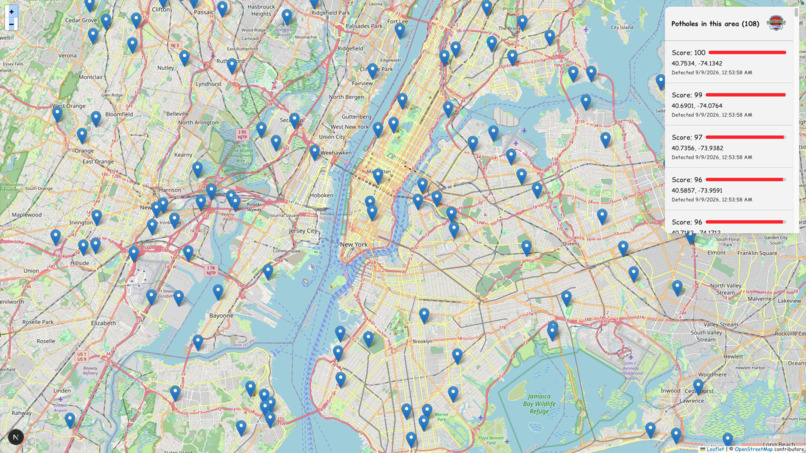
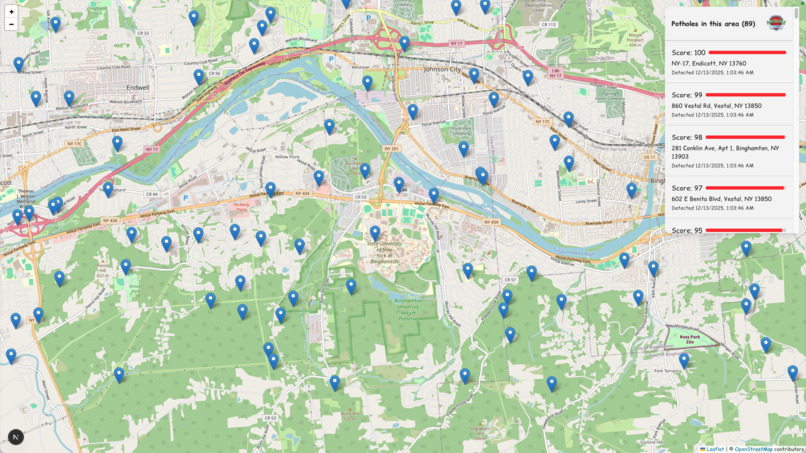
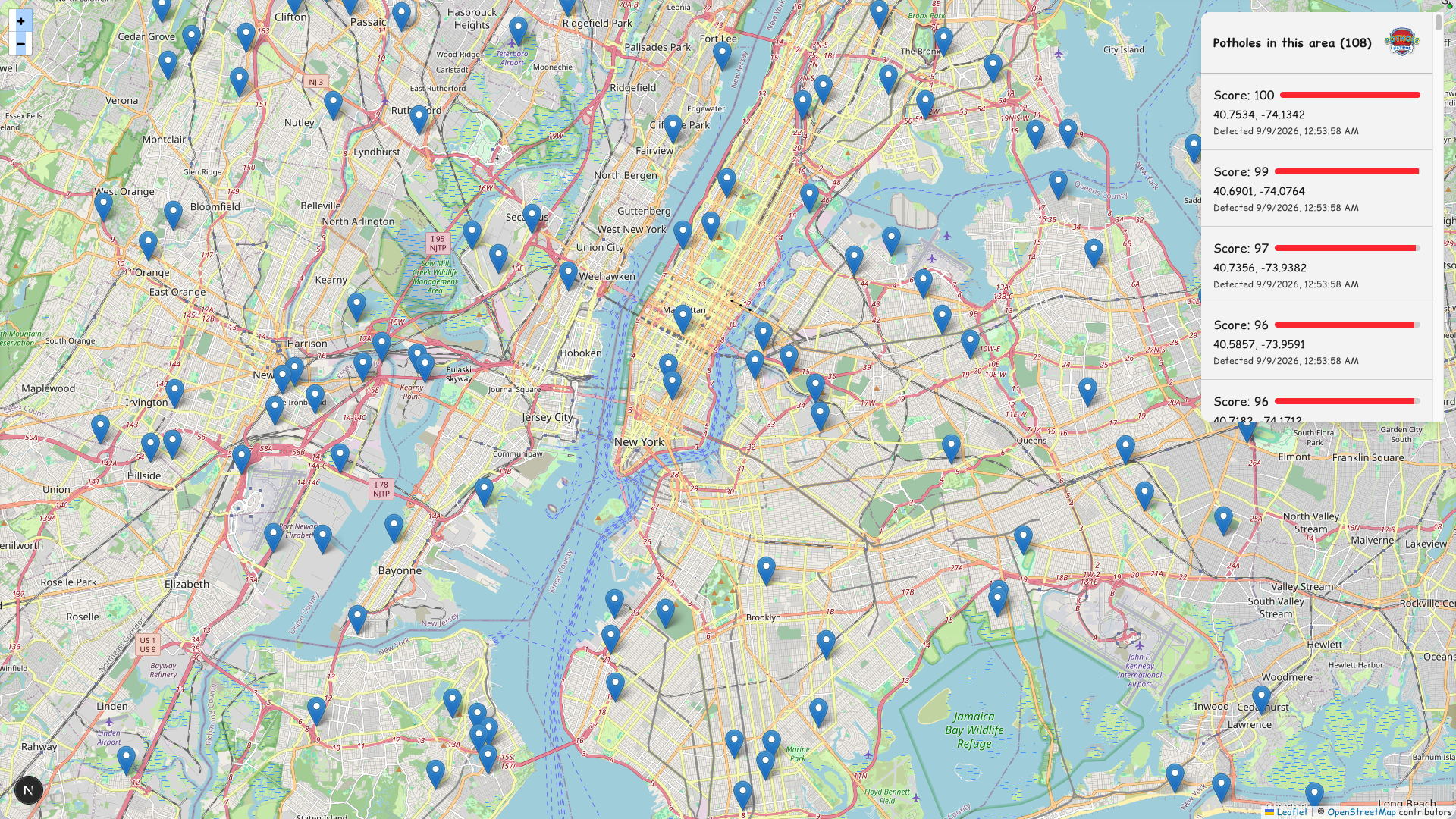
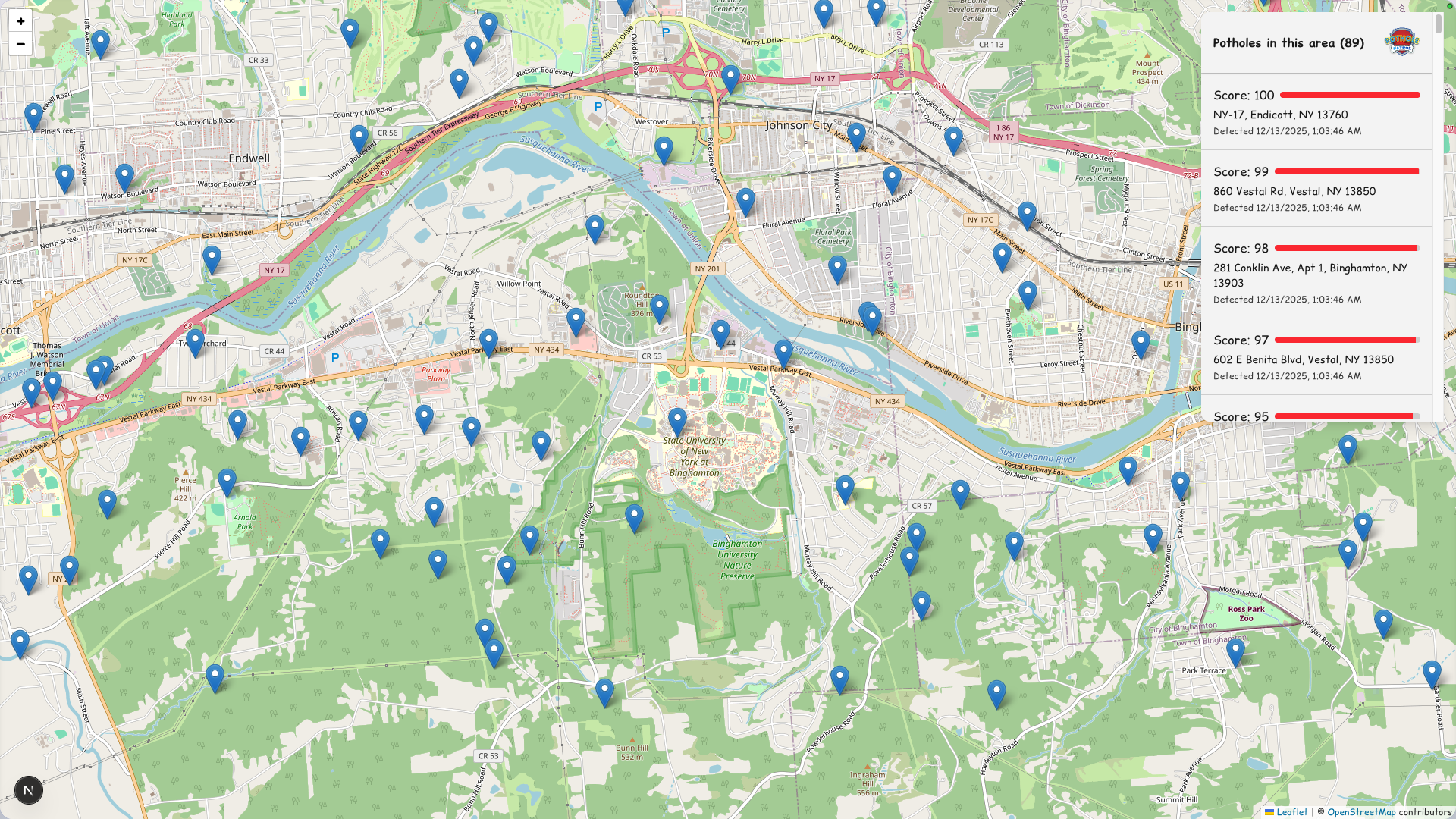
Other users can now connect to the dashboard frontend to view pothole data in real-time, including a map of potholes and a recommended repair priority list based on the data collected and our algorithms.
Our Tech Stack
We used a microservice architecture philosophy to build our application, with each component being able to be scaled independently for different workloads. The following technologies were used to build our application:
- Nuxt.js (Vue) for the camera frontend
- Express.js + Socket.IO for the WebSocket server
- YOLOv8 + PyTorch for the model backend
- Rocket.rs + PostgreSQL for the API backend
Next.js (React) for the dashboard frontend app
gRPC for inter-server communication
WebSockets for communication between camera and WebSocket server
REST API for communication between dashboard frontend and API backend
Known Limitations
The current limitation is bottlenecked by how fast the CV model can process images, so about 1-2 FPS per model backend instance. This could be improved with a more optimized model or by using multiple model backend instances to process images in parallel.
Also, API calls to the US Census Bureau and Geocodio are rate-limited, so we have to cache results to avoid hitting the rate limit. This is a known limitation that we would like to improve in the future.
AI Usage
AI was used to debug parts of our code.
Built With
- express.js
- grpc
- nextjs
- nuxt
- postgresql
- pytorch
- react
- rust
- socket.io
- vue
- websockets
- yolo
