-
-
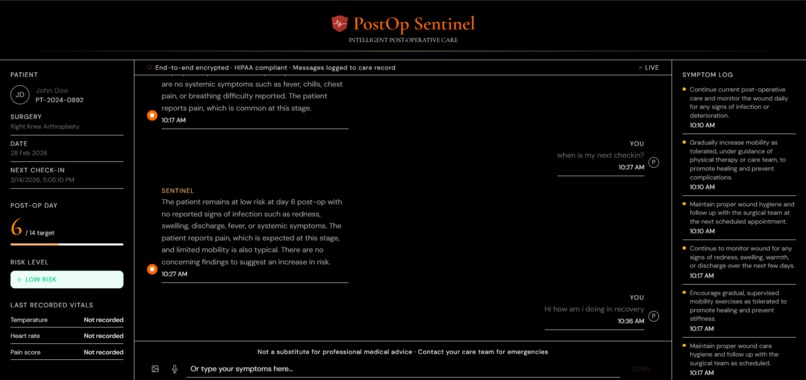
Patient chat screen
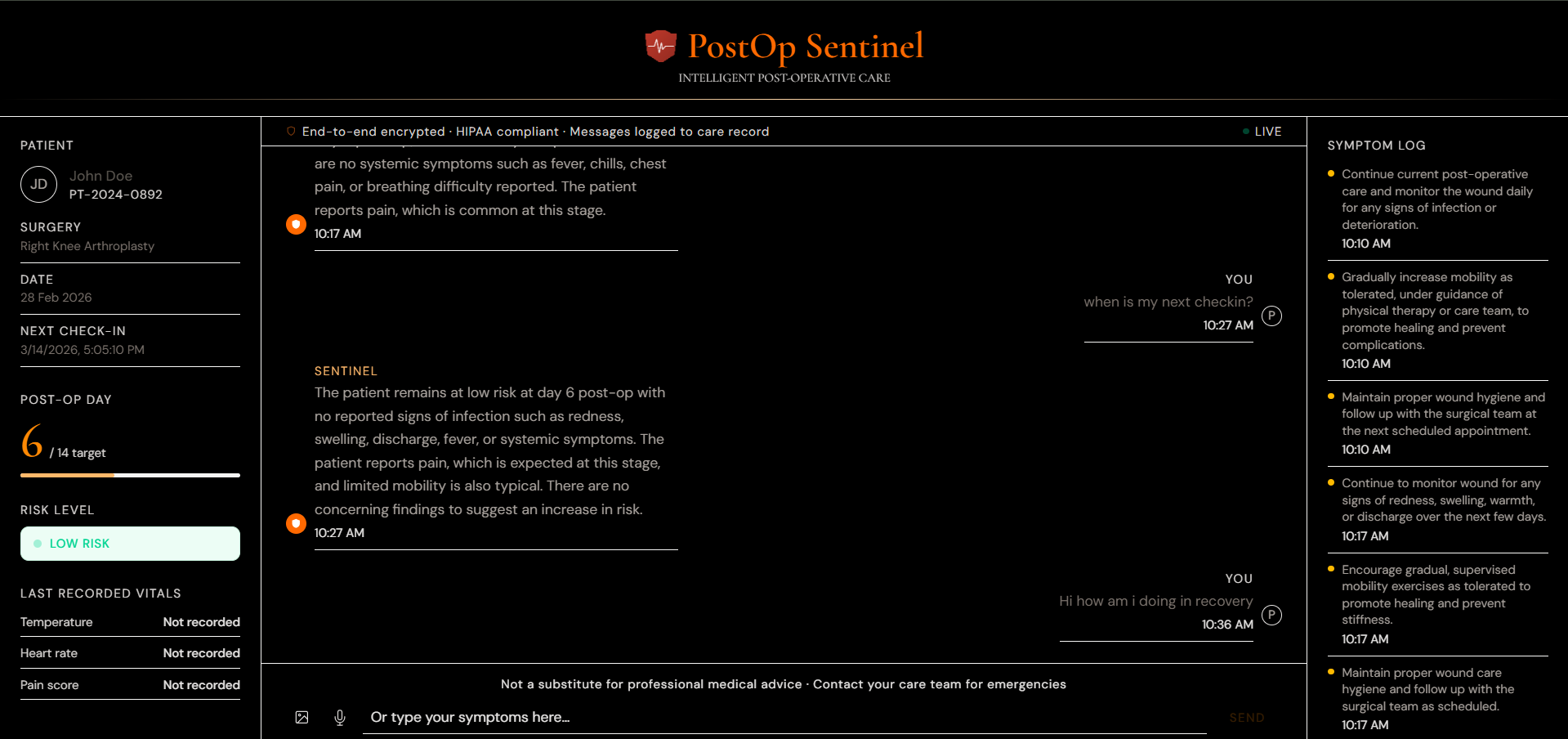
PostOp Sentinel
AI-powered post-surgery monitoring that detects complications early and protects patients recovering at home.
Inspiration
Post-operative recovery is one of the most vulnerable phases of patient care. Every year, over 310 million surgeries are performed globally, yet studies show up to 25% of patients experience complications. Many of these issues—such as infection, fever, or abnormal bleeding—emerge only after discharge when continuous clinical monitoring is no longer available.
Furthermore, the World Health Organization highlights a critical global shortage of healthcare workers. We were inspired to bridge this gap by building PostOp Sentinel, an intelligent "digital guardian" that extends hospital-level oversight into the home, ensuring symptoms are caught before they escalate into emergencies.
What it does
PostOp Sentinel is an AI-powered recovery assistant that performs automated conversational check-ins with patients.
- Voice-Based Reporting: Patients can report symptoms hands-free, which is vital for those with limited mobility or pain.
- Multimodal Analysis: The system analyzes text descriptions and photos of surgical wounds to identify redness, swelling, or discharge.
- Early Detection & Escalation: Using advanced reasoning, it identifies high-risk patterns and triggers intelligent alerts for healthcare providers.
- Accessible Interaction: By turning clinical forms into natural conversations, it improves patient compliance and data accuracy.
How we built it
The platform is designed for real-time interaction and high-speed reasoning:
- The AI Core (Amazon Nova):
- Amazon Nova 2 Sonic: Powers the speech-to-speech conversational engine, allowing for low-latency, natural voice dialogue.
Amazon Nova 2 Lite: Handles multimodal reasoning, processing wound images and text descriptions to identify clinical risk signals.
Backend: Built with FastAPI to manage patient scheduling and model orchestration.
Real-Time Streaming: We utilized Server-Sent Events (SSE) to ensure the AI's responses feel fluid and instantaneous.
Frontend: A clean, accessible web interface (React) designed for patients who may be fatigued or recovering.
Challenges we ran into
- The Frequency Balance: We struggled to find the "sweet spot" for check-ins—frequent enough to catch complications, but not so often that they became a nuisance to a recovering patient.
Accomplishments that we're proud of
- Successful Multimodal Integration: We are proud of how seamlessly the system switches between analyzing a patient's voice and evaluating a physical image of a surgical site.
- Accessible Design: Creating a tool that feels supportive and "human" rather than clinical, making it easier for elderly or high-pain patients to use.
- Leveraging Nova: Successfully implementing the Amazon Nova portfolio to create a sophisticated, agentic AI that feels like a proactive member of a care team.
What we learned
- Voice is the UI of Healthcare: We learned that for recovering patients, typing is a barrier. Voice interaction isn't just a "feature"; it's an accessibility requirement.
- The Power of Multimodal Insights: Text-only data misses the "visual truth" of a wound. Multimodal AI provides a much richer clinical picture.
- Agentic Efficiency: We discovered how autonomous monitoring agents can significantly reduce the manual workload for overstretched nursing staffs.
What's next for PostOp Sentinel
- EHR Integration: Connecting directly with hospital Electronic Health Records to provide surgeons with a seamless dashboard of patient progress.
- Wearable Sync: Integrating data from smartwatches (heart rate, SpO2, and sleep patterns) to add objective biometric data to the AI's risk assessment.
- Predictive Risk Scoring: Developing models to predict which patients are at the highest risk of readmission before they even leave the hospital.
- Personalized Care Plans: Tailoring the AI's personality and check-in frequency based on the specific type of surgery performed.
References:


Log in or sign up for Devpost to join the conversation.