-
-
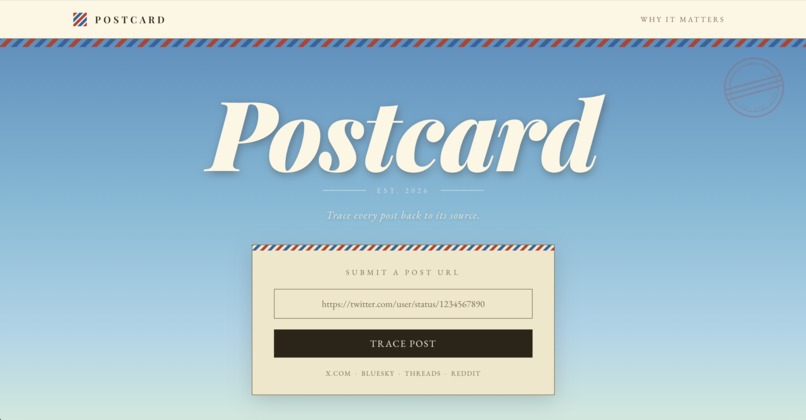
Landing Page
-
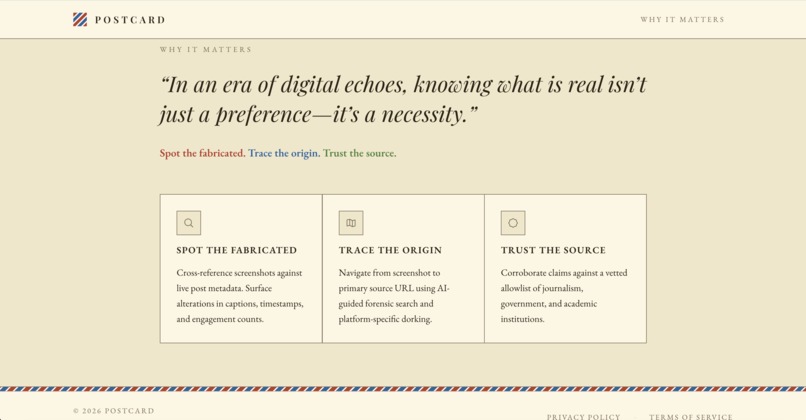
About section
-
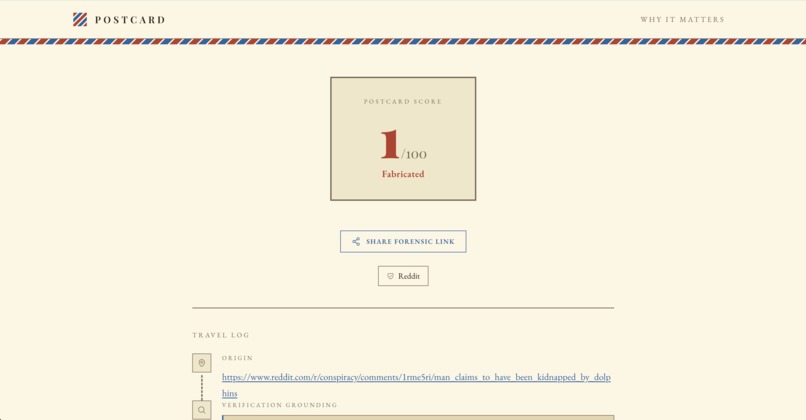
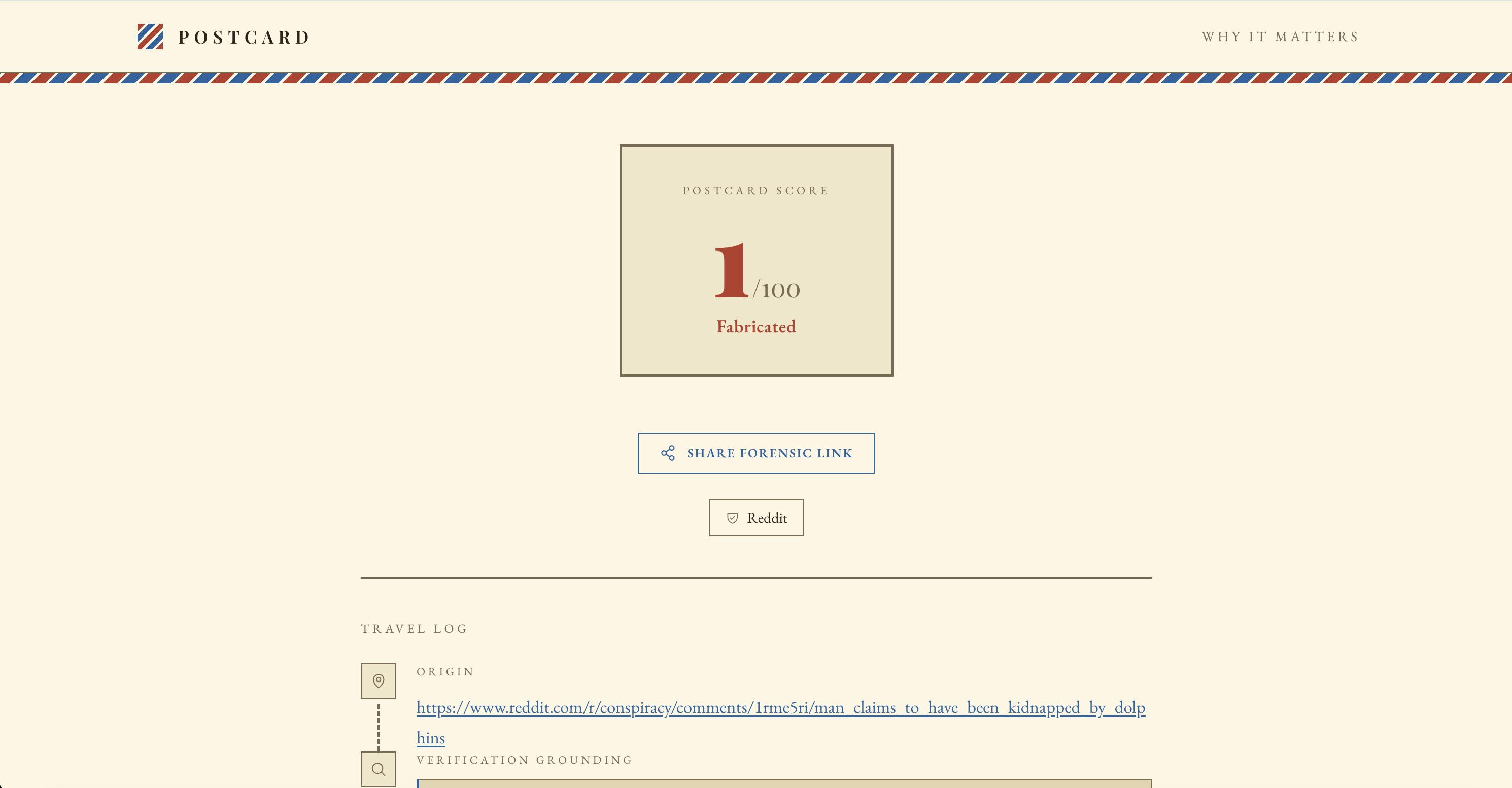
Forensic Log
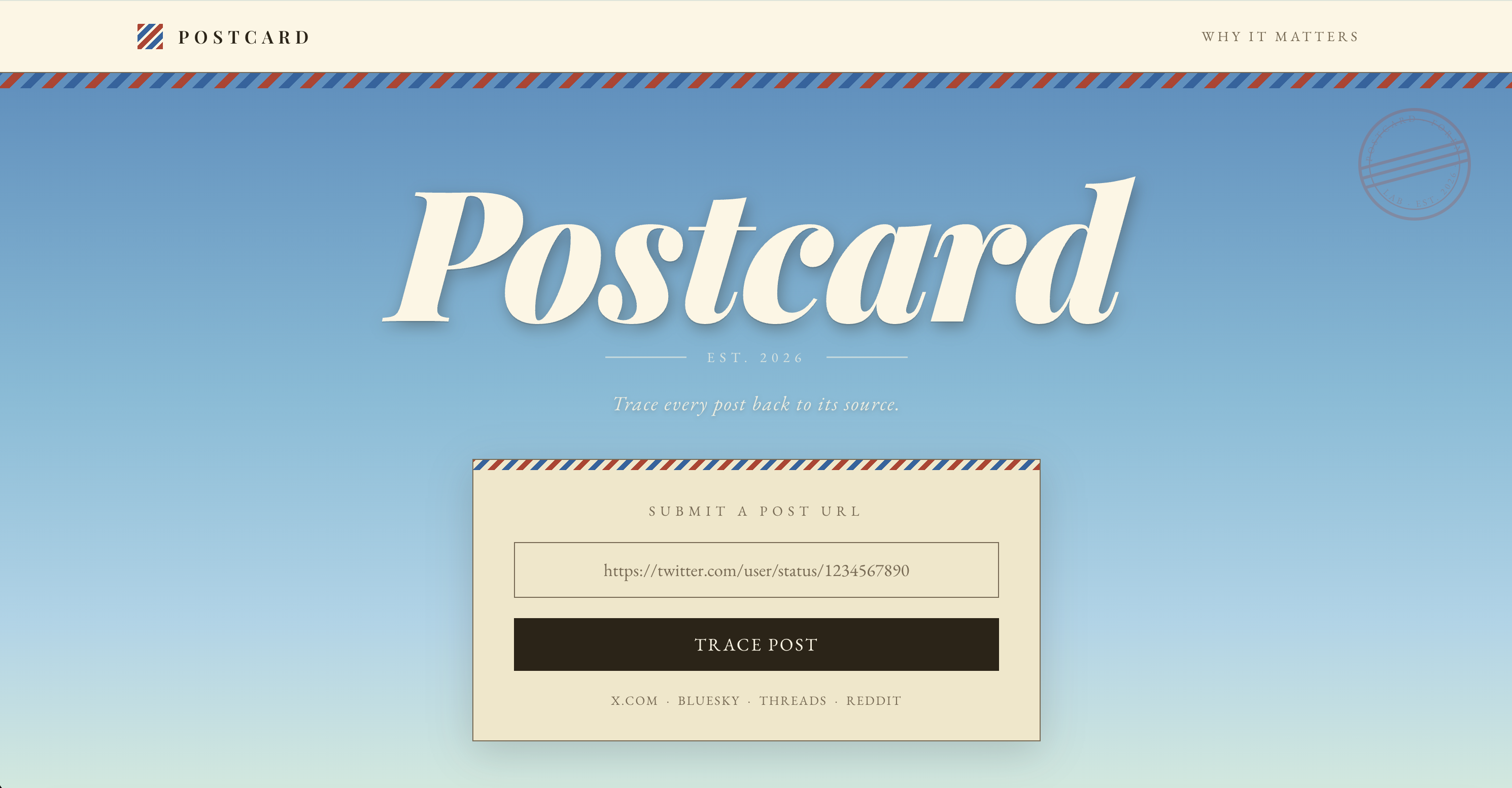
Postcard: Devpost submission
Tagline: Democratizing the truth. Trace every post back to its source. GitHub: github.com/postcardhq/postcard Demo: postcard.fartlabs.org
Inspiration
In our current "post-truth" era, information is often consumed via contextless screenshots. By the time a post goes viral, it has been cropped, captioned, and stripped of its metadata—making it nearly impossible to tell if the content is authentic or a manufactured narrative. We wanted to build a tool that acts as a digital "way back machine" for credibility, restoring the lost link between viral content and its primary source.
What it does
Postcard is a digital forensics pipeline designed to rebuild trust in online media. It takes a social media URL (or a screenshot) and traces it back to its original source. The core of the project is the Postcard Score (0–100%), a credibility metric calculated by auditing how much the content has drifted from the ground truth.
Key Features:
- Forensic Traceability: Automatically identifies the primary source of a claim across X, Reddit, and major news outlets.
- Drift Analysis: Audits content for forensic consistency, checking for temporal alignment and attribution errors.
- Screenshot-to-URL Resolution: Part of our original vision, this feature allows users to upload a screenshot to find its live, interactive counterpart for deep verification.
- Sub score Breakdown: Users don't just get a number; they see a breakdown of source reliability, temporal verification, and cross-platform corroboration.
How we built it
We developed a 4-stage forensic pipeline focused on deep audit log generation:
- Multimodal Ingest: We utilized Jina Reader to ingest live content and establish a "ground truth" version of the post.
- Forensic Audit: Using Playwright, we performed direct site checks to verify the origin and ensure the timestamp aligns with the reported narrative.
- Corroboration Engine: We implemented a deep search across trusted domains to verify claims and find mentions of the content elsewhere to determine its "drift."
- Verification Platform: Built with Next.js and Tailwind CSS, providing a clean, terminal-inspired interface for quick, simple forensic verification.
Challenges we ran into
The biggest hurdle was the "Wisdom of the Crowd"—trying to find a live URL from a static, often low-quality screenshot by triangulating platform-specific clues. Social media platforms also have aggressive bot detection, which made using Playwright for forensic verification difficult. We had to fine-tune our headers and navigation patterns to ensure we could retrieve the necessary metadata without being blocked.
Accomplishments that we're proud of
We successfully built a functional 4-stage pipeline that does more than just "fact-check"—it performs a technical audit. Seeing the Postcard Score update in real-time as the corroboration engine found matching sources across different platforms was a huge "aha!" moment for the team.
What we learned
We gained a deep appreciation for the fragility of digital metadata. Information is easily manipulated once it leaves its native platform, and screenshots are the primary vector for "context stripping."
Key insights:
- LLMs as Forensic Auditors: We learned that multimodal LLMs can be used for more than generation—they are powerful forensic tools for drift analysis (comparing "ground truth" to "viral claims").
- oEmbed as a Truth Source: Traditional scraping is often blocked or low-fidelity; leveraging official oEmbed APIs is a more robust way to capture absolute metadata (exact timestamps and author IDs) for OSINT verification.
- Wisdom of the Crowd: Rebuilding a credible forensic trail from a static, low-quality screenshot is difficult, but multimodal agents can bridge the gap by triangulating platform-specific clues found across the digital landscape.
Key Metrics
- Forensic Pipeline Stages: 4
- Postcard Score Range: 0-100%
- Type Safety: 100% (TS/Lint)
- Supported Platforms: X, Reddit, News Articles, Screenshots
Judging Alignment
- Cybersecurity: Demonstrates digital forensics and OSINT techniques to verify data integrity.
- Innovation: Uses multimodal LLMs for "drift analysis" rather than simple text fact-checking.
- User Experience: Provides a clean, terminal-inspired interface with real-time polling updates (migrated from SSE to ensure 100% production stability).
What's next for Postcard
- Browser Extension: Bringing Postcard directly into the feed, allowing users to right-click any post to see its score instantly.
- Expanded Platform Support: Increasing our corroboration engine to include specialized platforms like Telegram and Discord.
- API for Journalists: Opening up our forensic pipeline as an API for newsrooms to verify user-generated content in real-time.
Demos
- YouTube demo of the browser extension: https://youtu.be/TXQTkkFSJhU
- YouTube demo of the app: https://youtu.be/3AQTUkImhM8


Log in or sign up for Devpost to join the conversation.