-
-
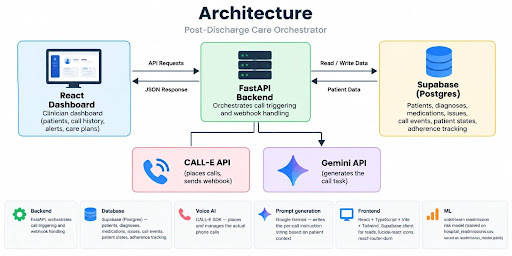
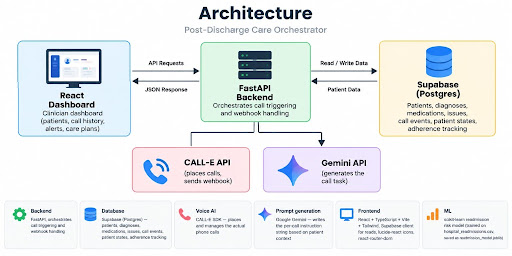
system architecture
-

logo
-

PostBridge
Inspiration
After a patient leaves the hospital, the care team often loses visibility into their recovery. Hospital records capture diagnoses, medications, and lab reports — but nothing about what happens once the patient goes home.
This is the post-discharge data gap.
So we asked ourselves: what if a simple phone call could keep that data flowing?
That question is how PostBridge was born.
What it does
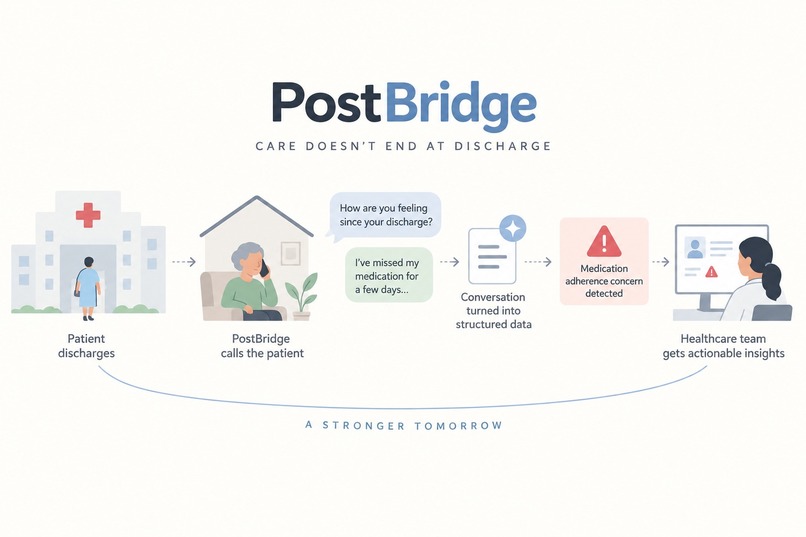
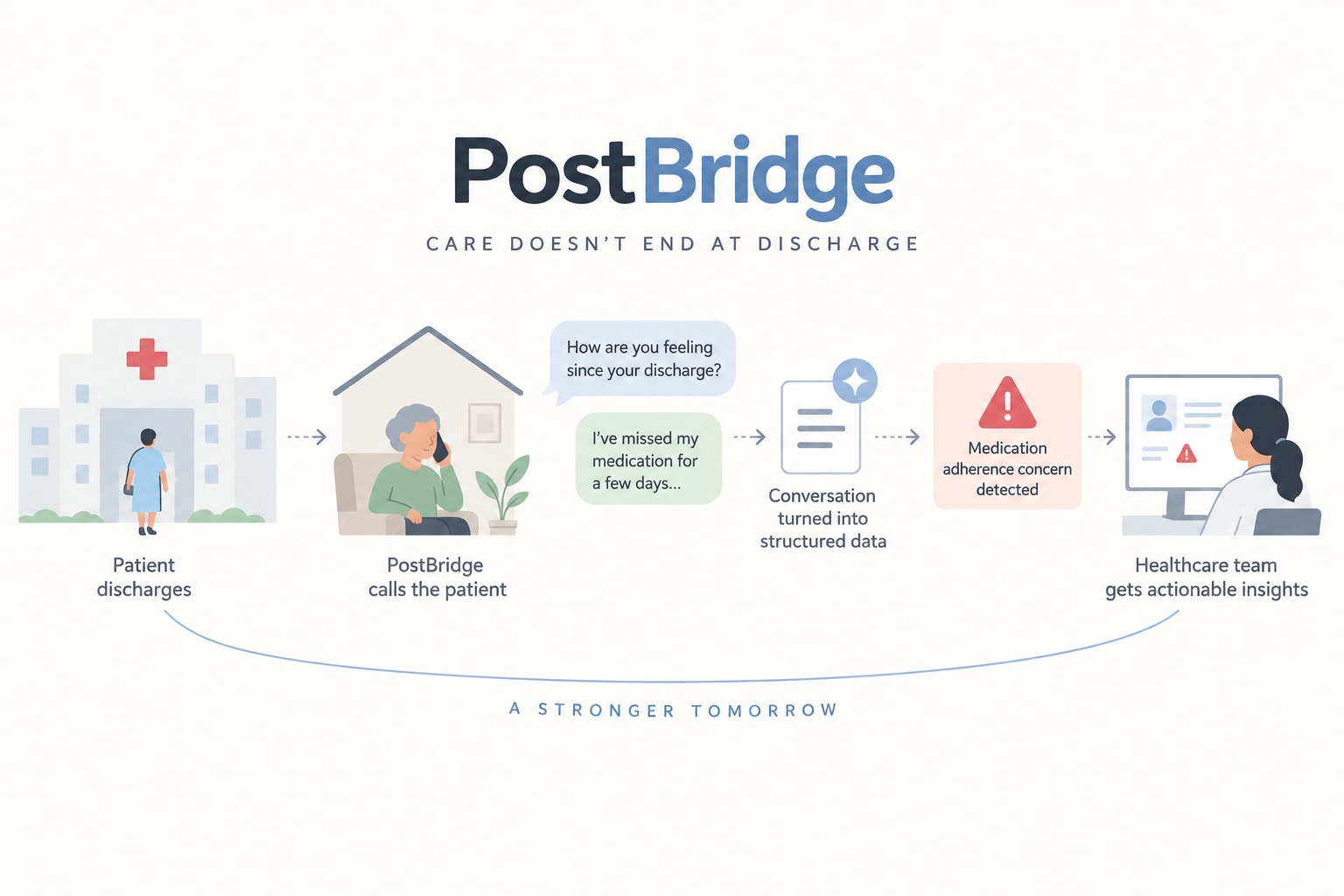
Automatically calls patients after discharge PostBridge checks in on their recovery, symptoms, medications, and any difficulties they're facing at home.
Turns the conversation into structured data For example, if a patient says "I've missed my medication for three days," PostBridge captures that as a medication-adherence concern.
Detects potential problems Worsening symptoms, repeated missed medication, inability to obtain medicine, lack of caregiver support, and more are flagged for healthcare-team review.
Powers readmission prediction PostBridge combines existing hospital data with the information gathered from conversations to train a model that estimates 30-day readmission risk — comparing hospital data alone against hospital data enriched with PostBridge's conversational data.
How we built it
We built PostBridge with React and TypeScript on the frontend, Python/FastAPI on the backend, and Supabase/PostgreSQL for patient data. CALL-E powers the automated voice calls, while AI/ML handles conversational feature extraction, alert detection, and readmission prediction. Patient responses are transformed into structured recovery features and combined with hospital data to train and compare readmission-risk models.
Challenges we ran into
Our biggest challenge was bringing voice AI, healthcare data, and machine learning together into one reliable pipeline. We had to handle unpredictable patient conversations, integrate real-time voice calls with our backend, structure and store conversational data, design a safe alert-escalation flow, and determine whether these new conversational features could actually improve readmission prediction.
Accomplishments that we're proud of
We're proud of building PostBridge as more than an automated phone-call system. We connected voice AI, healthcare data, structured feature extraction, safety-focused alerts, and a readmission-prediction pipeline into a single workflow. Our biggest accomplishment is turning something as unstructured as a patient's conversation into actionable, longitudinal data that can help healthcare teams identify at-risk patients after discharge.
What we learned
We learned that some of the most important information about a patient's recovery isn't captured inside the hospital. Conversations can reveal what happens at home — from missed medications and worsening symptoms to caregiver and access challenges.
We also learned that AI in healthcare needs clear boundaries: it can help structure information, but safety-critical decisions should remain governed by predefined rules and human clinical review.
Finally, we learned that conversational data should be evaluated, not assumed to be useful — which is why we compare hospital-only data against hospital data enriched with PostBridge's conversational features.
What's next for PostBridge
We want to evolve PostBridge from a prototype into a scalable post-discharge intelligence platform. Next, we plan to:
- Improve multilingual and diagnosis-specific conversations
- Automate recurring follow-up calls
- Expand conversational feature extraction
- Train the readmission-prediction model on more data
We'll also evaluate whether PostBridge's conversational features genuinely improve readmission prediction over hospital data alone, strengthen the clinical alerting workflow, build richer hospital dashboards, and improve security and compliance for real-world healthcare deployment.
Our long-term vision: make the period after discharge as visible and actionable as the period inside the hospital.
Built With
- ai
- call-e
- fastapi
- generative
- natural-language-processing
- postgresql
- python
- react
- speech
- supabase
- voice


