Inspiration
When I was a teenager, I used to exchange real postcards with people from different places. It was a simple experience, but some of those exchanges turned into friendships that I still remember.
What I liked wasn't just the message itself. It was the whole process: choosing a postcard, writing something, adding a stamp, sending it somewhere in the world, and waiting for something to come back.
Today, most communication is instant. Messages arrive immediately, notifications constantly ask for attention, and conversations can easily become another thing to keep up with.
I started wondering what would happen if we brought the experience of exchanging postcards into the digital world without turning it into another instant messaging app.
That became PostBox.
The idea is simple: make digital communication feel a little slower and more intentional. Users can discover people through their interests or destinations, send postcards, wait for replies, and gradually get to know people from places they may never have visited.
Going digital also solves some of the practical problems of physical postcards. There is no international postage, lost mail, or weeks of uncertain delivery. But the part I wanted to keep was the feeling of sending something and having something to look forward to receiving.
What it does
PostBox is a digital pen pal app built around postcards and slower communication.
Users can discover people based on shared interests or location and send them digital postcards. They can choose different postcard designs and stamps, write a message, and send it directly to another person, to a country's mailbox, or to the global mailbox.
If there isn't a suitable recipient immediately, a postcard can wait until someone becomes available rather than simply failing to send.
The app is intentionally different from a traditional chat application. There are no read receipts or expectations of an immediate response. The idea is to give people time to write something meaningful and come back when they have something to say.
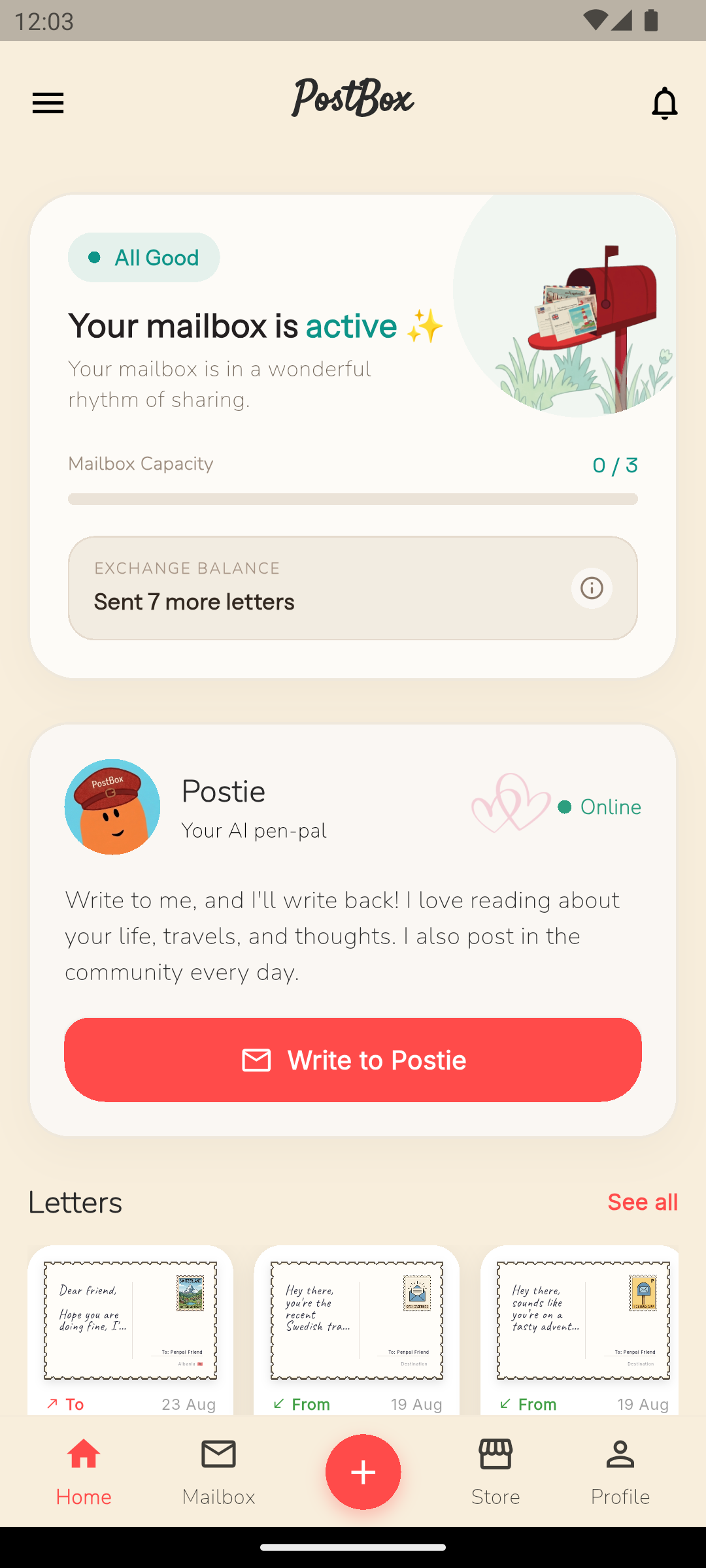
PostBox also includes Postie, an AI pen pal that is always available for users who want someone to write to. There is also a Community section with daily prompts and conversations where users can discover people outside of direct postcard exchanges.
The digital format also lets us do things that aren't possible with physical postcards. Users can build collections of postcards and stamps, explore different destinations, and keep their exchanges in one place.
At its simplest, PostBox is about making a message feel like something you actually sent rather than something you quickly typed.
How we built it
PostBox is built with Flutter on the mobile side and Laravel for the backend.
The backend handles users, profiles, interests, mailboxes, postcards, stamps, matching, delivery states, community features, moderation, and the virtual economy.
One of the more interesting parts was building the mailbox and delivery system.
A postcard doesn't always have to go directly from one user to another. It can also be sent toward a destination or the global mailbox and wait for a suitable recipient. Background jobs then handle things such as matching pending postcards and updating delivery states.
We also built Postie as an always-available pen pal, particularly to help with one of the problems every new social platform has: there may not be another suitable person available at the exact moment someone joins.
A lot of the work ended up being outside the main postcard UI. Privacy controls, moderation, delivery handling, users going away temporarily, background jobs, payments, and all the edge cases around them became a significant part of the product.
The app has been built iteratively. Instead of trying to design the entire system upfront, I've been changing the product based on what I see users struggling with and what I learn from operating it.
Challenges we ran into
The biggest challenge has been the cold start problem.
PostBox is a social product, so its usefulness depends on having other people around. When the community is small, a new user can join, look around, and find that there simply aren't enough people available to write to.
That's particularly difficult for PostBox because the product is intentionally slower. A user shouldn't need to wait around just to understand what the app is supposed to feel like.
This led to Postie, an AI pen pal that is always available. It gives new users someone to write to while also letting them experience the core postcard and letter flow.
We also introduced Express Mode for new users so that their first exchanges can happen sooner instead of immediately experiencing the full waiting period of the normal PostBox experience.
Another challenge has been balancing the original idea with what people are already accustomed to.
People are used to instant messaging, so even when they understand that PostBox is supposed to be slower, some still expect immediate interaction. The challenge has been improving the onboarding and early experience without turning PostBox into the kind of messaging app it was meant to be different from.
This has been one of the more useful lessons from building it: sometimes the product needs to explain its behavior better rather than simply changing the behavior.
Accomplishments that we're proud of
Honestly, one of the biggest accomplishments for me is simply that PostBox exists.
I was a user of Slowly, and I really liked the idea of meeting people through letters and building friendships at a slower pace. I often found myself thinking about features I wished it had or things I would approach differently.
At one point, I even dreamed about becoming part of the team behind it.
That wasn't really a realistic goal for me at the time, so eventually I decided to try building my own version of the idea.
PostBox is the result.
I'm proud that I built it, from the initial idea and UX to the Flutter application, Laravel backend, matching and delivery systems, AI pen pal, community features, payments, infrastructure, and Play Store release.
There is still a lot to improve, and the community is still small, but seeing real people sign up, send postcards, receive replies, and use something I built has been the most rewarding part.
For me, the achievement isn't that PostBox is finished.
It's that an idea I had for a long time became an actual product that other people can use.
What I learned
Building PostBox taught me that building a social product is different from building an application where the user is the only dependency.
A feature can work perfectly and still provide a poor experience if there aren't enough people around to use it.
That made the early user experience much more important than I initially expected. A new user needs to understand the concept quickly and have a reasonable path to their first meaningful interaction, even when the community is still growing.
I've also learned that users don't always use a product the way you expect. PostBox was designed around slower communication, but some users still look for the immediacy they're used to from other apps. That led to experiments such as Postie and Express Mode while trying to keep the core experience intact.
Another lesson has been the importance of user feedback. Some of the features I've added weren't part of the original idea at all. They came from seeing where users got confused, where they stopped using the app, or what they repeatedly asked for.
Technically, building PostBox has also been a practical education in running a real product end to end: mobile development, APIs, background jobs, matching, moderation, AI, payments, privacy, server infrastructure, and app-store publishing.
Most importantly, I learned that building something that works and building something people want to use are two different problems.
PostBox is still teaching me the second one.
What's next for PostBox
The immediate focus is improving the existing experience.
I want to make discovering pen pals, sending postcards, receiving replies, and exploring the community simpler and more predictable without losing the slower pace that defines PostBox.
I'm also continuing to improve matching and delivery so that users have a better understanding of what is happening while they wait for a postcard or reply.
The next major milestone is iOS. I want PostBox to be available beyond Android so that the community can grow across both platforms.
After that, I want to put more effort into marketing and organic growth. The goal isn't simply to get as many installs as possible, but to find people who genuinely like postcards, pen pals, and slower communication.
There is still a lot to build and learn.
For now, the goal is fairly simple: keep improving PostBox and see how far this idea can go.

Log in or sign up for Devpost to join the conversation.