-
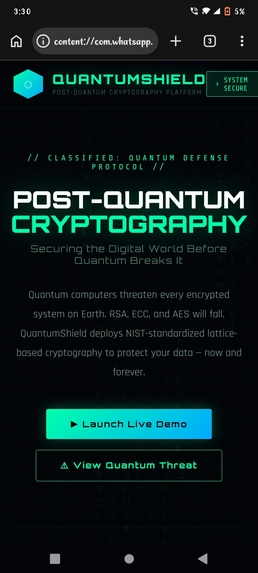
Post Quantum Cryptography

Post-Quantum Cryptography (PQC) is an emerging field of cryptography designed to protect digital communication from the potential threats posed by quantum computers. Current encryption systems such as RSA and Elliptic Curve Cryptography rely on mathematical problems that are extremely difficult for classical computers to solve. However, with the development of quantum computing and algorithms like Shor’s Algorithm, these traditional cryptographic systems may become vulnerable. This creates a serious security risk for sensitive information including banking transactions, government communications, healthcare records, and online data. Post-Quantum Cryptography focuses on developing new cryptographic algorithms that are resistant to attacks from both classical and quantum computers. These algorithms are based on complex mathematical structures such as lattice-based cryptography, hash-based cryptography, and error-correcting codes. One major advantage of PQC is that it can run on existing hardware and can be integrated into current security protocols with minimal changes. The purpose of this research is to highlight the importance of transitioning to quantum-resistant cryptographic systems in order to ensure long-term data security. As quantum technology continues to evolve, implementing Post-Quantum Cryptography will play a critical role in safeguarding digital infrastructure and protecting confidential information in the future.
Built With
- and-pqcrypto-(python-?-example-only).-no-frameworks
- backend
- canvas-api
- cloud
- css
- database
- google-fonts
- html
- javascript-(vanilla)
- or
- services

Log in or sign up for Devpost to join the conversation.