Inspiration
Stars are constantly evolving, yet understanding what happens at the end of their lives remains a fascinating challenge. Every star has unique characteristics, such as mass, age, temperature, and luminosity, that can provide clues about its evolution and eventual fate.
We wanted to explore how the properties of stars we observe today could help us identify potential future supernovae. At the same time, we were interested in understanding how stellar explosions shape the universe and how they could affect the planets orbiting those stars.
With Starfate, we wanted to bring astronomical data together into one interactive platform that makes exploring stellar evolution and potential supernova candidates easier and more accessible.
What it does
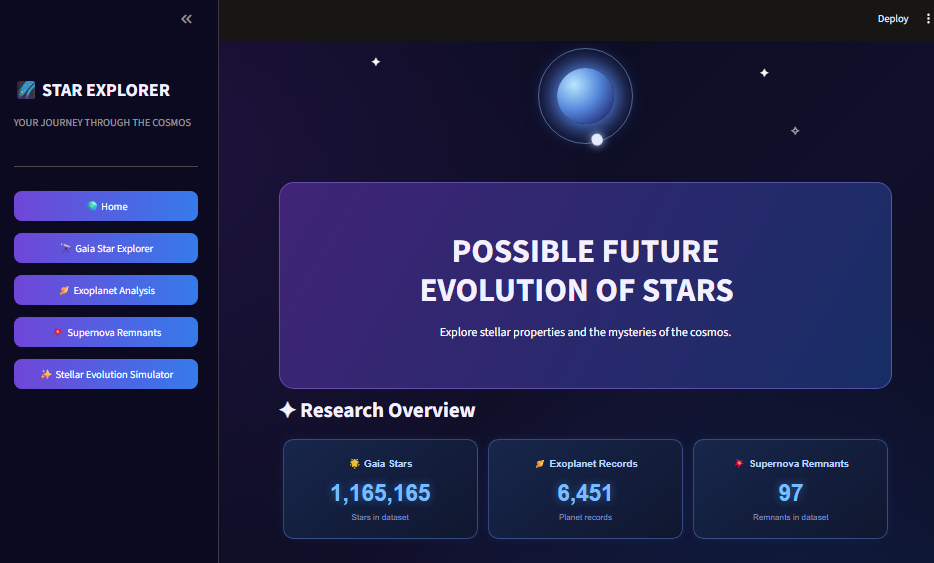
Starfate is an interactive astronomical data exploration application built around three main features.
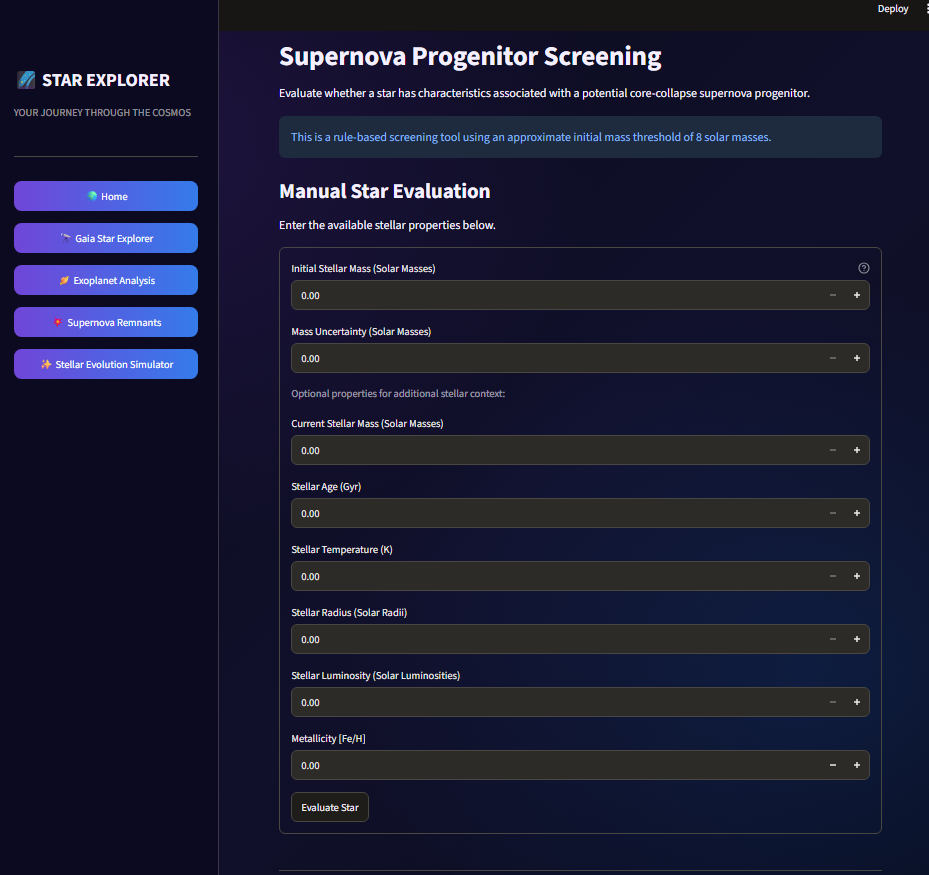
Exploring stars. Users can search for stars in the database and examine available properties, including initial mass, mass uncertainty, current mass, age, temperature, radius, luminosity, and metallicity. Users can also manually enter stellar measurements to explore stars that may not be included in the database.
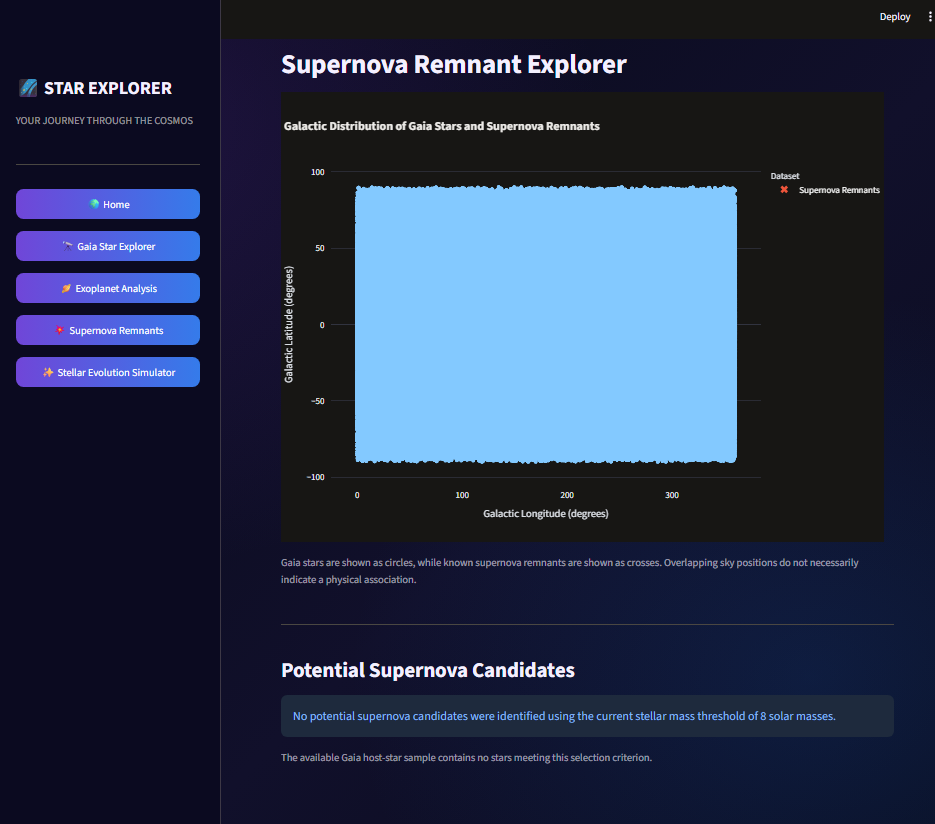
Screening potential supernova candidates. The application evaluates stellar measurements against approximate characteristics associated with core-collapse supernova progenitors. In particular, it considers the importance of initial stellar mass when screening potential candidates. Results help users understand whether a star meets the approximate mass criterion, does not meet it, or has insufficient information for screening.
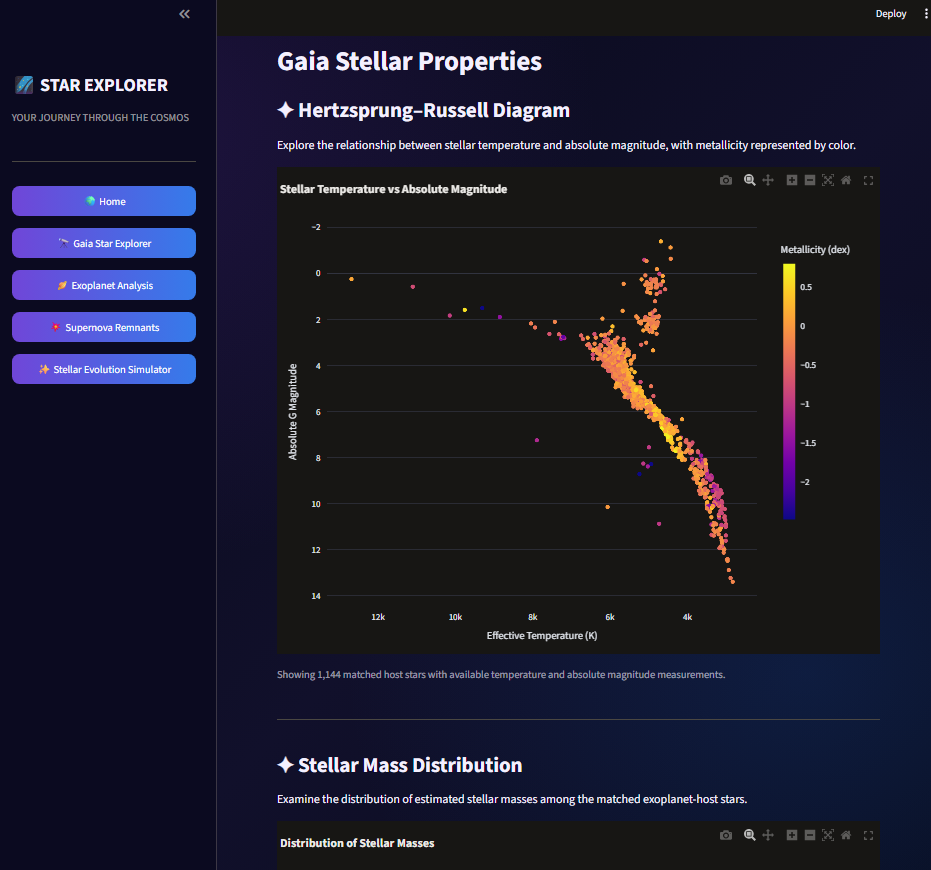
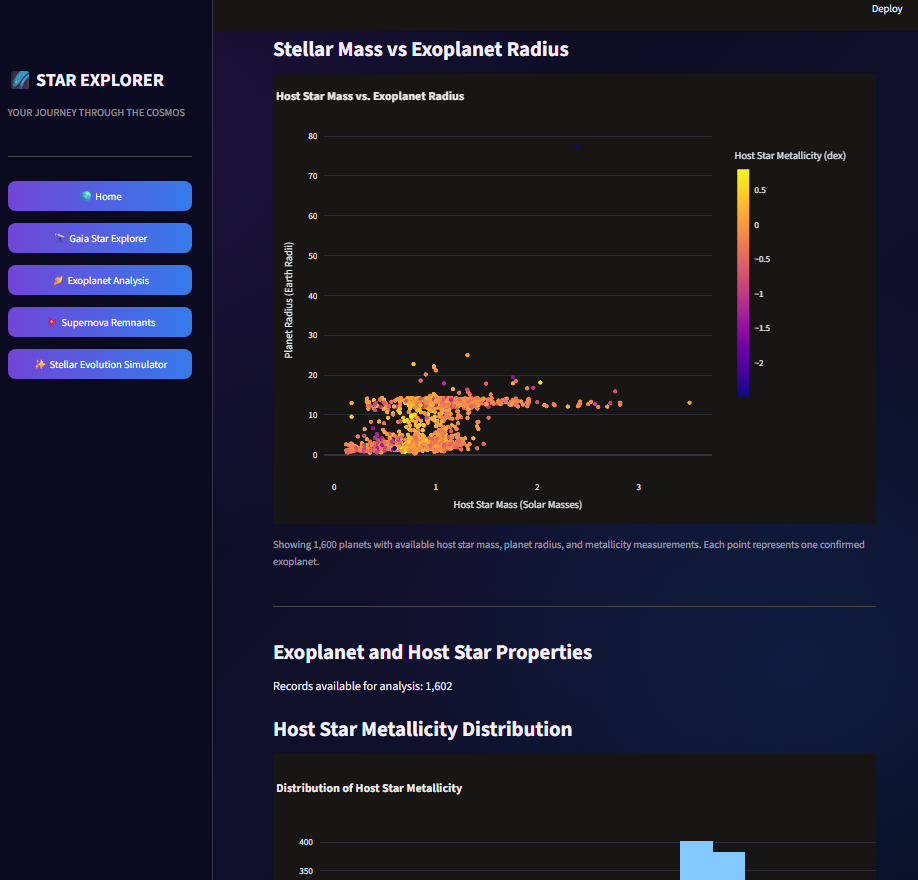
Visualizing astronomical data. Users can explore visualizations that reveal patterns and relationships between stellar mass, age, temperature, metallicity, and exoplanet characteristics. Starfate also compares the distribution of stars with the locations of known supernova remnants to explore their positions within the Milky Way.
How we built it
Starfate is built using Python and Streamlit to create an interactive web-based application.
The project uses several tools and libraries:
- Python: Main programming language for data processing and application logic.
- Streamlit: Creating the interactive website and user interface.
- Pandas: Cleaning, organizing, and combining astronomical datasets.
- NumPy: Performing numerical calculations and data processing.
- Plotly: Creating interactive graphs and visualizations.
- Jupyter Notebook: Exploring datasets, conducting statistical analysis, and testing visualizations.
Astronomical information comes from three sources: Gaia DR3, the NASA Exoplanet Archive, and a supernova remnant catalogue. Gaia and NASA records were matched using Gaia Source IDs, allowing stellar measurements to be combined with confirmed exoplanet host information.
Challenges we ran into
- Combining different datasets. Each astronomical source had different column names, formats, and identifiers. The information had to be cleaned and standardized before matching records.
- Handling missing information. Some stars had incomplete measurements, particularly for age and metallicity. Missing values had to be handled without treating them as zero.
Accomplishments that we're proud of
- Identified 1,424 unique exoplanet host stars from 2,045 matched confirmed exoplanet records.
- Created interactive visualizations to explore stellar properties and relationships between different measurements.
- Investigated the relationship between stellar mass and age, metallicity, and exoplanet radius.
- Developed a preliminary screening approach for identifying stars that meet approximate mass characteristics associated with potential core-collapse supernova progenitors.
- Established the foundation for an interactive website where users can explore database records and enter their own stellar measurements.
What we learned
Throughout this project, we gained experience working with real-world astronomical datasets and learned how to clean, merge, analyze, and visualize large amounts of scientific data.
We also learned more about stellar evolution, supernovae, and the importance of understanding the limitations of scientific measurements. In particular, we discovered that a star's current estimated mass cannot automatically be used to determine its initial mass or predict its final outcome.
Most importantly, we learned how data analysis can turn complex scientific information into something more accessible and interactive.
What's next for Starfate?
- Expanding the database: Incorporating additional astronomical datasets and more stellar measurements.
- Improving the calculator: Accounting for mass uncertainty and distinguishing between initial and current stellar mass.
- Adding manual input: Letting users enter their own stellar measurements to explore potential outcomes.
- Expanding visualizations: Providing more ways to explore stellar evolution, exoplanets, and supernova remnants.
- Exploring machine learning: Investigating whether reliable scientific datasets could support more advanced stellar classification.
Our long-term vision is to make Starfate an accessible platform for exploring stellar evolution and understanding the possible futures of stars.
Expected impact
Starfate aims to make astronomical data easier to explore for students, astronomy enthusiasts, and anyone curious about the life cycle of stars. By bringing information from multiple astronomical sources into one interactive platform, the application can help users better understand stellar characteristics, explore potential supernova progenitors, and discover how the stars observed today may evolve in the future.

