Inspiration
As someone who’s juggled a busy career and family life, I saw how small, consistent moments of intentional well-being could transform daily life. Seligman’s PERMA model—with its focus on positive emotion, engagement, relationships, meaning, and accomplishment—felt like the perfect framework to make positive psychology accessible, not just for experts, but for everyday people. I wanted to create something that fit into a 3-minute window, no login, no hassle—just immediate, actionable practices.
What it does
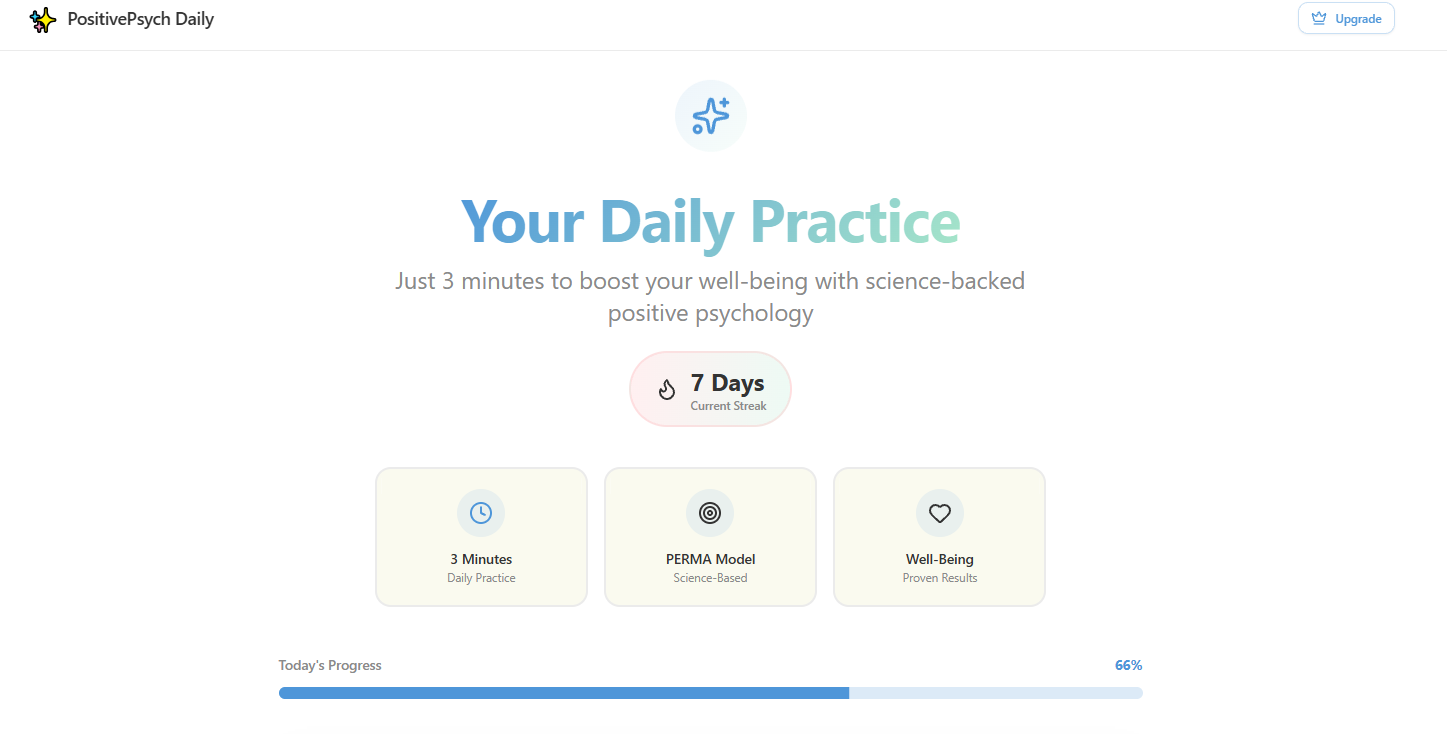
PositivePsych Daily delivers daily 3-minute positive psychology exercises tied to the PERMA model. Users explore their VIA character strengths, engage in meaning-focused reflection, strengthen relationships with simple prompts, and track their happiness over time. The app is designed to be intuitive, mobile-first, and ready to use the second you open it—no account setup required.
How we built it
I started by mapping user flows to prioritize simplicity: launch straight to the daily practice feed, with easy navigation to strength assessments, relationship prompts, and happiness tracking. I used React Native for cross-platform mobile compatibility, Chart.js to build the happiness trend visualizations, and Figma to design a minimalist, calming UI aligned with wellness principles. Every feature was built to center short, consistent habits—no overwhelming menus or long workflows.
Challenges we ran into
The biggest challenge was balancing depth with brevity: how to distill evidence-based positive psychology into 3-minute exercises without losing their impact. I also struggled with making the happiness tracker both visually intuitive and true to the PERMA framework—ensuring the data visualization told a clear story without overcomplicating the user experience. Additionally, designing smooth tab transitions while keeping all content pre-loaded for instant access required careful optimization.
Accomplishments that we're proud of
We created an app that puts science-backed wellness in the palm of your hand, with zero barriers to entry. The VIA Strengths tab distills a lengthy assessment into a quick, meaningful experience, and the happiness tracker turns abstract well-being into a tangible, motivating trend. Most importantly, the app feels warm and approachable—not clinical—making positive psychology feel accessible to anyone, regardless of their background in mental health.
What we learned
I learned that simplicity is the ultimate form of sophistication in wellness tech. Users don’t want complexity—they want small, doable actions that fit into their lives. I also deepened my understanding of how to translate psychological research into practical, user-friendly features, and how to design for emotional resonance (e.g., soft color palettes, clear, encouraging language) alongside functionality.
What's next for this project
Next, we plan to expand the library of daily exercises to include more personalized prompts tied to each user’s top strengths. We’ll add deeper PERMA reporting to help users see how different practices impact their well-being over time, and explore ad-free premium features like unlimited practice history. We also want to integrate gentle reminders (without being intrusive) to help users build consistency, and gather user feedback to refine the exercises for even greater real-world impact.

Log in or sign up for Devpost to join the conversation.