Portfolia - A Personalized Assistant for Financial Advising and Investment Management
Table of Contents
- Background & Motivation
- Problem Statement
- Stockformer
- Features
- What's Next
- Note for Application Testers
Background & Motivation
The financial and investment landscape can be daunting for newcomers due to the vast array of terminology, concepts, and investment strategies. Financial literacy and effective investment management are crucial skills in today's economy, yet many individuals struggle to navigate the complex world of finance. The abundance of financial jargon, investment options, and market volatility can be overwhelming for novice and experienced investors alike. Traditional financial advisory services are often expensive and inaccessible to the average person, creating a significant barrier to entry for those seeking to improve their financial well-being. The integration of Large Language Models (LLMs) and Machine Learning (ML) in personal finance offers a promising solution to democratize financial advice and empower individuals to make informed investment decisions.
Problem Statement
Portfolia is an AI-powered personal investment advisor and stock forecasting assistant powered by LLM agents and Time Series Transformers. The primary objectives are:
- To create an accessible and user-friendly platform that provides personalized financial advice and education to users of all experience levels.
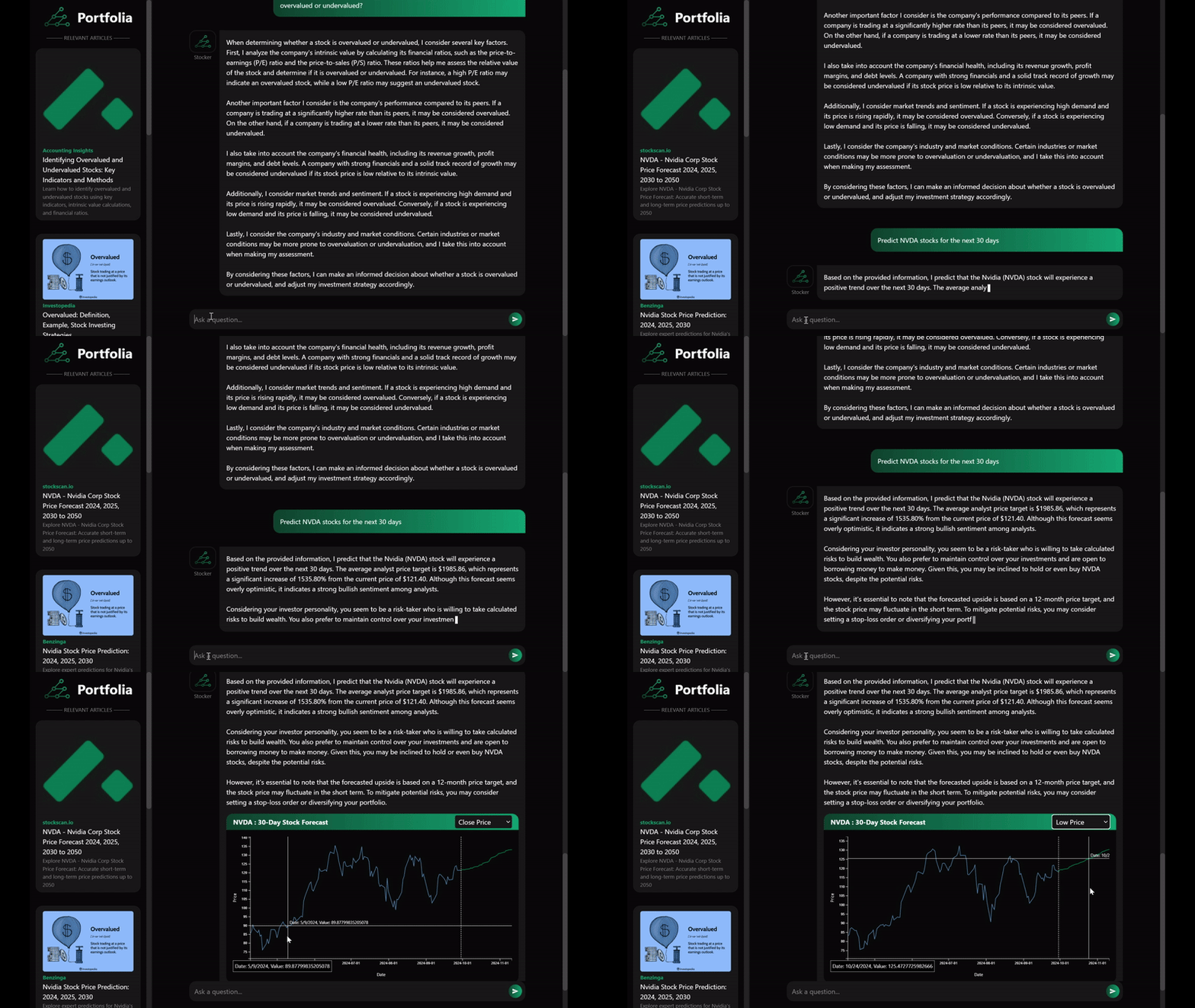
- To develop an accurate stock forecasting feature leveraging deep learning with time series transformers at various prediction lengths.
- To enhance financial literacy by explaining complex financial concepts in simple, understandable terms.
Stockformer: Time Series Transformer for S&P 500 Stock Forecasting
Given the complexity of financial data, characterized by its inherent randomness, noise, and non-stationarity, extensive research has been conducted on leveraging deep learning-based representation learning for accurate stock price prediction. A recent publication, "Transformers in Time Series: A Survey" (Wen et al., 2023), presents a case study utilizing Time Series Transformers to forecast the Bangladeshi stock market in Dhaka. Building upon this research, we have developed and trained a proprietary Time Series Transformer model specifically for the U.S. S&P 500 stocks.
To read more about our implementation, please click here.
Features
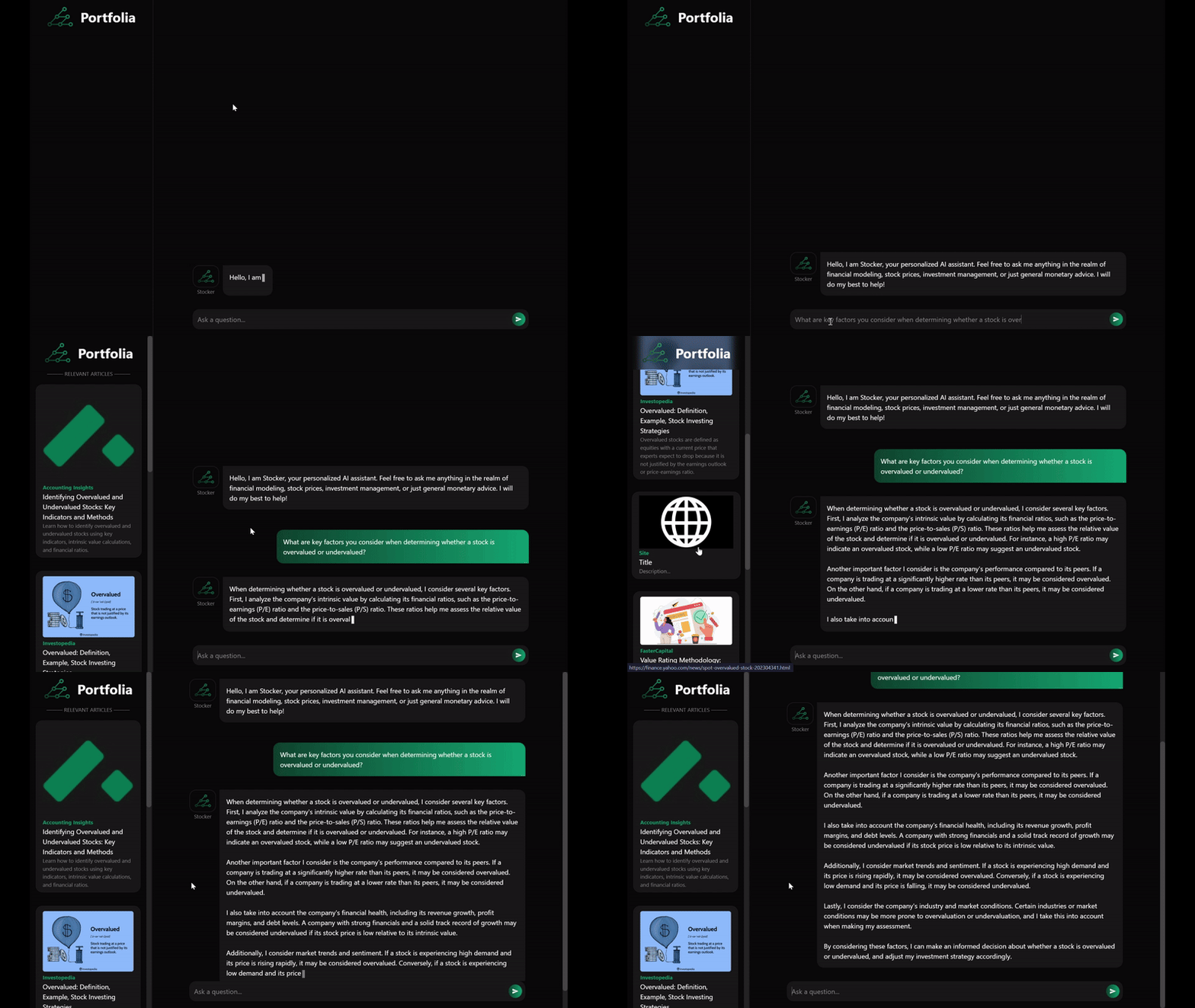
- Agentic RAG (Retrieval Augmented Generation): Implement LLM agents for techniques to understand and respond to user queries about financial concepts and investment strategies.
- Personalization: Utilize user-specific investor personality as context for providing tailored investment advice based on individual financial situations, goals, and risk tolerance.
- Stock Forecasting: Employ Time Series Transformers pre-trained on historical S&P 500 stock data to generate accurate stock price predictions.
- User Interface: Develop an intuitive, conversational interface that allows users to interact naturally with the AI advisor.
- Scalable Back-End: Build a system which enables horizontal scalability by allowing concurrent request handling for stock forecasting during inference.
What's Next for Portfolia
We aim to increase personalization by providing more user context is understanding the investor personality of the specified user. This way, the assistant can tailor its responses more suited to the investor's risk tolerance, financial goals, and methodology of thinking.
Additionally, a recommendation system (like a feed for stocks) is something in the works for the future.
Note for Application Testers
We built our app entirely using NVIDIA AI Workbench. Since we were working on a remote development server for the past month, we have been using the CLI which has been very intuitive since it behaves as a wrapper for fundamental libraries like Git and Docker.
As you can see in the repository file structure, the project was created with NVIDIA AI Workbench, hence why it includes the directories: models/, data/, code/, etc. along with additional files which were generated upon creation.
We created a custom Docker image for our application's container runtime which we would like the application testers to also use. Due to unforeseen issues with NVIDIA AI Workbench's default container not recognizing CUDA devices on our local development host, we decided to build our own image with the proper CUDA Toolkit drivers enabled for the container's runtime.
All of this information has been included in our repository's README along with the target system requirements in a labeled section. Thank you so much for the time and consideration.



Log in or sign up for Devpost to join the conversation.