-
-
01-landing-hero.png
-
02-role-intake.png
-
04-next-skill-ranking.png
-
03-transferable-skills.png
-
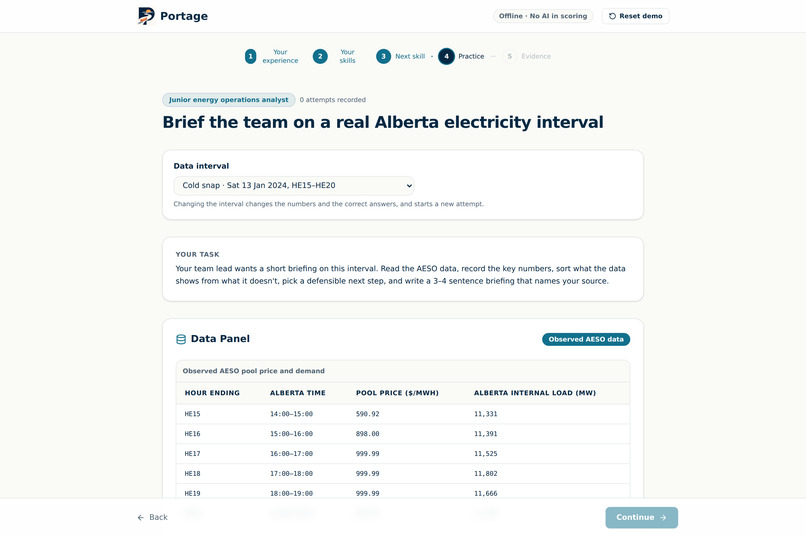
05-practice-aeso-data.png
-
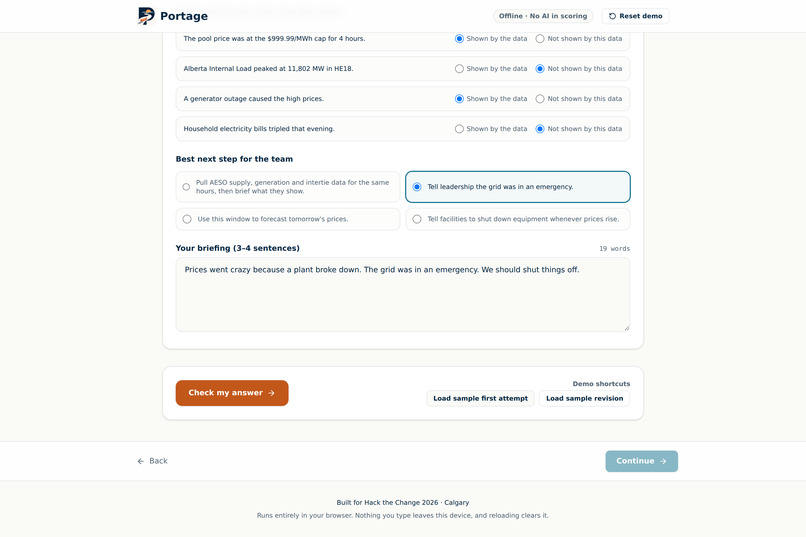
06-practice-decisions.png
-
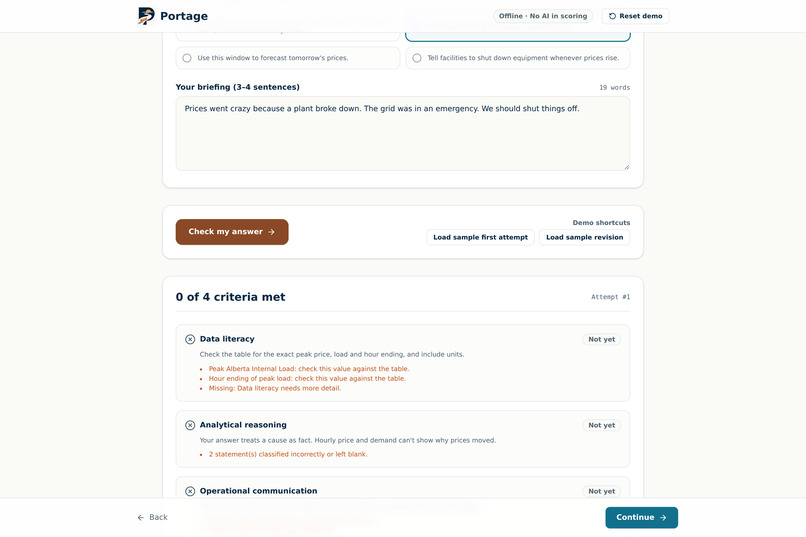
07-instant-rubric-feedback.png
-
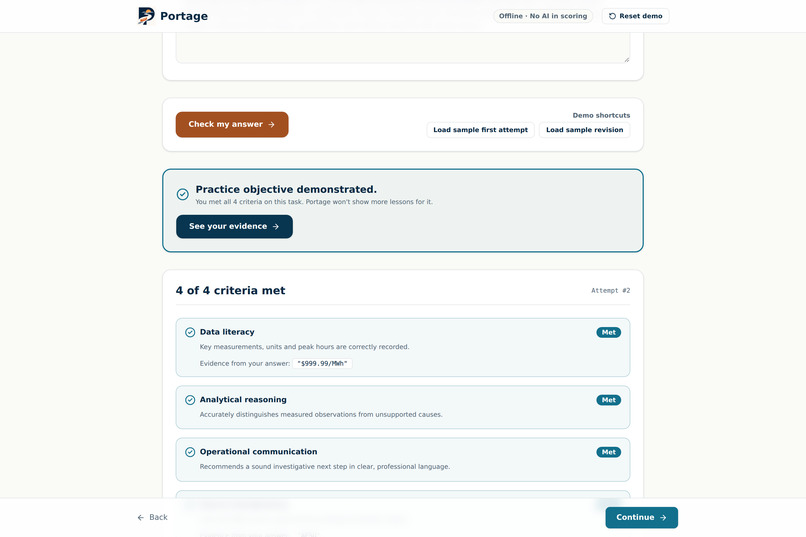
08-revision-mastery.png
-
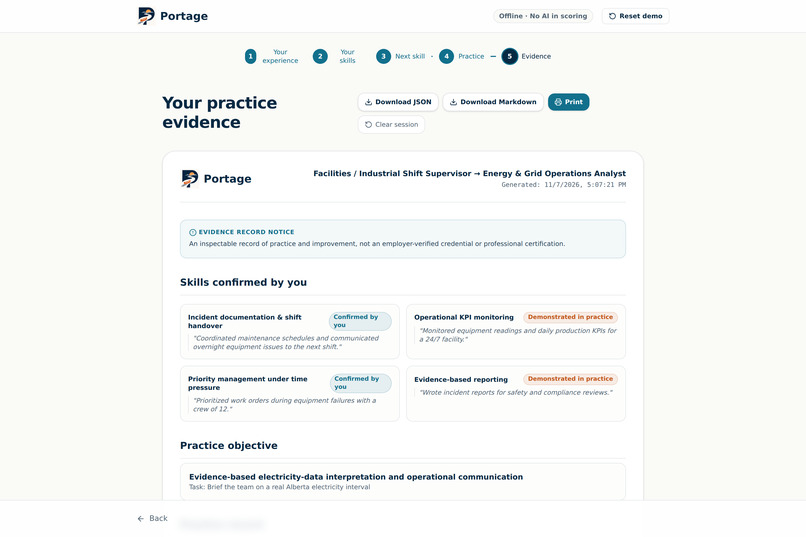
09-evidence-record.png
-
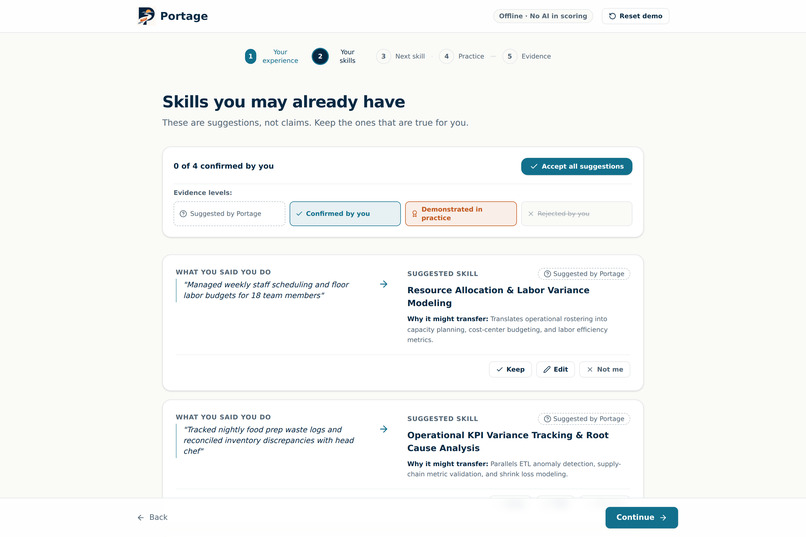
10-hospitality-bi-scenario.png
Inspiration
Career transitions are too often treated as an all-or-nothing reset. Frontline workers—whether operating industrial shifts, managing retail floors, or running restaurant service—are routinely told they have zero applicable experience and must start from scratch through expensive multi-year degrees or generic reskilling bootcamps.
According to Statistics Canada (2026), recent immigrants are disproportionately overqualified (32.6% vs. 19.1% for Canadian-born workers) and mismatched with their fields of employment (20.8% vs. 15.6%). Qualitative research by the City of Calgary and the Calgary Local Immigration Partnership (Community Lens / SDI Project) underscores how credential recognition barriers, lack of local practice records, and opaque hiring rubrics trap skilled workers in persistent underemployment.
We built Portage on a foundational premise: people changing careers shouldn't have to start from zero. Instead of vague personality quizzes or black-box generative resumes, Portage creates an inspectable, transparent bridge grounded in authentic, practice-based career diagnostics.
What it does
Portage is a client-side, browser-based career-transition platform powered by a declarative domain engine:
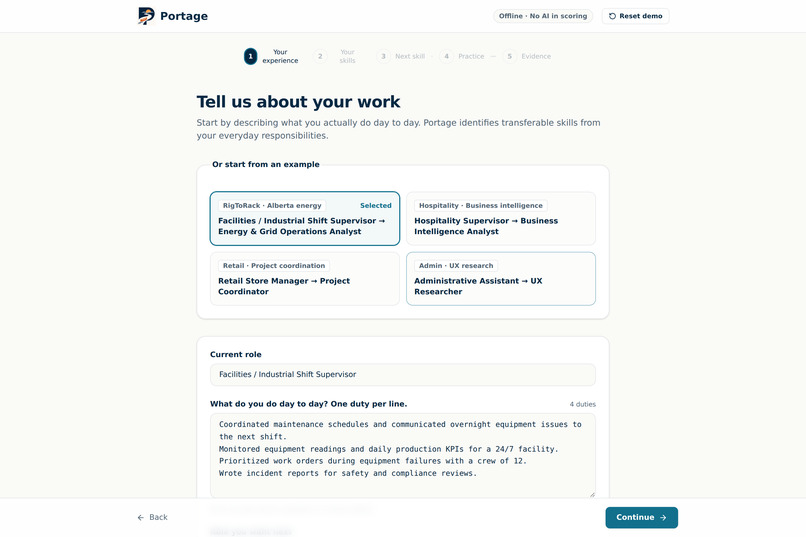
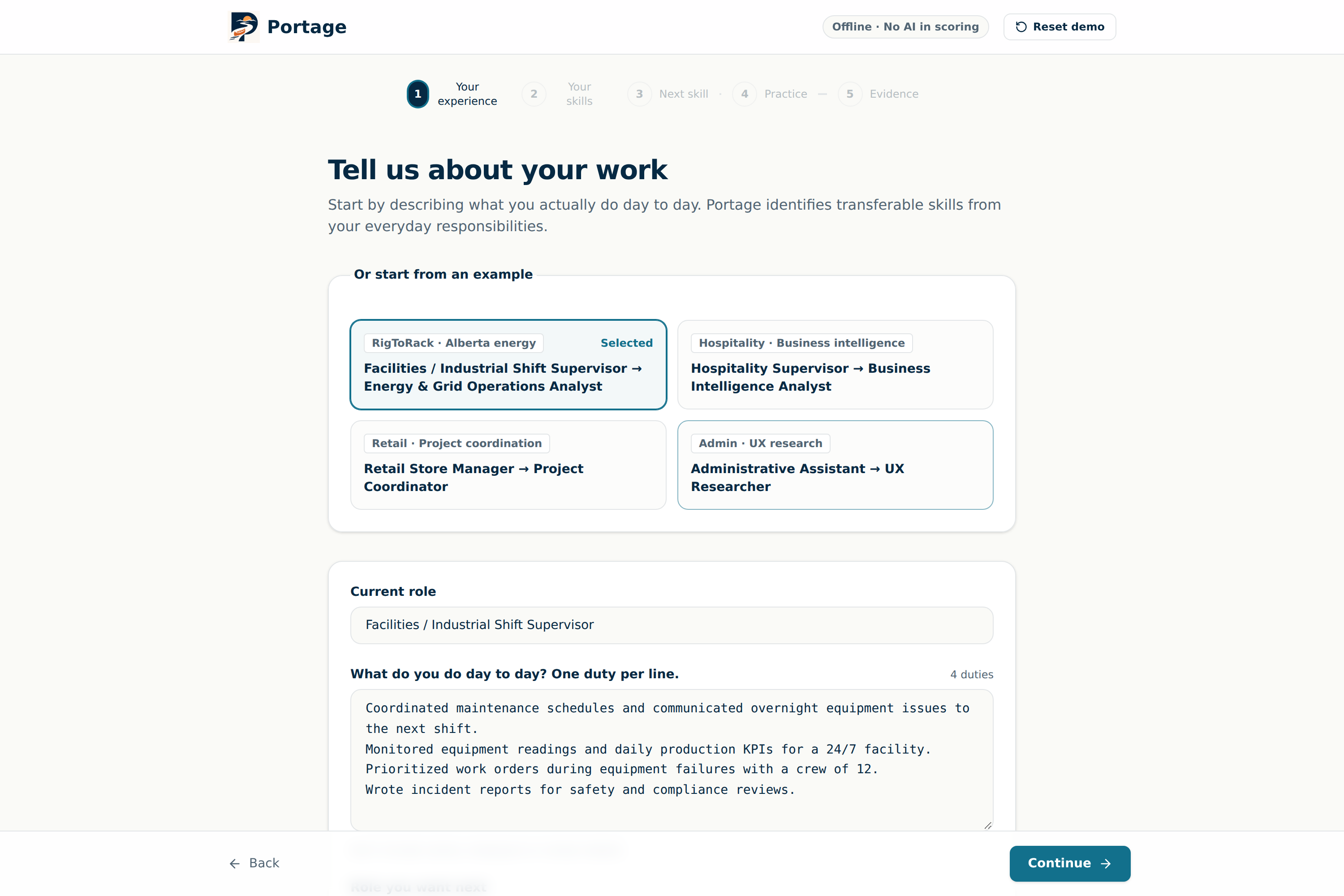
- Frontline Duty Intake: Users enter their day-to-day duties in plain language or load an authentic transition track.
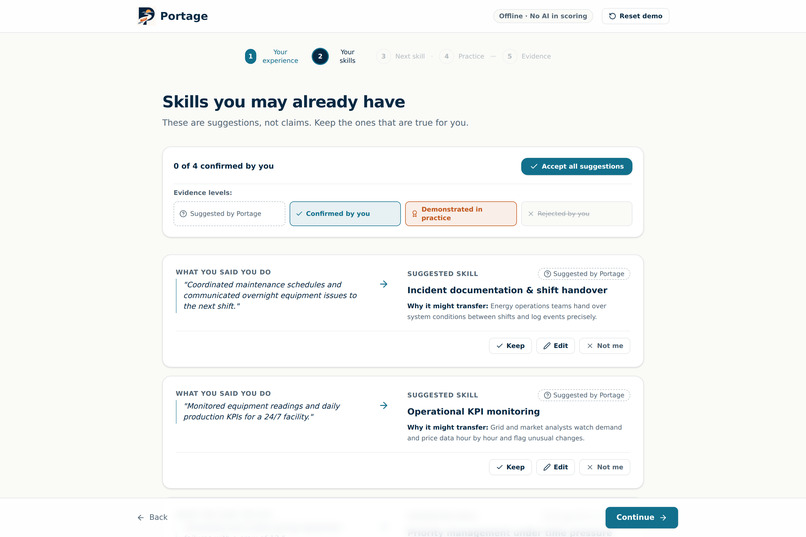
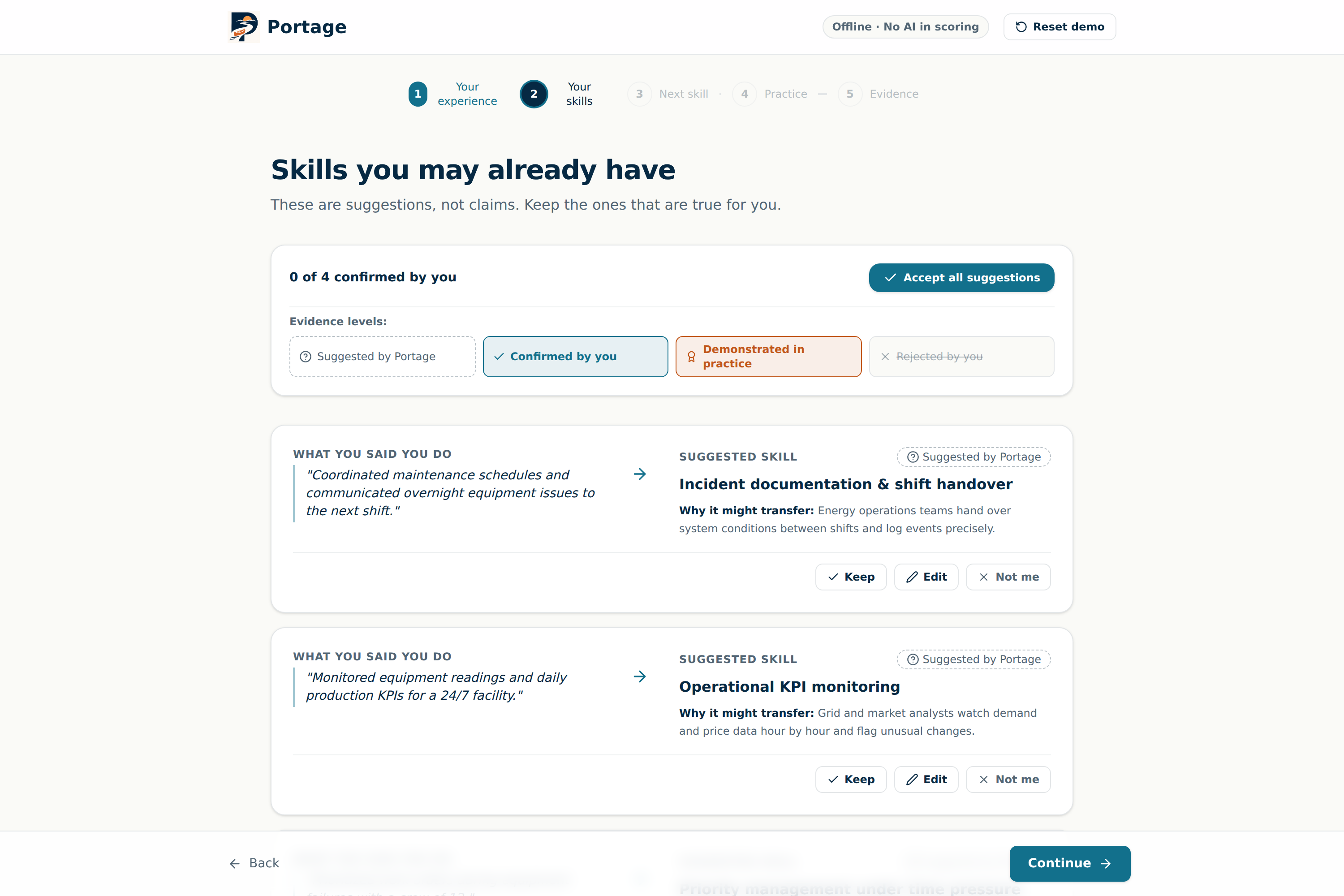
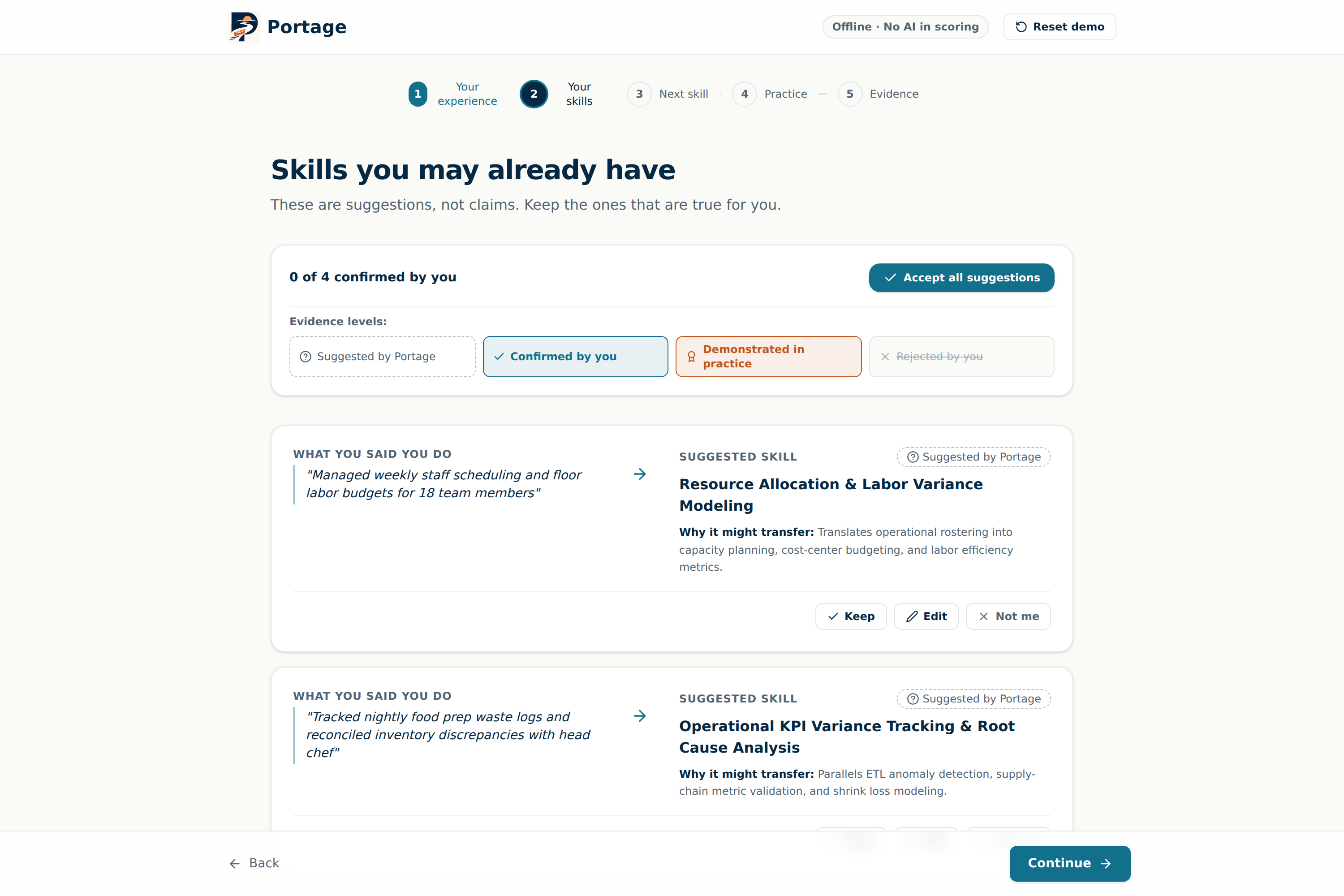
- Transferable Skills Discovery: An auditable lexicon maps everyday tasks to target-role competencies. The learner exercises full human-in-the-loop control to review, edit, or reject suggestions.
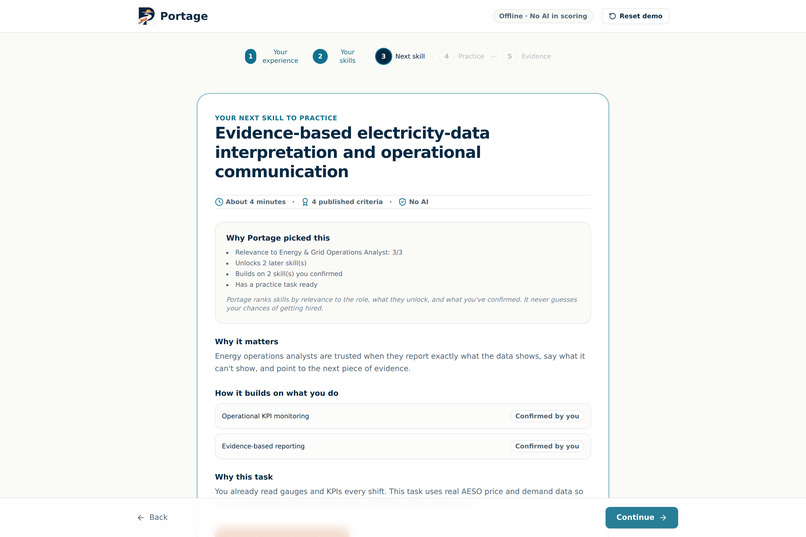
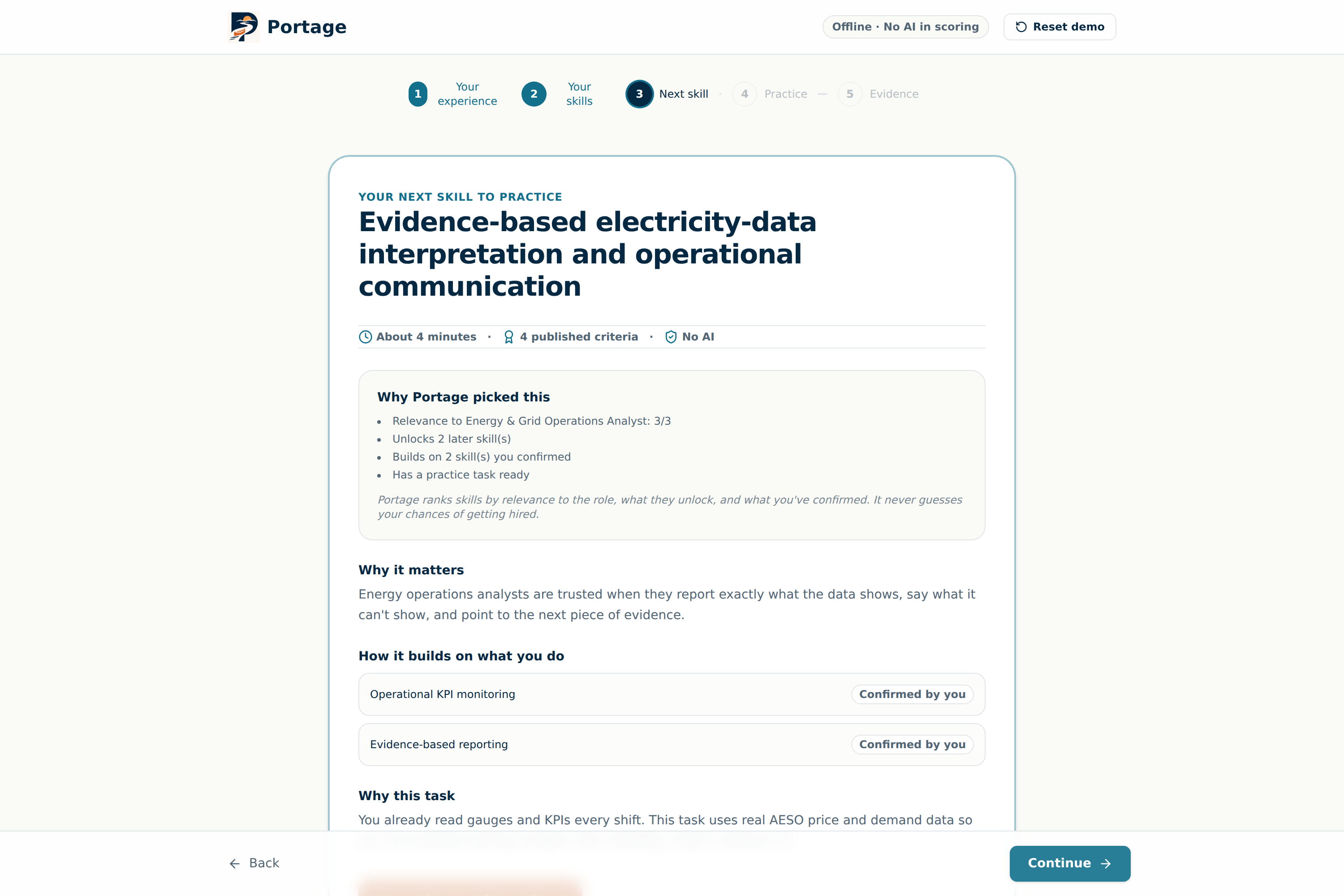
- Deterministic Gap Prioritization: The engine scores and ranks skill gaps between confirmed skills and target competencies using an explainable formula ($\text{Relevance} \times 3 + \text{Prerequisites} \times 2 + \text{Confirmed Foundation}$).
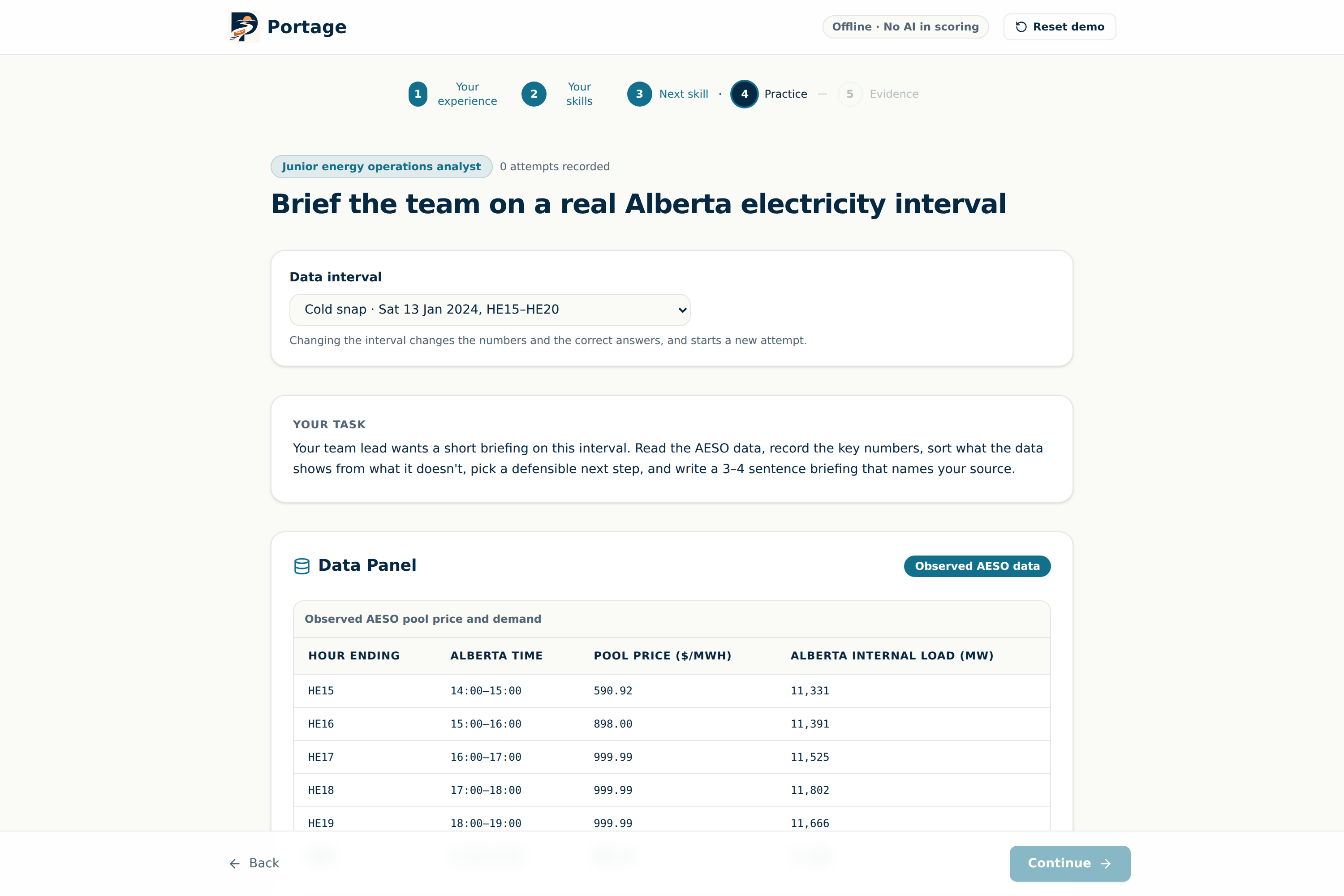
- Authentic Practice Task: Learners complete a realistic diagnostic job assignment using real data. Our flagship track, RigToRack, tests prospective Energy & Grid Operations Analysts against actual Alberta Electric System Operator (AESO) hourly pool-price telemetry from historic 2024 grid events (including the January 2024 polar vortex cold snap).
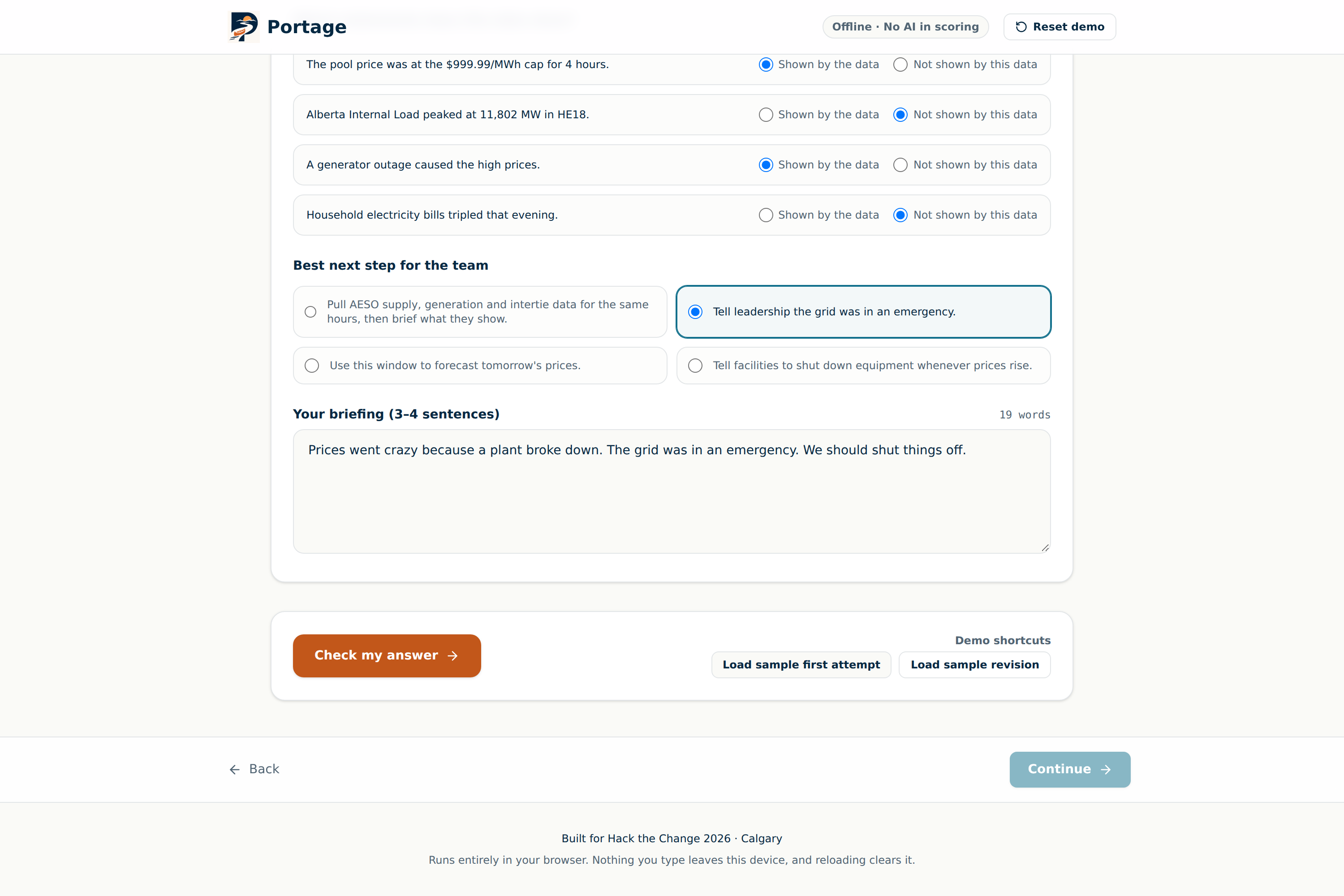
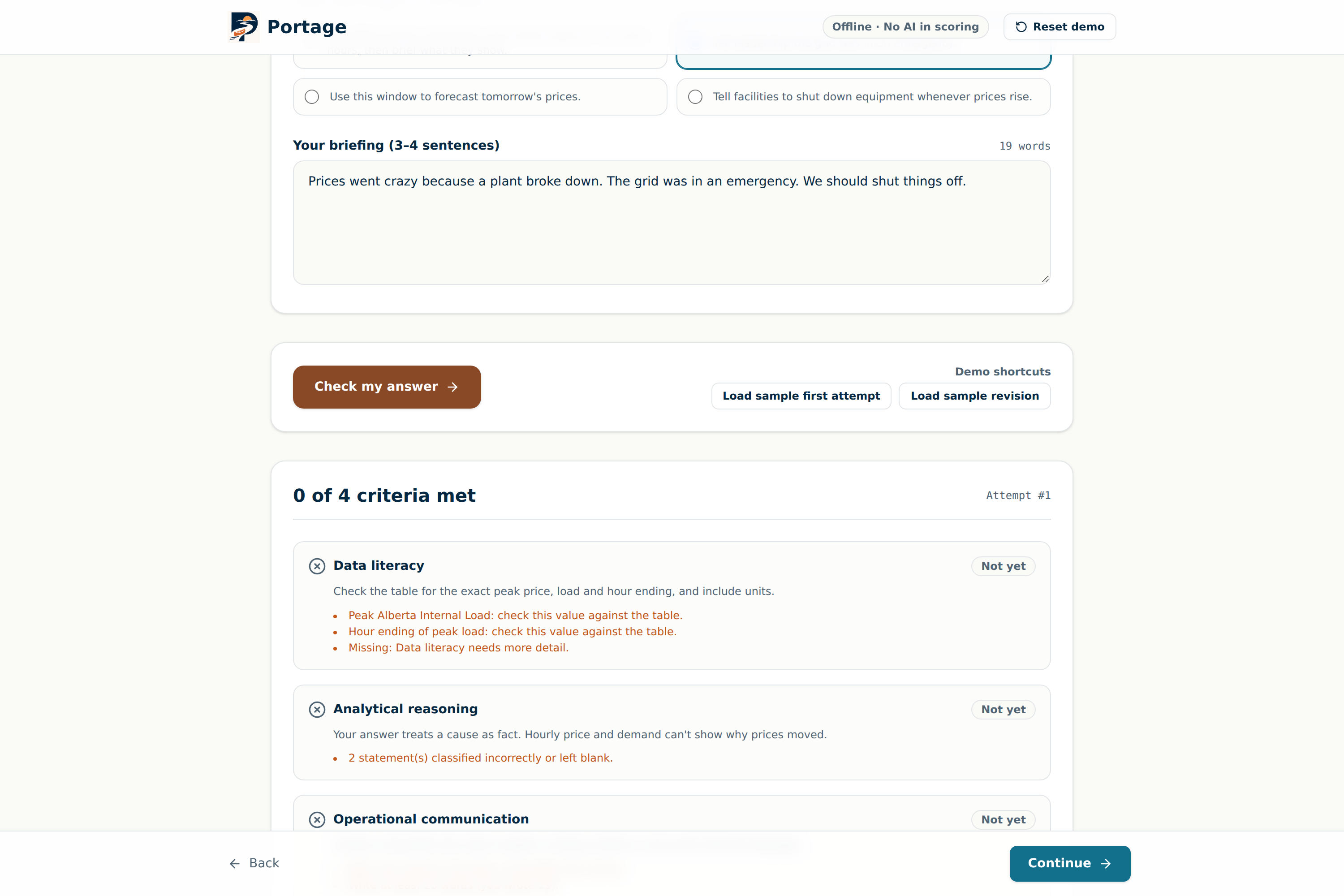
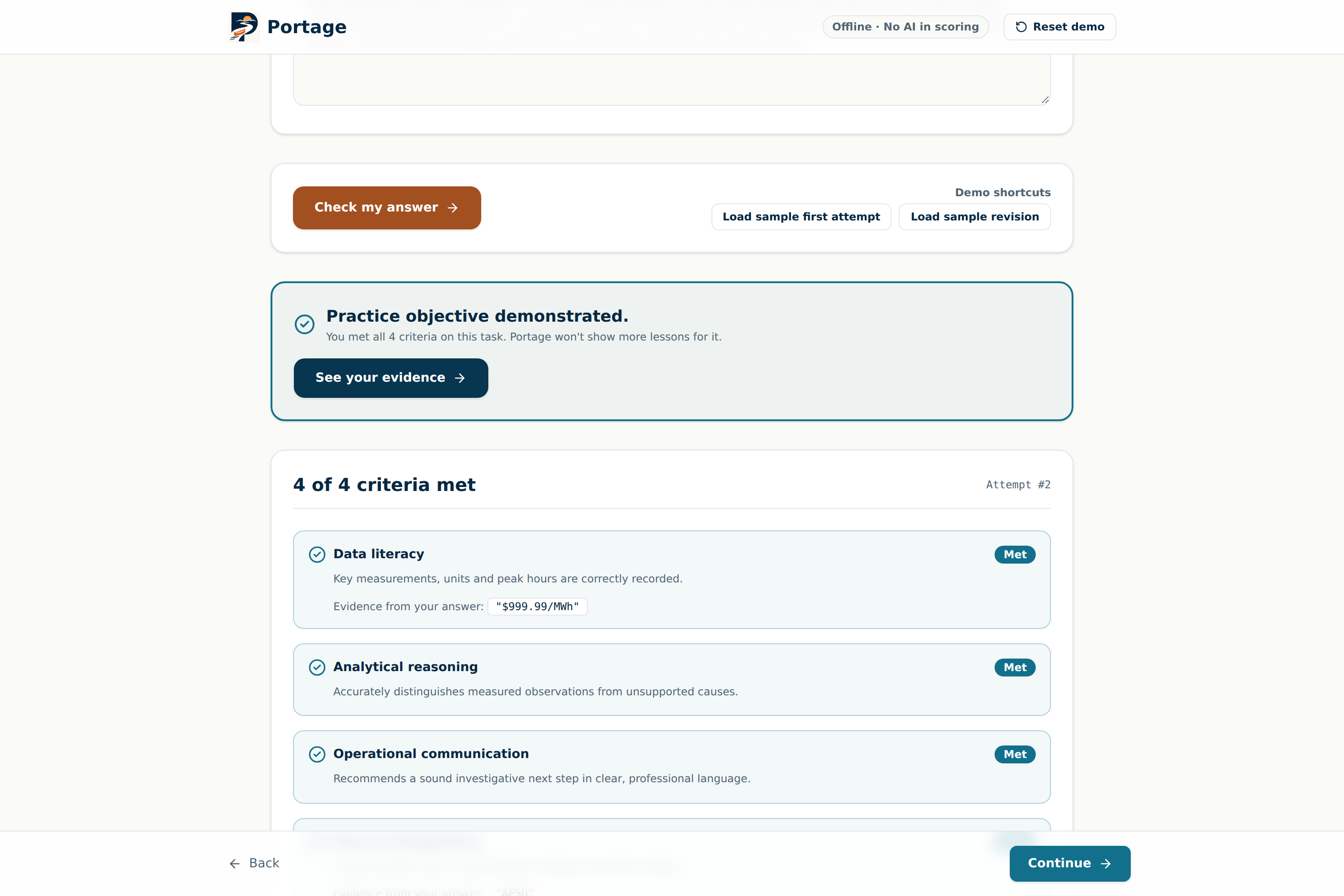
- Targeted Feedback & Microlearning: A transparent, published 4-criterion rubric evaluates work in 0ms with zero network calls. Bite-sized microlearning lessons trigger only for criteria not yet met.
- Side-by-Side Comparison: Learners revise their work and inspect a diff comparing their initial attempt to their revised submission.
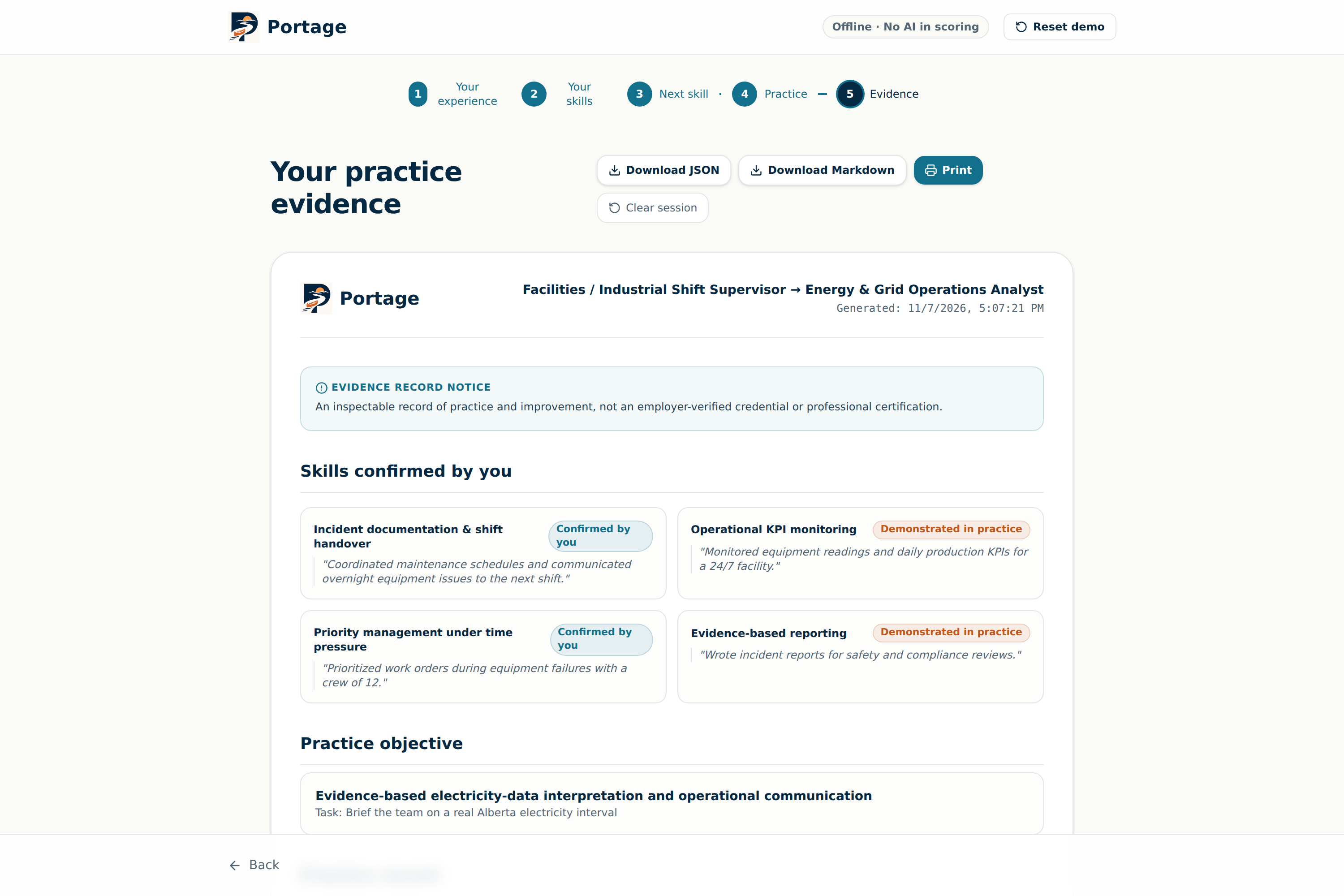
- Portable Evidence Record: Users export an inspectable, tamper-evident proof-of-work summary in Markdown or JSON, complete with raw data provenance and explicit disclaimers outlining boundaries and limitations.
How we built it
- Front-End & UI: Built with React 19, TypeScript, Tailwind CSS v4, and Vite, prioritizing accessible components (WCAG 2.1 AA contrast tokens, semantic landmarks, live region announcements, keyboard navigation, and reduced-motion support).
- Core Engine Architecture: A pure, deterministic state machine and rule engine (
src/engine/) managing schema validation, skill mapping, gap ranking, instant rubric evaluation, and evidence generation without runtime API dependencies. - Real Energy Telemetry Pipeline: Embedded raw historical CSV telemetry from the Alberta Electric System Operator (AESO), covering the January 2024 \$999.99/MWh price-cap cold snap and May 2024 solar renewal period. All metrics are dynamically computed at runtime directly from raw CSV lines with zero hand-coded figures.
- Verification & Testing: Enforced by 58 Vitest unit/domain tests and 14 Playwright end-to-end desktop and mobile browser tests.
- AI Tooling & Disclosure: Google AI Studio was used extensively during the development and design lifecycle of this project. Specifically, Google AI Studio assisted our team with architectural prototyping, synthesizing domain-specific frontline duty lexicons, drafting rubric criteria for multiple career tracks, and designing rigorous edge-case test suites. At runtime, Portage runs 100% deterministically in the client browser with zero AI/LLM API calls, ensuring zero hallucinations and total privacy.
Challenges we ran into
- Eliminating Runtime Hallucinations: Most career tools rely on generative LLMs to guess candidate competencies, resulting in unpredictable and unverifiable advice. We committed to eliminating black-box AI from the runtime path, engineering a deterministic, rule-based rubric engine where every score, feedback item, and lesson dispatch is explainable and reproducible.
- Handling Alberta Power Market Data Formats: AESO telemetry utilizes Mountain Time hour-ending (
HE01–HE24) notations. Standard ISO time parsers fail onHE24intervals and daylight saving transitions. We wrote a custom, zero-dependency parser (parse.ts) to extract peak prices, price-cap durations, and moving averages directly from raw public CSV lines without network roundtrips. - Designing Honest Evidence Records: Tech demos often overpromise with synthetic "verified certification" claims. We worked through multiple iterations to craft realistic disclaimers: Portage clearly states it produces an inspectable diagnostic practice record—not an accredited credential, formal licensing equivalence, or hiring guarantee.
Accomplishments that we're proud of
- 100% Offline, Zero-Cost, and Private: Portage operates entirely within the user's browser. It requires no login, sets no tracking cookies, makes zero external network calls, and stores no private user data on remote servers.
- A Single Declarative Engine Across Diverse Vocations: The exact same engine driving RigToRack (Industrial Shift Supervisor $\rightarrow$ Grid Operations Analyst with real AESO telemetry) seamlessly powers Hospitality $\rightarrow$ Business Intelligence, Retail $\rightarrow$ Product Management, and Admin $\rightarrow$ UX Research.
- Real Public Grid Telemetry: Rather than relying on toy mockups, our flagship challenge tasks users with evaluating actual historical wholesale energy market dynamics during an Alberta emergency grid alert.
- Comprehensive Quality Engineering: 58 domain unit tests and 14 automated Playwright e2e tests passing across desktop and mobile form factors.
What we learned
- Grounding Practice in Real Data Builds Real Confidence: Transitioning workers don't need another generic multiple-choice quiz. Engaging with actual AESO telemetry tables makes abstract analytics concrete, proving to workers that their existing frontline troubleshooting instincts translate directly into high-demand technical environments.
- Transparency Trumps Black Boxes: Providing learners with an open rubric and an explainable gap prioritization formula creates trust. Learners prefer knowing the exact rule behind an evaluation over an opaque, AI-generated summary.
What's next for TJ2CMD-CodeRiders-Portage: practice-based career transitions
- Broader Regional Transition Tracks: Expand scenario authoring to support additional Alberta vocational pathways, such as Heavy Equipment / Automotive Technicians $\rightarrow$ EV Fleet & Clean Tech Maintenance, and Supply Chain Logistics $\rightarrow$ Warehouse Operations Analyst.
- Custom Scenario & CSV Uploads: Empower community employment agencies, immigrant-serving non-profits, and workforce transition counselors to upload localized employer datasets and author custom diagnostic practice challenges.
- Employer Rubric Verification: Explore opt-in, client-side cryptographic signing for evidence records so hiring managers can independently verify that a diagnostic submission was completed against authentic, unaltered source data.
